
“Follow the smart money” is incomplete advice. Before copying a politician, corporate insider, or institutional whale, ask a less exciting question: How old is the information you're looking at?
AI driven market research can organize public filings faster than you can read them. It can't turn an old transaction into a live one, recover an exact purchase price from a disclosure bracket, or prove why someone traded. Its useful job is narrower: find the original record, interpret it correctly, and show what remains uncertain.
Table of Contents
- Where AI Driven Market Research Gets Its Data
- How AI Turns Filings Into Usable Signals
- Reading Congressional Trade Filings Without Overreading Them
- Decoding Form 4 Insider Trades by Transaction Type
- Following 13F Snapshots and Policy-Driven Sector Moves
- Where AI Misleads and How to Check It
- How TradeLikeInsiders Approaches Signal Tracking
Where AI Driven Market Research Gets Its Data
Main market-data sources and how fast they reach you
| Source | Who Files | Typical Delay | What It Shows | Main Limit |
|---|---|---|---|---|
| STOCK Act Periodic Transaction Report | Members of Congress and covered officials | Up to 45 days after the trade | Asset, transaction type, date and size range | Value ranges, no exact price |
| SEC Form 4 | Corporate officers, directors and owners of more than 10% | Two business days for most reportable transactions | Insider purchases, sales and other transactions | One insider trade is not proof of outlook |
| SEC Form 13F | Institutional managers with at least $100 million under discretion in covered securities | Up to 45 days after quarter end | Quarterly holdings snapshot | Positions may have changed since filing |
| Agency and regulatory releases | Federal agencies and courts | Same day as publication | Rules, proposals and enforcement actions | Effect on a company is indirect |
| On-chain whale flows | Blockchain wallets | Near real time | Large wallet transfers | Wallet owner is usually unknown |
Congressional disclosures come through the Clerk of the House and Senate Select Committee on Ethics. Under the STOCK Act, covered transactions exceeding $1,000 must generally be reported within 30 days after notice, and no later than 45 days after the transaction, according to the Congressional Research Service's STOCK Act report. An alert may be newly published without describing a newly executed trade.
Form 4 filings identify reportable corporate-insider transactions through SEC EDGAR. The critical distinction isn't purchase versus sale. You need the transaction code, ownership details, and footnotes before deciding whether an insider made a discretionary investment.
Institutional holdings reports describe positions at a reporting cutoff. They help you compare a manager's disclosed exposure across reporting periods, not reconstruct every execution or identify today's portfolio.
Publication speed isn't investment relevance
Agency releases become public when published, but a proposal isn't an enacted rule. Read the document's status, effective conditions, and affected business activities before attaching a stock-market interpretation.
On-chain transfers can appear quickly because the transaction is visible on a blockchain. Yet a transfer doesn't establish a sale, and an address label doesn't necessarily identify the beneficial owner. An exchange moving assets between wallets can look dramatic without expressing an investment view.
Practical rule: Sort every signal by its age before you weigh its apparent importance.
Keep event time, publication time, and alert time in separate fields. A fast notification system reduces your reading delay, not the filing delay embedded in the underlying record. The freshest feed isn't automatically the most informative one.
How AI Turns Filings Into Usable Signals
In McKinsey's 2024 global survey of 1,363 participants, overall organizational AI adoption reached 72%, up from 55% in 2023. Separately, the Infosys Knowledge Institute's survey found that 96% of marketing leaders had deployed AI in at least one marketing activity, while 52% said those deployments generated business value. Those aren't trader-performance measures. They illustrate why deployment and usefulness shouldn't be confused.
Think of a useful filing system as a sharp assistant who reads the documents, fills in a spreadsheet, and explains how certain each interpretation is.
The workflow should remain inspectable from document to conclusion.
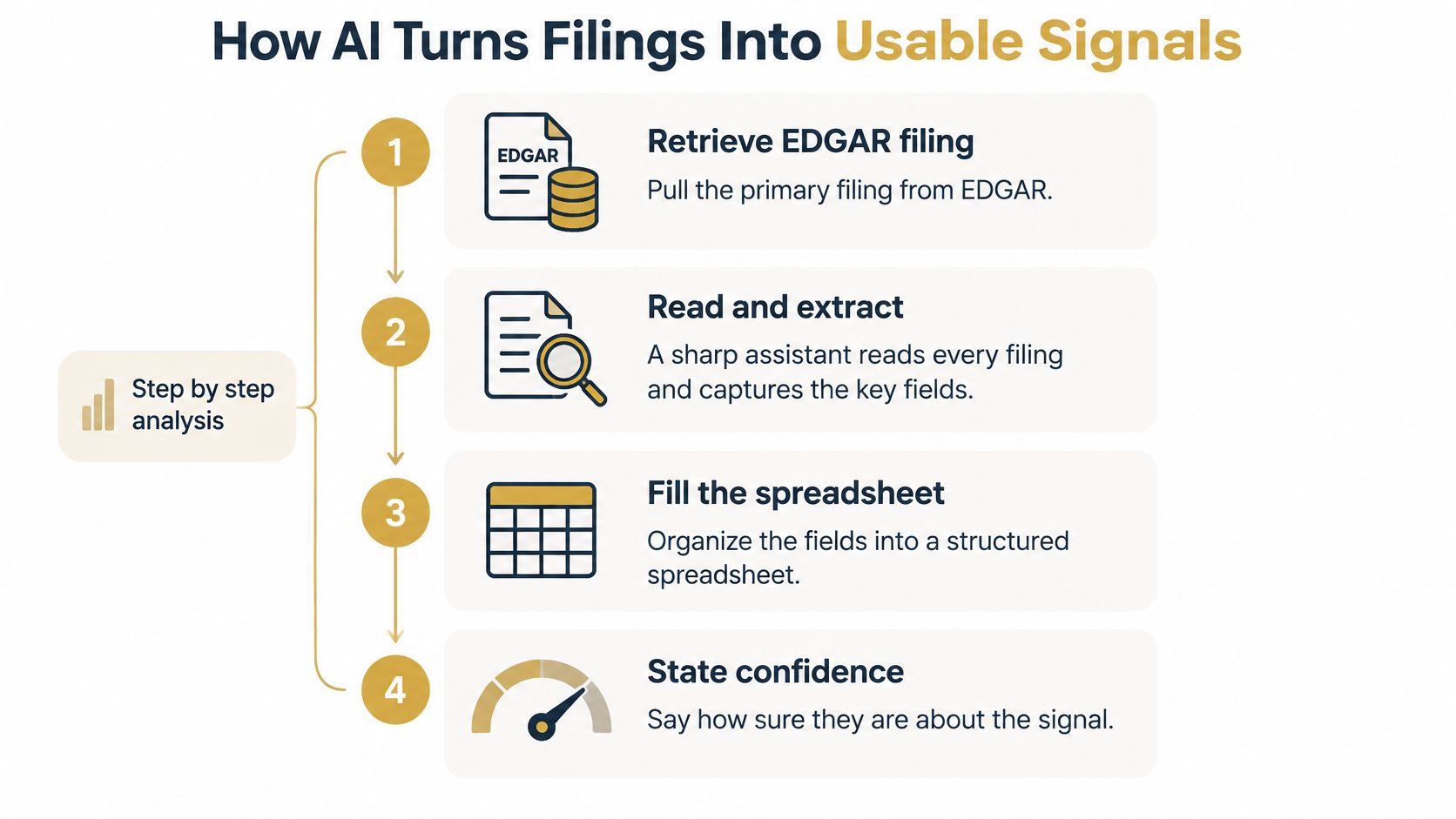
Build the evidence before writing the summary
Retrieve the primary record. Pull the filing from SEC EDGAR or the official House or Senate disclosure system. A secondhand summary can omit an amendment or a qualifying footnote.
Extract structured fields. Capture transaction date, filing date, issuer, security, transaction type, and direct or indirect ownership. Confusing the filing date with the transaction date can make an old event look fresh.
Normalize the company identity. Reconcile issuer names, tickers, and security classes. Otherwise, spelling differences can split one issuer into separate records, while similar names can incorrectly merge unrelated companies.
Classify the event. Separate purchases, sales, exercises, awards, policy proposals, and enforcement actions. Treating every increase in share ownership as a voluntary purchase produces misleading alerts.
Separate confidence components. Report extraction confidence, freshness, entity matching, and inference confidence independently. Perfectly reading a stale filing doesn't make the investment interpretation timely.
Attach the exact evidence. Every factual statement should point to the supporting record and field. If the document doesn't explain motive, the summary shouldn't invent one.
Models help with interpretation, not certainty
A 2024 financial-news study analyzed 965,375 U.S. articles published from 2010 through June 2023, comparing OPT, BERT, FinBERT, and the Loughran–McDonald dictionary; the GPT-3-based OPT model achieved 74.4% accuracy predicting stock-market return direction.
That's a historical test, not a promised trading result. Model design, information timing, and evaluation choices determine whether an apparent relationship survives outside the test sample.
Use language models to organize text and explain evidence. Use fixed calculation rules for arithmetic, transaction classification checks, and timestamp comparisons. The clearest quality test is whether the system declines to claim what its source doesn't support, even when a confident answer would sound more impressive.
Reading Congressional Trade Filings Without Overreading Them
A disclosed congressional purchase doesn't tell you the exact entry price, the eventual profit, or whether the official possessed nonpublic information. Those are separate claims requiring separate evidence.
Look at the underlying document rather than treating an illustrated trade card as the complete record.
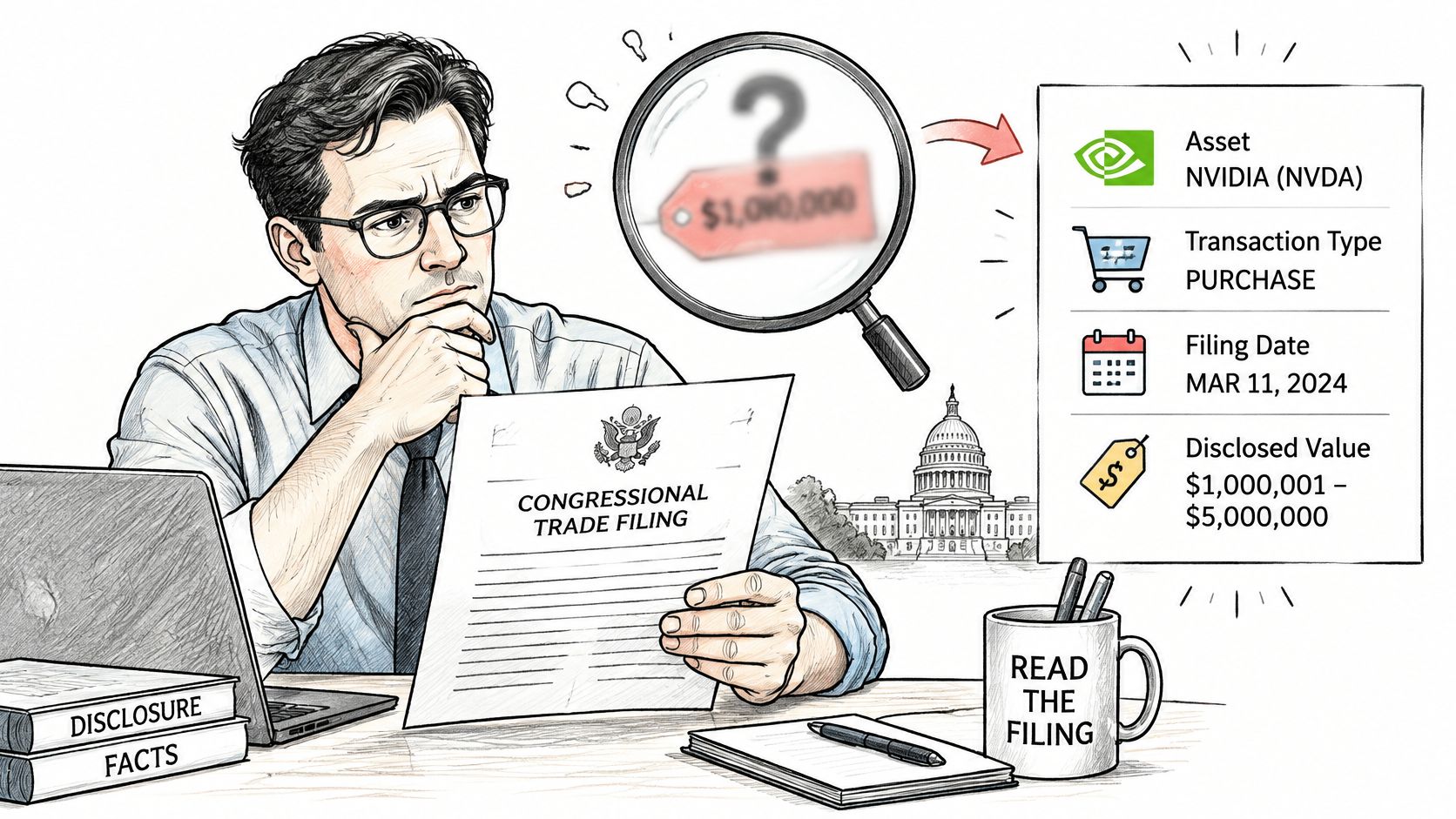
Congressional PTRs generally report value brackets, such as $1,001 to $15,000, rather than exact amounts or execution prices; the $1,000 sale-reporting threshold concerns total transaction value, not profit or loss, as explained in the Congressional Research Service's disclosure guidance. You can't calculate precise portfolio performance from those fields alone.
Follow the pattern without inventing the return
Say, hypothetically, the same member reports three purchases over six months, all involving companies in one sector and all expressed in broad brackets. That supports a description of repeated reported buying. It doesn't establish equal-sized purchases, a particular portfolio allocation, or a profitable strategy.
Even a consistent pattern needs ownership context. Check whether the record identifies the member, a spouse, or another covered owner, and preserve that distinction in your notes.
For a visual discussion alongside your own document checks, use the video below.
A practical review should answer these questions:
- Timing: How far apart are the transaction date and filing date, and what happened publicly between them?
- Size uncertainty: How wide is the disclosed bracket? Don't replace it with a midpoint and label that an actual investment.
- Repeated direction: Do separate records show consistent buying or selling, rather than a headline built around an isolated event?
- Independent activity: Are several members acting separately, or are you counting amended records and duplicated alerts?
- Political neutrality: Would you interpret the same filing the same way if the member belonged to the other party?
A sector pattern can justify further investigation into legislation, company disclosures, and industry conditions. It doesn't justify a claim that an official anticipated a particular announcement.
A filing proves a reportable event was disclosed. It doesn't, by itself, prove a return, a tip, or wrongdoing. Keep those boundaries intact when an AI summary offers a more dramatic narrative.
Decoding Form 4 Insider Trades by Transaction Type
Form 4 transaction codes and how to weigh them
| Code | Transaction | Usual Reading | Weigh It More When |
|---|---|---|---|
| P | Open-market or private purchase | Insider acquires shares through a purchase | Several distinct insiders buy in the same window |
| S | Open-market or private sale | Could reflect diversification, liquidity needs, or a plan | Footnotes indicate discretionary activity rather than a prearranged plan |
| M | Exercise or conversion of a derivative security | Often converts options into shares | Read alongside any associated sale |
| F | Payment using securities, including tax withholding | Often shares withheld to cover taxes | Usually low signal on its own |
| A | Grant, award, or other acquisition under the applicable rule | Often company compensation | Usually low signal on its own |
| G | Gift | Shares transferred without payment | Usually no directional market signal |
The code changes the interpretation. A purchase involves an acquisition through a transaction; an award may reflect compensation. Combining them into an insider-buying total makes the figure easier to advertise and harder to use.
Read the code together with the security description and footnotes. A purchase of common stock isn't interchangeable with a transaction involving a derivative, and an indirect holding isn't necessarily personally controlled in the way a headline implies.
Read the complete transaction sequence
An option exercise can increase reported shares while an associated sale reduces them. Read related lines together before deciding whether the insider increased their continuing economic exposure. Otherwise, you may mistake a compensation-related sequence for a fresh expression of conviction.
Sales deserve particular restraint. An insider can sell for diversification, taxes, personal spending, or reasons the filing doesn't disclose. A sale alone doesn't identify which explanation applies.
Check for a Rule 10b5-1 trading plan, a prearranged arrangement for trading securities, in the filing's disclosures and footnotes. Its presence changes the context because the trading instructions were established earlier. Its absence doesn't automatically make a sale bearish.
Count distinct decision-makers, not repeated notifications about the same transaction.
Role matters too. A chief executive's purchase and a director's purchase provide different organizational context, but title alone doesn't establish predictive power. Compare the transaction with the insider's continuing holdings rather than calling it significant solely because the dollar figure looks large.
- Check participation: Are separate insiders purchasing, or does one person account for the entire pattern?
- Check sequence: Do exercises, dispositions, and withholding entries belong to the same transaction?
- Check ownership: Does the filing describe direct ownership, indirect ownership, or a change between them?
- Check amendments: Has a corrected filing changed the original interpretation?
Don't confuse these transaction records with the holdings-report framework described in the SEC's Form 13F instructions. They answer different questions: insider activity versus institutional positions. Neither one insider transaction nor an impressive-looking cluster proves future stock performance.
Following 13F Snapshots and Policy-Driven Sector Moves
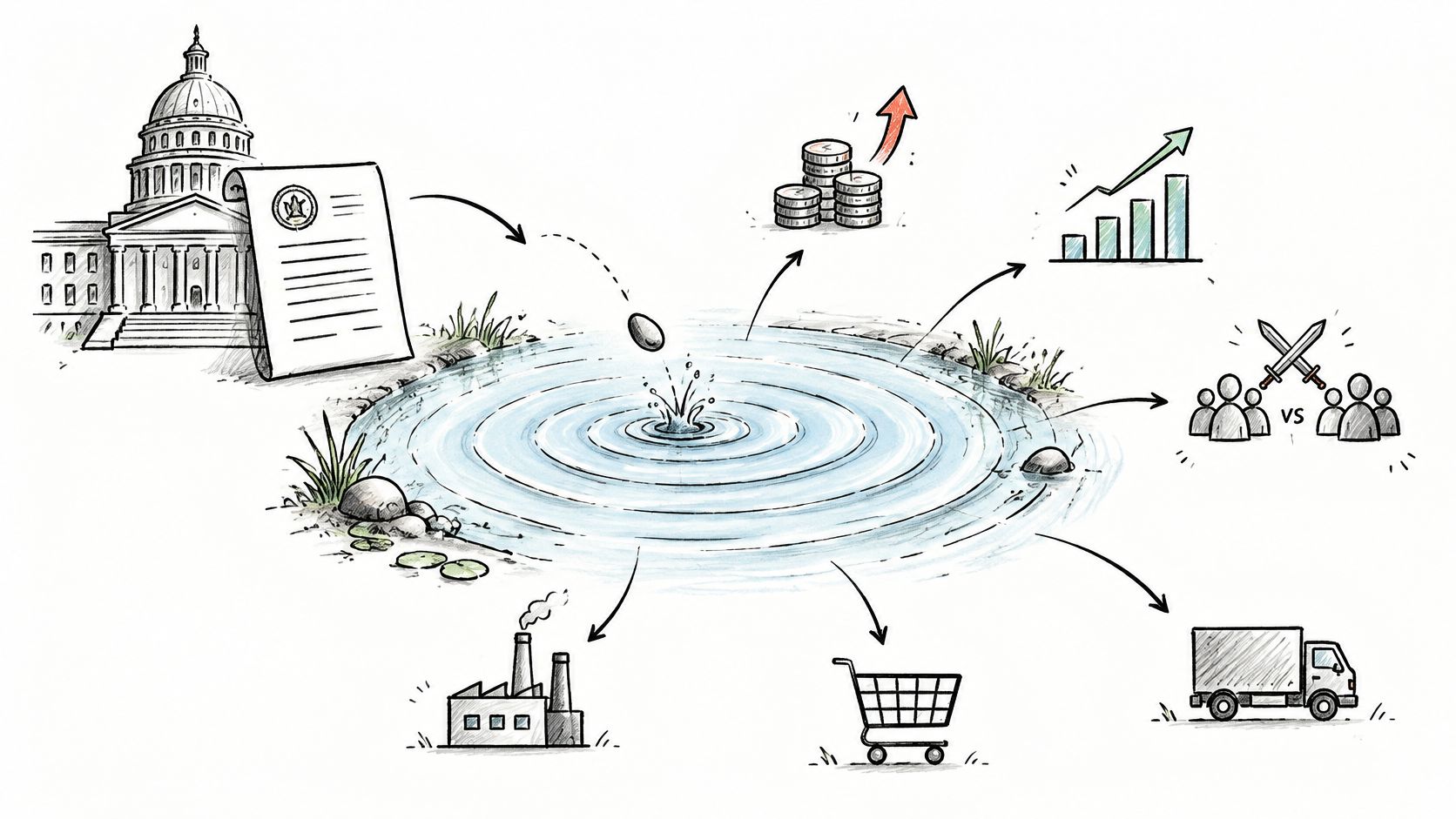
A policy change resembles a stone dropped into a pond, but traders still have to identify which businesses the ripples reach. A subsidy, procurement requirement, or market-access restriction can affect companies differently even within the same sector.
Use the image as a conceptual map, not evidence that every company benefits equally.
Institutional managers generally must submit Form 13F when they exercise investment discretion over at least $100 million in Section 13(f) securities, with reports due within 45 days after each calendar quarter ends, according to the Congressional Research Service's Form 13F overview. That makes the report a holdings snapshot, not an execution log.
Connect policy to an actual business mechanism
Start with the official bill, enacted text, agency rule, or procurement announcement. Determine whether the action is proposed, final, effective, or still subject to conditions.
Then trace a concrete chain:
- Government action: Identify the tax, subsidy, regulatory requirement, purchasing decision, or access restriction.
- Business exposure: Locate the affected product, customer group, input cost, or revenue stream.
- Competitive effect: Ask which firms qualify, which must spend more, and whether competitors face the same conditions.
- Valuation question: Consider whether investors already expected the change and whether the business impact is material.
Party labels aren't a substitute for that work. The useful question is how the provision changes a company's economics.
Compare holdings without assigning motives
Compare successive 13F reports using share counts and security identity, not just reported market value. A position's value can rise because its price rose, even if the manager didn't add shares.
List the largest position changes by manager, group them by sector, and inspect whether relevant policy developments occurred during the reporting period. Timing may support a hypothesis, but it won't reveal the manager's reasoning or exact execution dates.
A disclosed holding may have been reduced or eliminated after the reporting cutoff. A policy announcement may also affect a company less than the headline suggests because eligibility, implementation costs, or existing contracts limit its exposure.
Use this sequence: policy event, affected revenue or cost line, institutional position change, evidence-based interpretation. If the business mechanism is missing, the political story isn't ready to become an investment thesis.
Where AI Misleads and How to Check It
AI can make weak evidence look polished. A clean chart and fluent explanation don't tell you whether the underlying sample represents the market you're trying to understand.
The OECD's 2025 cross-country study of AI adoption cautions that studies can overrepresent AI users, omit sampling weights, and use inconsistent definitions of firms, industries, and AI itself. Apply that lesson to investing: a feed dominated by highly visible U.S. issuers doesn't describe every company, investor, or international market.
Common mistakes and the check that prevents them
| Mistake | Why It Misleads | Check to Run |
|---|---|---|
| Treating a congressional filing as live | Publication follows the underlying transaction | Compare the trade date with the filing date |
| Reading a value range as an exact size | Amounts are reported in brackets | Preserve the full bracket |
| Assuming a 13F position still exists | It describes holdings at a reporting cutoff | Inspect subsequent filings and acknowledge the remaining gap |
| Trusting a single AI summary | Models can misstate dates or ownership | Open the primary record and match the fields |
| Ignoring who is missing from the sample | Visible filers aren't the entire market | Identify excluded companies, owners, or regions |
Test what was actually knowable
Historical sentiment tests can accidentally include information unavailable when a trade would have occurred. That's leakage, and it can turn an unusable strategy into an attractive backtest.
Require publication timestamps, separate development and evaluation periods, and test after estimated trading costs. Also check whether results survive different market conditions rather than depending on one unusually favorable environment. Directional accuracy isn't the same as profitability because gains, losses, execution costs, and trading frequency all matter.
Language models introduce another failure mode: a plausible answer with incorrect fields. A review of financial-model benchmarks reports 65.8% accuracy for the best evaluated model on FinanceBench, which tests factual questions derived from public-company SEC filings. That's a benchmark result, not a universal error rate, but it's enough reason to verify extracted facts.
Preserve the original source timestamp and the system's retrieval timestamp. When a record changes, keep the prior version so you can distinguish a corrected disclosure from a model changing its interpretation.
A citation is useful only if the linked document supports the specific sentence attached to it.
Run an audit before accepting the signal
- Define the sampling frame. State which filings, companies, markets, and transaction categories the analysis includes.
- Name the missing segment. Identify excluded securities, unrecognized entities, incomplete records, and markets outside the feed.
- Separate observation from inference. The filing records a purchase. A claim about confidence in future earnings is an interpretation.
- Seek independent confirmation. Check another insider, an official policy development, or company operating disclosures. Repeated summaries of the same filing don't count.
- Write the invalidation condition. Specify what would undermine your explanation, then preserve ranges and scenario uncertainty instead of manufacturing a precise forecast.
For example, a policy-based thesis weakens if the final eligibility language excludes the company you identified. A supposed buying cluster weakens if the transactions turn out to be awards rather than discretionary purchases.
Practice evaluating those failures, not just attractive outcomes. In a simulation journal, record what you knew at the time, what you inferred, and what evidence would have changed your mind. That produces a more honest test than rewriting the explanation after prices move.
How TradeLikeInsiders Approaches Signal Tracking
TradeLikeInsiders, operated by HeliosNet LLC, brings congressional disclosures, corporate-insider activity, institutional holdings, policy signals, and whale flows into one research workflow, alongside educational AI analysis and a paper-trading simulator using simulated money. The useful distinction is the treatment of the evidence, not just the number of alerts: a delayed disclosure needs a different reading from a newly published agency release or an observable blockchain transfer. Timestamped sources and disclosure context help readers distinguish those records rather than treating everything on a dashboard as equally fresh. Open the primary record and match the dates, ownership, transaction classification, and security before accepting the interpretation.
The strongest use of AI driven market research is disciplined triage. Let software organize documents and surface connections, then decide whether the evidence supports the explanation. For your next review, choose a signal, write down its event date and public-availability date, identify what the source proves, and state what remains unknown. Keep the original record beside your notes and resist filling gaps with an appealing story. That habit matters more than receiving another alert a little faster.
HeliosNet LLC offers educational AI analysis and a paper-trading environment for practicing with simulated money. Visit TradeLikeInsiders to explore public-market signals, check their supporting records, and practice recording a thesis before acting on it.
This content is for informational purposes only and is not financial advice. Do your own research.