The most popular advice about AI stock alerts is also the least useful: get the signal faster, receive more notifications, and react before everyone else. That sounds like an edge, but speed alone doesn't solve the core issue. Retail traders often see a headline after the price has already begun moving, while insiders, public officials, and large institutions may act earlier, based on information that later becomes public.
AI alerts try to narrow that timing gap by watching filings, market activity, policy updates, and news, then turning raw events into readable summaries. The useful question isn't whether an alert arrived quickly. It's whether the underlying signal is fresh, correctly interpreted, independent from other signals, and still worth examining after the crowd sees it.
Table of Contents
- Why AI Stock Alerts Are the New Edge for Retail Traders
- What AI Stock Alerts Actually Watch
- Comparing the Three Core Signal Sources
- How an AI Alert Pipeline Works in Practice
- The Hidden Problem With AI Stock Alerts
- How to Evaluate Any AI Alert System
- Putting It All Together Responsibly
Why AI Stock Alerts Are the New Edge for Retail Traders
The public trades on news. Insiders trade on information. That contrast is a little too neat, but it captures the basic problem with manual market watching. By the time a retail trader reads a headline, identifies the relevant company, and decides what it might mean, other participants may already have reacted.
The market-alert ecosystem grew with electronic and algorithmic trading. In U.S. markets, automated and algorithmic systems have been widely estimated to handle roughly 60% to 70% of U.S. equity market share, while many institutional desks moved from manual monitoring toward event-driven notification systems that track price, volume, filings, and news near real time, as described by AltIndex's overview of stock alerts. Retail-facing tools use similar foundations, although they aren't operating with the same infrastructure or objectives as high-frequency firms.
The useful edge is information structure
A modern alert might detect an SEC Form 4 filing, identify the company and insider, compare the transaction with previous activity, check nearby price and volume behavior, and produce a short explanation. Another system might process a STOCK Act disclosure, connect it to a sector affected by a bill or regulation, and place the event beside other public signals.
That process matters because raw disclosure data is difficult to read at scale. Some platforms advertise coverage of more than 10,000 alternative and financial data points per company, but breadth doesn't automatically create insight. A system that collects everything can also overwhelm users with duplicate, stale, or weakly relevant alerts.
Practical rule: Treat an alert as a research shortcut, not as a verdict.
The best products make uncertainty visible. They show the filing date, transaction type, source, and relevant context instead of presenting a polished sentence that sounds more certain than the evidence deserves. Readers comparing platforms can also examine educational material such as the TradeLikeInsiders research blog, while keeping independent verification in the workflow.
AI stock alerts are therefore most valuable when they reduce search time without removing judgment. Reliability, latency, and crowding matter more than notification volume. A fast alert based on a delayed filing can still be useful, but only if the system explains the delay and doesn't disguise it as a live signal.
What AI Stock Alerts Actually Watch
Electronic markets produce a continuous stream of trades, quotes, and volume changes. AI systems place additional layers on top of that stream, including filings, news, policy events, and other alternative data. The system isn't seeing the future. It's sorting events and deciding which ones deserve a trader's attention.
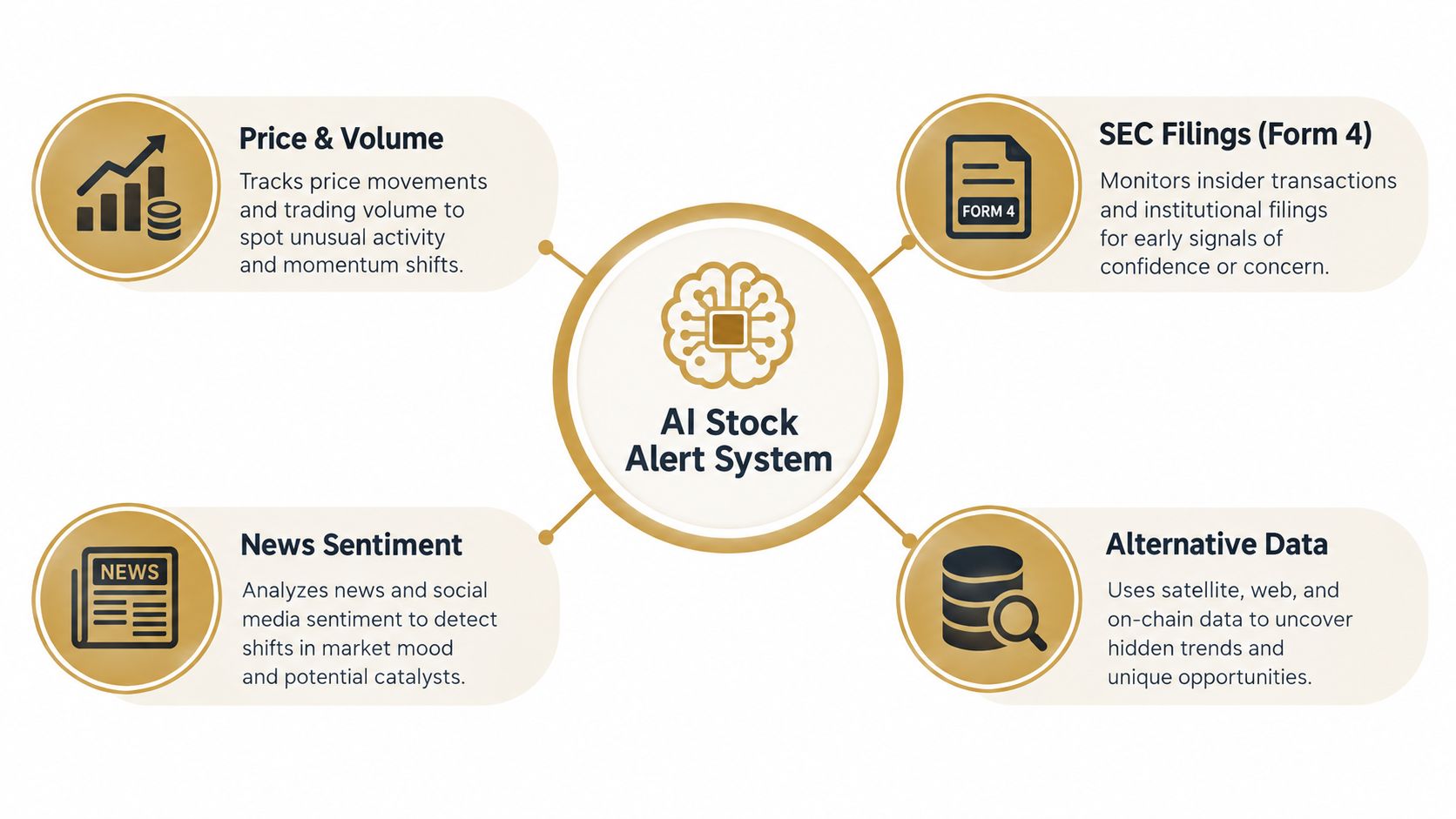
Four signal layers
Price and volume are the market's immediate record of activity. They can show that something is happening, but they usually don't explain why. An unusual move may reflect news, hedging, a large order, or a temporary liquidity gap.
SEC Form 4 filings record transactions by corporate insiders. In most cases, an insider must file within two business days of the transaction, and the filing includes the amount bought or sold and the price per share, according to the SEC's Forms 3, 4, and 5 reference. That makes Form 4 a structured source, but not a live feed.
STOCK Act disclosures cover purchases and sales by members of Congress and certain staff. Covered transactions over $1,000 generally must be reported within 45 days, as explained by the Congressional Research Service summary of the STOCK Act. The delay means a congressional alert is evidence of a disclosed past action, not proof of what the person currently owns or believes.
13F filings show selected institutional holdings. An investment manager exercising discretion over $100 million or more in Section 13(f) securities must file within 45 days after each calendar quarter-end, according to the SEC's Form 13F instructions. These reports identify holdings as of the quarter's final day, so they're useful for studying institutional positioning but poor for pretending to follow a fund tick by tick.
What the AI layer adds
The model can classify an event, connect a person to a company, group related filings, summarize a policy development, and flag contradictions. It may also compare a disclosure with market context, such as whether the stock already moved sharply before the filing appeared.
That doesn't turn a delayed disclosure into a prediction. It gives the trader a cleaner starting point. The central distinction is simple: AI detects and organizes signals, while the trader decides whether the signal is timely, relevant, and actionable.
Comparing the Three Core Signal Sources
These sources don't deserve equal weight. Each one represents a different kind of information, arrives on a different schedule, and carries a different risk of misinterpretation.
| Signal Source | Disclosure Timing | Typical Edge | Noise Level | Crowding Risk |
|---|---|---|---|---|
| Insider activity | Form 4 is generally required within two business days | Direct evidence of a company's insider transaction, especially when buying clusters or aligns with company context | Moderate, because insiders sell for many reasons and transactions can be routine | High when widely distributed alert systems publish the same filing |
| Congressional activity | Covered transactions over $1,000 are generally reported within 45 days | A public policy-exposure signal that may help identify sectors connected to legislation or regulation | High, because the disclosure is delayed and personal portfolio decisions have many possible explanations | Moderate to high when a widely followed disclosure becomes a headline |
| Whale or institutional activity | Options flow can appear quickly, while 13F holdings arrive within 45 days after the quarter ends | Shows attention, positioning, or potential conviction from larger participants | High for options activity, since hedgers and market makers also trade actively | High for highly visible, fast-moving flow |
Insider activity
Corporate insider buying generally deserves more analytical weight than an isolated sale. A sale may reflect taxes, diversification, a scheduled plan, or personal liquidity needs. A purchase requires the insider to commit capital, although that still doesn't guarantee a favorable outcome.
Clusters deserve attention because several related purchases can tell a different story from one routine transaction. Even then, the trader should inspect the actual filing, the insider's role, transaction size, and whether the purchase was open-market activity or part of an automatic plan.
Congressional activity
Congressional disclosures are useful for studying the connection between policy and markets, not for copying a politician's portfolio. A lawmaker's purchase may reflect broad sector exposure, an outside adviser, or an investment decision made well before the public report appears.
The delay makes context essential. A disclosure can help generate a research question, such as whether new legislation affects a group of companies, but it shouldn't be treated as a timely entry signal.
Whale activity
Options flow is fast but especially easy to misread. A large trade may be a hedge, part of a spread, or one leg of a more complex position. A 13F is slower but easier to interpret as a documented institutional holding, though it still describes a past reporting date.
A sensible workflow uses these sources as different lenses, not votes to be added together. An insider filing may establish company-specific relevance, a policy signal may explain sector exposure, and institutional activity may add context. None removes the need to check the original record.
How an AI Alert Pipeline Works in Practice
Consider a hypothetical illustration, not a real trade. A biotech chief financial officer files two Form 4 purchase reports. Around the same period, a senator later reports a transaction involving the same company. An alert pipeline shouldn't fire three separate notifications and leave the user to connect them.
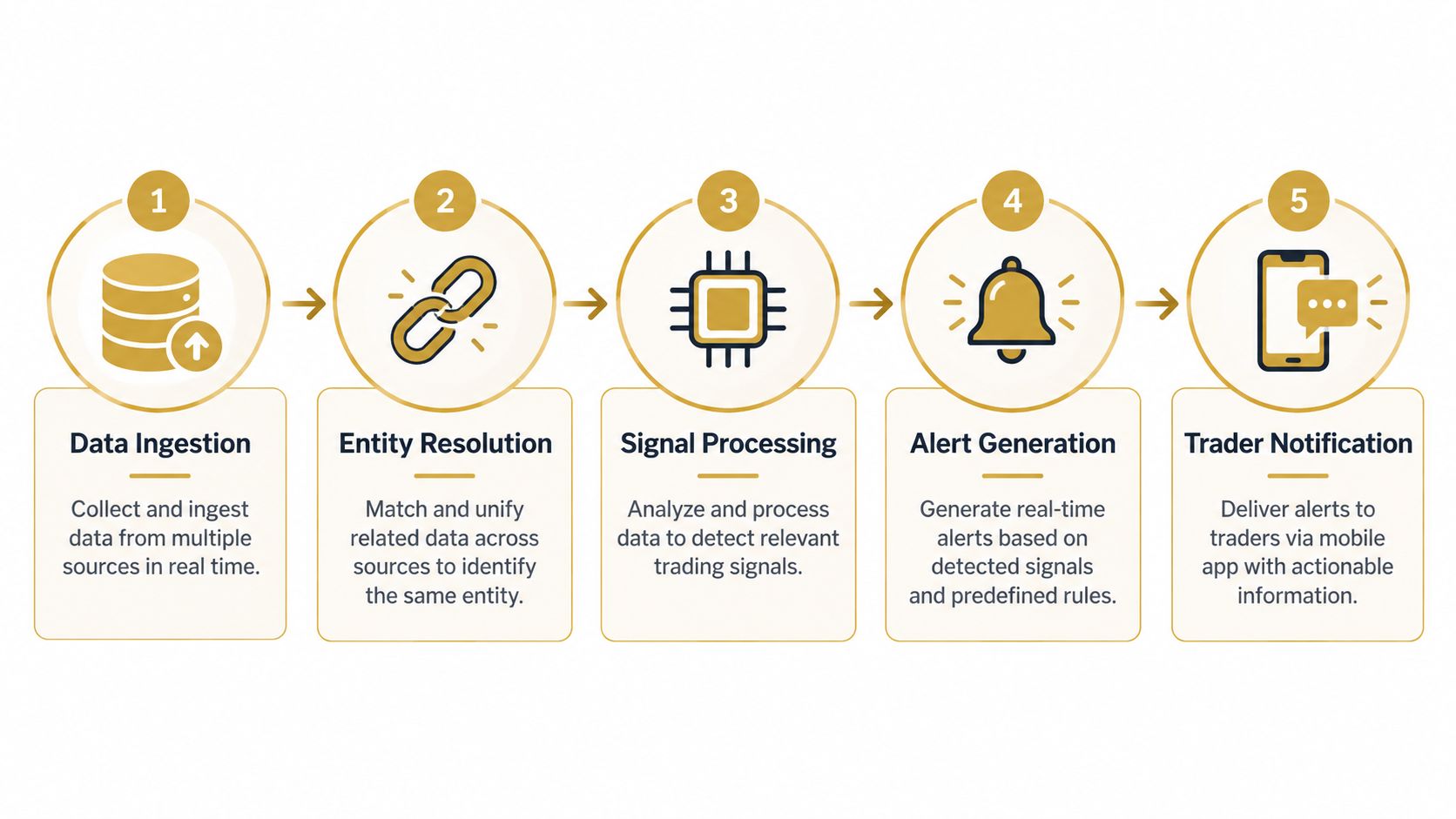
From filing to usable event
Data ingestion pulls records from sources such as SEC filings, congressional disclosure systems, exchange feeds, and curated news. The first job is completeness and timestamp accuracy. If the system doesn't know when a filing became public, its confidence language is already compromised.
Entity resolution maps names, titles, companies, and securities to the right records. This prevents a common failure: combining two people with similar names or linking an insider to the wrong issuer.
Signal processing identifies patterns. Two purchases by one executive may mean something different from several executives buying independently. The system can also add price, volume, sector, and policy context.
Alert generation ranks the event and writes a summary. A responsible summary might say that two Form 4 purchase filings by a named corporate officer were detected, that a congressional disclosure references the same issuer, and that the records should be checked directly before any decision. It should show the ticker and reported transaction details from the filings, not invent a recommendation.
Trader notification delivers the result through an app, email, or dashboard. A useful notification includes source links, public timestamps, filing type, and a clear statement of what remains unknown.
The pipeline may assign a confidence score based on signal strength, recency, source quality, and historical behavior. That score is a prioritization tool, not a probability that the trade will win. Historical insider performance can be especially misleading if the sample excludes costs, market regime changes, or losing signals that were filtered out.
A clean filing received later is more useful than a fast alert built on the wrong entity.
Latency still matters. Research on algorithmic trading around macro news found that a 300 millisecond delay significantly reduced returns, and that delays from 10 milliseconds to one second produced statistically significant degradation for strategies with success ratios of 60% or higher, according to this study of speed, algorithmic trading, and market quality. Retail investors shouldn't assume those results transfer directly to filing-based alerts. They do show why a product must define which part of its pipeline is time-sensitive.
For a practical example of how market-alert content can be organized, see this TradeLikeInsiders sample research article.
The Hidden Problem With AI Stock Alerts
More alerts and faster delivery sound like progress, but they can make a trader less independent. If every subscriber receives the same Form 4 filing, reads the same AI summary, and reacts to the same confidence label, the product may distribute a crowd rather than an edge.
Model overlap creates crowded signals
Model overlap happens when different tools use the same public filings, similar language models, and similar ranking rules. The output can look independent because it appears in several apps, but the systems may be responding to one shared source.
Reflexivity adds another problem. Once an alert reaches enough users, the alert can influence the price it was meant to describe. A retail trader who receives the notification after the first wave may be acting on a crowded reaction, not discovering the original event.
False confidence is even more subtle. A fluent summary can make an ambiguous filing sound like a conviction call. The language may be polished while the underlying evidence remains thin.
| Failure Mode | What Causes It | How It Drains Edge | Defensive Response |
|---|---|---|---|
| Model overlap | Multiple systems rank the same public filing in similar ways | Traders enter together and reduce the advantage of early discovery | Check whether the signal is genuinely new and compare its public timestamp |
| False confidence | A model turns incomplete context into decisive-sounding prose | Users mistake readability for reliability | Read the original filing and separate facts from interpretation |
| Reflexivity | The alert itself drives attention and orders | Late users inherit worse prices and more volatility | Treat the alert as a research trigger, not an execution command |
| Signal saturation | Too many users receive an identical high-priority alert | A historically useful pattern may no longer offer the same entry conditions | Track outcomes after the alert, including missed and ignored signals |
The right response isn't to reject AI. It's to ask the system to slow you down when the evidence is weak. An alert that says “verify the filing, check whether the move already occurred, and note that the transaction may be routine” can be more useful than one that labels the same event as a strong opportunity.
A peer-reviewed news-trading study found that event-based models outperformed sentiment-based models, while a bi-level event detector produced a 9.11% average return in that study, as reported in the ACL Findings paper on event-based news trading. That result supports structured event classification in that research setting. It doesn't establish a universal return for retail alerts, and it doesn't remove the risk that many traders will crowd the same event.
The strongest alert may be the one that tells you not to act yet.
How to Evaluate Any AI Alert System
Don't begin with the number of notifications a platform can send. Begin with the evidence behind each notification. A service that produces fewer, better-documented alerts may be more useful than one that fills your phone with unranked events.
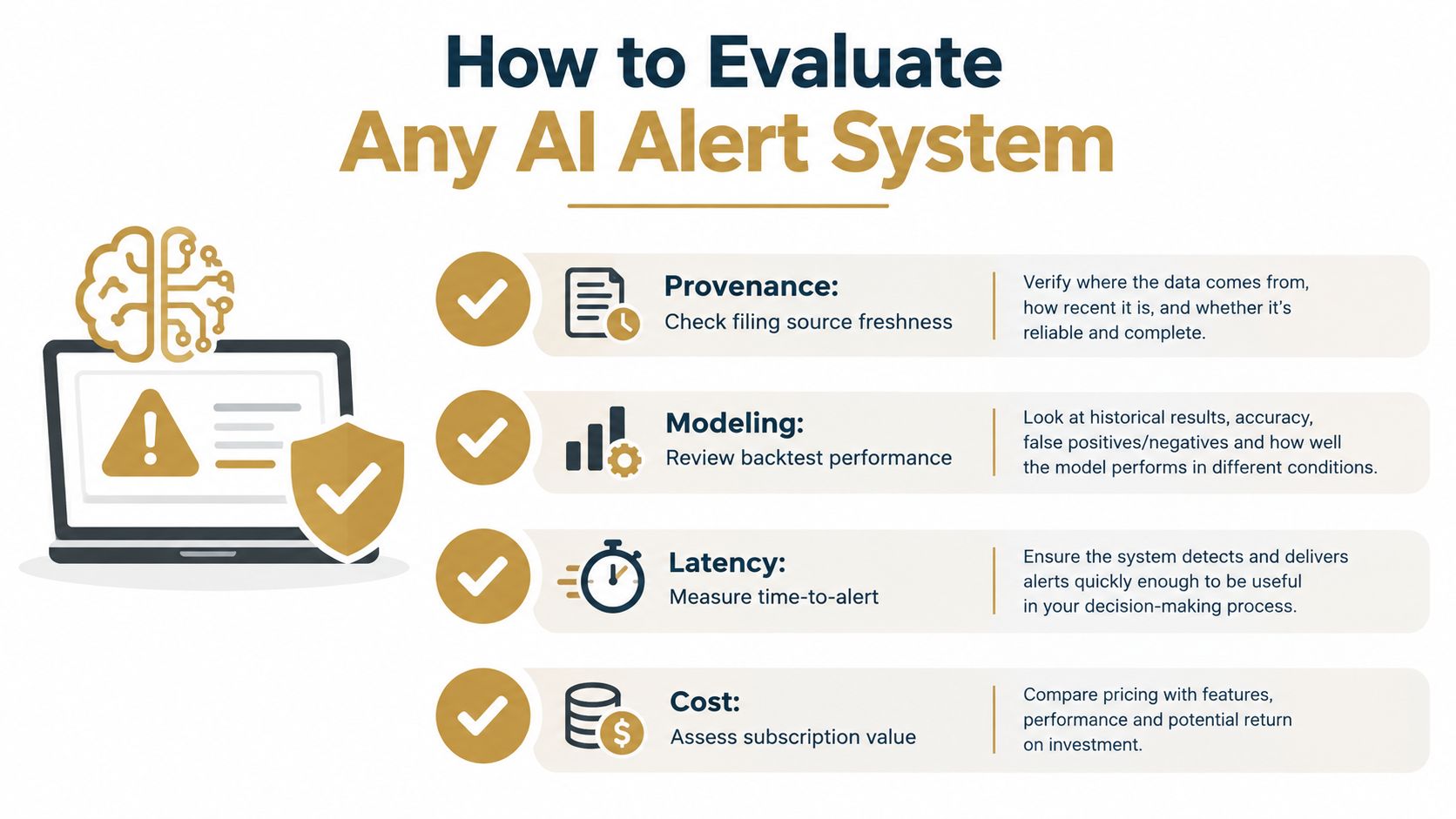
Questions to ask before subscribing
Where does the data come from? Ask whether the service links directly to SEC EDGAR, official House or Senate disclosure records, exchange data, or licensed aggregators. Check whether every alert shows when the underlying filing became public and whether the source record is available for review.
How does the platform define a successful signal? A credible provider should explain its historical methodology, including the observation window, treatment of losing signals, transaction costs, and whether the results are live or backtested. If it only displays a win rate without defining the measurement, the number tells you little.
What does confidence mean? Is it a model score, a ranking among current alerts, or an estimated likelihood? Those are different things. Confidence should never hide missing information, delayed disclosure, or a low-quality source.
How quickly does the alert arrive? Test the time between the public filing timestamp and the notification. For congressional and 13F records, also ask whether the system clearly labels the delay instead of presenting old information as current.
Does it remove duplicates? If three systems notify you about the same filing, you need to know whether they represent three independent signals or one event copied three times. Deduplication is a basic quality test.
Can you verify the summary? The alert should expose the filing, transaction type, reported amount or range where applicable, date, person, company, and relevant caveats. A summary without a source is a prompt for skepticism.
What are you paying for? Compare subscription cost with source quality, alert clarity, history, and the ability to export or journal results. A free trial is useful only if it lets you test real alerts rather than a curated demonstration.
Does the service respect the line between research and advice? Look for clear disclosures, lawful data sourcing, and features that encourage verification. A platform should help you investigate public information, not imply that an AI label replaces judgment.
TradeLikeInsiders is one example of a platform that aggregates congressional disclosures, SEC insider filings, whale activity, and policy signals, then adds AI summaries and a paper-trading environment. Whatever service you test, use the same questions and judge the workflow rather than the marketing language.
Putting It All Together Responsibly
An alert becomes useful when it changes your process, not when it changes your impulse. Start with three habits that keep public information in its proper role.
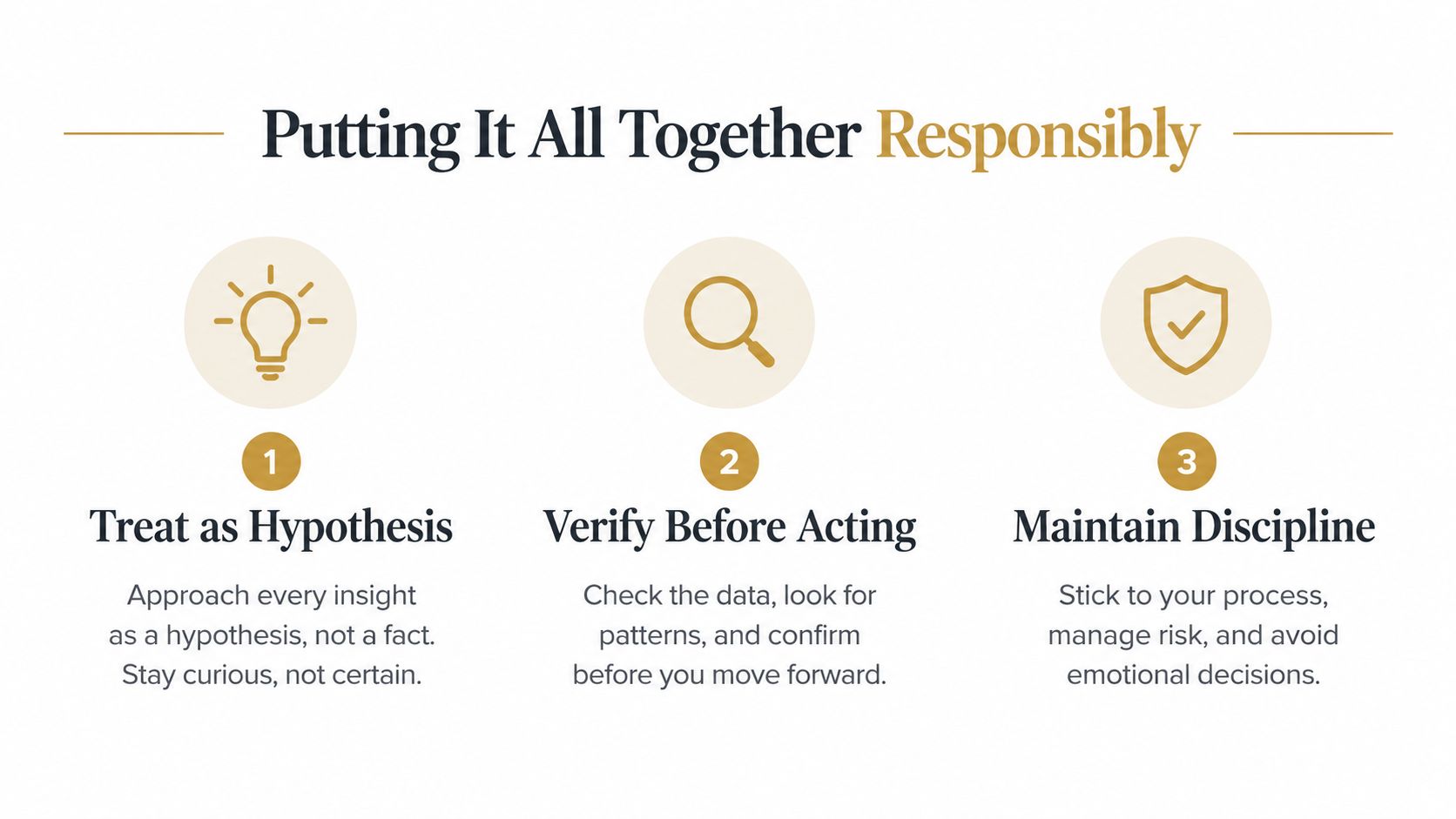
Treat every alert as a hypothesis
A Form 4 purchase can suggest that an insider chose to commit capital. A congressional disclosure can point to a possible policy connection. A 13F can reveal a reported institutional holding. None of those facts answers the more important questions by itself: why did the transaction happen, when did it happen, what has already changed, and what information is missing?
Write the hypothesis in plain language before you investigate. For example, “This filing may indicate company-specific interest” is more disciplined than “This insider knows the stock will rise.”
Verify before acting
Open the original source. Confirm the issuer, person, transaction date, filing date, and reported details. Then check whether the price reaction has already occurred and whether the alert combines independent evidence or merely repeats one public event.
Keep a simple journal with:
- Alert source: Record whether it came from Form 4, a congressional disclosure, 13F, options activity, news, or a combination.
- Model confidence: Save the platform's label, while remembering that it isn't a guarantee.
- Your reasoning: Write why you considered the event relevant and what could invalidate the idea.
- Outcome: Record what happened, including cases where you ignored the alert.
This record exposes hindsight bias. It also shows whether you respond differently to an attractive summary than to the underlying evidence.
Maintain discipline
Use alerts for idea generation unless you've independently designed and tested an execution process. Keep exposure small enough that a run of false signals won't damage your account, and don't confuse a paper-trading result with live performance.
Never seek or trade on material non-public information. Public filings and public policy records are legitimate research inputs, but an AI tool shouldn't provide secret information or encourage unlawful conduct. The responsible reframe is simple: the best AI stock alert makes you more careful and skeptical, not merely faster.
HeliosNet LLC offers TradeLikeInsiders, a research and alerting platform that brings congressional disclosures, SEC insider activity, whale moves, and policy signals into one place, with AI summaries and a paper-trading environment for testing your process. If you want to compare public signals while keeping verification and journaling in the workflow, visit TradeLikeInsiders. This content is for informational purposes only and is not financial advice. Do your own research.