A brief on your screen says a lawmaker sold a stake worth between $15,001 and $50,000 in a defense contractor. The prose is clean, the ticker is right, and there's a link at the bottom. What's missing is the transaction date, and that single absence decides whether you're reading a live signal or a six-week-old receipt.
That's how these tools usually fail. Not with a wild invention, but with a tidy paragraph that drops the one field you needed.
The most repeated advice about AI summaries is to pick a tool that cites its sources. That advice is close to useless by itself. A citation proves a document exists. It doesn't prove the sentence attached to it says what the document says. A brief can link straight to a Periodic Transaction Report and still print the filing date where the trade date belongs, and the link is exactly why nobody opens it.
The question that protects your money is narrower and harder. For this specific claim, is the evidence direct, inferred, stale or contradicted?
Table of Contents
- What an AI Summary Tool Actually Does
- How to Check Each Summary Claim Against Its Source
- Congressional, Insider and 13F Filings Compared by Speed
- How Policy Moves Reach Sectors and Stocks
- Where AI Summaries Quietly Leave Things Out
- Test a Summary Against the Filing Before You Act
What an AI Summary Tool Actually Does
An ai summary tool retrieves information from long or scattered sources, such as a congressional Periodic Transaction Report, an SEC Form 4, an agency rule release, or a news story, then compresses it into a short brief. It works like a junior analyst preparing a quick note: useful for finding the main points, but not a substitute for checking what the documents say.
AI-generated summaries now appear in some search results. A 2025 analysis found them in 18% of 68,879 Google searches by 900 U.S. adults. The number describes that analysis, not every search or summary tool.
The Five Steps Behind Every Summary
A summary's reliability depends on the steps before its prose reaches you:
- Retrieve the source with its dates. Filing date, transaction date, and as-of date are different fields. If a tool loses that distinction, its summary can misstate when an event happened.
- Extract passages that carry facts. These may include tickers, buy or sell direction, value ranges, committee names, and effective dates.
- Generate compressed text from those passages. If the model fills gaps with general knowledge about a company or politician, the summary can sound plausible while going beyond the source.
- Check each sentence against its passage. This is the step that determines whether the claims are supported, inferred, or at odds with the filing.
- Attach citations that open to the relevant source. A citation beside each claim is easier to verify than one link at the end of a paragraph.
Here is the process in one view.
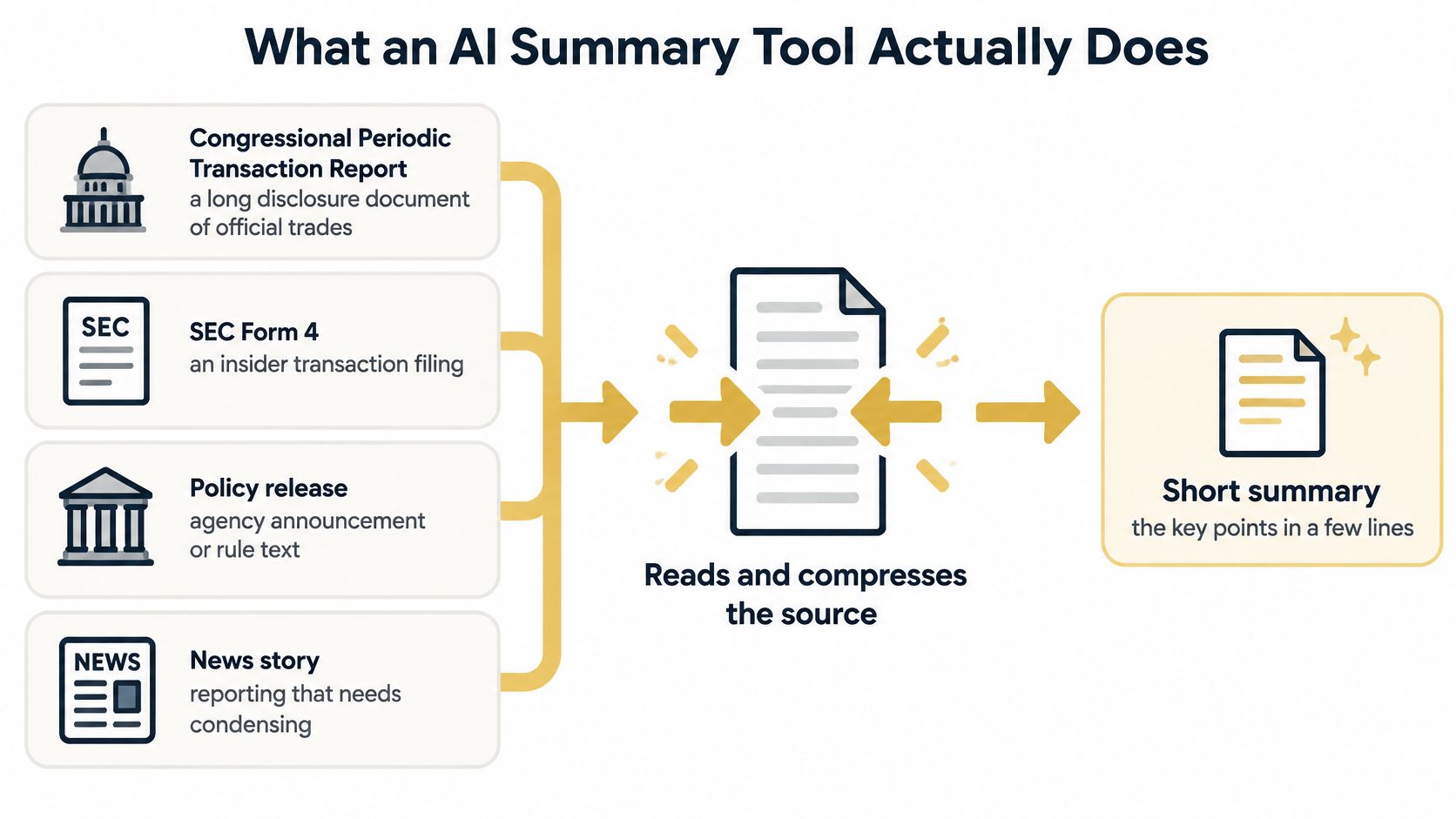
Compression is a risky step. A long filing may become a few sentences, and qualifiers such as “approximate,” “delayed,” “value range,” and “may include” can disappear. Without them, a range can read as a precise amount, a delayed disclosure as a current trade, or a quarter-end portfolio as a current position. The output may be shorter, but the underlying claim has changed.
Text summarization has a longer history than today's generative tools. The field has moved from statistical methods through deep learning and pretrained models. IBM researcher Hans Peter Luhn published “The Automatic Creation of Literature Abstracts” in 1958, and GPT-3 arrived in 2020 with 175 billion parameters, according to the documented history of text summarization. Current products combine information retrieval with generative rewriting.
Judge a summary by whether its claims track the source, not by how polished the prose sounds. Fluency can hide a missing qualifier; a source link gives you a way to check, not proof that the sentence is accurate.
How to Check Each Summary Claim Against Its Source
Readable and supported are different products, and only one of them gets marketed. Strip the branding off any filing summary and every claim in it lands in one of four buckets: supported by the passage, inferred by the model, outdated because a newer filing supersedes it, or contradicted by another document. Nearly every tool shows you none of those labels.
That gap has a cost you can measure. Participants in the 2025 study on traceable summaries answered source-comprehension questions significantly more accurately when summaries included traceability links, and the benefit was strongest when those summaries contained hallucinations (χ² = 22.2, p = 2.4 × 10⁻⁶). The same paper cites a BBC/EBU assessment in which 45% of responses from leading AI assistants contained at least one significant error, with sourcing and attribution the largest problem category, and 76% of respondents said sourcing errors would substantially damage their trust.
The Claim-Check Table to Run Before You Trust Anything
| Claim Type | Check Against | Red Flag |
|---|---|---|
| Ticker and transaction type | Original PTR or Form 4 line item | Ticker or buy/sell direction not in the filing |
| Transaction and filing dates | Date fields printed on the filing | Filing date presented as the trade date |
| Dollar size | Reported value range on the filing | A single precise figure stated as fact |
| Cause of the trade | Cited news or document dated before the trade | A "because of" claim with no source |
| Current holding | Most recent filing, if any | Claim that the position is still held today |
| Counterevidence | Other sources covering the same event | Only bullish or only bearish sources cited |
The Audit Routine That Takes Two Minutes
Highlight every number, name, date and causal word in the summary, then find the exact passage behind each one. Ten highlights, ten passages. If a highlight has no home, the claim is decoration.
The failure isn't rare. Research defines a hallucination as any generated span unsupported by the source document, and benchmark work reports that approximately 25% of summaries produced by traditional end-to-end pretrained models on CNN/Daily Mail contained hallucination problems, per a peer-reviewed study in Scientific Reports. A fluent sentence about a transaction size, a date or a causal link is not evidence of anything except fluency.
Model size doesn't rescue you either. The strongest summaries in the 2024 TACL benchmark of 10 large language models were judged on par with human-written ones, and the researchers concluded that instruction tuning, not scale, was the biggest factor in zero-shot performance. Their quality framing is the practical one: factual faithfulness, coverage, readability and adherence to instructions, scored separately rather than averaged into one number.
Working rule: if you can't find the supporting passage in two minutes, the claim is unverified. An unverified claim isn't a signal, it's a rumor with better grammar.
Congressional, Insider and 13F Filings Compared by Speed
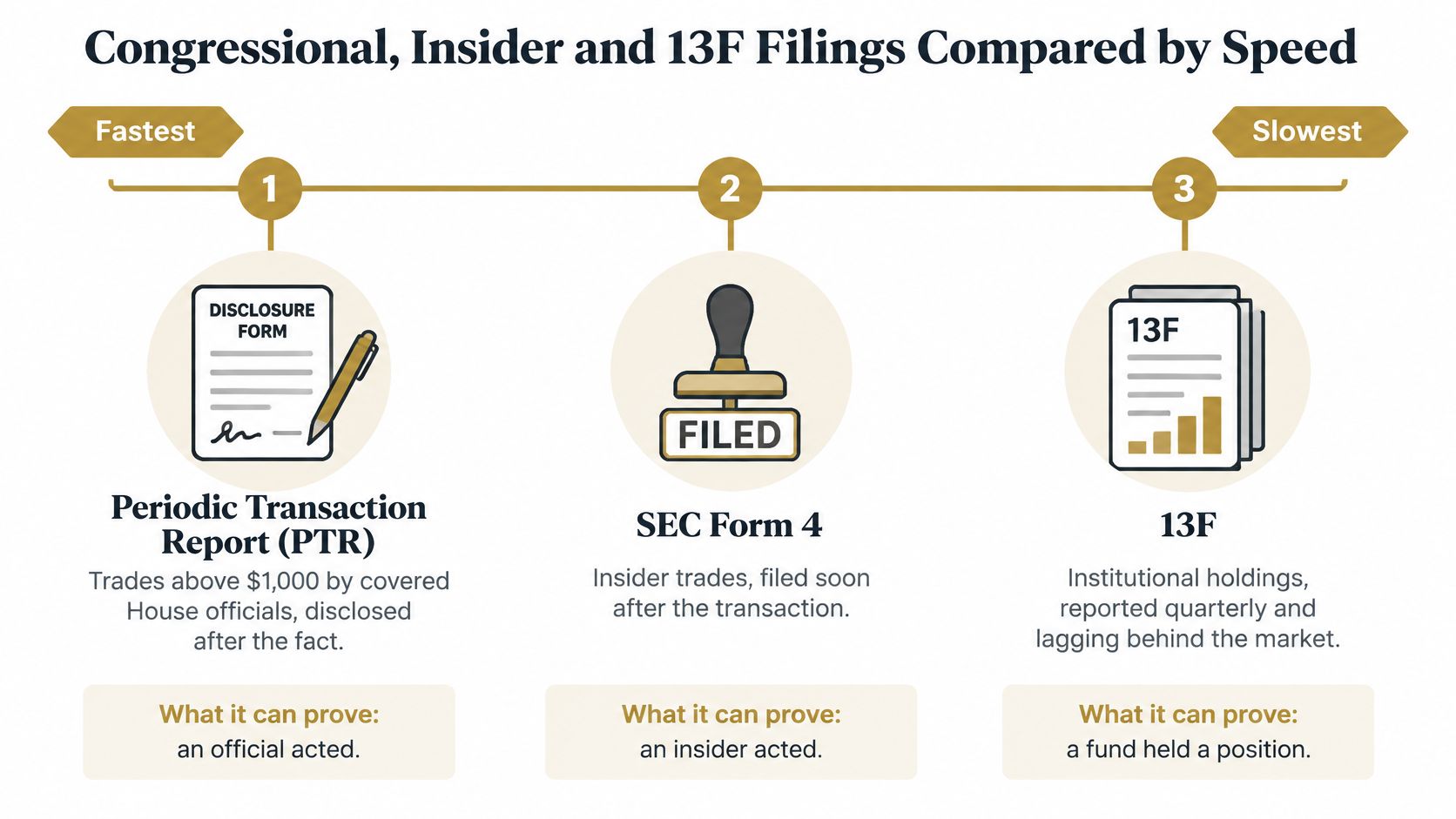
The filing with the freshest information is not necessarily the one with the clearest signal. Form 4 is fastest, a Congressional Periodic Transaction Report can arrive up to 45 days after a trade, and 13F-HR is the slowest. Check the filing type and its dates before treating a summary as current.
Under the STOCK Act, covered House officials must report qualifying purchases, sales or exchanges of securities exceeding $1,000. The deadline is the earlier of 30 days after the filer learns of the transaction or 45 days after the transaction date, according to the House Ethics Committee's STOCK Act guidance. For sales, the threshold is based on the transaction's total dollar value, not profit or loss. A PTR shows what was reported, not what the official holds now, and usually gives a value range rather than an exact amount.
Form 4 Is Faster and Much Narrower
A Form 4 covers transactions in a company's own stock by its officers, directors and owners of more than 10% of the company. It is due within two business days, making it the fastest of these filings. That speed does not make every entry a directional signal. Open-market purchases and sales may indicate conviction, while an option exercise or shares withheld for taxes can look like a buy or sale in a compressed summary without saying much about outlook. Check the transaction code and details before accepting a summary's claim that an executive “bought.”
A 13F-HR is the slowest and broadest of the three. Institutional managers with at least $100 million in qualifying US equity securities report holdings as of quarter end, with the filing due 45 days later. A mid-February filing, for example, reports positions as of December 31, so it is already a quarter-old snapshot. Managers may request confidentiality for positions, which means a missing name is not proof that a fund held no position.
| Filing | Who Files | What It Shows | Filing Window |
|---|---|---|---|
| Periodic Transaction Report (STOCK Act) | Covered House officials | Securities transactions above $1,000, often as value ranges | Earlier of 30 days after notice or 45 days after the trade |
| SEC Form 4 | Corporate officers, directors and owners of more than 10% of a company | Trades in that company's own stock | Due within two business days of the trade |
| 13F-HR | Institutional investment managers holding at least $100 million in qualifying US equity securities | Equity holdings as of quarter end | Due 45 days after quarter end |
TradeLikeInsiders surfaces STOCK Act congressional disclosures, SEC Form 4 insider filings and on-chain whale flow. When checking an AI summary, verify that it names the filing type and the date the information reflects. Without those details, a true statement about a trade or holding can still be misleading about its timing.
How Policy Moves Reach Sectors and Stocks
The headline is rarely the signal. The sector exposure is. A bill, a proposed rule or an agency release changes the economics for a whole industry first, and only then do individual companies reprice around it.
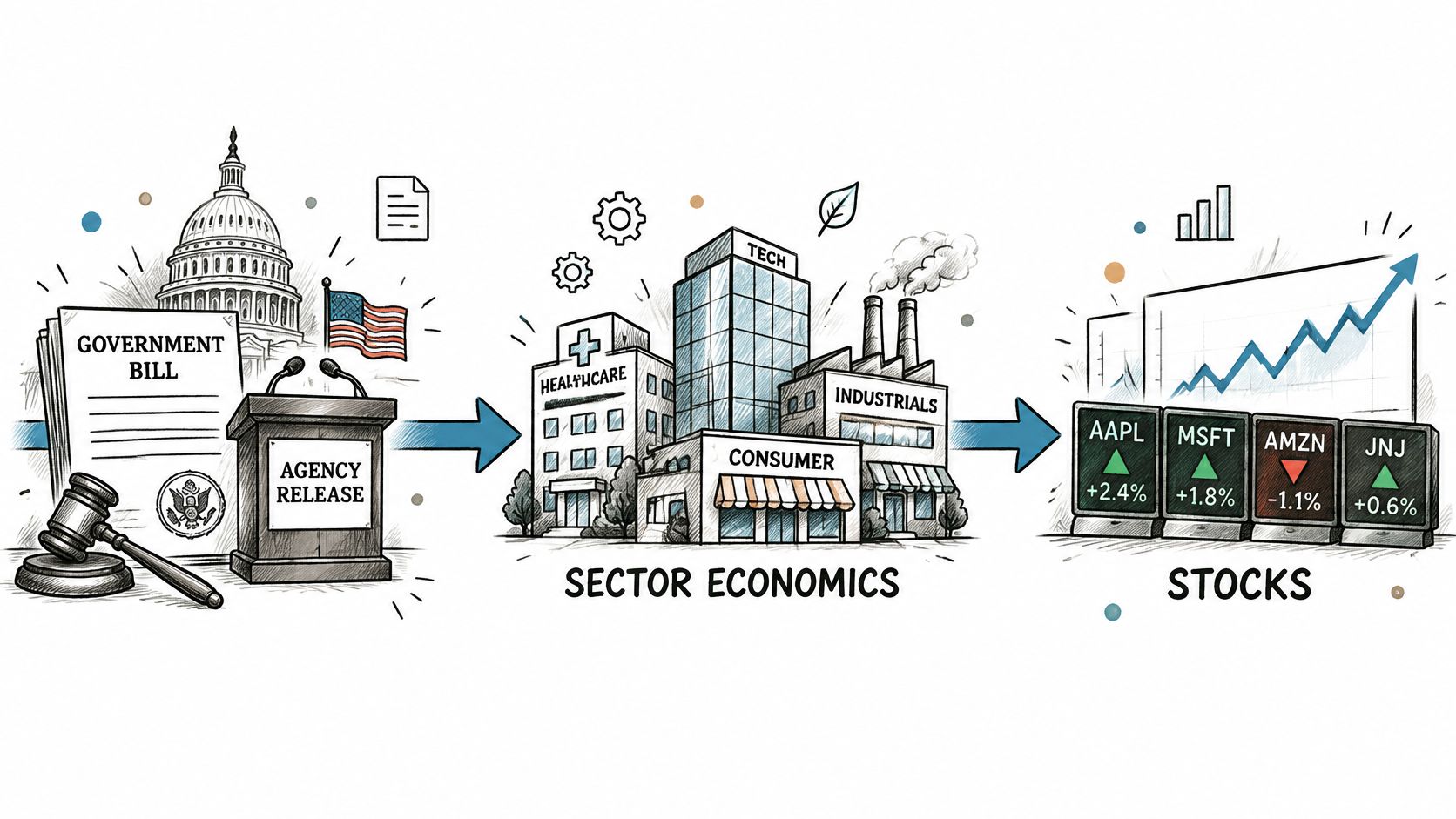
The public trades on news. The people closest to the process trade on information about how it will unfold, which is a different thing and often arrives earlier.
Run the same four checks on any proposal, from either party.
- Identify the stage. Introduced, through committee, scheduled for a floor vote, signed, or in a comment period. Each stage has a different probability of becoming real.
- Read the text for named sectors. Not the press release, the text. Reimbursement language, tariffs, permitting rules and tax treatment all point at specific industries.
- Separate direct from indirect exposure. A change in healthcare reimbursement hits hospital operators and device makers differently, and a supplier two steps down the chain differently again. An energy rule touches producers, utilities and equipment makers in ways that rarely move together.
- Track the dates where the rule can still change. Comment periods and final rulemaking dates are the windows where a proposal gets softened or scrapped.
A summary that says a bill is "bullish for energy" has told you nothing you can check. A summary that names the provision, the sector and the date it takes effect gives you something to verify.
That distinction is where most policy coverage breaks down. By the time a vote is headline news, much of the move has already been priced in, and the follow-through depends on details buried in the text. A summary of headline sentiment tends to confirm what you already heard. A summary tied to the actual provision, with the stage and the date attached, tells you whether you're early, late or looking at a story that already played out.
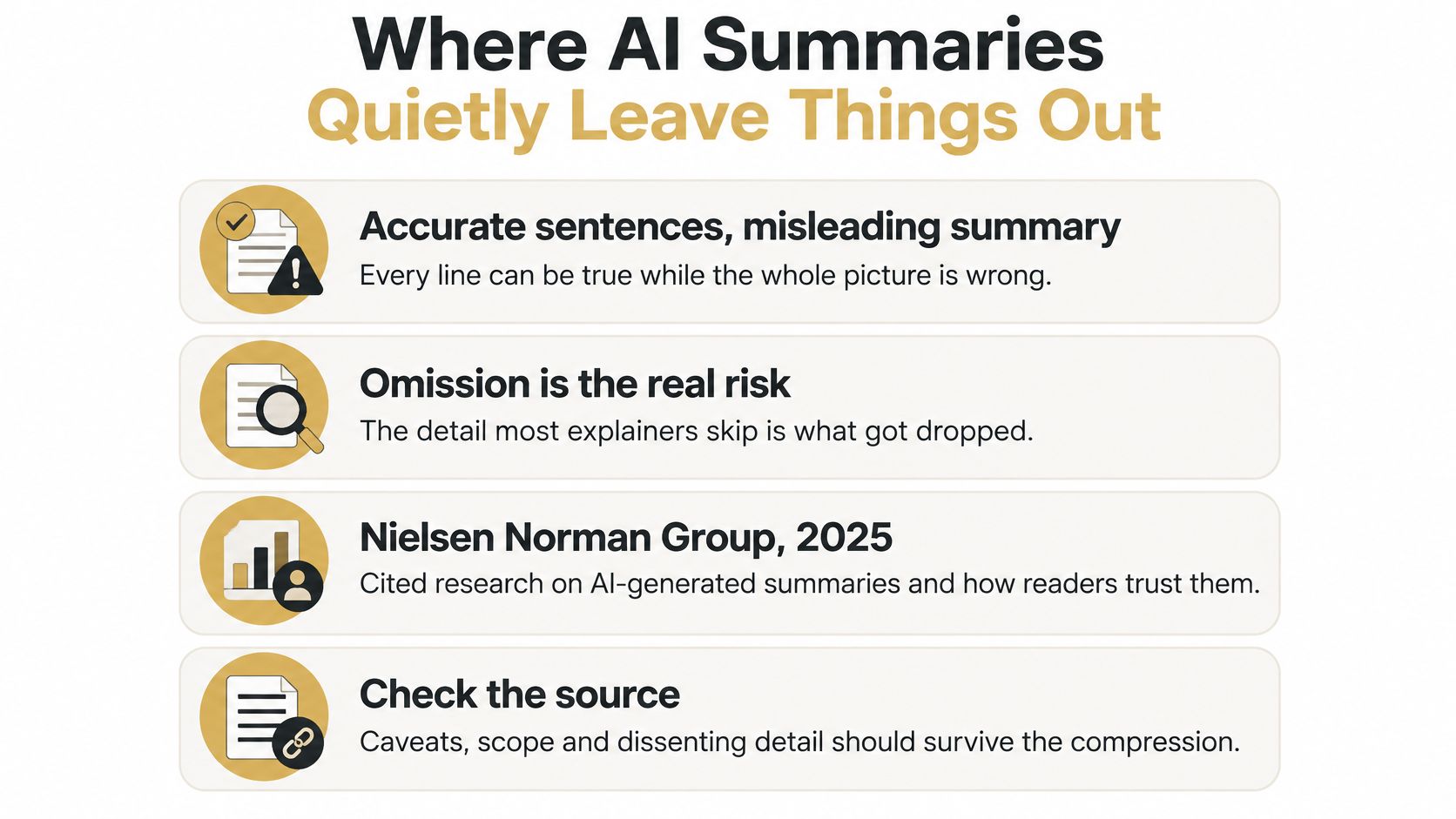
Where AI Summaries Quietly Leave Things Out
A shorter summary is not a better summary. Compression improves scanning and removes dissent at the same rate, and only one of those is good for you.
Nielsen Norman Group's 2025 research on AI-generated review summaries found that important details were sometimes omitted, contradictory themes appeared, and participants expected the AI to emphasize positives while downplaying negatives. The researchers recommended showing source counts, references, quotations and links. Read that again: users walked in expecting the summary to flatter the subject, and the summaries cooperated.
Length makes it worse in a specific direction. A multi-model evaluation found factual consistency strongest at roughly 50 output tokens while perceived quality peaked near 150 tokens, per the multi-model summarization study. The version readers like most is the version with more room for unsupported detail.
Picture ten disclosures involving the same official. Nine are purchases, one is a large sale, and the summary covers the nine. Every sentence is accurate. The impression is false.
Demand five things from any output before you act on it:
- Consensus. What the majority of the sources say.
- Dissent. The strongest opposing evidence, stated fairly rather than strawmanned.
- Missing-data warnings. Which dates, amounts or documents weren't available.
- Source distribution. How many filings or outlets support the claim, and whether one loud source is carrying it.
- A "what would change this conclusion" line. The single fact that would flip the read.
For market use, add two sorting steps of your own. Separate bullish evidence from bearish evidence, and label every item current or stale. Then ask whether the signal reflects one influential source or a broad pattern across many. A cluster of filings is a much stronger read than one large disclosure a summary happened to lead with.
Test a Summary Against the Filing Before You Act
None of this takes long once it's a sequence rather than a mood.
- Pull the primary document. The House PTR, the SEC EDGAR Form 4 or the 13F. A summary is a pointer. The document is the evidence.
- Confirm the transaction date, the filing date and the as-of date. A correct number pinned to the wrong date produces a confident, wrong conclusion.
- Run the claim-check table on every number, name and causal word. "Because" is a claim about cause, and it needs a source dated before the trade.
- Label each item current or stale. A disclosure that's weeks old can describe a position that's already closed.
- Compare against a second source on the same event. Two documents agreeing is stronger evidence than one fluent paragraph.
Practice is the cheapest way to build the habit. TradeLikeInsiders offers a paper-trading simulator where users practice with simulated money, which lets you run these checks and log the outcome without a position on the line.
TradeLikeInsiders tracks congressional trades, insider activity, whale moves and policy signals in one place at TradeLikeInsiders. Treat every summary there, and everywhere else, as a first draft that needs a source behind each claim. No summary guarantees an outcome, and past patterns don't predict future results.
This content is for informational purposes only and is not financial advice. Do your own research.
HeliosNet LLC runs TradeLikeInsiders.com, where delayed congressional disclosures, SEC Form 4 insider filings, whale flow and policy updates sit in one research feed with educational AI analysis attached to each. If you want to practice auditing claims against primary documents before anything is at risk, the paper-trading terminal gives you a place to do it with simulated money. Start at TradeLikeInsiders.