AI trading signals don't guarantee profits, and the best ones still need out-of-sample testing after costs. A 2025 review of 57 peer-reviewed studies found useful predictive and risk-management benefits in some market conditions, but also plenty of failure modes, especially when regimes change.
The popular line is that AI sees what humans miss. The harder truth is that most of the edge lives or dies on execution, liquidity, delay, and risk controls, not on the label “AI.”
Table of Contents
- The Hard Truth About AI Trading Signals
- What AI Trading Signals Actually Are
- How to Evaluate AI Signal Effectiveness
- Data Sources and Signal Types Compared
- Common Pitfalls and Red Flags
- Building Your AI Signal Workflow
- Practical Takeaways and Next Steps
The Hard Truth About AI Trading Signals
AI trading signals are not magic money machines. They can help, but only when the model is tested properly and the user is honest about costs, timing, and market conditions. The best evidence says the edge is conditional, not guaranteed, and that matters more than any flashy marketing claim.
A 2025 systematic review of 57 peer-reviewed studies found that deep-learning models like long short-term memory and gated recurrent-unit systems often improved short-term prediction in stable or moderately volatile markets, while ensembles and reinforcement learning sometimes improved profitability and risk-adjusted performance in harder conditions. It also found that performance broke down during regime shifts, liquidity shocks, and structural breaks, which is exactly where retail traders usually get hurt. The same review reported that 38 studies found machine-learning strategies outperforming buy-and-hold on measures like Sharpe ratio, return consistency, or drawdown reduction, but that's a baseline, not a promise. Systematic review of machine-learning applications in cryptocurrency trading
Backtests are where people fool themselves
A clean backtest can hide ugly reality. If the model only looks good on the same data it learned from, or if it ignores spreads, slippage, and market impact, the signal is probably selling confidence, not edge. That's why live performance has to be judged after transaction costs, across different market regimes, and with explicit risk controls.
Practical rule: if the signal can't survive a delayed entry and a realistic position size, it isn't tradable.
The old research record says the same thing in a different way. A study in the Journal of Financial and Quantitative Analysis found that profitable technical trading rules could be identified from historical prices, but their out-of-sample profitability declined over time as markets adapted. In plain English, a pattern can exist in the past and still stop working once enough people crowd into it or the market structure changes. Investor alert on AI fraud and trading claims
What to believe and what to ignore
Trust signals that publish the raw ingredients. Ignore services that only show the winners, hide the losers, or talk about “AI systems that can't lose.” In practice, that kind of language is a red flag, not a feature.
The right mindset is simple:
- Treat AI outputs as probabilities: A signal is a research input, not a forecast.
- Demand a real test: Look for out-of-sample results, not polished screenshots.
- Check the regime: A model that works in calm markets can fail in a shock.
- Respect costs: A tiny paper edge can vanish once you trade it.
If a provider won't show you how the signal behaves after costs and delay, walk away. That's not caution, that's basic survival.
What AI Trading Signals Actually Are
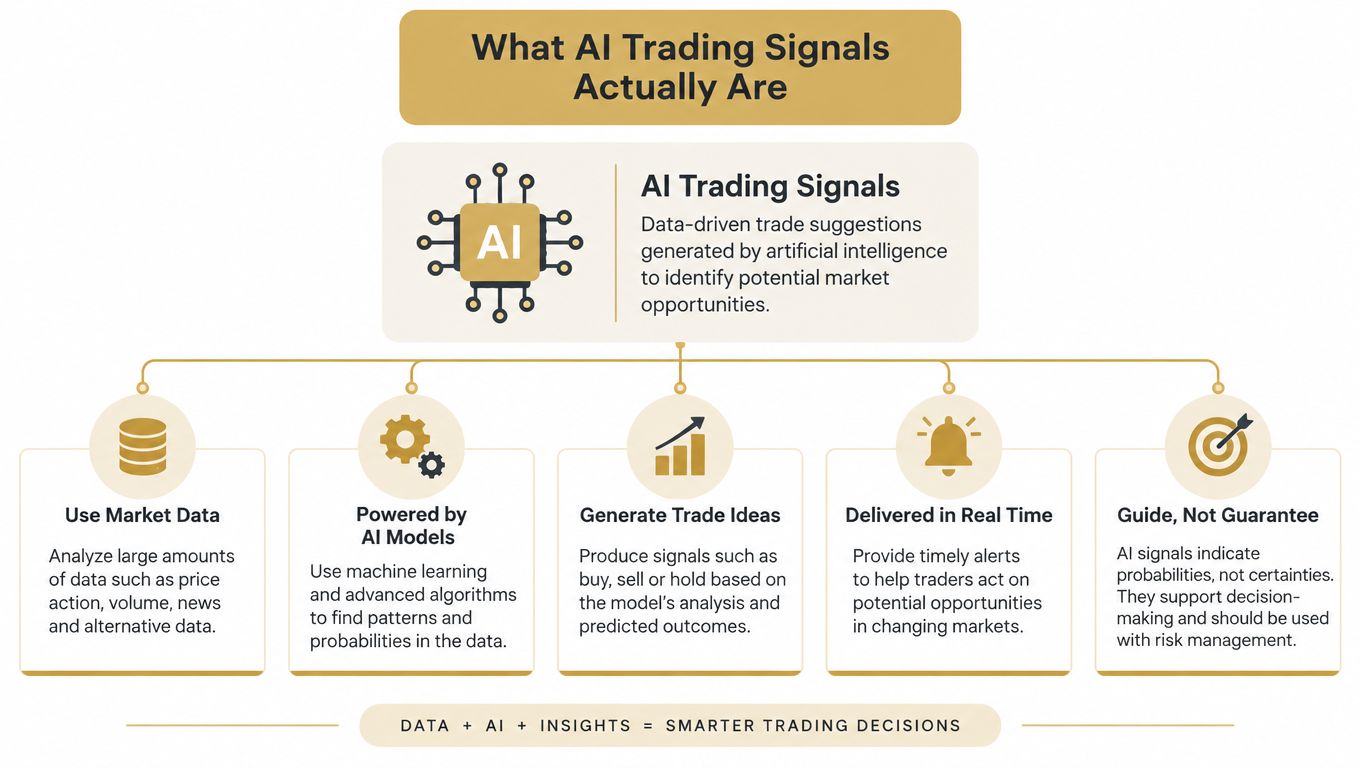
AI trading signals are automated suggestions built from data. They can say buy, sell, or hold, but they don't know the future and they don't care what the marketing page says. The value is in the data, the timing, and the rules wrapped around the signal.
Four common signal families
Most AI systems fall into a few buckets. Some are simple, some are fancy, but they all depend on the same thing, finding patterns that still matter when money is on the line.
- Price-based signals: These read price, volume, volatility, and momentum. They're the closest thing to classic technical trading, just automated.
- Sentiment signals: These scan news, social media, or filings for bullish or bearish tone.
- Alternative-data signals: These use non-market data like on-chain activity, consumer behavior, or other outside information.
- Hybrid signals: These combine several sources and try to score them together.
Each type has a weak spot. Price models can overfit noisy patterns. Sentiment can react late. Alternative data can be sparse or distorted. Hybrid systems can look smarter than they are if the pieces aren't independently validated.
What the model is really doing
A signal engine usually ingests a set of features, scores them, and outputs a probability-weighted decision. The output is not certainty, it's a rough estimate of whether a setup has enough edge to matter after costs. That distinction is the whole game.
For a retail trader, the useful question isn't “Is it AI?” It's “What information was available when the signal fired, and how was it tested?” If you can't answer that cleanly, you're probably buying a story, not a tool. TradeLikeInsiders sample article
Where the label gets abused
The phrase “AI trading signals” gets slapped onto a lot of weak products. Sometimes there's no real model at all, just a rules engine with a fancy name. Other times the system is real, but the seller is hiding the ugly parts, like the fact that the edge dies outside a narrow market window.
The cleanest way to think about it is this, AI doesn't make a bad signal good. It just makes it faster to produce and easier to market.
How to Evaluate AI Signal Effectiveness
Traders waste time on the wrong metric. A glossy return screenshot and a decent win rate tell you almost nothing. A signal has to survive timing, liquidity, turnover, transaction costs, and drawdown, or it is just marketing with a chart attached.
Judge the signal on execution, not hype. You want proof it works out of sample, under realistic fills, and with enough transparency to see what drives the result. If a provider cannot show that, the model may be clever, but the product is still suspect.
What a serious signal card should show
Every signal needs an audit trail. If the provider hides the inputs, the delay, or the trading rules, you cannot judge the output.
- Exact signal time: What was known when the alert fired?
- Publication lag: How long after the event did you receive it?
- Entry and exit rules: What triggers the trade, and what closes it?
- Costs and slippage: What happens after spread and execution friction?
- Liquidity assumptions: Can you trade the size they imply?
- Benchmark and drawdown: What did the signal beat, and at what risk?
That is research. The other version is theater.
Why crowding can break the edge
A Wharton experimental study found that when multiple AI traders enter the same environment, they can inject noise into prices, reduce learning quality, lower profits, and cut market efficiency and liquidity relative to a benchmark. A popular signal can weaken fast once too many users pile in. Wharton study on AI traders and market efficiency
Direct answer: a signal that looks strong in isolation can get weaker once a crowd starts using it.
Test the signal twice, once with immediate results and once with delayed results. If the edge fades when the crowd shows up, the signal is crowded, contaminated, or both.
AI-washing is the scam
FINRA has warned that unregistered automated-trading services may exaggerate AI capabilities, make unsupported profitability claims, highlight winners while omitting losses, or claim that AI can predict markets and control risk automatically. That is AI-washing, selling a weak or ordinary product as if the model itself guarantees returns. FINRA warning on unregistered automated-trading entities
A good provider answers hard questions. A bad one dodges them. Ask about out-of-sample behavior, costs, delay, and the conditions where the signal fails. If the seller will not discuss those points, walk away.
For a consolidated research view, this sample research page on insider-trade alerts shows how congressional trades, insider activity, whale moves, and policy signals can be grouped in one place. That kind of layout makes it easier to judge whether a signal has context or just a catchy label.
Data Sources and Signal Types Compared
Not all signals deserve the same trust. SEC Form 4 insider filings, congressional disclosures, whale tracking, and social sentiment all behave differently, and the delay matters as much as the source. If you blur those differences, you'll end up trading lagged information as if it were fresh.
Signal Type Comparison
| Signal Type | Typical Delay | Abnormal Returns | Key Limitation |
|---|---|---|---|
| SEC Form 4 insider filings | Disclosure lag, then market reaction | Intraday reactions can be positive over short holding periods, but can disappear or turn negative at realistic tradable sizes | Liquidity, market impact, and disclosure latency |
| Congressional stock trades | Weeks of delay, because PTR filings can come later | Typical trades show near-zero abnormal returns around disclosure dates | Lagging information, amounts reported in ranges |
| Whale or institutional moves | Depends on the filing or on-chain source | Can be informative, but tradability depends on size and market depth | Liquidity constraints and crowding |
| Price and volume models | Immediate | Can help with short-term prediction in some regimes | Regime shifts and overfitting |
| Social or news sentiment | Near real-time, but noisy | Useful as context, not a standalone edge | Manipulation, hype, and false signals |
Insider filings are useful, but not free money
AI systems that convert SEC insider filings into alerts need to model execution capacity and disclosure latency, not just the headline reaction. Intraday evidence shows that prompt reactions to insider announcements can look profitable over short horizons, but those gains disappear when each signal is constrained to a realistic tradable dollar amount. Returns are also negatively related to liquidity, which means market impact and spreads can eat the edge fast. SEC Form 4 liquidity and execution study
That's why a decent insider-alert system should track filing time, market cap, dollar volume, spread estimates, insider role, and transaction type. It should also use chronological splits, not random ones, because random testing can leak issuer or regime information.
Congressional trades are slower, so use them differently
Congressional disclosures should be treated as event context and prioritization, not as direct buy signals. The reporting rules under the STOCK Act matter here. Covered individuals report qualifying trades over $1,000 through a Periodic Transaction Report, generally due within 30 days after notification and no later than 45 days after the transaction itself. That delay means the market sees the trade much later than the person made it. CRS guide on STOCK Act reporting deadlines
The other mistake is to confuse disclosure with insight. Reporting a trade doesn't prove the filer had material nonpublic information, and it doesn't prove the trade was smart. For research, congressional activity works best as a prompt to check sector exposure, policy relevance, and whether the underlying legislation moved cash flows. CRS note on STOCK Act and insider-trading law
Whale signals need a reality check
Big holders move size, and size creates friction. A whale alert can be useful if you care about momentum or market structure, but if the underlying asset is thin, the signal may be more interesting than tradable. That's where liquidity-adjusted confidence matters more than raw enthusiasm.
A sharp trader doesn't ask, “What did the whale do?” first. They ask, “Can I get in and out without donating the edge to spreads and slippage?”
Common Pitfalls and Red Flags
AI trading signals fail for boring reasons. The chart looks smart, the pitch sounds technical, and the edge disappears once you check timing, costs, and who is really behind the data. A signal that looks sharp on paper can still be junk in live trading.
Compare the red flags against your actual use case
Start with the vendor, not the marketing copy. If a platform will not explain where the signal comes from, what delays affect it, or how it behaves in weak markets, treat that as a warning.
- Guaranteed-return language: Any claim that a system cannot lose is fantasy.
- Selective win screenshots: A few winners tell you nothing without the losses and the full sample.
- Missing timestamps: If you cannot tell when the signal was first available, the test is useless.
- No trading frictions: Backtests that ignore spreads, slippage, and fees are too clean to trust.
- No failure cases: A serious model has conditions where it underperforms. If the vendor will not show them, assume they exist.
A useful test is simple. Ask for the raw alert time, the execution time, the data inputs, and a plain explanation of what happens when the market moves against the model. Vague answers usually mean the process is hiding something.
High agreement can still mean bad data
Consensus is not proof. If several AI systems point the same way, the crowd may be leaning on the same flawed input, or the market may be reacting to engineered activity rather than genuine demand. That problem shows up fast in thin or hype-driven markets.
If a signal is built on wallet activity, social chatter, or exchange flows, check whether the move is coming from real accumulation or manufactured noise. Compare venues, inspect volume, and see whether the edge survives fees and price impact. If it disappears after those checks, it was never a real edge.
Watch for AI-washing, not just bad math
A polished dashboard does not mean the model is useful. Promoters love technical language, but they often leave out the parts that matter: how the signal was trained, how often it changes, what inputs it depends on, and where it breaks. That omission is the red flag.
Look for five things they avoid saying clearly, because those gaps usually matter more than the pitch:
- the exact source of the signal
- the delay between event and alert
- the costs assumed in testing
- the markets where it failed
- the rules for retiring a weak signal
If a vendor will not answer those points directly, you do not have a signal. You have a sales deck.
Stop asking the wrong question
The wrong question is, “Which AI can predict the next move?” The right one is, “What still works after delay, costs, selection bias, and ugly market regimes?” That question filters out most of the hype.
A platform earns trust when it shows retired signals, paper-trading logs, and separate results for fast and delayed execution. Without that, you are just staring at a polished guess.
Building Your AI Signal Workflow
The cleanest AI signal workflow starts with suspicion. Assume the model is noisy until it proves otherwise. If it cannot survive paper trading, cost checks, and ugly market conditions, it does not deserve real money.
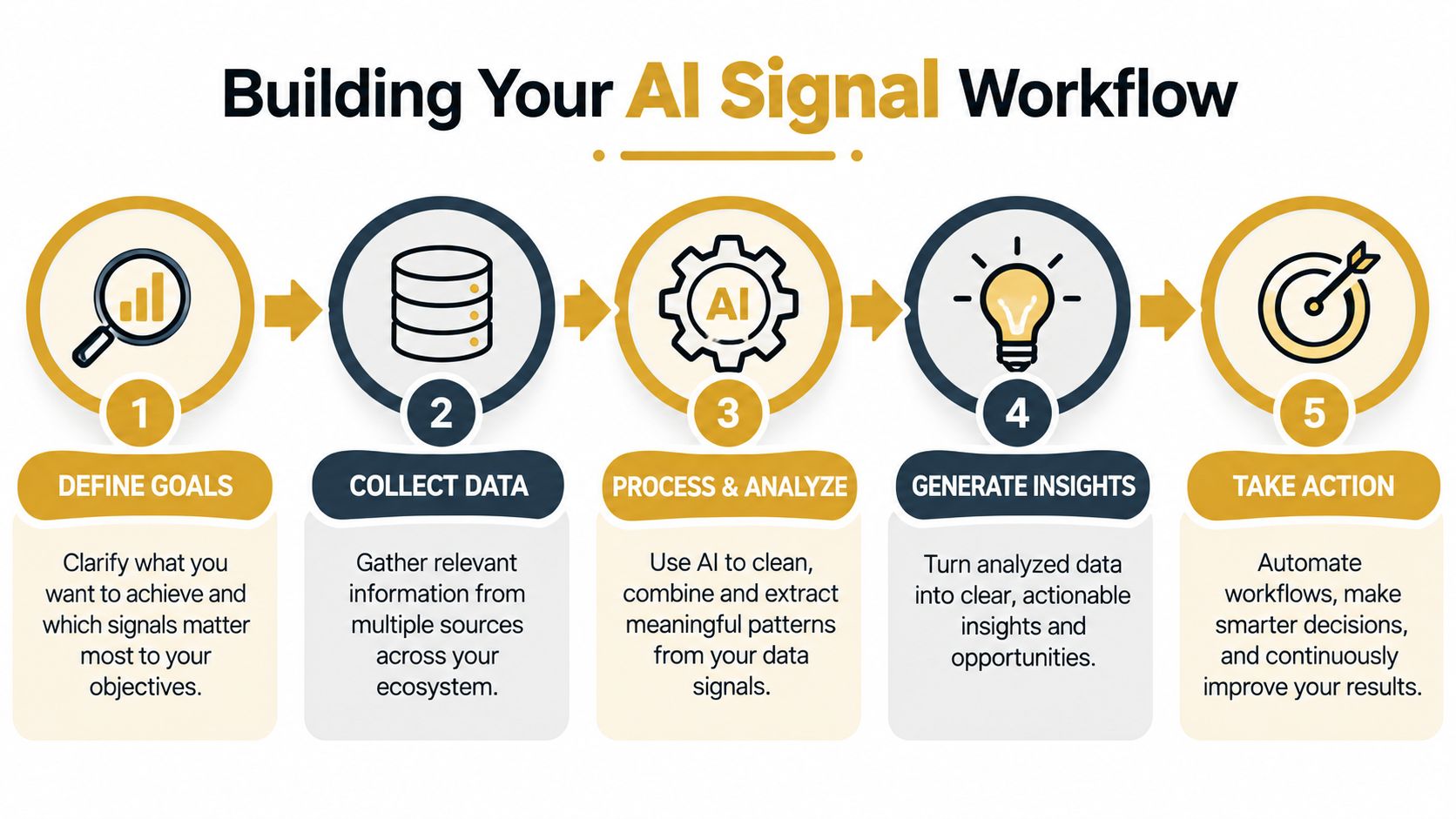
Paper trade first, but do it properly. Log the timestamp, source, trigger, and result for every alert. Then review the signal across different market regimes, because a hot streak in one patch of price action means very little. Size positions to liquidity, not confidence. A signal can look sharp and still be too large for the market you are trading.
Stop worshipping the alert stream
A lot of traders treat fresh alerts like truth. That is lazy. A better workflow separates the idea from the execution, then forces the idea to earn trust before it touches capital.
- Test in simulation before risking cash.
- Record the full trail, including delay and outcome.
- Check whether the edge survives fees and price impact.
- Cut signals that fade, even if they looked good last month.
- Keep sizing conservative until live results match paper results.
That discipline matters more than a clever dashboard. Markets punish sloppy execution faster than they reward smart-looking models.
Use more than one input
Single-source signals break easily. An insider purchase, a congressional disclosure, and a policy shift can point in the same direction, but they should not carry the same weight by default. Cross-checking inputs helps you spot real agreement versus one noisy source dressing itself up as insight.
A research platform like TradeLikeInsiders can help here because it puts congressional trades, insider activity, whale moves, and policy signals in one place. That does not remove judgment. It just gives you a cleaner way to compare signals without jumping between scattered alerts.
Scale only after the signal earns trust
Do not scale because the interface looks smart. Scale because the signal held up under delay, costs, and live conditions. If paper trading looks fine and live execution falls apart, the edge was never real enough to size aggressively.
Keep the machine on idea duty and keep your rules on money duty. That split is boring, but it protects capital.
Practical Takeaways and Next Steps
AI trading signals are tools, not crystal balls. Judge them on timestamped data, delay, costs, and out-of-sample results, not on hype or polished screenshots. Start with paper trading, watch for AI-washing, and remember that delayed disclosures and crowded signals can look smarter than they are. For more research and updates, check the TradeLikeInsiders blog. This content is for informational purposes only and is not financial advice. Do your own research.
HeliosNet LLC runs TradeLikeInsiders, a market research and alerting platform that tracks congressional disclosures, SEC insider filings, whale activity, and policy signals in one place. If you want a cleaner way to evaluate ai trading signals with context instead of hype, visit TradeLikeInsiders and see how the alerts, summaries, and paper-trading tools fit your workflow.