
The most popular advice about an artificial intelligence summary is to read the brief, spot the politician or the insider, and trade the headline before everyone else does. That advice treats a fluent paragraph as a live order ticket. It is not one.
An artificial intelligence summary is a short, machine-written brief that condenses filings into a few sentences. It does not know whether a position is still open, whether a dollar figure is only a range, or whether a bill caused the trade. The public trades on news. Officials and corporate insiders file information that reaches you late, often in bands rather than exact dollars.
I would start by treating every sentence as a claim to audit. Check the date, the filer, the amount band, and any line that tries to explain why. A clean brief is a map back to House disclosures, Senate filings, and SEC EDGAR. A sloppy one can misdate a trade or invent a cause and still sound sure of itself.
Table of Contents
- How an AI Market Summary Gets Built
- Where Each Input Comes From and How Old It Is
- Reading a Congressional Disclosure Without Overreading It
- Insider and Whale Filings Explained Through Form 4 and 13F
- How Policy Changes Reach Sectors and Prices
- Checking an AI Summary Against Its Sources
- Build a Verification Routine Before You Act on Any Summary
How an AI Market Summary Gets Built
An artificial intelligence summary is a short, machine-written brief that condenses several source documents into a few sentences. It does not predict prices. Think of a fast research assistant who reads every filing and must footnote each sentence. Speed is the product. A verdict on the stock is not.
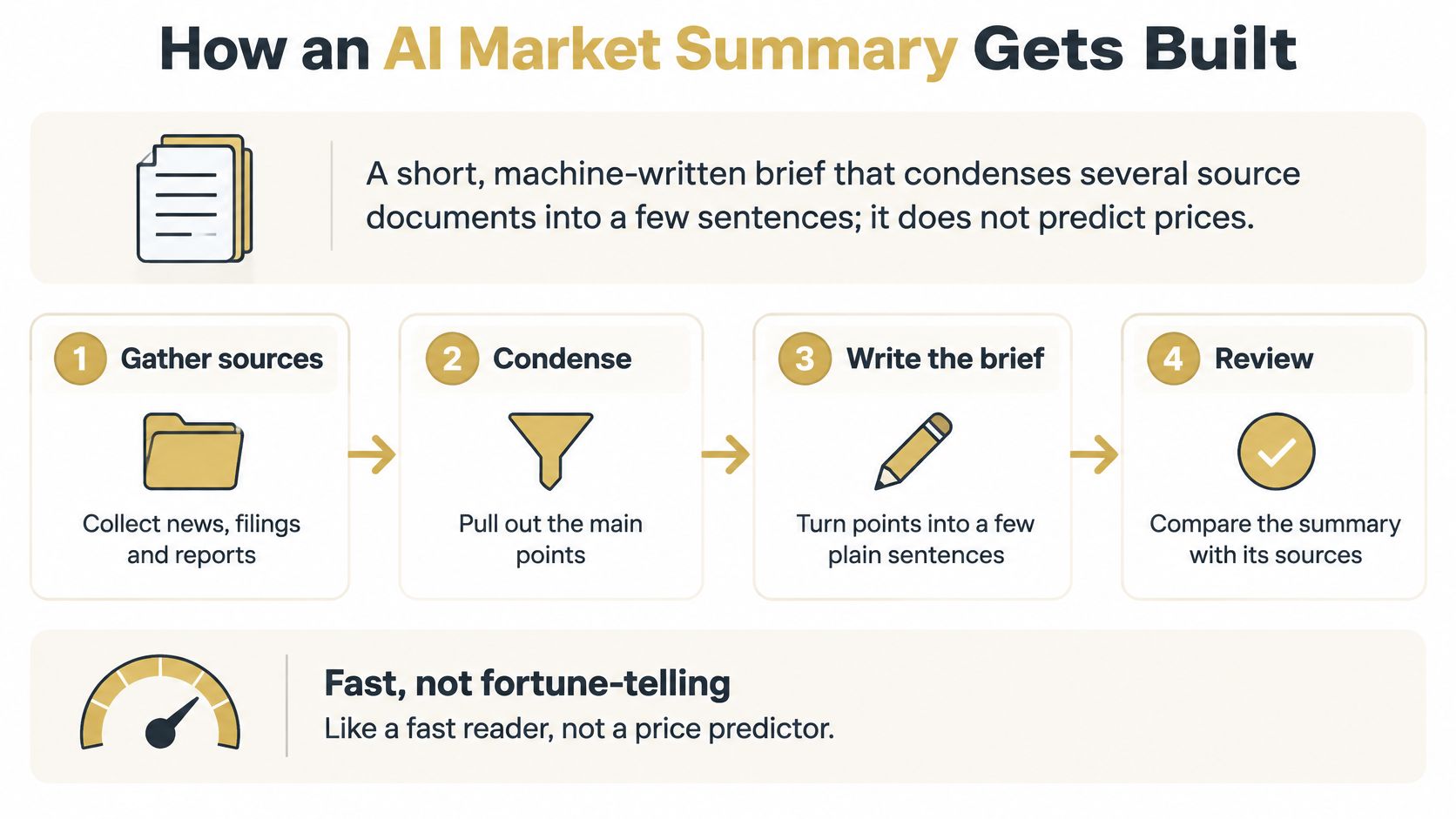
The pipeline, one stage at a time
- Collect dated inputs. Pull congressional periodic transaction reports, SEC Form 4 and Form 13F filings, Federal Register notices, and market prints that carry a publisher timestamp. Undated text does not enter the bundle.
- Normalize the entities. Map issuer, official or insider, transaction type, asset, amount range, and both the trade date and the filing date. Same person, same company, same ticker spelling.
- Retrieve only the tied passages. Keep the source document, the publication timestamp, and the span that mentions those entities. Drop near-duplicate press copies.
- Generate from that bundle alone. The model writes from the retrieved pages, not from a memory of last quarter's headlines.
- Cite each claim, or stay quiet. Every market-impact sentence gets a citation. If the pages do not support a direction, the brief abstains.
What retrieval actually fixes
Retrieval-augmented generation (RAG) conditions the model on retrieved primary documents instead of memory alone. In a controlled dialogue-generation study, retrieval augmentation reduced hallucinated responses by more than 60% relative to standard non-retrieval models, on both automatic and human checks, as described in that retrieval study. Retrieval still fails when the context is irrelevant, incomplete, or contradictory. Filter by metadata before any semantic search, keep document versions, and score citation precision, unsupported claims, and entity or date accuracy. Fluency is the wrong score.
Practical rule: A summary is a map back to sources, not a verdict. If a sentence cannot point at a filing span, drop the sentence.
A correct line can still mislead a trade. Put a weeks-old disclosure next to today's price and the prose reads as current. The timestamps are what stop that trick.
Where Each Input Comes From and How Old It Is
A summary is only as fresh as its oldest input. The prose can be written this morning. The trade inside it may be from last month. A timestamp check matters more than how smooth the paragraph sounds.
Filing deadlines and typical lag by source
| Source | Who files | Filing deadline | Typical lag | Where to check |
|---|---|---|---|---|
| Congressional periodic transaction report (STOCK Act) | Members of Congress and certain staff | Within 30 days of learning of the trade, and no later than 45 days after the trade | Up to 45 days | House Clerk disclosure database and Senate eFD system |
| SEC Form 4 | Corporate officers, directors, and owners of more than 10% of a company's stock | Within two business days of the transaction | Up to two business days | SEC EDGAR |
| SEC Form 13F-HR | Institutional managers holding at least $100 million in qualifying securities | 45 days after calendar quarter end | Up to 45 days after quarter end; positions reflect quarter end | SEC EDGAR |
| Federal Register and agency releases | Federal agencies | Published on the release date | Usually same day | federalregister.gov and the issuing agency's site |
| Market prices | Exchanges, through data providers | Continuous | Seconds to one session, set by the publisher timestamp | Data provider's timestamped feed |
The two lags that fool a chart
A congressional periodic transaction report can be up to 45 days old when you first see it. The clock is not "when the market moved." It is when the filer learned of the trade, with a hard stop 45 days after the transaction date. By the time a dashboard highlights the name, the position may already have been closed, added to, or hedged somewhere the report does not show.
A Form 13F-HR is slower in a different way. Holdings are a snapshot as of quarter end, and the manager has 45 days after that quarter ends to file. You are looking at a book that was already closed before the file hit EDGAR. Shorts are absent. The reason for any change is absent too.
Form 4 is the fast corporate file, due within two business days. Agency releases usually land the same day they are published. Mix those clocks in one paragraph and a 40-day-old congressional trade sits beside today's print as if both happened this afternoon.
Label every claim with its source type and its age. Treat anything without a date as unverified. If the brief will not say how old the input is, I would not use it as a reason to research the name further.
Reading a Congressional Disclosure Without Overreading It
One filing shows a reported transaction in a covered security, above a dollar threshold, on a stated date, by a named filer. That is the whole record. It is not a tip, and it is not proof the official still holds the shares.
Under House Committee on Ethics rules, Members, officers, and certain employees file a Periodic Transaction Report (PTR) for each qualifying purchase, sale, or exchange above $1,000 in reportable securities. The report is due within 30 days after the filer learns of the transaction, and never later than 45 days after the transaction date. Senate STOCK Act filings use that same window. A disclosed trade can already be weeks old. Widely held mutual funds and ETFs are excluded from this transaction-reporting requirement. Amounts arrive as ranges, not as an exact dollar print.
Four checks before you lean on a PTR
- Transaction date versus filing date: Read both. The trade date is when the securities moved. The filing date is when the public could see it. A gap of several weeks is normal, not a hidden signal.
- Asset type: Individual reportable securities are in scope. A widely held fund or ETF that never appears on a PTR was not "hidden." It was outside this particular report.
- Amount range, not a precise figure: The form uses bands. A sentence that turns a band into an exact dollar amount has altered the filing.
- Amendment status: A later PTR can correct an earlier one. Read the latest version before you treat the first headline as final.
What the filing does not prove is the part traders skip. It does not prove the official still holds the position. It does not prove the trade reflects information that is still current. It does not prove a link to any bill, hearing, or committee. Both parties file these reports. The form does not rank motives.
A PTR is a dated record of public exposure, not a live signal. Read the transaction date, the asset, and the threshold before you form a view.
Insider and Whale Filings Explained Through Form 4 and 13F
Form 4 and Form 13F answer different questions. Form 4 is a near-term transaction file from corporate officers, directors, and owners of more than 10% of a company's stock, due within two business days. Form 13F is a quarterly snapshot of long equity holdings from institutional managers with at least $100 million in qualifying securities. One is a trade. The other is a book at quarter end.
Form 4 transaction codes that matter most
| Code | Meaning | How to read it |
|---|---|---|
| P | Open-market purchase | Discretionary buy with the insider's own money; the code most traders watch |
| S | Open-market sale | Can reflect diversification, taxes, or a pre-scheduled plan, not only a view on the company |
| A | Grant or award | Compensation issued by the company; usually not a market decision |
| M | Option or derivative exercise | Converts options into shares; often paired with a sale on the same day |
| F | Shares withheld for taxes | Company-handled tax payment on vesting or exercise; not an open-market trade |
| G | Gift | Transfer with no sale price; check who received the shares |
Code P is watched, and it is still not a thesis
Code P, an open-market purchase, is the line most tape-readers circle. The insider used their own money in the market. That is more informative than a grant. It still does not tell you position size relative to net worth, whether more buys are planned, or whether the shares were sold the next month.
Code S is where fluent summaries go wrong. A sale can be diversification, a tax bill, or a pre-scheduled Rule 10b5-1 plan. The code records an open-market sale. It does not record fear. Code M often sits next to a same-day sale because an exercise created shares that were partly sold. Code F is the company withholding shares for taxes. Calling that an insider dump is a misread of the form. Code G moves shares with no sale price. Look at who received them before you call it distribution.
What the quarterly book leaves out
A 13F shows long positions as of quarter end. It omits shorts. It shows that a holding rose or fell between two quarters and does not say why. A whale here is shorthand for a very large holder, not a buy or sell signal by itself. Clustered adds across several managers are a research prompt. A single line item is a fact about one book on one date.
A code tells you what happened. The reason still needs the filing text, the plan checkbox, and the surrounding quarters. If the summary skips the code and jumps to motive, it has left the document.
How Policy Changes Reach Sectors and Prices
Policy does not hit a stock in one jump. A headline sits at a stage, and the stage is the fact.
A bill is introduced. A committee acts, or it does not. One chamber passes it. Both chambers pass it, and it is signed, or it stalls. Separately, an agency proposes a rule, opens a public comment period, issues a final rule, sets an effective date, and later enforces it. Markets often move at the announcement or the proposal, long before anything takes effect. A useful brief names the stage. "Congress is considering" and "a final rule is effective on a stated date" are different claims.
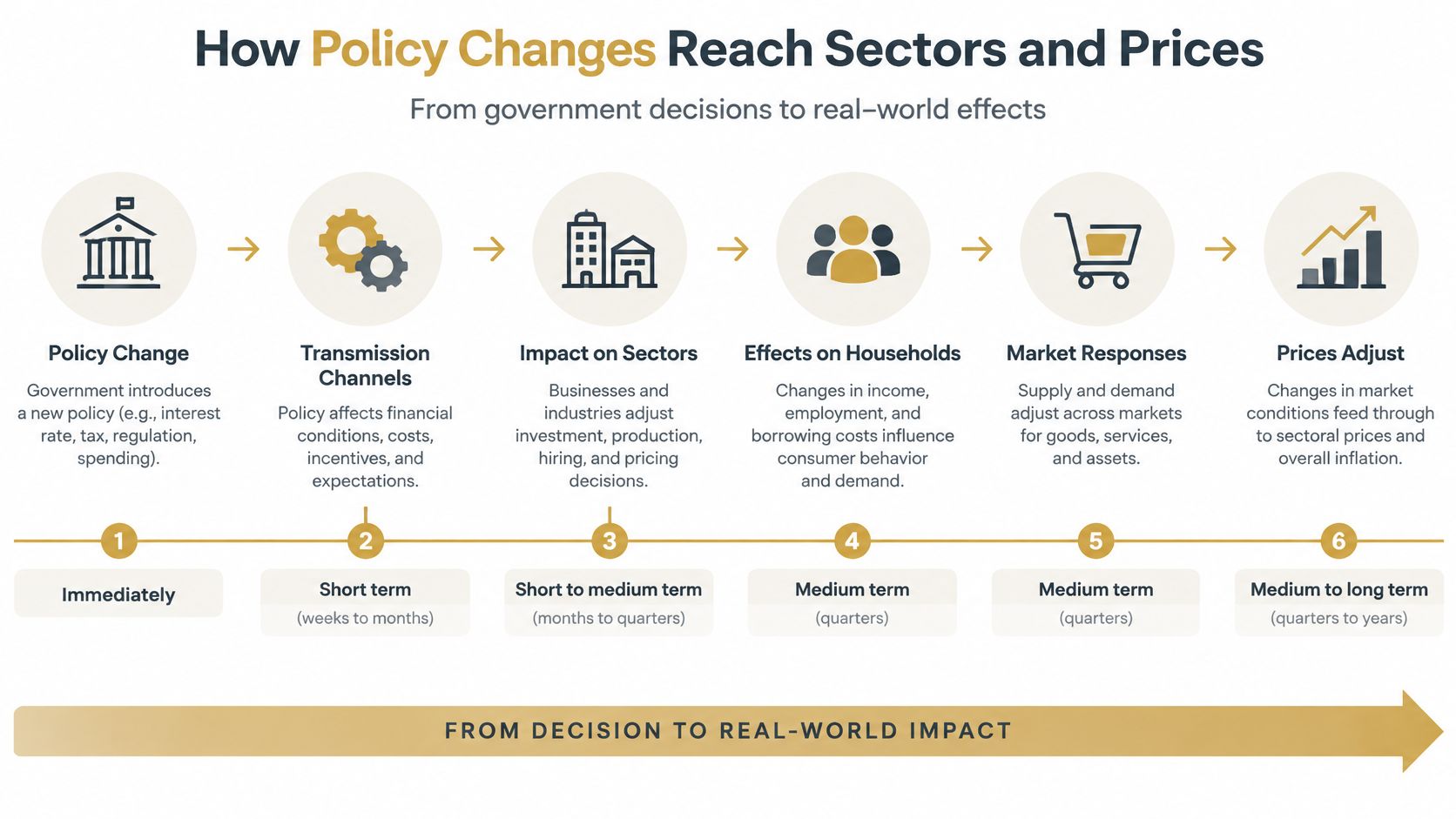
A made-up rule, used only as a drill
Say, as a hypothetical, an agency proposes a rule that would require new reporting from companies in one industry. Nothing in this example is a real filing or a real issuer. The sector effect depends on how much of each company's revenue touches that reporting duty, not on the headline's adjectives.
Map exposure in three lines. Name the affected industry. List the filers inside it that you follow. Estimate the revenue share that would sit under the rule, using the company's own segment disclosure, not a social-media guess. A firm with a thin slice of revenue in that niche is not the same bet as a firm that lives there. Comment periods change text. Final rules slip. Enforcement can be narrow.
Policy shocks come from both parties and across administrations. Describe the impact on the exposed group. Skip the personalities. A sound sentence is a conditional: if this proposal becomes a final rule, these filers with this kind of revenue mix face a new reporting cost. Until the stage changes, that conditional is the whole claim.
Checking an AI Summary Against Its Sources
The most common failure is a fluent sentence that swaps a name, a date, or a cause and still reads clean. You can audit that class of error yourself, without trusting a second model to grade the first one.

An AI checker is not automatically reliable either. FaithBench, a human-annotated set of challenging hallucinations from 10 modern LLMs across eight model families, found that even the strongest detection systems reached nearly 50% accuracy. Coin-flip territory. So pair deterministic tests with a person. Match dates, tickers, amounts, names, and quoted spans against the source. Separate plain extraction from any sentence that predicts a move. Benchmarks such as RAGTruth exist for span-level review, so you can name the error type instead of waving at "the model was off."
Common summary errors and how to verify each
| Error type | What it looks like | How to verify |
|---|---|---|
| Entity substitution | A different name, company, or official appears than in the filing | Compare every named party against the filer and issuer fields |
| Incorrect date order | A filing is described before the trade it reports, or a filing age is wrong | Compare the transaction date, filing date, and publication timestamp |
| Numerical alteration | An amount range or share count is changed or rounded | Match the exact range text and share count in the source |
| Polarity reversal | A purchase is described as a sale, or the reverse | Check the transaction code and the buy or sell field |
| Unsupported causal claim | A trade is said to be caused by a bill or event with no source | Require a source span that states the cause, or treat the claim as unverified |
| Conflated sources | One filing's details are attached to another filer or issuer | Check the filer identity and filing ID against the original record |
Run four passes over each brief. Compare names, dates, and amounts with the source text. Require a source span for every causal claim. Check whether the filing was amended after publication. Then stress-test the pipeline itself: feed it a contradictory pair of filings or a file with a missing timestamp. If it still produces a confident direction, it is guessing, and every summary downstream inherits the guess.
Zero tolerance for altered numbers or names in a plain extraction summary. A rounded range is a different fact.
Sample after you ship the workflow. Filings get amended, tickers collide, and model behavior shifts with each update. A one-time spot check will not catch next month's miss.
A short walk-through of reading a primary filing beside a generated brief is worth ten minutes before you build the habit.
Build a Verification Routine Before You Act on Any Summary
Before you rely on any brief, run the same four steps. They take less time than unwinding a bad read.
- Open the primary source behind each claim. That means the EDGAR filing, the House or Senate disclosure, or the agency release, not a recap of the recap.
- Check the date fields and the age of each input against today. Trade date, filing date, and publication time are three different facts.
- Confirm the wording. Names, amount bands, share counts, and transaction type must match the form, including the error types in the table above.
- Ask what would prove the summary wrong. If the brief cannot state a fact that would kill the claim, it is commentary.
Then decide. The signal is either strong enough to research further or weak enough to drop. That call is yours, and it has to fit your own risk limits. Nothing here is a recommendation to buy or sell a security.
TradeLikeInsiders at tradelikeinsiders.com offers educational AI analysis and tracks congressional trades, insider activity, whale moves, and policy signals in one place, with source timestamps on the inputs.
This content is for informational purposes only and is not financial advice. Do your own research.
HeliosNet LLC builds TradeLikeInsiders so you can read delayed congressional disclosures, SEC insider filings, large-holder activity, and selected policy updates without treating a generated paragraph as a live trade. The educational summaries sit on timestamped sources, which is the audit habit this piece is about. If you want that workflow in one place, visit TradeLikeInsiders.