The public trades on news. Insiders trade on information. But the popular advice to find the smartest AI and copy its picks skips the harder question: What information did it use, and when did that information become public?
Politicians disclose covered transactions through STOCK Act filings. Corporate officers report ownership changes on SEC Form 4. Institutions disclose certain holdings through Form 13F. These are public records, not a secret trading feed, and none gives you a complete picture of someone's current portfolio.
Congressional disclosures can arrive up to 45 days after a transaction, subject to an earlier deadline after the filer learns of it, according to House financial disclosure guidance. Congressional transaction amounts also appear in ranges, not exact allocations. An app that turns those records into a supposedly real-time copy-trading service is selling false precision.
The best AI trading app should help you inspect evidence, understand delays, and test an idea before risking money. These seven picks are assessed through that insider-signal lens, alongside research quality, usability, pricing, and risk controls. This is educational guidance, not a set of trade recommendations.
Table of Contents
- 1. HeliosNet LLC
- 2. TrendSpider
- 3. Public
- 4. Kavout
- 5. Trade Ideas
- 6. Composer
- 7. Danelfin
- The 7 Best AI Trading Apps at a Glance
- Pick the Signal You Actually Want to Follow
1. HeliosNet LLC
Best fit for research connecting public disclosures, insider activity, whale flows, and policy.
Our TradeLikeInsiders platform brings STOCK Act congressional disclosures, SEC Form 4 insider filings, on-chain whale activity, and selected policy updates into one research workspace. We offer educational AI analysis and a paper-trading simulator, not access to undisclosed transactions.
The practical advantage is consolidation. Instead of treating a congressional filing, an executive transaction, and a regulatory announcement as unrelated headlines, you can investigate whether they support a coherent thesis. Our congressional and insider disclosures are delayed, so the transaction timestamp and publication timestamp matter more than how fresh an alert looks.
What You Get and Where to Be Skeptical
The Live Signal Engine and Smart Alerts Center organize activity around members, committees, and influential traders. AI summaries, confidence cues, AI Market Read, and citation-backed Q&A help explain why an event might matter to stocks or crypto.
Those explanations are useful starting points, but confidence isn't a probability of profit. Open the underlying disclosure and distinguish a reported fact from the model's interpretation.
- Research controls: Plain English, Basics, and Experienced display modes adjust the presentation, while watchlist syncing supports ongoing monitoring.
- Practice tools: Simulated trading, order journaling, and performance history let you examine decisions without using live money.
- Listed pricing: The publisher lists free access, Pro at $9.99/month, and Elite at $19.99/month, with priority trackers and predictive features gated by plan.
- Market-data limits: External-provider snapshots carry timestamps and aren't streaming execution prices.
For institutional research, don't confuse an on-chain transfer with a disclosed securities position. A wallet movement and a Form 13F holding answer different questions and need different context.
Practical rule: Use the alert to decide what deserves investigation, not what deserves an order.
The trade-off is straightforward: this is a disclosure-led research platform, not a substitute for execution software or independently checked market prices. No customer testimonials, awards, or certifications underpin this assessment.
This content is for informational purposes only and is not financial advice. Do your own research.
2. TrendSpider
TrendSpider fits traders who already think in charts but want event context beside them. Its value isn't just explaining a filing. It's helping you turn a research idea into a scan, alert, or testable trading condition.
TrendSpider combines charting, market scanning, strategy testing, and Sidekick AI. Sidekick supports chart analysis and the creation of scans, indicators, and alerts. Government-trading data, insider activity, and unusual options flow add context beyond price patterns.
A Disclosure Is Context, Not an Entry Rule
Say an insider purchase attracts your attention. Rather than acting on the headline, you could investigate the filing, examine the chart, and test a condition involving price and volume. That's a more defensible workflow than asking an assistant whether the stock will rise.
- What works: Technical analysis and event-driven information sit together, reducing the need to switch between disconnected tools.
- What takes work: Scanning, backtesting, forward testing, and automated bots create a learning curve. Some real-time feeds and higher-capacity tools cost extra.
- What to verify: A backtest must use information available at the time. Assigning a disclosure to its transaction date rather than its publication date can make a historical strategy look artificially strong.
Web, desktop, iOS, and Android access support different workflows, but platform breadth doesn't establish thorough congressional, institutional, or policy coverage. Verify the particular dataset you intend to trade around.
For policy context, the disclosure-focused research blog can complement chart work. Keep the original filing as the factual reference.
Choose TrendSpider for charting plus event context, not for an assumption that AI or a favorable backtest can validate a live strategy.
This content is for informational purposes only and is not financial advice. Do your own research.
3. Public
Public is the convenient choice when you want AI research close to your brokerage account. That convenience also creates its main risk: the distance between an interesting explanation and a live order becomes very short.
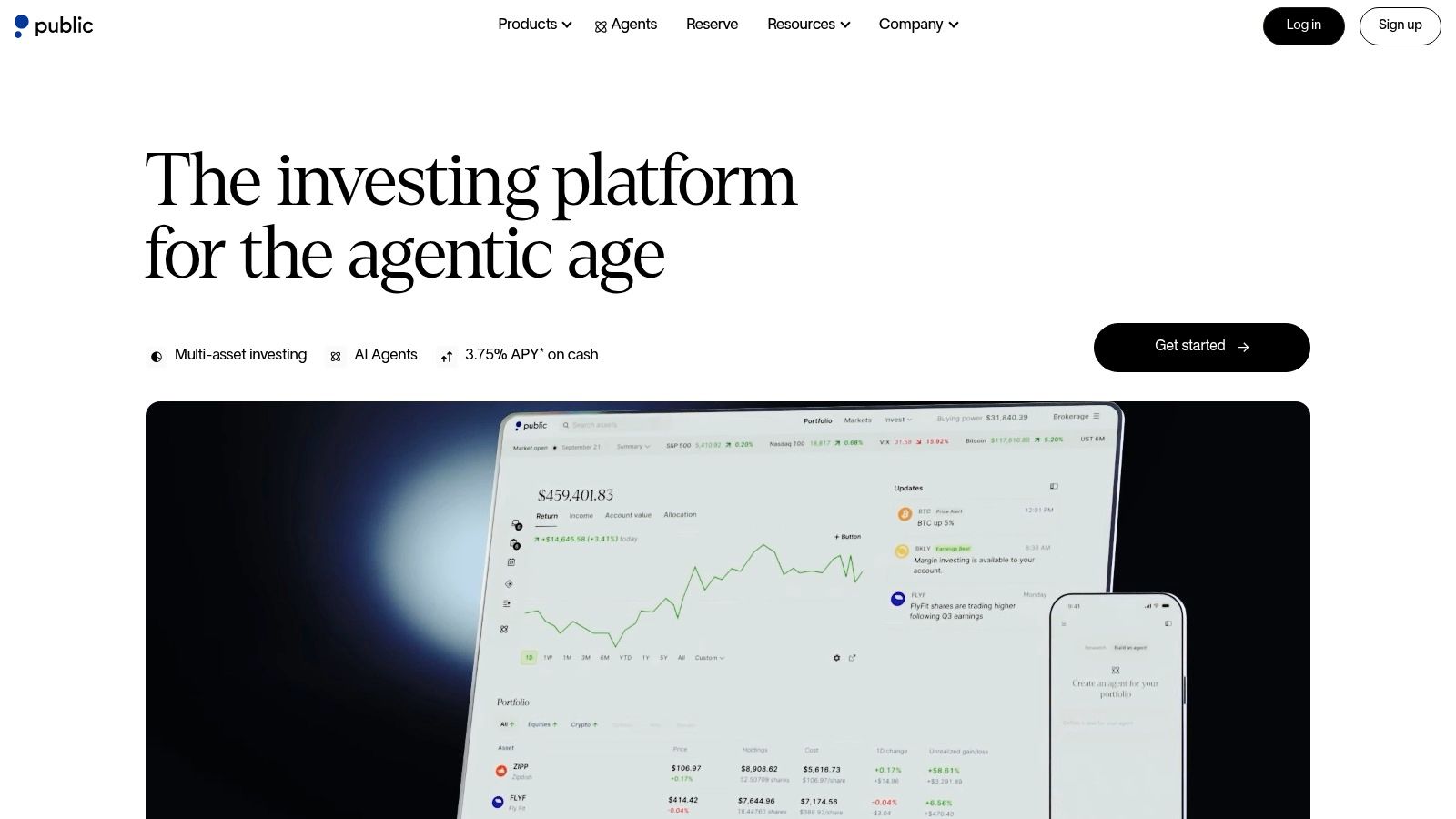
Public offers Alpha, an AI research assistant for exploring filings, earnings materials, historical information, and sentiment. According to the company, Alpha is included at no additional charge for Public investors, though its responses are experimental and may be inaccurate.
Keep Research and Permission Separate
Public also offers AI-agent features built from user instructions, with review and approval before activation. Brokerage access includes stocks, ETFs, options, and crypto, subject to availability and eligibility.
Plain-language instructions are approachable, but they aren't automatically precise. A request to monitor insider activity still needs definitions for eligible transactions, publication timing, position limits, and actions the agent may take.
An assistant explaining a filing and an agent acting on your account need different levels of trust.
That distinction matters beyond this platform. In Betterment's 2025 retail survey, 53% of respondents used generative AI for financial purposes at least monthly, but only 26% would let it manage investments.
Public isn't specialized for congressional disclosures or policy-to-ticker analysis. Use Alpha to investigate company context, then verify any cited House or Senate disclosure, Form 4, or institutional filing separately.
The trade-off: integrated research and execution are convenient, but users remain responsible for checking agent rules, account permissions, and applicable trading costs. Don't mistake an included assistant for a complete insider-research service.
This content is for informational purposes only and is not financial advice. Do your own research.
4. Kavout
A congressional transaction tells you someone reported an action. It doesn't tell you whether the business is attractive at today's price. Kavout is useful when you want to place that event beside broader stock research.
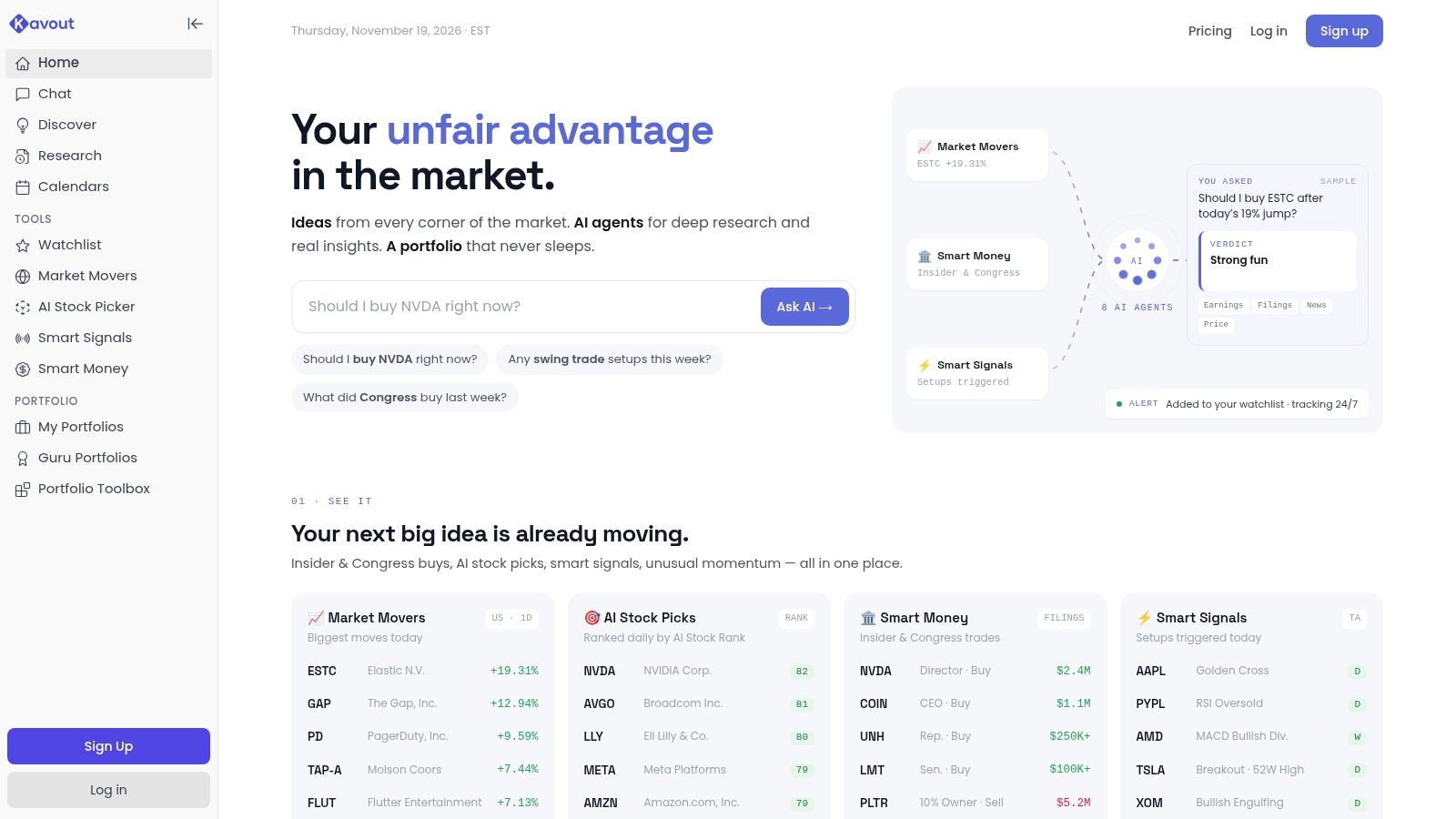
Kavout combines AI research agents, market signals, stock rankings, and investment tools. Its Kai Score ranks stocks from 1 to 9, drawing on fundamentals, technical indicators, and market sentiment, according to the platform.
Use Rankings to Narrow the Investigation
Kavout's stated research includes insider trades and congressional transactions, with coverage spanning stocks, ETFs, crypto, and forex. That makes it relevant to investors who want multiple inputs rather than a single disclosure feed.
- Strong use case: Screen for candidates, then ask natural-language research questions about the businesses and events behind them.
- Important limit: A composite score doesn't explain a politician's motive, establish an insider's intent, or prove that an institution still holds a position.
- Pricing trade-off: A free tier supports initial exploration, while more complete research and coverage require a paid plan.
For Form 4 research, inspect the transaction code and footnotes. An open-market purchase, an option exercise, a gift, and a tax-related sale aren't interchangeable evidence of conviction.
Likewise, don't interpret a favorable stock ranking as a policy-impact assessment. A regulatory change may help a company's suppliers while increasing its own costs, and the share price may already reflect expectations.
Kavout fits screening and research better than hands-off execution. Its congressional and insider coverage is relevant, but assess source accessibility, disclosure timestamps, and institutional coverage before treating it as your primary event-research tool.
This content is for informational purposes only and is not financial advice. Do your own research.
5. Trade Ideas
Trade Ideas is built for active stock scanning, not for reconstructing a policymaker's portfolio. Choose it when your problem is finding and testing intraday setups after you've established the event context.
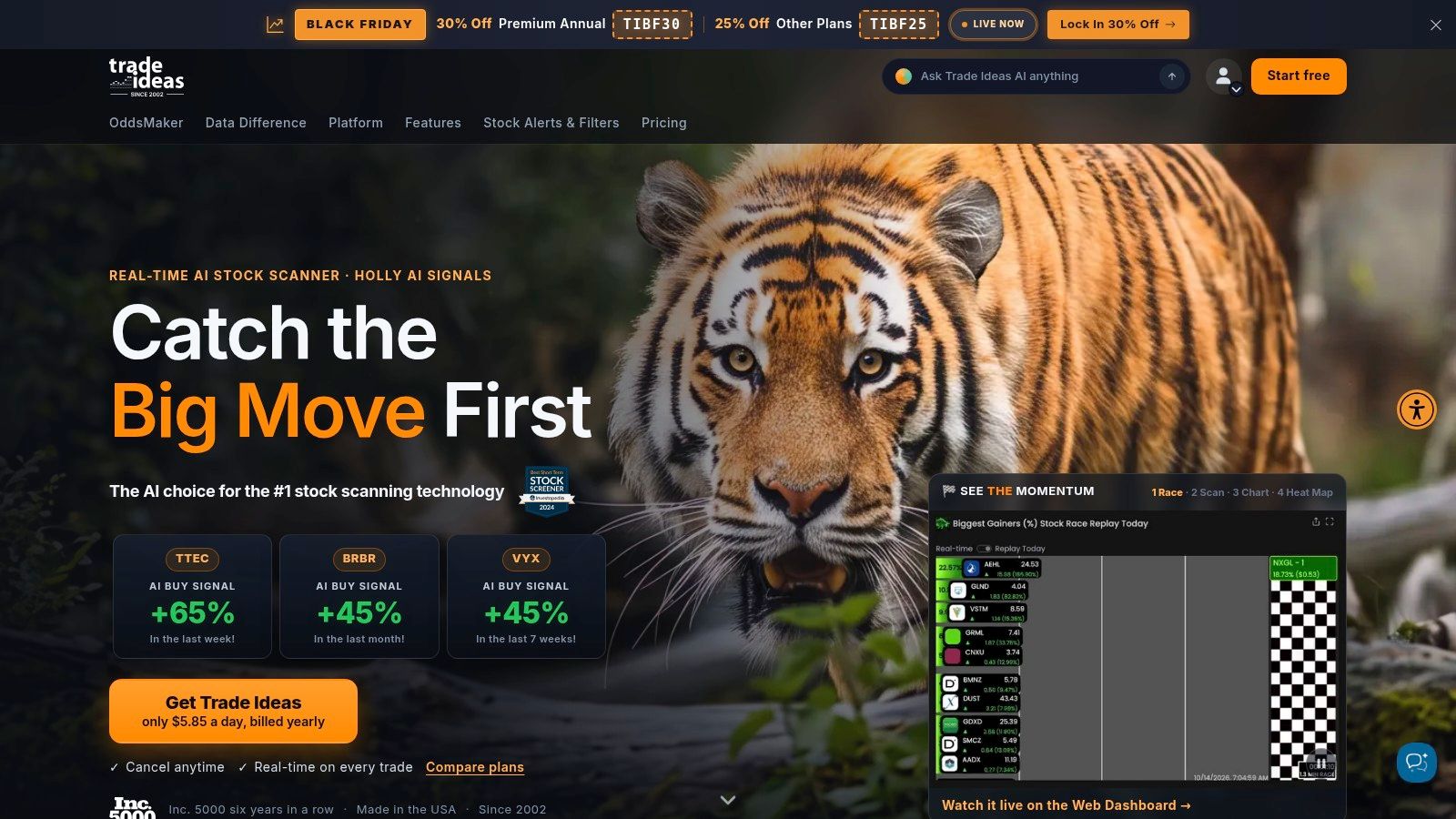
Trade Ideas provides real-time scans, alerts, and Top Lists. Its AI Assistant turns plain-language requests into scans and alert windows, while Premium adds Holly AI signals, suggested risk levels, and setup-testing tools.
Fast Scans Don't Make Old Disclosures Fresh
A newly published filing may be worth researching, but the reported transaction still happened earlier. Trade Ideas can help investigate present market behavior; it can't remove the delay embedded in the original information.
Paper trading and OddsMaker backtesting support evaluation before live execution. Test whether your setup remains plausible after spreads, trading costs, and slippage, meaning the difference between an expected price and the actual execution price.
Execution check: A simulated fill isn't proof that your live order would receive the same price.
The platform's strength is also its limitation. It focuses primarily on stock trading rather than congressional records, policy interpretation, or crypto flows, and beginners may find its breadth demanding. Premium adds capabilities at a higher price, so identify the exact feature you need before upgrading.
Historical evidence supports restraint: the Investing.com discussion of Barber and Odean's study reports that the most active households earned 11.4% annually versus 17.9% for the market in the studied sample.
Keep your event-research reading separate from execution rules. More alerts aren't an advantage if they encourage unnecessary turnover.
This content is for informational purposes only and is not financial advice. Do your own research.
6. Composer
Composer suits traders who can explain their rules before asking software to execute them. If your thesis can't be translated into clear conditions, automation will make the ambiguity harder to manage.
Composer combines brokerage access, no-code strategy building, backtesting, and automated execution. Its Trade with AI tools help turn ideas into structured workflows, with strategy saving, sharing, and portfolio-building features.
Automate the Process You Understand
Composer's free Starter plan allows users to automate an initial strategy and build and backtest strategies. That's useful for learning how rules behave without beginning with a programming project.
Its insider-signal limitation is important: Composer isn't primarily a congressional-disclosure, Form 4, institutional-filings, or crypto-flow monitor. Don't assume an AI-generated strategy can access and correctly interpret every external event you describe.
- Define the input: Specify whether a condition uses a published disclosure, a price indicator, or a manually researched decision.
- Define the response: State allocation rules, exit conditions, and circumstances that should pause execution.
- Inspect the test: Check data availability, transaction assumptions, and whether the strategy depends on a narrow historical environment.
For institutional signals, Form 13F is a holdings report, not a live order feed. Comparing additions, reductions, and concentration can support research, but the filing doesn't reveal a manager's complete exposure or establish what they own now.
Composer's advantage is repeatability, not superior access to insider information. It can help apply understood rules consistently, but automation can magnify mistakes as easily as it reduces repetitive work. Review the generated logic rather than approving it because the explanation sounds confident.
This content is for informational purposes only and is not financial advice. Do your own research.
7. Danelfin
Danelfin is the simpler research option for investors who prefer rankings to a sprawling trading terminal. It's primarily an idea-generation and analysis product, not a brokerage or autonomous trading bot.
Danelfin analyzes stocks and ETFs using AI Scores informed by technical, fundamental, and sentiment information. Paid plans add features including AI price forecasts, trade-idea lists, portfolio tools, and automatic syncing with eligible U.S. brokerage accounts.
A Score Can't Replace the Filing
Its free plan provides limited access, making it possible to assess the presentation before paying. The main trade-off is that broader rankings, forecasts, and useful portfolio features sit behind paid plans.
For an insider-focused investor, Danelfin works better as a second opinion than as the original source of an event. A score may help prioritize research, but it doesn't establish whether congressional activity, an executive purchase, or an institutional position reflects an actionable opportunity.
- Useful pairing: Start with a verified public filing, then inspect the company's broader technical and fundamental picture.
- Coverage boundary: Don't assume stock and ETF rankings include direct crypto execution, congressional tracking, or policy analysis.
- Model boundary: A forecast is an estimate. It isn't evidence that a disclosed trader had the same thesis.
Ask what would invalidate the model's interpretation. A policy proposal might stall, a company might have offsetting exposures, or investors might already have anticipated the announcement.
Danelfin is a reasonable fit when you want digestible research and portfolio monitoring, not research-plus-brokerage execution. Public fills the integrated brokerage role more directly; Danelfin helps evaluate ideas before you act elsewhere.
Keep the distinction clear: a ranking answers how a model assesses a security, while a filing records a reported event. Neither alone explains what you should do next.
This content is for informational purposes only and is not financial advice. Do your own research.
The 7 Best AI Trading Apps at a Glance
| Item | Best for | Signal focus | Pricing / free tier | Paper trading |
|---|---|---|---|---|
| HeliosNet LLC | Researching disclosure-driven trade ideas | Congressional trades, SEC insider filings, whale activity, policy updates | Free tier; Pro $9.99/month; Elite $19.99/month | Yes; simulated portfolio with $100,000 starting balance |
| TrendSpider | Active traders combining chart analysis and scanning | Technical analysis, government and insider activity, unusual options flow | Pricing details not provided | Forward testing available; paper trading not specified |
| Public | Combining AI research with brokerage access | Filings, earnings, historical data, and sentiment | Alpha included at no additional charge for Public investors | Not specified |
| Kavout | AI-assisted stock ranking and multi-market research | Kai Score, fundamentals, technicals, sentiment, insider and congressional trades | Limited free tier; paid plans add research and coverage | Not specified |
| Trade Ideas | Active stock scanning and strategy testing | Real-time stock scans, alerts, and Holly AI signals | AI Assistant included across listed plans; exact prices not provided | Yes |
| Composer | Building and automating rules-based strategies | AI-assisted strategy discovery, backtesting, and execution | Free Starter plan with strategy building, backtesting, and first strategy automation | Backtesting available; paper trading not specified |
| Danelfin | AI-ranked stock and ETF research | Technical, fundamental, and sentiment signals | Limited free plan; paid plans add forecasts and portfolio tools | Not specified |
Pick the Signal You Actually Want to Follow
The best AI trading app isn't necessarily the one with the most automation. It's the one that solves your research problem without hiding the evidence or encouraging decisions you can't explain.
For government-to-market research, a disclosure-focused platform such as ours is the closer fit. For charts alongside event context, choose TrendSpider. Public combines research and brokerage access, while Danelfin provides rankings and portfolio research rather than direct execution.
Match the Tool to the Decision
- Government and insider signals: Prioritize original filings, separate transaction and publication dates, and clear explanations of reported amount ranges.
- Broader screening: Consider Kavout when you want congressional and insider research alongside multi-factor rankings.
- Rules-based automation: Consider Composer when you can define and evaluate the strategy's conditions.
- Intraday scanning: Consider Trade Ideas when your main task is monitoring current stock-market setups.
Before relying on any alert, verify its timing through the House and Senate financial disclosure portals or SEC EDGAR. Read the underlying Form 4 or Form 13F rather than stopping at an AI summary. Apply the same standards to officials from both parties.
Policy research needs another layer. Separate the announcement, legislative or regulatory action, effective date, and likely company impact. Then ask who benefits, who bears the costs, and whether investors already anticipated the change.
Treat every AI signal as a research starting point, never an automatic trade trigger.
Practice in paper-trading modes where available, and journal the original evidence, your interpretation, and what would disprove it. Include fees and realistic execution assumptions when assessing simulated outcomes.
Don't pay for several overlapping subscriptions before identifying a concrete gap. Start with the workflow you need, such as checking congressional disclosures or comparing institutional holdings, and evaluate whether the app makes that work clearer and more disciplined. An attractive forecast isn't enough.
This content is for informational purposes only and is not financial advice. Do your own research.
HeliosNet LLC offers educational AI analysis of delayed congressional disclosures, SEC insider filings, whale flows, and selected policy signals, alongside simulated trading practice. Visit TradeLikeInsiders to explore the research tools and test a disclosure-led workflow before putting live money at risk. This content is for informational purposes only and is not financial advice. Do your own research.