
Picking the simulator your broker offers is convenient. It isn't automatically good practice. You can learn where the buy button sits and still be unprepared for real fills, the prices at which orders execute, or slippage, the difference between your expected price and your execution price.
The best paper trading platform depends on the question you're testing. Learning an order ticket, rehearsing an options strategy, and investigating congressional disclosures are different jobs. A polished chart doesn't make a simulator equally useful for all of them.
People often say the public trades on news while insiders trade on information. That's a useful reminder to investigate context, not a reason to assume every disclosed transaction predicts the next move. Public filings tell you something happened, but interpreting what it means takes work.
A useful simulator should help you test what you could have known and done at the time, not what looks obvious afterward.
For signal-driven practice, you need the original disclosure, its publication timestamp, a plausible entry, and a record of why you acted. You also need to tolerate a dull or losing stretch without resetting the account and erasing the evidence.
These options serve different purposes. Each gets the same checks: simulation fidelity, asset coverage, account requirements, and journaling. The strongest choice is the one that helps you answer your actual trading question.
Table of Contents
- 1. Congress & Insider Trading Signals
- 2. TradingView Paper Trading
- 3. thinkorswim paperMoney by Charles Schwab
- 4. Webull paperTrade
- 5. moomoo Paper Trading
- 6. Interactive Brokers Paper Trading
- 7. Wall Street Survivor
- Paper Trading Platforms Side by Side
- Match the Simulator to the Question You Are Testing
1. Congress & Insider Trading Signals
Best for connecting public signals to a documented trading idea. TradeLikeInsiders combines congressional disclosures, SEC insider filings, crypto-whale activity, and selected policy updates with an educational paper-trading terminal.
Our advantage is the connection between research and practice. You can investigate a disclosure, use educational AI analysis to understand its context, record a simulated order, and review performance without committing live funds. Plain English, Basics, and Experienced presentation modes let users adjust the explanation rather than struggle through unfamiliar terminology.
The signal research platform organizes activity around influential actors, committees, and market themes. Alerts and AI summaries help narrow the reading list, but the underlying filing remains the evidence.
Separate the Transaction From Its Publication
Congressional activity isn't a live trade feed. The Congressional Research Service's STOCK Act explanation describes disclosure requirements for covered transactions exceeding $1,000, generally no later than 45 days after the transaction; reported amounts appear in ranges rather than exact position sizes.
That changes the practice question. You're testing a response to a public disclosure, not copying an official's original entry. Use House or Senate financial disclosures to verify the report, and apply the same standards regardless of party.
Corporate filings need a different interpretation. Under the SEC's Form 4 instructions, the form generally must be filed before the end of the second business day after execution. Read transaction codes and footnotes through SEC EDGAR to distinguish open-market purchases from compensation, option exercises, or tax-related transactions.
- Fidelity: Timestamped sources distinguish reported events from current market activity. Our market snapshots use publisher timestamps rather than streaming prices, so don't treat them as executable quotes.
- Asset coverage: Research spans congressional securities disclosures, corporate insider activity, and on-chain whale flows. Research coverage doesn't establish that every referenced instrument is supported by the paper terminal.
- Account requirements: No live funds are required for simulated trading. Research and analysis access varies by plan.
- Journaling: Built-in order journaling and performance history support reviewing the thesis alongside the outcome.
The trade-off: Consolidated research saves navigation, but delayed disclosures and AI interpretation still require verification. A policy proposal also isn't an enacted law, so record which legislative or regulatory milestone your thesis depends on.
Use TradeLikeInsiders when you want signal discovery and educational practice together, not when you need proof of live execution quality.
2. TradingView Paper Trading
A filing gives you a reason to investigate. TradingView gives you a chart-based workspace for rehearsing the response. It's a strong fit when your question is whether a public catalyst aligns with a defined entry, stop, and exit.

TradingView Paper Trading sits inside Supercharts. You can place market, limit, and stop orders from charts, an order ticket, or the depth-of-market interface, which displays buy and sell interest at different prices. Stop-loss and take-profit settings help turn an opinion into an explicit plan.
Its strength is visual consistency. You can investigate a policy-sensitive sector, mark the price conditions that would support your idea, and practice waiting instead of treating every alert as an instruction.
- Fidelity: Simulated orders and positions update with the platform's data, but fills don't establish that enough real buyers or sellers were available.
- Asset coverage: Practice spans markets such as stocks, forex, crypto, commodities, and index futures.
- Account requirements: The simulator is free without a brokerage deposit. Free-plan restrictions still apply to some charting features.
- Journaling: Use order and position history for execution records, then maintain a separate thesis journal for filing context and decision rules.
Keep Replay Separate From Evidence
Historical Bar Replay is useful for practicing decisions without watching the entire session unfold. It isn't permission to enter before the information became public. Mark the disclosure's publication time before judging any historical opportunity.
TradingView also runs virtual trading competitions, but competition results answer a different question from disciplined strategy testing. A leaderboard can encourage positions you wouldn't otherwise take.
My recommendation: Choose it for chart-led practice across markets. Pair it with original filings and a consistent journal, using the market-research blog for educational context rather than as a substitute for primary documents.
3. thinkorswim paperMoney by Charles Schwab
thinkorswim paperMoney is better suited to learning an advanced trading workflow than finding a simple starting screen. That complexity is useful if you intend to practice options, futures, or detailed position analysis. It's unnecessary friction if you only want to record a stock idea.
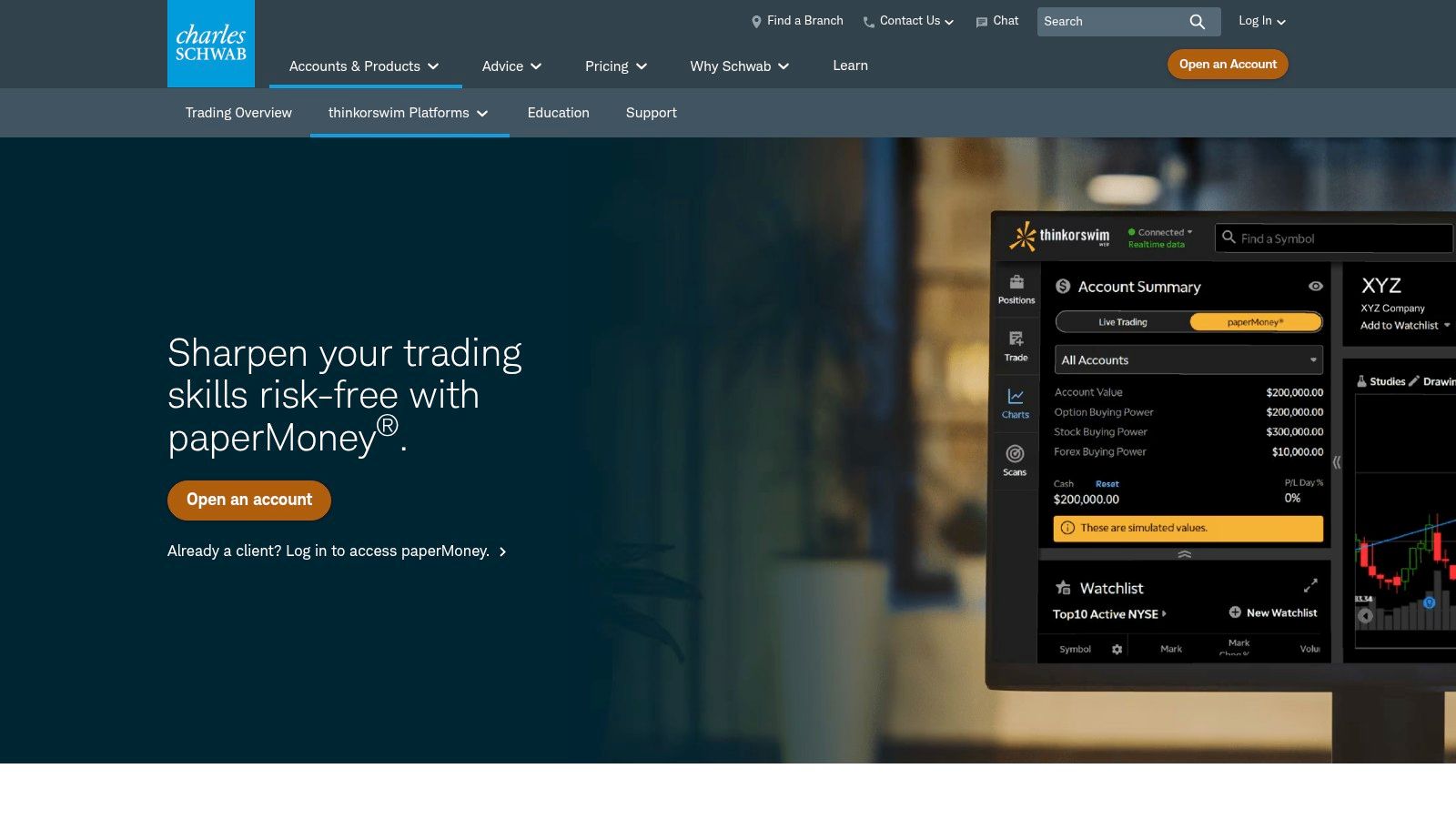
Schwab's paperMoney platform offers $100,000 in virtual buying power, real-time market data, and practice in equities, options, futures, and forex. Its analysis tools, customization, educational materials, and profit-and-loss views make it useful for rehearsing a broker-style process.
Don't let the default virtual balance dictate your position sizes. Practice with an allocation that reflects the constraints you want to study.
Options Need More Than Plausible Entry Prices
An options position can look sensible on entry and behave differently around expiration. Assignment means an option seller must fulfill the contract's obligation, and early assignment can change the position before its planned exit.
The Stock Education review of options simulation documents differences between simulators' treatment of assignment and expiration. That's a reason to inspect the applicable rules, not to assume this platform reproduces every contract event.
- Fidelity: Real-time data supports timely practice, but paper fills and outcomes don't reliably reproduce live execution.
- Asset coverage: Equities, options, futures, and forex support broad workflow practice.
- Account requirements: A Schwab account is required to log in to paperMoney.
- Journaling: Performance and profit-and-loss information help review results. Keep your signal thesis and filing timestamps in a separate decision log.
For a policy-driven options idea, document both the policy scenario and the contract mechanics. Otherwise, you won't know whether a disappointing result came from your interpretation, timing, or instrument choice.
Choose paperMoney for platform depth. Don't choose it because a large virtual balance makes complex strategies feel inexpensive.
4. Webull paperTrade
Say you notice a public filing while checking markets on your phone. Webull paperTrade makes it convenient to rehearse the order immediately. The danger is that convenience can turn investigation into reflex.
Webull's paper-trading simulator is available through mobile, desktop, and web platforms. It supports stocks, ETFs, options, crypto, futures, and event contracts, although availability and mechanics differ between newer and legacy versions.
The newer simulator adds order types and advanced options strategies. Extended-hours and overnight practice are advertised for eligible products, but don't assume every instrument follows the same schedule.
- Fidelity: Some legacy fills may use the last traded price without considering available volume. That can make an apparent execution more generous than a live order.
- Asset coverage: Broad product support is useful, but confirm availability in the simulator version you're using.
- Account requirements: Paper trading is free and uses a Webull login. Keep simulated access distinct from any live-product permissions.
- Journaling: Record the simulator version, session, order type, and signal timestamp alongside your trade history.
Test the Price, Not Just the Button
Liquidity means the ability to trade an intended quantity without substantially changing the price. A displayed price doesn't establish that your entire order could execute there.
A simulated fill at the last traded price isn't evidence that someone would have taken the other side of your order.
This matters when a policy announcement attracts attention outside regular trading hours. Your practice should include the bid-ask spread, the gap between buyers' quoted bids and sellers' quoted offers, rather than relying solely on the last price.
Webull works well for learning a familiar, accessible interface. It's less convincing as a standalone strategy-validation tool when the fill assumptions aren't clear. Write down those limitations before celebrating the result, especially for thinly traded securities or fast-moving crypto.
5. moomoo Paper Trading
Community discussion can help generate trade ideas, but it does not establish whether the underlying reasoning is sound. moomoo pairs simulated trading with educational resources and community features, so the key is to treat each idea as a hypothesis and check it against its original signal.
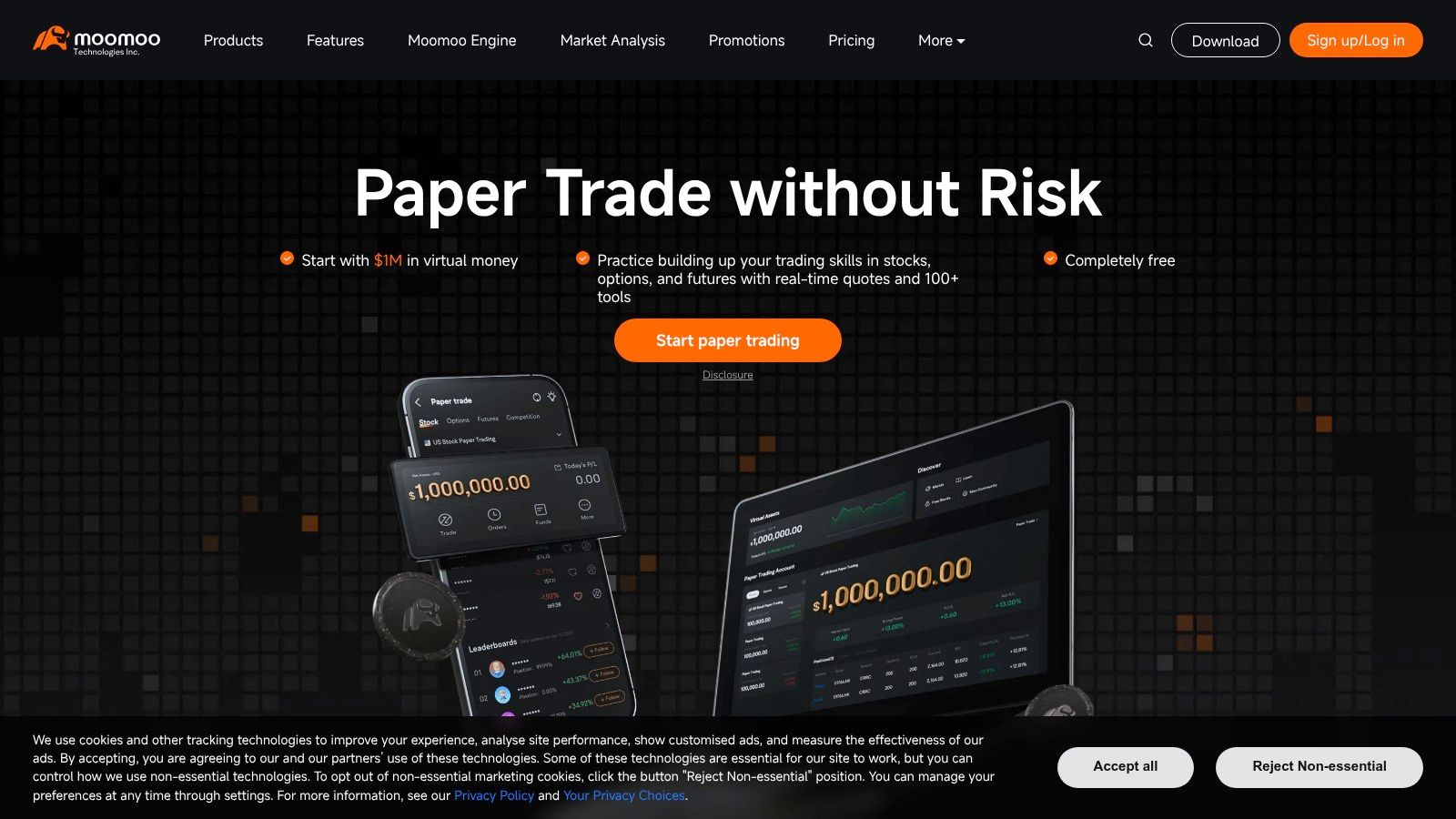
The moomoo paper-trading app supports practice with stocks, options, and futures without opening a brokerage account. Its tools and product coverage are more extensive in the app than on the web.
Use Community Ideas as Hypotheses
An institutional purchase discussed online may refer to a reported holding, a recent transaction, or speculation. Check the original filing and its date before treating the explanation as a trading signal. For congressional STOCK Act disclosures, remember that reports are delayed, can arrive up to 45 days after a trade, and state transaction amounts in ranges. SEC Form 4 filings offer another signal to investigate.
- Fidelity: Simulated trading rules differ from live mechanics. Check the product's rules before drawing conclusions from results.
- Asset coverage: The app supports stocks, options, and futures. Web coverage is more limited.
- Account requirements: Paper trading does not require opening a brokerage account.
- Journaling: Record the signal, filing date, thesis, and planned exit alongside simulated transactions. Community discussion cannot replace your own rationale.
The learning environment is the draw; discussion and competitions can also pull attention toward frequent trades instead of a defined test. Keep each practice trade tied to a written hypothesis, then review whether the simulated result supports it.
TradeLikeInsiders offers a simulator with simulated money, surfaces delayed congressional disclosures, SEC Form 4 filings, and on-chain whale flow, and provides educational AI analysis. Its educational trading resources can complement a moomoo journal, while original filings remain the basis for evaluating a signal. Choose moomoo if its learning tools help you maintain a consistent practice routine.
6. Interactive Brokers Paper Trading
Interactive Brokers makes sense when account configuration is part of the experiment. If you're testing across markets, currencies, or order types, a simple buy-and-sell simulator may leave too much out.
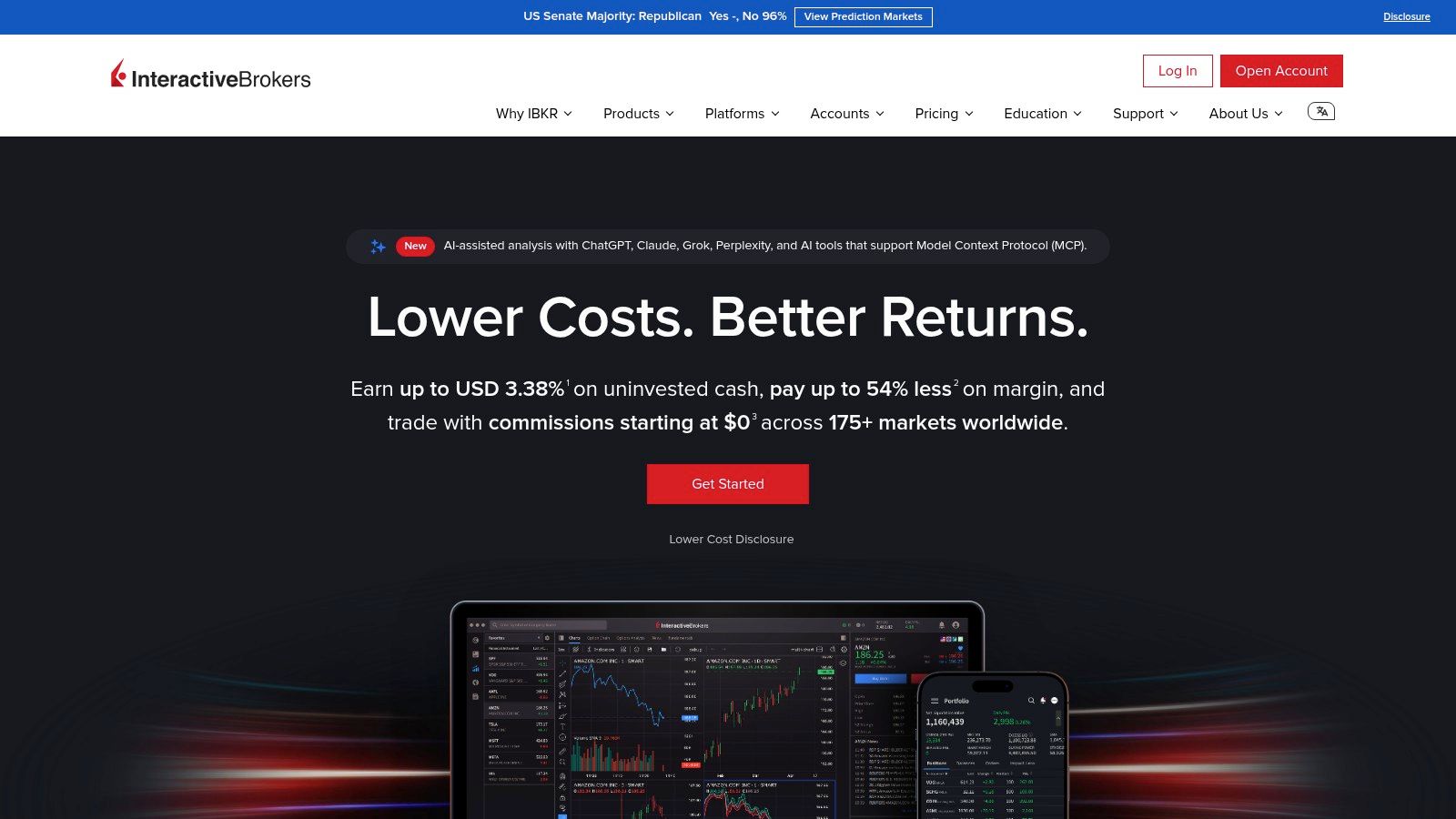
Interactive Brokers provides paper trading through platforms including Trader Workstation and IBKR Mobile. Paper-account settings can reflect the associated live account's permissions and configuration, while simulated statements support account-level review.
That depth comes with setup and learning costs. This isn't the lowest-friction choice for someone who wants to investigate a congressional disclosure and record a hypothetical stock position.
- Fidelity: Many workflows resemble the production platform, but some order types and trading behaviors are unsupported or behave differently.
- Asset coverage: Broad market and product access makes it suitable for multi-asset practice, subject to account permissions and simulation support.
- Account requirements: A standard paper account requires an approved and funded production account.
- Journaling: Simulated statements help reconcile activity. Add your own catalyst notes and decision timestamps to explain the orders.
Institutional Holdings Aren't Live Whale Trades
For institutional research, start with what the filing represents. The SEC's Form 13F instructions set a reporting threshold of at least $100 million in Section 13(f) securities and generally require filing within 45 days after quarter-end.
Those reports describe quarter-end holdings, not necessarily current positions. They also don't reveal every asset or exposure an institution may hold.
A sensible simulation tests a rule you can reproduce: how you respond when a filing becomes public, perhaps using changes across successive reports. It shouldn't assume you entered when the institution did.
Choose Interactive Brokers for complex workflow rehearsal, not because a professional-looking interface makes delayed information current. Track financing, currency conversion, and permissions where relevant, and note any costs or behaviors the simulation leaves out.
7. Wall Street Survivor
Not everyone needs a professional trading terminal. Wall Street Survivor is better suited to learning portfolio decisions and discussing them with a group. That's a legitimate use of paper trading, provided you don't mistake a game result for execution evidence.

Wall Street Survivor combines a web-based virtual portfolio with investing courses, private games, leaderboards, and periodic competitions. Its materials describe practice with stocks, ETFs, crypto, and options, although contest parameters and supported securities can vary.
The educational case for simulation is stronger than the claim that virtual profits predict real ones. In a 2010 study of 61 students completing a nine-week equity-trading exercise, average test scores increased by 14 points out of 100, according to the academic report indexed by ERIC. That supports simulation as a learning method, not any particular platform's investment performance.
Make the Game About Reasoning
A private group could compare different interpretations of a proposed regulation. Each participant would identify the affected business activity, explain the expected effect, and state what evidence would invalidate the idea.
- Fidelity: It's designed more for learning and games than detailed broker-style execution analysis.
- Asset coverage: Stocks, ETFs, and crypto are central to its virtual-portfolio offering; verify options availability and each contest's eligible securities.
- Account requirements: Free registration is available without a credit card.
- Journaling: Keep a shared decision log alongside portfolio results so participants can compare reasoning, not just rankings.
Better competition rule: Require a written thesis before entry and a written review after exit.
The strength is accessibility. The limitation is that advanced order controls and realistic execution aren't the main focus.
I'd choose Wall Street Survivor for a beginner learning group or an investing class. For fast reactions to SEC filings, detailed options mechanics, or venue-specific crypto execution, a broker-style simulator is a more appropriate next step.
Paper Trading Platforms Side by Side
The useful question is whether a simulator lets you test an idea and review the result clearly. This comparison includes signal research, chart practice, broker-style trading, and education. For each platform, check what you can trade, what access it requires, and what kind of practice it supports.
| Item | Asset Coverage | Account Requirement | Best For |
|---|---|---|---|
| Congress & Insider Trading Signals | Congressional disclosures, SEC insider filings, and on-chain whale flow | No live funds needed; research access varies by plan | Researching public signals and testing ideas with paper trading |
| TradingView Paper Trading | Stocks, forex, crypto, commodities, and index futures | Free simulator; no brokerage deposit required | Chart-focused practice across multiple markets |
| thinkorswim paperMoney by Charles Schwab | Equities, options, futures, and forex | Schwab account required | Practicing complex trades on a broker platform |
| Webull paperTrade | Stocks, ETFs, options, crypto, futures, and event contracts | Free simulator; requires a Webull login | Practicing across a broad range of products on Webull |
| moomoo Paper Trading | Stocks, options, and futures on the app; more limited coverage on web | No brokerage account required for app practice | Combining simulation with market tools and learning resources |
| Interactive Brokers Paper Trading | Broad range of markets and products | Approved, funded production account required for a standard paper account | Advanced, multi-asset practice |
| Wall Street Survivor | Stocks, ETFs, crypto, and options practice | Free registration required | Beginner investing education, virtual portfolios, and competitions |
Congressional and insider disclosures are delayed, not real-time trades. Use them to form a testable thesis, then record the entry, exit, and reasoning in your journal. The simulator helps you examine the idea; it does not make the underlying disclosure current.
Match the Simulator to the Question You Are Testing
The best paper trading platform isn't necessarily the one you'll eventually use for live orders. You might use a signal-focused workspace to investigate disclosures, TradingView to rehearse chart conditions, and a broker simulator to learn execution mechanics. Each tool should have a clearly defined job.
Start with the question, not the feature count. Are you learning order entry, testing whether a public signal adds useful information, or practicing how to manage a position after the initial excitement fades? Those exercises need different records.
Execution assumptions deserve particular attention. The Stock Education comparison of paper and real-money trading explains how simplified spreads, instant fills, and omitted liquidity constraints can overstate simulated performance. An attractive result isn't very informative if you can't explain how the entry and exit prices were produced.
A Practical Selection Checklist
- Confirm asset coverage: Check the actual simulator, not just the provider's live brokerage menu. Verify the instrument, session, and relevant contract events.
- Inspect simulation fidelity: Identify how fills, available liquidity, spreads, slippage, fees, and partial executions are modeled.
- Check account requirements: Separate free registration from brokerage approval, funding requirements, and market-data access.
- Require reviewable records: Preserve every order alongside its thesis, source timestamp, risk limit, position size, and exit rationale.
- Define invalidation: Write down what evidence would change your mind before you enter, not after the position moves against you.
For congressional signals, model the delay and preserve the reported value range. Don't turn a broad disclosure band into a precise position estimate. For Form 4 activity, distinguish discretionary purchases from other transaction types; for institutional reports, separate holdings snapshots from recent trading.
Policy-driven ideas need similar discipline. Identify whether you're responding to a proposal, committee action, agency announcement, final rule, or implementation milestone. Then explain how that event could affect revenue, costs, competition, or demand rather than assuming political attention alone makes a useful trade.
TradeLikeInsiders tracks congressional trades, insider activity, whale moves, and selected policy signals in one place, with simulation and journaling for educational practice. Whatever tool you choose, make your next exercise concrete: select a public signal, verify its source, record when it became available, and write your decision rules before placing the simulated order.
HeliosNet LLC offers public-signal research, educational AI analysis, and a paper-trading environment for practicing ideas without live funds. Visit TradeLikeInsiders to investigate a disclosure, document a simulated trade, and review the reasoning behind it. This content is for informational purposes only and is not financial advice. Do your own research.