The 2012 STOCK Act didn't ban members of Congress from owning stocks. It confirmed that existing insider-trading law already applies to them and added a disclosure rule, with covered trades above $1,000 reported within 30 days of the filer learning about them and never later than 45 days after the trade.
That single fact kills the most popular advice in this corner of the market, which is to mirror congressional trades because politicians "know something." Sometimes they do. Often the filing you're reading is a month stale, the size is a range, and the person who bought may not be the member at all. Congress insider trading law is narrower than the headlines and looser than the conspiracy theories, and the gap between those two readings is where retail money gets hurt.
The public trades on news. Insiders trade on information. The distance between those two things is the whole game.
What follows is the rulebook, the clocks, and the hard limits on what a filing proves.
Table of Contents
- What Congress Insider Trading Law Actually Prohibits
- Deadlines Across Congress Insiders and Whales
- Reading a Congressional Periodic Transaction Report
- Penalties and the Scale of Late Filings
- What a Disclosure Can and Cannot Tell You
- Where to Find the Primary Filings
- Research the Filing Before You Trade
What Congress Insider Trading Law Actually Prohibits
The mistake most readers make is treating Congress insider trading law as a permission slip. Buy whatever you want, file the paperwork, and you're clean. In fact, it's closer to the opposite.
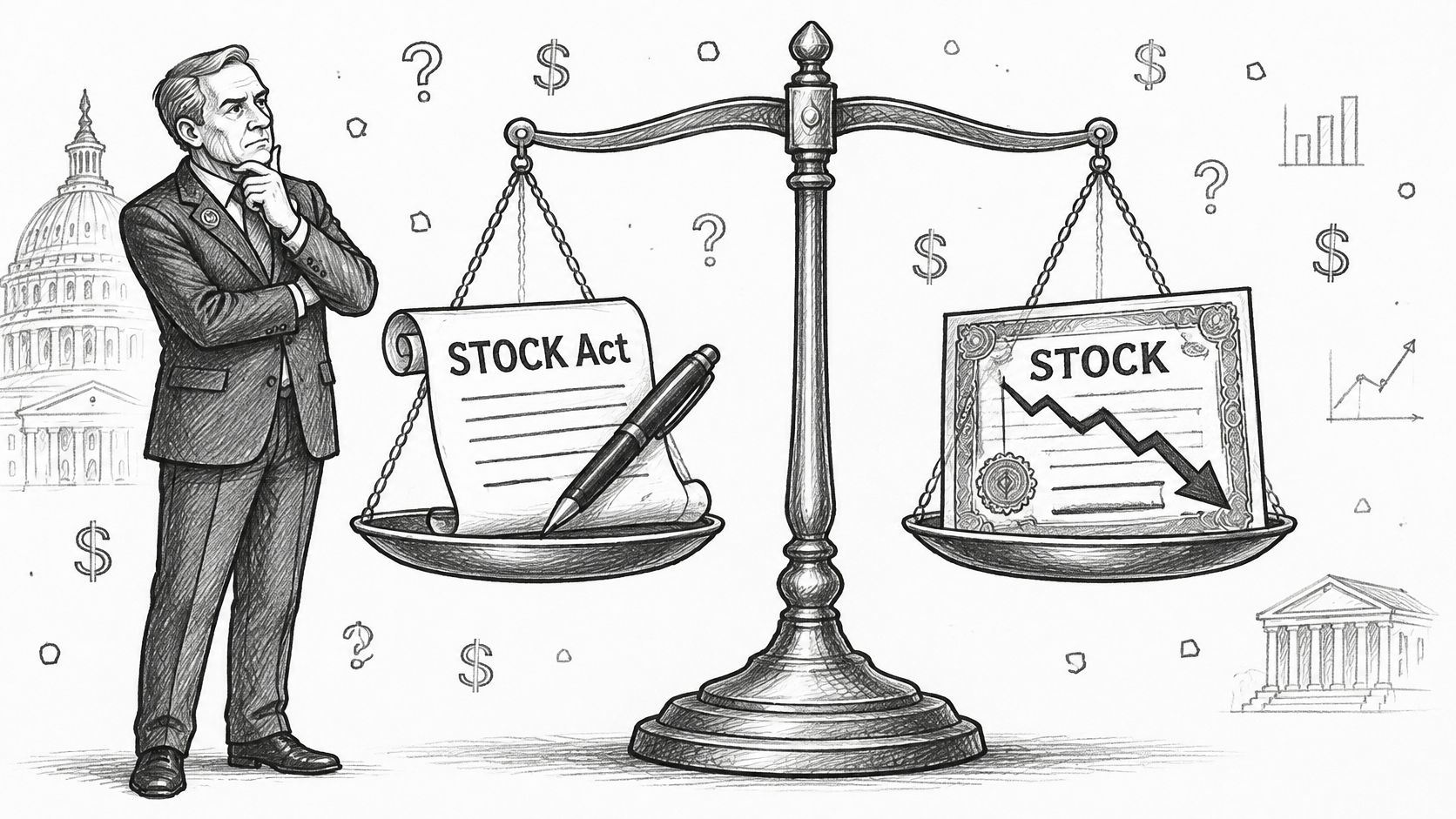
Not a ban and not a license
Congress insider trading law is a duty rule with a reporting rule bolted onto it. The duty comes from the 1934 Securities Exchange Act and SEC Rule 10b-5. The reporting comes from the Stop Trading on Congressional Knowledge Act of 2012, signed by President Barack Obama on April 4, 2012 as Public Law 112-105.
That statute says Members of Congress and congressional employees may not use nonpublic information obtained through their official positions to make a private profit. It also expressly rejects any special exemption for legislators and staff under Section 10(b) and Rule 10b-5, and it states that congressional officials owe a duty of trust and confidence to Congress, the U.S. government, and U.S. citizens when they handle material, nonpublic information from their public work.
It never says a member can't own a stock. Owning is fine. Trading on what you learned in a closed briefing is not.
The locked door image: the information sits behind a door the official can open because of the job. Using what's behind that door for personal gain is the violation. Holding shares in a company you already owned is not.
The chain a prosecutor has to build
The STOCK Act doesn't create a standalone congressional insider-trading crime. It confirms that members and staff stay inside the existing federal securities framework, and the SEC describes the operative analysis as fact-intensive, per its statement on applying insider trading law to members of Congress and their staffs. Section 3 of the Act separately bars using nonpublic information from official duties for private profit.
In practice, four links have to connect:
- Access: the person held material, nonpublic information.
- Duty or misuse: the information came from an official position, and trading or tipping it breached a recognized duty.
- The act: a securities transaction or a tip to someone who traded.
- The payoff: a measurable gain or avoided loss.
Scienter, meaning a culpable state of mind, still matters. Carelessness alone isn't the same as intent.
Two signals that look identical and aren't
Monitoring products and hot takes both go wrong here. A late or sloppy Periodic Transaction Report is a disclosure event. It may show reporting noncompliance. It does not prove illegal trading. An alleged trading violation is a securities event, and it needs materiality, nonpublic status, duty, scienter, and a link to the transaction.
A congressional trade on its own proves neither. It's a data point that tells you where to look next.
Deadlines Across Congress Insiders and Whales
Three disclosure regimes, three very different clocks. Scan the table, then read the cells traders misread most.
| Who files | Form | Usual deadline | What you can see | What it leaves out |
|---|---|---|---|---|
| Members, officers, and covered congressional staff | Periodic Transaction Report under the STOCK Act | Earlier of 30 days after notice or 45 days after the trade | Qualifying stocks, bonds, futures, and other securities over $1,000, in dollar ranges | Exact dollars and price, most mutual funds and ETFs, and any live trade |
| Directors, officers, and beneficial owners over 10 percent | SEC Form 4 on EDGAR | Generally two business days after the transaction | Trade date, price, shares, transaction code, and resulting ownership | Whether a sale is bearish, and any intent behind it |
| Institutional managers with at least $100 million in Section 13(f) securities | SEC Form 13F | Generally 45 days after quarter-end | Certain U.S.-listed long holdings as of quarter-end, and changes versus the prior quarter | Short positions, trades inside the quarter, and the current book |
The congressional clock is the slowest
Covered filers submit a Periodic Transaction Report for qualifying securities transactions exceeding $1,000, and the deadline is generally the earlier of 30 days after the filer receives notice or 45 days after the transaction itself, as the Congressional Research Service summary of STOCK Act reporting lays out. Covered instruments include stocks, bonds, commodity futures, and other securities.
Two exclusions matter for interpretation. Mutual-fund transactions and income-producing real property generally fall outside the periodic-reporting requirement, so a member with no filings may be invested in funds. And the Act requires covered disclosures to be posted publicly on official House or Senate websites within 30 days after filing.
Annual financial disclosure forms are a separate document. Merge them with periodic reports without normalization and you'll manufacture duplicate events and bad holding-period math.
Form 4 is fast and precise
Corporate insiders file through the SEC's EDGAR system, and Form 4 normally lands within two business days of the transaction, carrying the trade date, the securities acquired or disposed of, the price, and the resulting ownership position, as the SEC's Form 4 framework supports. Two-day reporting against a 45-day window is not a subtle difference.
The catch is transaction codes. An open-market purchase tells you something different from an option exercise, a tax-withholding sale, a gift, or a pre-scheduled plan trade. Read the code before you read anything into the headline.
13F is a quarterly photograph
A manager exercising discretion over at least $100 million in Section 13(f) securities files Form 13F quarterly, generally within 45 days after the quarter ends, per the SEC's Form 13F reporting requirements. It shows reportable U.S.-listed long holdings as of quarter-end. It excludes short positions and says nothing about what the manager did in week three of the quarter.
Keep three dates and one number
Every alert system, spreadsheet, or note you keep should carry the execution date, the filing date, and the publication date. Signal age is publication minus execution. When that number climbs into weeks, adjust your expectations down accordingly.
Reading a Congressional Periodic Transaction Report
A Periodic Transaction Report works like a delayed receipt. It confirms that a transaction happened, but it reaches you weeks later, so treat it as a record of the past and read it for what it can and cannot prove.
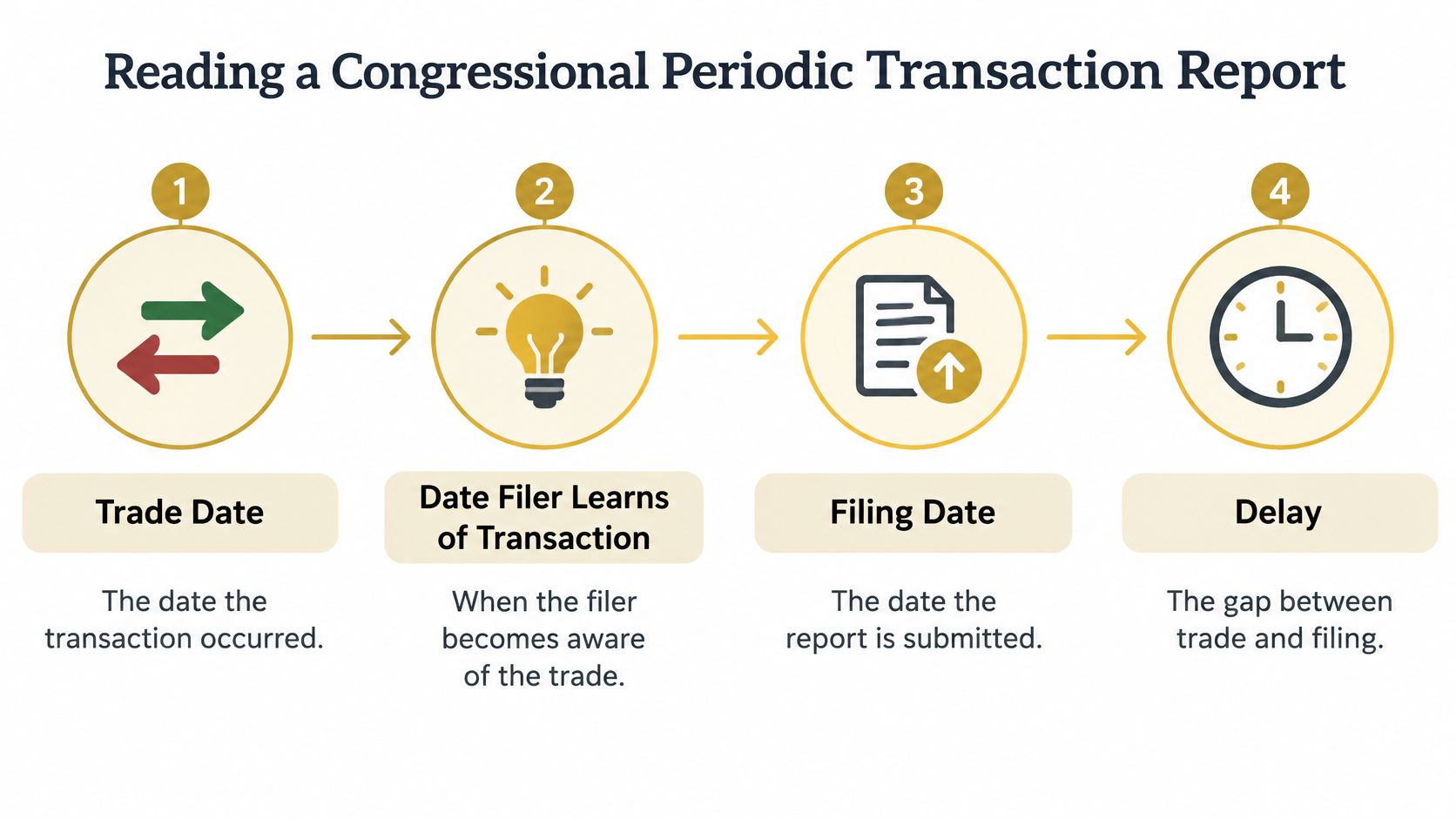
Four timestamps, in order
The filing clock comes from the statute: under 5 U.S.C. § 13105, a filer must report within 30 days of receiving notice of the transaction and no later than 45 days after the transaction itself, per the statutory text at 5 U.S.C. § 13105. The two-track deadline exists because a filer with a managed account may not learn of a trade until a statement arrives, so the law starts counting from notice and caps the total wait at 45 days.
| Timestamp | What it marks | How to treat it |
|---|---|---|
| Trade or execution date | When the transaction happened | The only date that belongs to the market event |
| Notice date | When the filer learns of the transaction | Starts the 30-day side of the filing clock |
| Filing date | When the report is submitted | Tests whether the statutory deadline was met |
| Publication date | When the House or Senate site posts it, due within 30 days after filing | The first moment outside traders can see and act on it |
Punctual and stale can describe the same filing. A report that lands on day 44 met every legal requirement and still describes a trade from six weeks earlier.
What the dollar band cannot tell you
PTRs report transaction values in dollar bands, not exact figures. You learn the size category, not the cash moved. That single design choice rules out a lot of inference.
- Exact entry price: unavailable, so profit cannot be computed from the filing.
- Current position: the report doesn't say whether the member still holds the asset.
- Portfolio weight: no context on how the trade fits the rest of the account.
- Who decided: a managed account, a spouse, or a dependent can generate the activity.
- Clean history: amendments rewrite earlier filings, so a report snapshotted once and never updated can leave you working from wrong numbers.
Research on these disclosures finds they consistently lag the trades themselves by about a month, a delay that matches the statutory window and, standing alone, is not evidence of concealment, per the CRS explainer on congressional trading disclosure. The useful question is whether the position is still open and the information still current.
If you want to watch the pipeline from a private trade to a public record, this walkthrough covers the same ground visually:
One more trap: a disclosed purchase does not establish that the member personally picked the stock. In a managed account, the decision often belongs to an adviser operating under a mandate. A timely, properly filed report proves a trade happened and was reported. It proves nothing, by itself, about why the trade was made.
Penalties and the Scale of Late Filings
Scale is worth knowing, as long as you don't turn it into a scandal narrative.
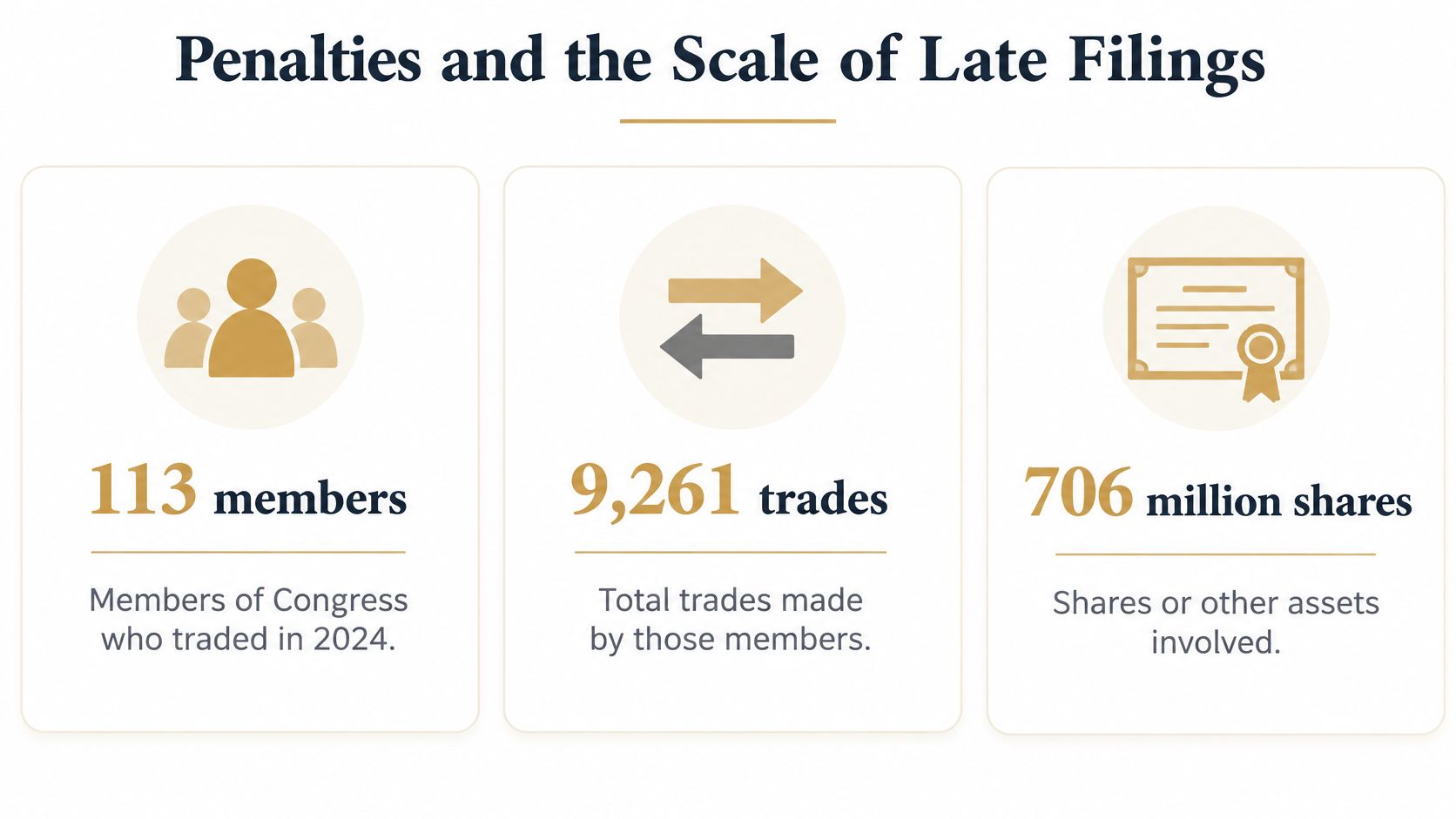
In 2024, 113 members of Congress made 9,261 trades involving approximately 706 million shares or other assets, according to figures cited in the Congressional Record in 2025.
On the compliance side, a 2024 analysis of congressional disclosures counted 3,439 trades and found that 590, or 17.2 percent, were filed late under the STOCK Act's 45-day reporting requirement, according to CapitolExposed's 2024 review.
The penalty for a first-time failure to disclose covered trades on time is $200, per the Brennan Center for Justice's 2025 explainer.
A small fine and a large information gap can coexist. Lateness is a compliance miss, not proof of a crime, and not proof of a profitable trade.
Two things follow. First, roughly one in six filings in that sample arrived after the statutory window, which means any analysis that assumes filings land on time is already wrong. Second, members of both parties file these reports, and the data doesn't rank individuals or reveal motive. Don't read it that way.
As of 2026, the disclosure regime described here is the law in force. Proposals to restrict member trading have been introduced in Congress, but they haven't replaced the STOCK Act, and pending bills shouldn't be described as enacted rules.
The practical takeaway is a calendar problem. If late filings are routine, you have to track the trade date and the filing date as separate events and compute the distance between them before you read anything into a disclosure.
What a Disclosure Can and Cannot Tell You
Copying a politician sounds like edge. Most of the time it's just expensive delay.
A congressional report can flag a company, a sector, or a policy theme worth researching, especially when the same name shows up repeatedly across filings. It cannot tell you the entry price, whether the position is still open, or that a specific bill caused the trade. To test that last one, you go read the bill text, check which committee handled it, and compare the timeline against the company's own announcements.
Insider filings reward reading the code
Form 4 arrives fast enough to matter, which makes the details carry more weight. A cluster of open-market purchases by several different insiders is more informative than a single sale, because sales often come from tax bills, gifts, diversification, or pre-set plans that have nothing to do with outlook. One filing is a clue, not a forecast.
A 13F is something you compare, not something you copy
A whale's quarterly filing shows what a large manager held, added, or cut between two quarter-ends. The work is in the comparison: did the share count rise or fall, how concentrated is the position, and did several large holders move the same way? Remember the snapshot leaves out short positions, so a manager with a large reported long may also be hedged in ways the form never shows.
Don't stack three clocks as if they ticked together
A congressional report, a Form 4, and a 13F covering the same company may describe three different dates. Layering them into one "smart money" signal without normalizing the timestamps produces a story that never happened.
Policy is the piece that moves sectors. A law, a rule, or an agency action that changes a company's costs or demand is a real catalyst. A filing is a pointer telling you to go read that primary source on EDGAR or a congressional disclosure site. Nothing here is a ticker tip, and no filing promises a return.
Where to Find the Primary Filings
Verify before you act. Every record below is free and public, and each one beats a screenshot from social media.
- Congressional disclosures: start with the House and Senate financial disclosure portals for STOCK Act Periodic Transaction Reports and annual forms. The House Committee on Ethics financial disclosure guidance explains which filings cover which transactions. Note the posting date shown on each document.
- Form 4: search SEC EDGAR by company or by insider name, open the filing, and read the transaction code, price, shares, and post-transaction holdings.
- Form 13F: search EDGAR by the filer's legal name, open the information table for the quarter, then pull the prior quarter and compare share counts line by line.
Then match records across sources. Align on company name and ticker, and log the execution date, filing date, and publication date for every item you keep. Signal age is publication minus execution, and it should be visible in whatever tracker you use.
Two naming traps catch people. Filer names can be near-identical across related entities, and institutional filers often file under a legal entity name that looks nothing like the brand on the door. If the name doesn't match, the holdings probably don't either.
Research the Filing Before You Trade
Before any congressional line influences a decision, write four things down: the trade date, the publication date, the dollar band, and whether the instrument is even covered by the reporting rule. If the gap is measured in weeks, file the item under history.
Then look for something faster on the same company. Recent Form 4 transaction codes tell you whether insiders are buying in the open market or just exercising options. Ask the harder question too: does a pending bill, rule, or agency action change this business's costs or demand? If you can't answer that in one sentence, the filing hasn't given you a thesis.
Working rule: a disclosure starts research. It never finishes it.
TradeLikeInsiders pulls congressional disclosures, insider filings, whale moves, and policy signals into one dashboard at TradeLikeInsiders.com, with delayed data labeled as delayed, a paper-trading simulator for testing ideas with simulated money, and educational AI analysis for context. Use it as a research desk, not a signal to copy.
This content is for informational purposes only and is not financial advice. Do your own research.
HeliosNet LLC built TradeLikeInsiders for exactly this problem: filings scattered across House and Senate portals, EDGAR, and institutional 13F tables, each on its own clock. You can see congressional disclosures, Form 4 insider activity, whale flow, and policy signals side by side, with timestamps that keep trade dates separate from publication dates, and a paper-trading simulator to test a thesis before risking real capital. Visit TradeLikeInsiders to start researching the filings rather than the headlines.