Copying politicians' trades sounds like a shortcut. It isn't. Before you can judge a disclosed purchase, you need to know whether you could have acted on the information at the price your strategy assumes.
A useful Congress insider trading tracker answers a less exciting question than “Who bought what?” It tells you what the public could know, and when. That distinction separates a research tool from a feed of stale trades dressed up as fresh opportunities.
Table of Contents
- Which Filings a Tracker Covers and How Late They Arrive
- What the STOCK Act Requires and What the Data Hides
- Why the Filing Date Matters More Than the Trade Date
- Policy Bills and 13F Whale Moves Need Their Own Lens
- Do Congressional Trades Actually Beat the Market
- Setting Up Alerts Without Drowning in Noise
- Deciding What a Signal Means for Your Watchlist
Which Filings a Tracker Covers and How Late They Arrive
Disclosure streams a tracker pulls from
| Filing | Who files | Maximum lag | Where to check |
|---|---|---|---|
| STOCK Act PTR (House) | Members, officers and certain senior staff | Earlier of 30 days after notice or 45 days after the trade | House Clerk |
| STOCK Act PTR (Senate) | Senators and covered staff | Same statutory deadline as House PTRs | Secretary of the Senate |
| Annual financial disclosure | Members and covered officials | Annual filing that repeats prior-year trades | House Clerk or Secretary of the Senate |
| SEC Form 4 | Corporate officers, directors and owners above 10% | Within two business days of the trade, generally | SEC EDGAR |
| SEC Form 13F | Institutional managers with over $100 million in qualifying securities | 45 days after each quarter ends | SEC EDGAR |
Every row is a delayed public record, not a live order. The reporting deadline also isn't a guarantee of when a tracker will ingest or display the record.
The Congressional Research Service's STOCK Act overview explains the congressional reporting framework, including the earlier-of-30-or-45-day deadline and the separate House and Senate disclosure channels. Those channels matter because an aggregator's normalized entry isn't the original legal record.
Different forms answer different questions
House and Senate Periodic Transaction Reports, usually shortened to PTRs, describe reportable transactions. Read them as activity records, not complete portfolio statements. The chamber identifies where to verify the filing, not whether the trade deserves more weight.
Annual financial disclosures provide broader financial context, but they can repeat transactions you've already seen. The House financial disclosure instruction guide explains that qualifying transactions appear both on PTRs and annual statements. Counting both appearances as separate trades manufactures activity that never happened.
SEC Form 4, available through SEC EDGAR, concerns corporate insider ownership changes. Before interpreting an entry as conviction buying, inspect the transaction description and ownership details. An ownership change isn't automatically an open-market purchase.
SEC Form 13F, also available through SEC EDGAR, is a holdings disclosure. Comparing filings can reveal changes between reporting snapshots, but it doesn't provide an execution log.
First check: Open the original filing and confirm the form type before reacting to an alert.
A tracker that blends these streams without clear labels invites category errors. A congressional purchase, a corporate ownership change and an institutional holding aren't interchangeable signals, even when they reference the same company.
What the STOCK Act Requires and What the Data Hides
The STOCK Act, signed on April 4, 2012, confirmed that members of Congress, congressional employees and other covered officials aren't exempt from federal insider-trading laws. Its disclosure framework makes qualifying securities transactions visible, but visibility alone doesn't establish misconduct.
Under the House Periodic Transaction Report instructions, covered purchases, sales and exchanges exceeding $1,000 generally require reporting. The test uses gross transaction value, not profit, so a sale at a loss can still be reportable.
Apply the threshold to the transaction
Consider two hypothetical transactions: a $3,000 sale at a loss and a $20,000 purchase clear the reporting threshold; a $600 trade does not. These examples illustrate the rule, not actual activity by any official.
The threshold captures only part of an official's financial exposure. The House Ethics Committee's financial disclosure guidance explains the treatment of widely held investments, including qualifying mutual funds and ETFs. When a filer lacks control over the underlying holdings, those investments are generally excluded from PTR reporting.
A tracker therefore shows a selective slice of exposure, not a complete portfolio. An empty feed doesn't establish that an official has no equity exposure. A cluster of individual-stock purchases doesn't establish the portfolio's overall allocation.
Keep disclosed amounts as buckets
Disclosed transaction value brackets
| Disclosed range | Floor | Ceiling | Tracker rule |
|---|---|---|---|
| $15,001 - $50,000 | $15,001 | $50,000 | Store as bucket only |
| $50,001 - $100,000 | $50,001 | $100,000 | Store as bucket only |
| $1,000,001 - $5,000,000 | $1,000,001 | $5,000,000 | Store as bucket only |
| $5,000,001 - $25,000,000 | $5,000,001 | $25,000,000 | Store as bucket only |
A hypothetical filing in the $15,001 to $50,000 bucket doesn't disclose a transaction of $32,450. A midpoint may make a dashboard easier to sort, but it is an estimate, not a reported fact.
Use clear handling rules:
- Preserve the range: Display the original bracket beside each transaction.
- Separate ownership: Keep the filer's activity distinct from transactions attributed to a spouse or dependent child.
- Identify the asset: Store the security, issuer, asset class and action separately.
- Label uncertainty: Flag ambiguous security matches instead of assigning a ticker.
- Avoid false precision: Don't add bucket midpoints and present the total as exact money flowing into a stock.
Committee labels also need context. Check the committee's jurisdiction and the relevant legislative event before treating a connection as meaningful. An industry label beside an official's name doesn't establish access to actionable information.
Preserve the transaction date, filing date, asset type and reported value range in the record. Together, they describe what the disclosure says and when it became part of the record, not proof of a current position.
Why the Filing Date Matters More Than the Trade Date
Say an official executes a purchase, later submits a PTR, and the record subsequently becomes publicly accessible. A tracker discovers it after publication. Those are distinct events, and only the public release can make the filing usable to an outside trader.
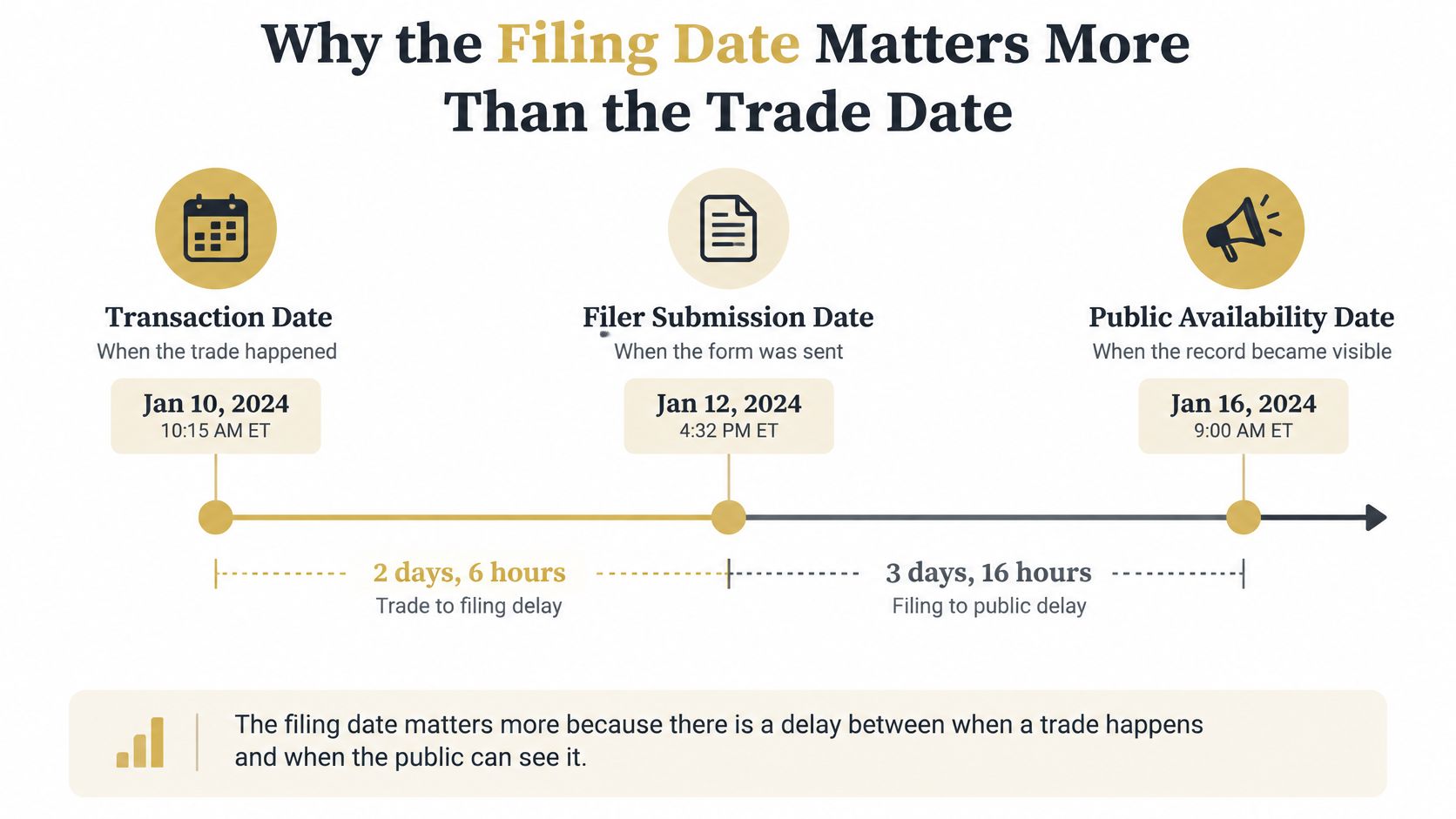
Under the House Ethics Committee's financial disclosure rules, the ordinary reporting deadline is the earlier of 30 days after notification or 45 days after the transaction. That statutory limit shouldn't be confused with a guaranteed public-feed latency: amendments, extensions, weekends and publication delays can complicate the observed timeline.
Store the clocks separately
- Transaction date: When the purchase, sale or exchange happened.
- Filer submission date: When the filer sent the disclosure.
- Public-availability date: When an outside researcher could access the record.
- Ingestion time: When your own system discovered it.
The last timestamp is operationally useful, but it shouldn't replace public availability. A scraper restarting after an interruption can discover an old filing without making its contents new.
Backtests must start with accessible information
A backtest is a historical simulation of a strategy. If it assumes a purchase on the official's transaction date, even though the disclosure wasn't public, it uses look-ahead bias: information from the future sneaks into an earlier decision.
Execute the simulated strategy only after public availability, using a realistic opportunity to trade. Calculate signal age when the filing enters the system, and retain the source document so the timing can be audited.
A newly discovered record isn't necessarily newly available information.
Amendments require version control. Preserve the earlier version, identify what changed, and reprocess the affected signal instead of announcing another purchase. An amended security identifier may change your analysis without representing another transaction.
Our congressional and insider disclosures on TradeLikeInsiders are delayed, not real-time trades. Whatever interface you use, ask the same questions: How old is the transaction, and when could the public first see it?
Policy Bills and 13F Whale Moves Need Their Own Lens
A congressional transaction describes an official's reported activity. A policy document describes a potential change to the business environment. An institutional filing describes a manager's reported holdings. Combining them can improve a research question, but combining them carelessly creates a story without evidence.
Follow the policy mechanism
Start with the actual bill, hearing materials or agency release. Identify what would change for a company: revenue eligibility, compliance costs, procurement opportunities, competition or access to a market.
For a hypothetical Democratic-sponsored clean-energy proposal, investigate eligibility rules and the affected supply chain. For a hypothetical Republican-sponsored permitting proposal, investigate approval requirements and the industries facing them. Apply the same standard to both: sponsorship isn't passage, a hearing isn't implementation, and a broad sector connection isn't company-specific exposure.
Use a short verification sequence:
- Read the document: Separate operative provisions from political summaries.
- Check jurisdiction: Confirm which committee or agency controls the relevant process.
- Map the business effect: Explain how the provision could change expected cash flows.
- Compare public timestamps: Establish whether prices moved before or after the announcement.
The useful question isn't whether a politician and a company share an industry connection. It's whether a specific public development changes the investment case.
Separate holdings from transactions
Read Form 13F as a dated institutional snapshot, not a whale's current order book. A difference between reports identifies a change in reported holdings, but it doesn't establish the execution date, purchase price or reason.
Likewise, inspect Form 4 transaction details before assigning meaning. A corporate officer's disclosed acquisition deserves a different reading depending on whether it reflects an open-market purchase, compensation-related activity or another transaction type.
On-chain whale flow is different again. A visible transfer can establish movement between addresses without establishing the owner's investment thesis or whether a purchase or sale occurred.
The legal boundary matters. Trading on material nonpublic information in breach of applicable duties can be illegal; researching lawfully public disclosures is different. Neither a lawful filing nor a profitable outcome, by itself, proves that someone traded unlawfully.
Do Congressional Trades Actually Beat the Market
A disclosure isn't the same as an informational advantage. The MIT-hosted Capitol Losses study found no evidence of informed trading or above-market portfolio returns for Congress as a whole or identifiable subsets, with the average congressional investor underperforming by approximately 2% to 3% annually during the study period.
That finding doesn't prove every congressional trade lacks value. It does undermine the assumption that a congressional label is enough to build a market-beating strategy.
Rank research priority, not promised returns
Performance can differ by member, security, sector, holding period and transaction direction. A useful screening system therefore asks which filings deserve investigation, not which politicians deserve automatic copying.
Signal confidence factors
| Factor | Stronger signal | Weaker signal |
|---|---|---|
| Filer count | Several officials disclose related exposure in a narrow release window | One filing with no related disclosures |
| Lag from trade | Filed within days of the trade | Filed near the statutory reporting limit |
| Committee link | Verified jurisdiction over the sector and a related legislative event | Proximity alone, with no verified link |
| Trade history | Repeated activity in the same name over time | A single trade with no pattern |
Here, stronger means more worth researching, not proven to predict returns. Several related disclosures can reflect common exposure to the same public news rather than independent private insight.
Repeated activity also needs context. A pattern can justify opening more source documents, but repetition doesn't establish the motive, the size of the overall position or the quality of the investment.
Testing standard: Count an outcome as evidence only if the strategy could have acted on information available at the time.
Measure the strategy you could actually run
Keep a journal containing the original transaction date, public-release time, assumed execution price, costs and exit rule. Compare the result with a suitable benchmark, not only whether the stock rose.
Benchmark-adjusted returns ask whether the strategy did better than an appropriate alternative. A technology stock rising alongside its sector isn't automatically evidence that the filing added value.
Keep purchase and sale tests separate, too. A sale doesn't necessarily express a bearish forecast, and an apparent successful purchase can become unsuccessful under a different holding period. Define those choices before evaluating the result, rather than choosing whichever window flatters the trade.
Setting Up Alerts Without Drowning in Noise
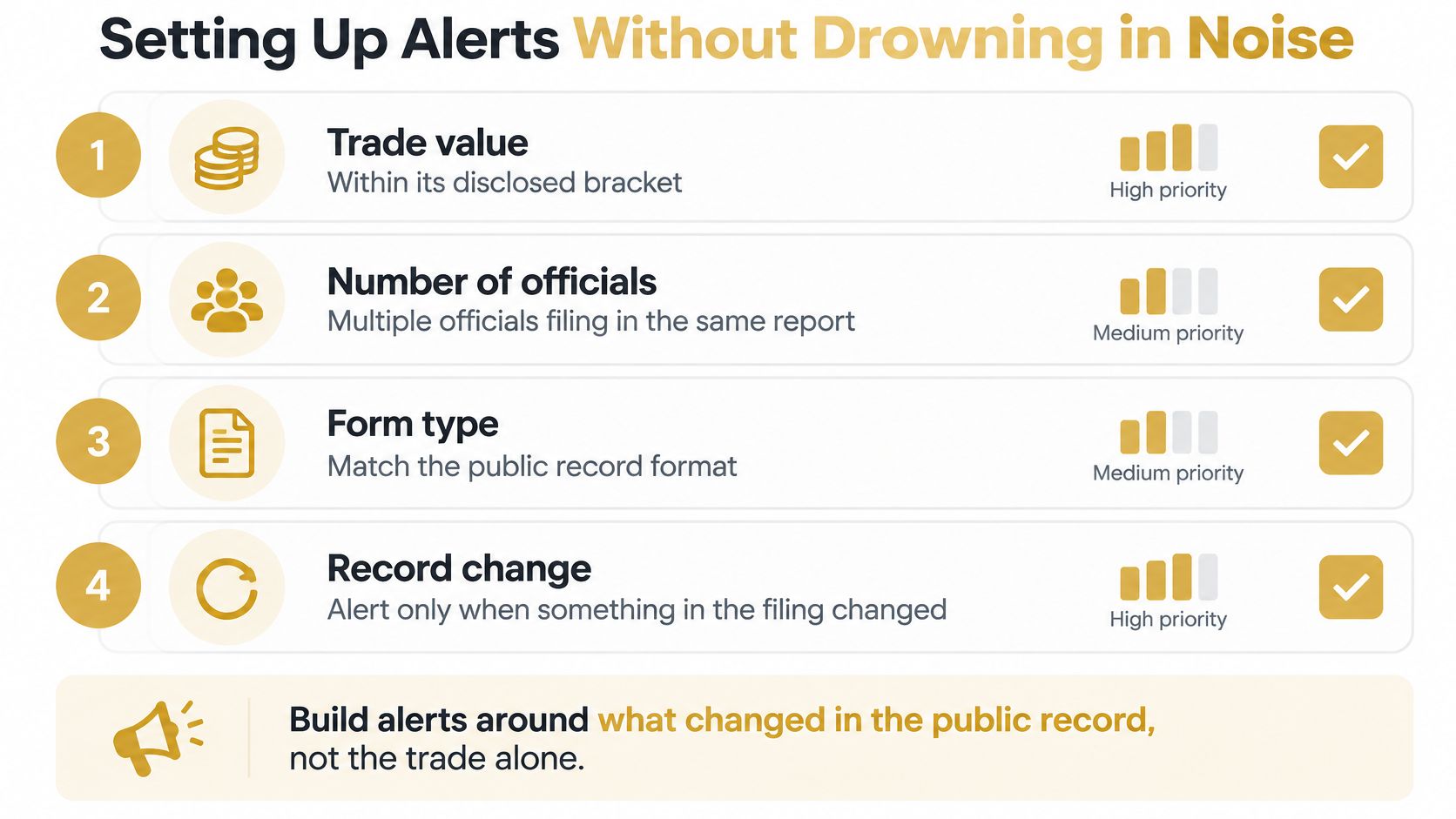
Build alerts around changes in the public record, not around dramatic descriptions of the underlying transaction. Your first job is to decide whether a filing adds information you haven't already processed.
Score relevance before sending notifications
Use high, medium or low ratings for these filters, with form type checked before scoring:
- Trade value: Judge size within the disclosed bracket, without manufacturing an exact amount.
- Related filers: Look for officials reporting connected exposure within a narrow public-release window.
- Sector relevance: Require a verified connection to your watchlist or a specific policy event.
- Record status: Distinguish a new disclosure from an amendment or repeated annual entry.
As a starting rule for your own workflow, require meaningful support from at least two filters before sending a push notification. That's a workload-control choice, not a validated profitability threshold.
Route each record to the right lane
The cluster lane groups related PTRs. Keep the individual source records visible so you can tell whether the cluster reflects distinct filers and transactions rather than duplicate ingestion.
The single high-value lane captures a large disclosed bracket without pretending it has corroboration. Label it as a single record, and don't let a prominent name substitute for supporting context.
The amendment lane reports what changed. If the amendment corrects an asset name, the notification should describe that correction rather than announce fresh buying.
Corporate insider alerts need their own grouping. Several officers making open-market purchases close together can deserve closer investigation than an isolated purchase, but verify transaction type before calling it a buying cluster.
Use separate clocks for alert freshness and transaction age. An old transaction can produce a new disclosure; an old disclosure should not become fresh just because your system has just imported it.
Finally, audit what the filters exclude. If nearly every notification gets ignored, tighten the criteria. If relevant filings disappear from view, keep them in a searchable review queue rather than turning every record into an interruption.
Deciding What a Signal Means for Your Watchlist
Say a dashboard displays a newly published purchase in a company on your watchlist. Another row shows an amendment, while an institutional holdings change appears nearby. The shared company name doesn't make them the same event.
A historical example shows why release timing deserves attention. In September 2024, members of Congress disclosed 473 trades, comprising 164 purchases and 309 sales, and 27 were made public more than 45 days after the trade date, according to ColdPine's September 2024 filing summary. That's a dated snapshot, not a description of current activity or, by itself, proof of a filing violation.
Review the evidence before changing your plan
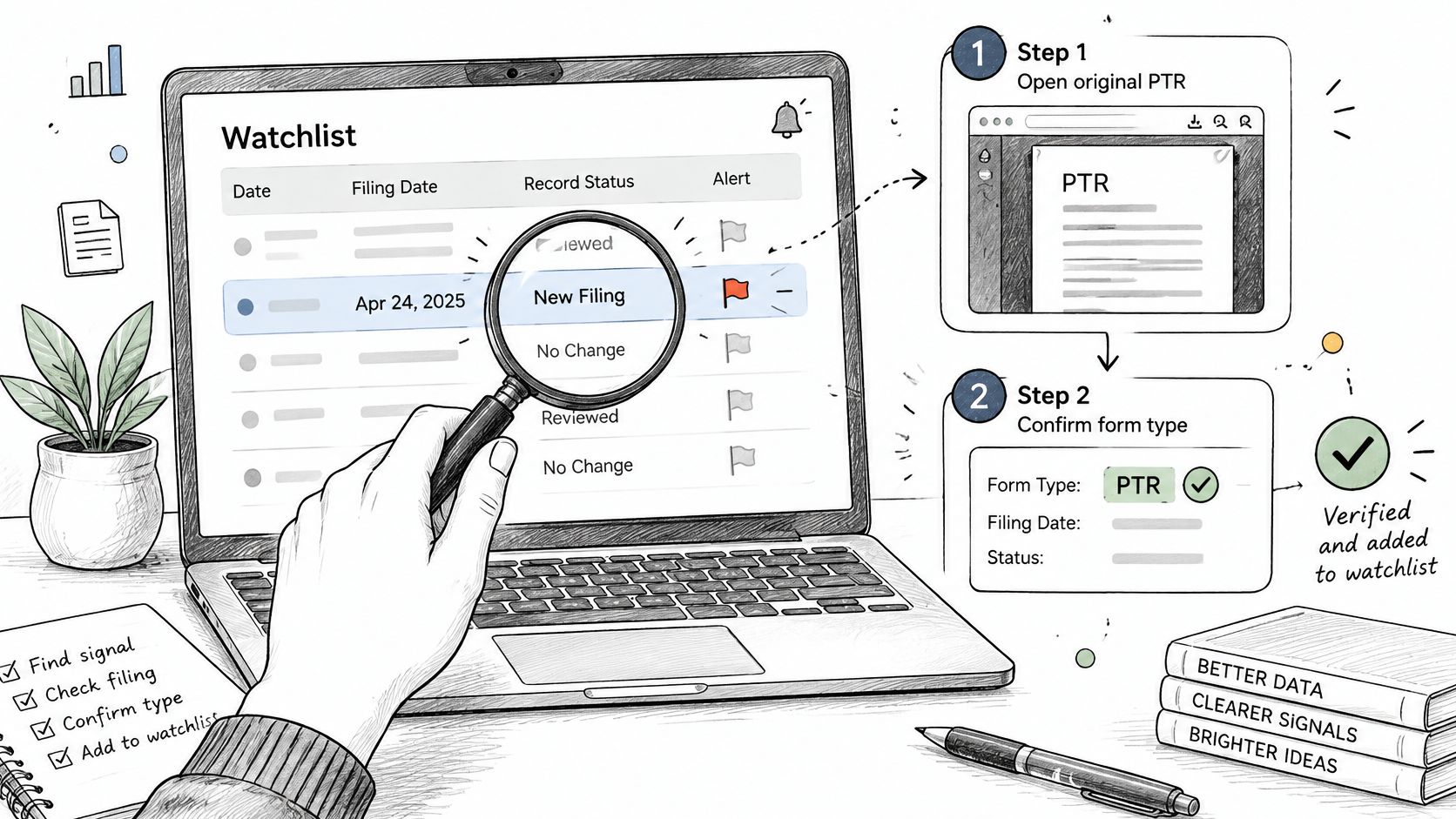
- Open the original PTR. Confirm that the dashboard row represents the form and transaction it claims.
- Read the bracket. Retain the disclosed range rather than treating an estimated value as exact.
- Check the timeline. Compare execution with public availability and identify any amendment.
- Investigate public explanations. Look for policy news, committee activity and company announcements.
- Make a watchlist decision. Decide whether the evidence changes your research priority, supports further testing or adds nothing useful.
The slogan that the public trades on news while insiders trade on information misses an important distinction: a filing doesn't reveal the information behind a decision. It reveals a reportable event. You still have to investigate the explanation.
A signal belongs beside price, fundamentals and risk limits, not above them. If it survives the checks and fits your predetermined process, evaluate it through that process; otherwise, log it and move on.
HeliosNet LLC offers TradeLikeInsiders, which brings STOCK Act disclosures, SEC Form 4 filings, on-chain whale flow and policy signals into a research workflow with educational AI analysis. Visit TradeLikeInsiders to examine the underlying signals and practice your decision rules in our paper-trading simulator using simulated money.
This content is for informational purposes only and is not financial advice. Do your own research.