The popular advice on Congress trading stocks sounds simple: copy what lawmakers buy and skip what they sell. That's the wrong mental model. The public trades on news, insiders trade on information, and congressional filings usually sit somewhere in between, delayed enough that the easy money, if there ever was any, may already be gone.
That doesn't make the data useless. It makes it delayed policy-exposure data, which is a very different thing. If you read it like a live alert feed, you'll get chopped up. If you read it like a research input, you can learn a lot about sectors, committees, timing, and the kinds of names that tend to matter.
Table of Contents
- Why Everyone Watches Congress Trading Stocks
- How STOCK Act Disclosures Work
- What a Filing Tells You and What It Hides
- Congress Versus Insiders and Whales Compared
- How Policy and Legislation Move Sectors and Stocks
- How to Read Congressional Trades Without Getting Burned
- Smarter Ways to Follow the Money From Here
Why Everyone Watches Congress Trading Stocks
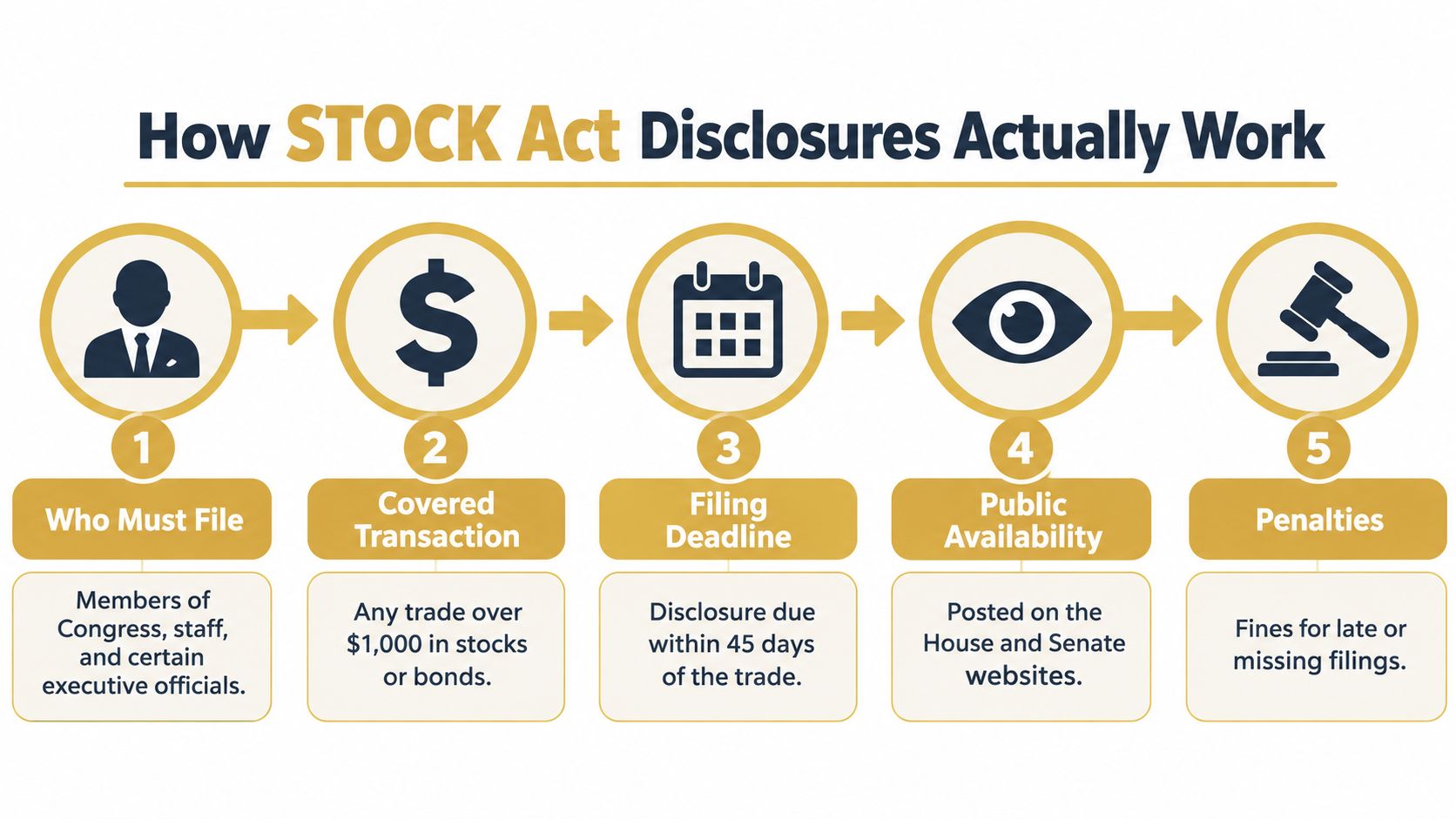
Congressional trades draw attention because they sit where power, money, and public trust collide. Members of Congress, congressional staff, and certain other covered officials are subject to federal insider-trading restrictions under the STOCK Act, signed on April 4, 2012. The Congressional Research Service summary of the STOCK Act framework also explains that disclosures are filed after the trade, with the reporting window running from 30 days after notification and no later than 45 days after the transaction. That delay is the whole game.
The appeal is obvious
Retail traders like clean stories. A filing tied to a lawmaker looks cleaner than a rumor, a chat-room tip, or a headline. It has a name, a date, and a public record, which makes it feel useful even when the timing is already stale.
That delay matters more than the headline. By the time the public sees the form, the market may have moved, the sector may have repriced, and the trade may already be old news. Judge every filing by its trade date, not its filing date.
The contrarian takeaway
A simple buy-or-sell reaction misses the point.
The better read is slower and a little more skeptical. Look at policy exposure, committee influence, and whether the activity clusters in a sector that could react to upcoming regulation or budget choices. Size matters too, because a one-off trade does not mean the same thing as repeated activity across related names. That is why filings work better as delayed policy-exposure data than as copy-trade alerts. They are a clue to where government action and market positioning overlap, not a signal to mirror every move.
How STOCK Act Disclosures Work
The key mistake is treating a disclosure as the trade itself. The trade happens first, then the public form shows up later through the House Clerk or Senate Secretary. A filing is paperwork, not the market event.
Read the timeline the right way
A better mental model is a delayed receipt. You pay today, but the receipt lands later, after the price may have moved. Congressional filings work the same way, so the trade date matters more than the filing date.
A covered transaction generally means a trade over $1,000 (CRS). The disclosure rules cover securities such as stocks, bonds, and commodities, while certain qualifying diversified mutual funds are excluded. That gives you a structured but incomplete view of activity, not a full portfolio dump.
What the public sees
Congressional ethics offices collect the forms and make them available for public inspection. For the 116th Congress, the House reported receiving 6,331 financial-disclosure reports and 3,722 periodic transaction reports from Members, officers, and employees, while the Senate reported 3,712 public financial-disclosure and periodic-transaction reports in 2020 and 3,876 in 2021.
Those numbers matter because they show scale. This is not a novelty feed. It is a public data set large enough to study patterns, delays, and clusters across sectors.
A filing tells you a trade happened. It does not tell you whether the signal is still fresh.
What a Filing Tells You and What It Hides
A congressional disclosure gives you a clue, not a full position sheet. It can show that a covered official reported a transaction, but it cannot tell you enough to trade on blind faith. The cleanest way to read it is as delayed policy-exposure data, not as a copy-trade alert.
The amount is usually a range
Congressional transaction reports usually show trade size in ranges, not exact proceeds or exact cost basis (CRS product TE10119). So you can judge scale, but you cannot see the exact dollars committed, the entry price, or whether the person still holds the security by the time the filing lands.
That missing detail matters. A reported purchase may reflect diversification, an investment manager's action, a spouse's account, or a trade made weeks earlier. It can look like conviction when it is only paperwork catching up.
Three questions beat one hot take
Before reacting to any disclosure, ask three questions.
- How big is it? A range gives you size, not precision.
- How old is it? Filing delay can make the signal stale.
- What is the context? Family account, manager trade, committee exposure, and sector all change the read.
Size matters more when the trade sits near a committee or policy area that could move related names. A cluster of filings in one sector can matter more than a single isolated trade, because it hints at shared exposure rather than a lone bet. Delay also matters. A filing that arrives late is more like a weather report after the storm than a live radar screen.
The wrong move is treating every purchase as bullish and every sale as bearish. The better move is to use the filing as one input, then check company filings, valuation, liquidity, and policy context. For readers who want to see how disclosure data is organized in practice, an example of how we package disclosure data for readers shows the format without pretending the filing says more than it does.
Congress Versus Insiders and Whales Compared
Congress, corporate insiders, and institutional “whales” all move money, but they are not speaking the same language. Use the feed that matches the question. Congressional filings are best for policy exposure. SEC Form 4 is better for company-specific insider behavior. SEC Form 13F is better for following large managers over a quarter, not for chasing same-day moves.
The three feeds serve different jobs
Corporate insider activity is reported on SEC Form 4, the public report for insider buying and selling. It is still not a live ticker, but it is usually closer to the event than a congressional disclosure because it is tied to company insiders and filed through the SEC's reporting system.
SEC Form 13F works differently. It is a quarterly institutional ownership report with a defined threshold, and it applies when an investment manager controls at least $100 million in Section 13(f) securities and files within 45 days after year-end and after each of the first three calendar quarters (SEC Form 13F). It shows long holdings and changes in share counts, but it is not a live whale tracker.
| Signal | What It Shows | Delay | Blind Spot |
|---|---|---|---|
| Congress | Covered legislative trades and disclosure activity | Up to 45 days after the trade or notification | Exact price, current holding, and full context |
| Form 4 | Corporate insider buys and sells | Usually within two business days of the transaction | Still not real-time, and it does not show the whole portfolio |
| 13F | Large managers' disclosed long positions | 45 days after quarter-end | Short positions, derivatives, private assets, and intra-quarter trading |
Use the right tool for the right question
If you want to know whether a lawmaker may be exposed to a sector, congressional filings help. If you want to know whether an executive is buying their own company, Form 4 is the sharper read. If you want a map of what large funds owned last quarter, 13F is the better lens.
The mistake is mixing them up. A quarterly snapshot is not the same as real-time whale tracking, and a disclosure is not the same as a timely trading edge.
Congress filings are delayed policy-exposure data. Read them with that lag in mind, then weigh size, committee proximity, and clustering. A single small trade can be noise, while several filings tied to the same sector can point to where policy pressure may be building.
How Policy and Legislation Move Sectors and Stocks
Government action moves markets because government sets rules, money flows, and legal boundaries. That doesn't mean every bill creates a tradeable move. It means certain sectors naturally react when Washington changes the frame.
Map the policy area to the sector
Defense names pay attention to budget signals. Energy names react to drilling, permitting, and regulatory pressure. Healthcare watches drug pricing and reimbursement policy. Technology cares about antitrust hearings, privacy rules, and export controls.
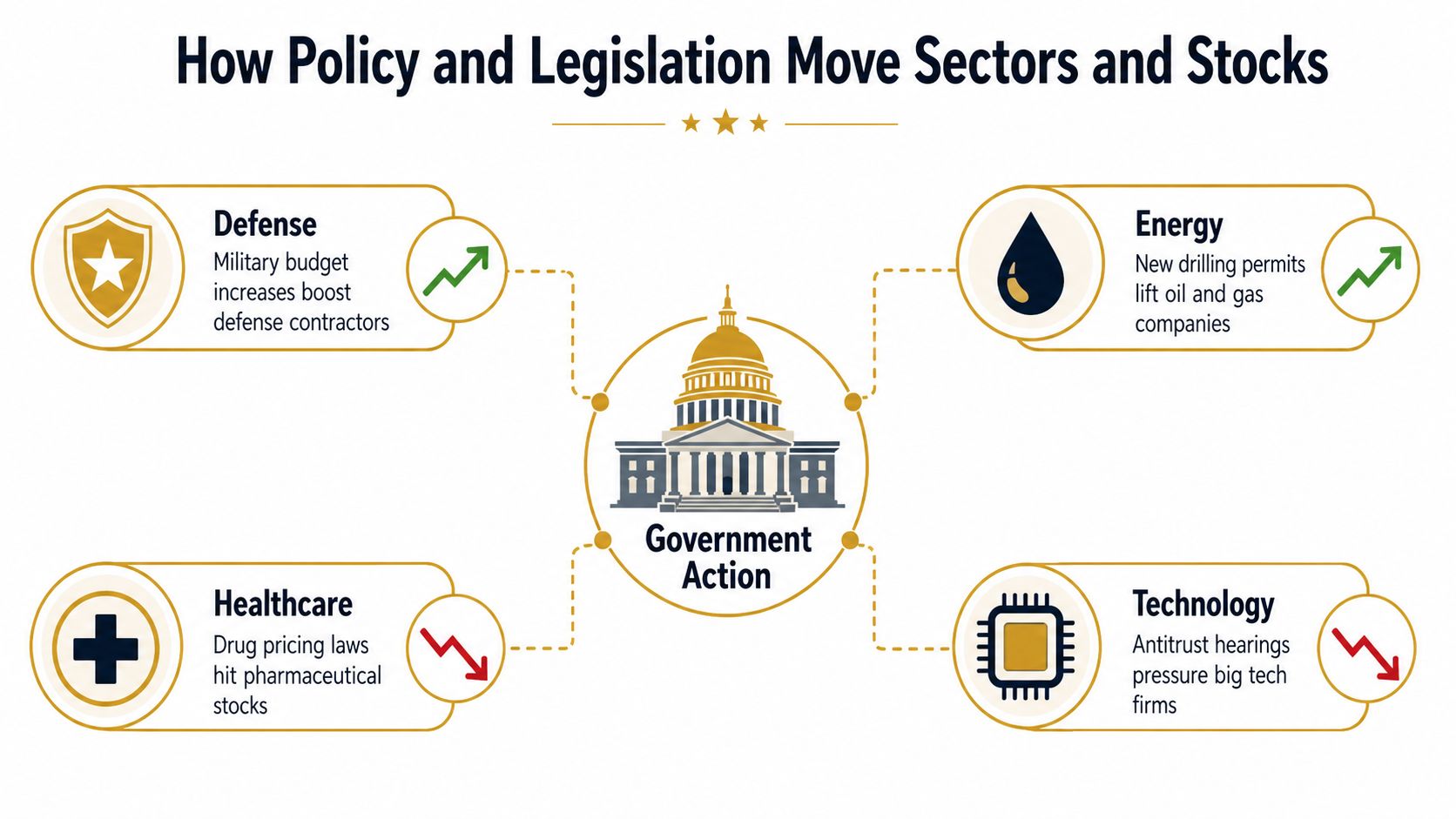
That mapping is useful because it stops you from chasing the wrong headline. A bill about procurement may matter more to contractors than to consumer brands. A hearing on competition may matter more to platform companies than to small software firms.
Committee exposure is the quiet clue
Committee assignments matter because they shape what lawmakers see early and where they spend time. If a member sits close to health, defense, energy, finance, or tech policy, their disclosures can hint at where they think the pressure points are. That still doesn't prove skill or privilege, but it does narrow the field.
The neutral way to read this is simple. Don't ask, “Which ticker did Congress buy?” Ask, “Which policy area is this filing touching, and which industries would care if that policy moved?”
How to Read Congressional Trades Without Getting Burned
Congressional trading looks attractive because it is public, concrete, and wrapped in politics. That is also why people misread it. A filing is easy to screenshot, but hard to read well.
Start with timing, not excitement
The first question is how stale the information is. A trade can sit hidden for weeks before the public sees it, and the STOCK Act allows disclosure delays of up to 45 days after the transaction. If you ignore that lag, you are not studying a signal, you are reacting to an old headline.
A University of Pennsylvania study of 2022–2024 disclosures found that the typical congressional trade did not produce abnormal returns, and around the first public appearance of buys and sells, equal-weighted cumulative abnormal returns were zero (University of Pennsylvania study). The useful wrinkle was size. Trades in larger firms performed better than trades in smaller firms.
Use a filter, not a hunch
The right reading method is simple.
- Compare trade date to disclosure date. A wide gap means the market may already have moved.
- Look for clustering. Several filings in the same sector can matter more than one isolated trade.
- Check company size and liquidity. Bigger, more liquid names often behave differently from small, thinly traded ones.
- Separate trade type from context. Buy, sell, family account, manager action, and amendment are not interchangeable.
- Benchmark against the market. Compare the trade against sector, size, momentum, and broad market factors, not just the stock chart.
One older study in this area found that pre-STOCK Act trading could show stronger abnormal returns. Those effects weakened after the law took effect. The point is not that every older winner was improper. The point is that the rulebook changed, so the pattern changed too.
If you want a place to compare congressional disclosures with insider activity, whale moves, and policy context in one feed, TradeLikeInsiders combines those views with timestamped context and educational tools.
Smarter Ways to Follow the Money From Here
Congress trading stocks is best read as delayed policy-exposure data, not a copy-trade alert. Treat the filing as a clue about where lawmakers may have felt pressure, seen opportunity, or expected legislative movement.
Form 4 and 13F are different animals. Form 4 tracks insider activity closer to the company. 13F captures quarter-end positioning from managers that cross the reporting threshold and file on a lag. Congress sits in its own lane, where policy exposure and public trust matter as much as price action. TradeLikeInsiders puts those disclosures next to insider filings, whale activity, and policy context so you can compare the signals instead of chasing one headline.
The useful reading rule is simple. Judge each filing by delay, size, committee exposure, and clustering. A lone trade from a member on a committee tied to health care means something different from a random buy in a crowded sector. If several lawmakers tied to the same policy area show similar activity, that cluster is more informative than any single disclosure.
Keep a watchlist and a paper-trading journal. Write down when you first saw the filing and when the trade occurred. That habit keeps you honest about what was known, when it became public, and whether the market already moved.
This content is for informational purposes only and is not financial advice. Do your own research.