
“Copy what politicians buy” is popular advice. It's also the wrong starting point. Before you study the company, study the dates: when the trade happened, when the official filed it, and when you could have read the disclosure.
Congressional financial disclosure reports are evidence to investigate, not orders to imitate. Used carefully, they can help you examine financial interests, sector exposure, and possible conflicts. Used carelessly, they turn an old transaction into a fresh-looking trading story.
Table of Contents
- What Congressional Financial Disclosure Reports Are
- Where to Find Each Filing and Its Deadline
- How to Read a Filing Field by Field
- Why a Filing Is a Delayed Clue, Not a Live Trade
- Congressional, Insider and Institutional Filings Compared
- How Policy Moves Show Up in Disclosure Patterns
- Verify Every Signal Before You Act on It
What Congressional Financial Disclosure Reports Are
The public trades on news; insiders trade on information. That's a useful warning about information gaps, not proof that an official's investment involved privileged knowledge. Congressional disclosure exists to help citizens scrutinize financial interests and potential conflicts.
The modern framework began with the Ethics in Government Act of 1978, covering Members of Congress, congressional officers, and certain employees; the STOCK Act, signed April 4, 2012, affirmed that Members and employees are subject to federal insider-trading laws and required online access to covered forms filed from 2012 onward, according to the Congressional Research Service's disclosure overview.
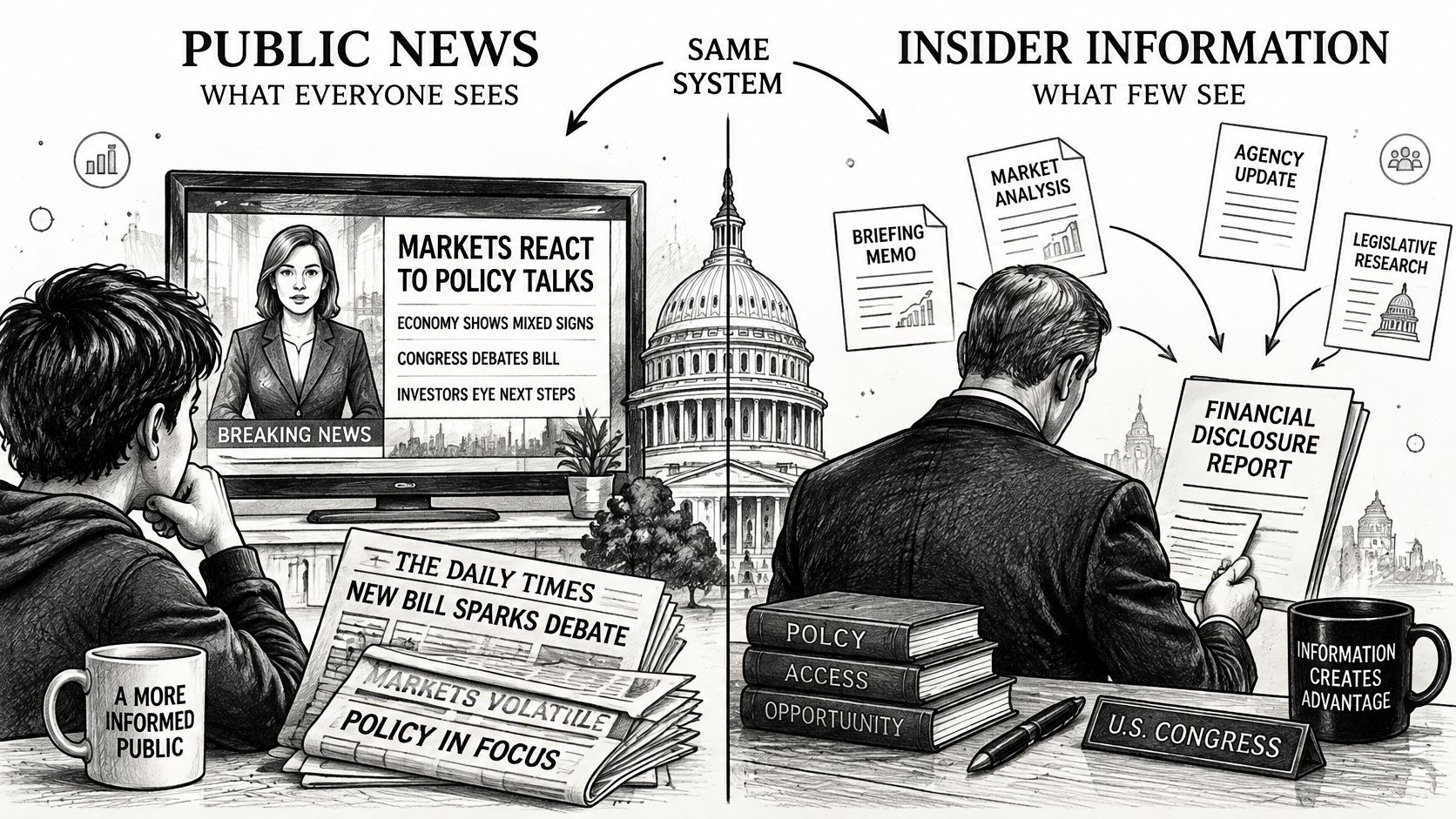
A financial snapshot versus a transaction record
- Annual financial disclosure: A broad account of reportable finances, including income, gifts, liabilities, real property, and business-related personal property. Think financial snapshot, not a brokerage statement.
- Periodic Transaction Report, or PTR: A record of qualifying purchases, sales, or exchanges. Think transaction receipt, not a complete portfolio.
These documents answer different questions. An annual report helps you examine an official's financial interests; a PTR helps you investigate particular investment activity.
Start with the document type. Accountability research and trade research overlap, but they aren't interchangeable.
Before opening a filing, decide which question you're asking. Neither document, by itself, predicts where a stock goes next.
Where to Find Each Filing and Its Deadline
Congressional filing types, deadlines and contents
| Report | Who files it | Deadline | What it shows |
|---|---|---|---|
| Annual financial disclosure | Members, officers and covered employees | Normally May 15; reports filed under extensions must be public within 30 days of filing | Income, gifts, liabilities, real property and business-related personal property |
| Periodic Transaction Report (PTR) | Covered filers who buy, sell or exchange securities above $1,000 | Earlier of 30 days after notice or 45 days after the trade | Each transaction's asset, type, transaction date and value range |
| Senate public disclosure reports | Senators and covered Senate staff | Annual-report deadline for annual filings; transaction-report deadline for PTRs | Annual and transaction reports published on Senate public disclosure pages |
The annual deadline applies to a financial snapshot. A PTR deadline is tied to a transaction and notification. An extension's public-availability requirement does not change the filing deadline for every report type.
The Senate's financial disclosure page describes the reporting rule for purchases, sales, or exchanges exceeding $1,000: file within 30 days after notification and no later than 45 days after the transaction. Filing volume can vary across years and includes reports beyond stock transactions by elected Members.
Search the official record first
Use the House Clerk's Financial Disclosure Reports database for House records and the Senate's public disclosure pages for Senate records. Search by the official's name, select the reporting period, and identify the report type before opening a result.
Third-party summaries can help locate a filing. Check the official document for ownership labels, corrections, asset descriptions, and details a summary may omit.
- Save the original: Keep the document or its official reference with your notes.
- Record your search date: This shows what was available when you checked.
- Check the reporting window: A filing that has not appeared yet does not establish that no transaction occurred.
- Confirm the report category: A search result with an official's name is not automatically a new stock transaction.
A missing result is an unresolved lookup, not a trading conclusion. Check the spelling, report type, reporting period, and deadline before interpreting silence.
How to Read a Filing Field by Field
Read every filing in the same order. Consistency matters more than speed because the easiest mistakes involve ordinary details: the wrong company, the wrong owner, or the wrong date.
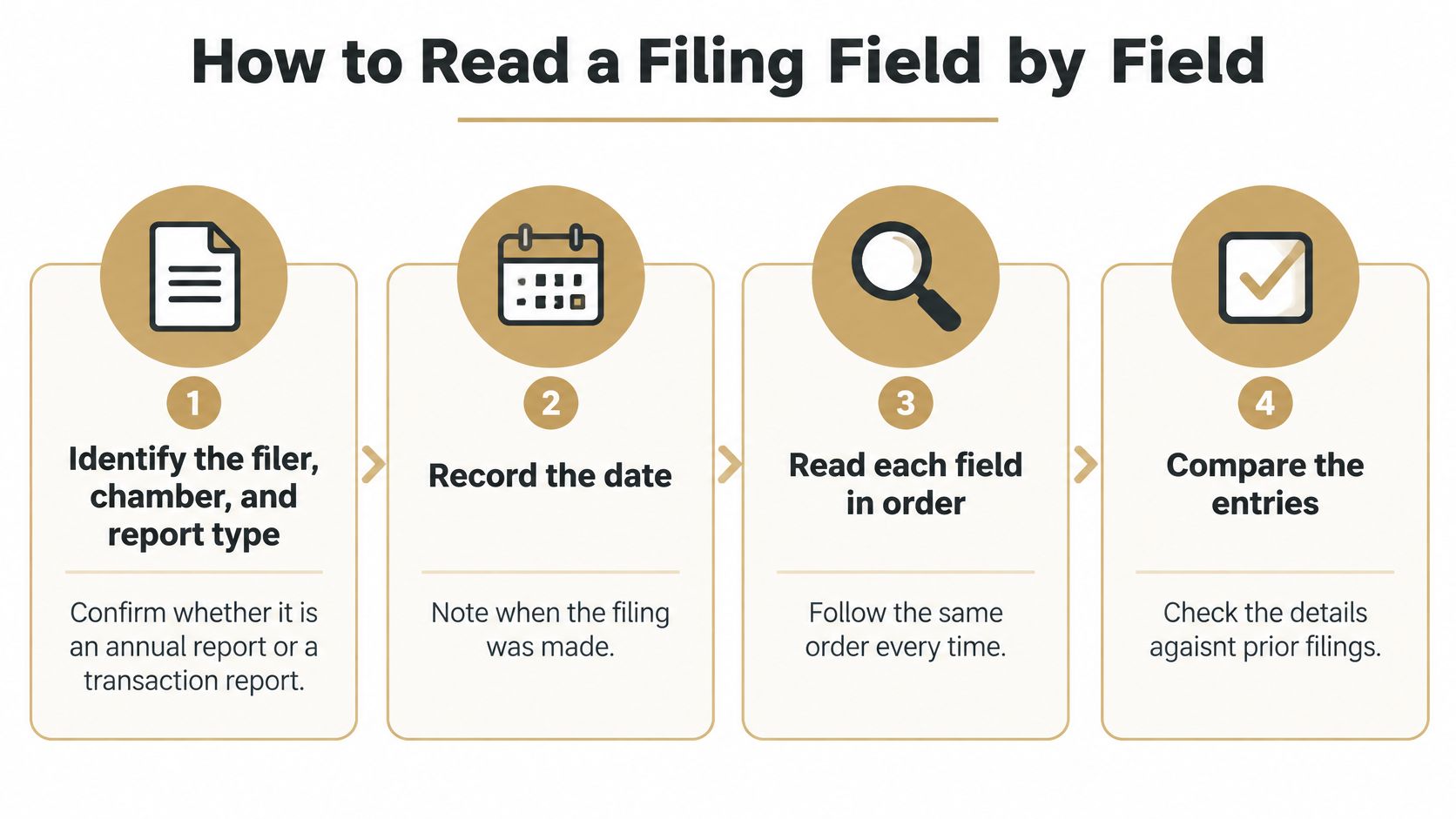
Use a repeatable reading order
Identify the filer, chamber, and report type. Confirm whether you're reading an annual disclosure or a PTR, because a listed asset isn't necessarily a newly reported purchase.
Record the asset name and any ticker provided. Similar company names, different share classes, and loosely matched tickers can send your analysis toward the wrong security.
Mark purchase, sale, or exchange. Don't collapse them into a generic activity label, because they describe different actions.
Put the transaction date and filing date in separate fields. A date attached to a search result may describe document submission rather than investment execution.
Copy the reported value range exactly. Don't substitute its midpoint and then present that estimate as the official's actual investment.
Check the ownership designation, including the filer, spouse, dependent child, or joint ownership. The House Ethics Committee's financial disclosure guidance explains that reportable transactions can involve these family interests and that disclosed amounts generally use ranges rather than exact trade sizes.
Flag amendments and preserve both versions. Compare what changed instead of replacing the original entry, especially if you're evaluating what a reader could have known earlier.
Two threshold mistakes to avoid
For sales, measure the transaction's total value, not the investor's gain. A sale at a loss can still meet the reporting test.
The congressional disclosure testimony published by the House explains that the $1,000 threshold applies to each transaction, separate transactions of $1,000 or less don't become reportable merely because their combined value exceeds that amount, and a sale's threshold uses total value sold rather than profit or loss.
That distinction prevents a common error: assuming the public record captures every small adjustment to an account. It doesn't justify reconstructing missing transactions from guesses.
Use this log template:
| Filer | Asset | Type | Transaction date | Filing date | Reported range | Official source |
|---|---|---|---|---|---|---|
| Name and ownership label | Exact description and ticker if listed | Purchase, sale, or exchange | As reported | As submitted | Copy verbatim | Saved document reference |
Add amendment status and your search date as extra columns. Keep facts copied from the filing separate from interpretations you add later.
Why a Filing Is a Delayed Clue, Not a Live Trade
Consider a hypothetical trade: execution comes first, the filer becomes aware of it, submission follows within the reporting window, and publication makes the document available to readers. By the time you notice an alert, you're already downstream of the original decision.
The sequence matters more than the excitement of the headline. A recently published report can describe an investment decision that isn't recent at all.
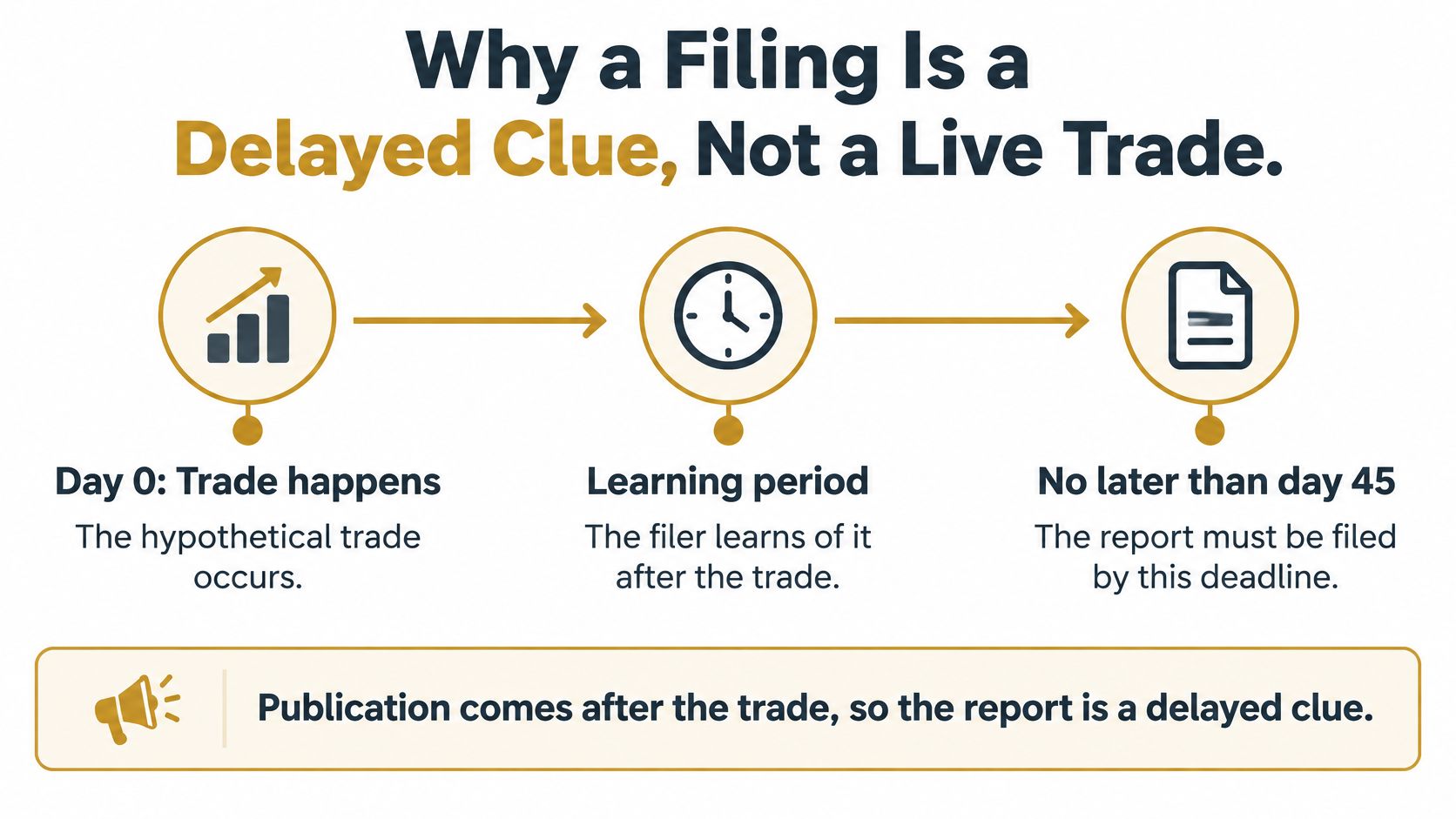
The four dates on every congressional filing
| Date | What it is | Why it matters |
|---|---|---|
| Transaction date | Day the filer bought, sold, or exchanged the security | Starting point for measuring the decision's age |
| Awareness date | Day the filer learned of the trade | Relevant to the notification-based deadline; mark unknown when absent |
| Filing date | Day the PTR was submitted | The gap from execution measures reporting lag |
| Publication date | Day the filing appeared on the official House or Senate site | Establishes when readers could first access it; can trail submission |
These are dates to track, not fields you should assume every document supplies. If you can't establish publication or awareness, write unknown rather than substituting the filing date.
Measure age before interpreting intent
Calculate staleness as your reading date minus the transaction date, using calendar days. Separately calculate reporting lag from transaction to filing, and access lag from transaction to verified publication.
Those measurements answer different questions. Staleness tells you how old the decision is today; access lag tells you whether a historical strategy could have used the information at a particular moment.
A newly delivered alert isn't necessarily newly available information, and newly available information isn't necessarily a new trade.
Even a filing submitted promptly is historical evidence. Once a transaction is older than the maximum reporting window, label it historical rather than fresh, but don't mistake a younger disclosure for a live position.
A delayed record can still support retrospective pattern analysis, meaning an examination of past sector exposure or repeated behavior. It cannot establish that you could have replicated the original entry, and it doesn't establish what the account holds now.
Our congressional and insider disclosures on TradeLikeInsiders are delayed, not real-time trades. Timestamped source context helps readers separate the underlying transaction from the moment they encounter it.
Write the staleness figure beside every signal before assigning it significance. Without that step, you're evaluating the headline's urgency rather than the evidence's age.
Congressional, Insider and Institutional Filings Compared
Speed and detail across the three filings
| Filing | Speed | Price shown | Size shown | Where to check |
|---|---|---|---|---|
| Congressional PTR | Up to 45 days after the trade, subject to the earlier notification-based deadline | No exact execution price | Value range only | House Clerk and Senate disclosure sites |
| SEC Form 4 | Generally within two business days of the transaction | Per-share price for reported transactions, with explanatory details where applicable | Reported share count | SEC EDGAR |
| SEC Form 13F | Generally within 45 days after quarter end | No execution price | Reportable holdings as of quarter end | SEC EDGAR |
These records cover related territory, but they aren't substitutes. SEC EDGAR, the Securities and Exchange Commission's filing database, is the primary place to check corporate insider and institutional filings.
Choose the filing that answers your question
SEC Form 4 reports changes in beneficial ownership by covered corporate officers, directors, and large shareholders. Beneficial ownership means an ownership interest recognized under the reporting rules, not necessarily shares held directly in someone's personal brokerage account.
For a reported transaction, Form 4's price and share information makes it the closest of these documents to a transaction-level record. Read the transaction code and footnotes before calling an entry a discretionary buy or sell: an ownership change and an ordinary market purchase aren't automatically the same thing.
A congressional PTR answers a narrower question: what qualifying transaction was disclosed, by whom, and within what reported range? It doesn't give you the same precision for calculating exposure or reconstructing an entry price.
SEC Form 13F is a quarterly report of covered institutional holdings. It helps you examine what a large manager reported holding at quarter end, not the day or price at which the manager established that position.
Compare the question each document can answer, not just whether its headline says buy.
Combine observations without inventing confirmation
Suppose you find a congressional purchase and a corporate insider purchase in the same sector. That gives you separate observations with different reporting rules, ownership contexts, and time gaps.
It doesn't prove coordination or a shared thesis. Adding an institutional holding doesn't settle the matter either, because a position snapshot isn't an execution record.
Pull the underlying documents from SEC EDGAR and the official congressional systems before comparing them. Label each date by its meaning, preserve explanatory notes, and avoid blending transaction activity with quarter-end ownership into a single fresh-buy narrative.
How Policy Moves Show Up in Disclosure Patterns
Say a proposed bill would change the rules for a regulated industry. A committee schedules a hearing, investors debate the consequences, and the sector's stocks move over the following weeks.
You then discover a congressional transaction involving that industry. The tempting story is that the official anticipated the move, but the filing alone doesn't establish that explanation.
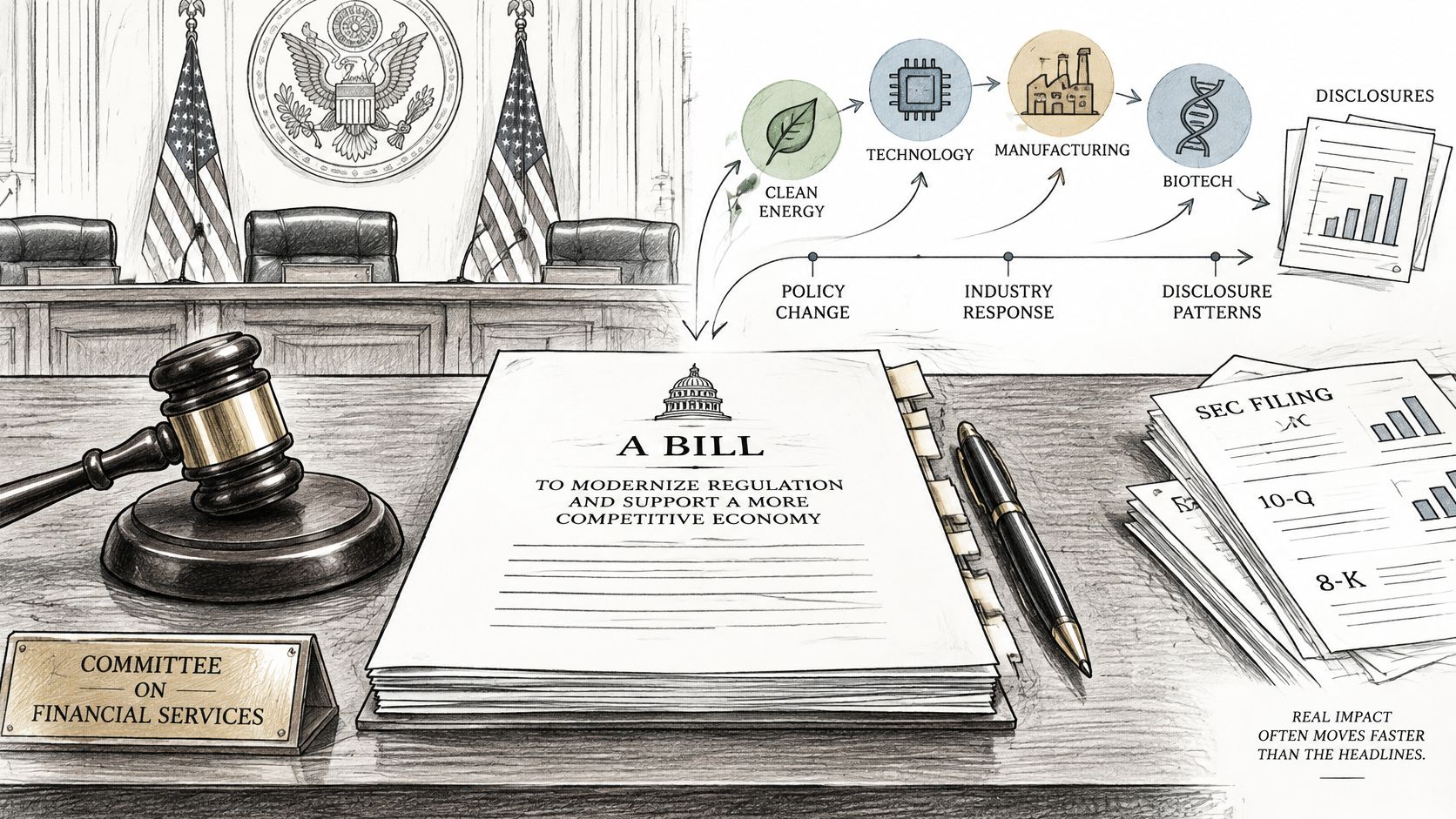
Test the sequence, not the political story
Start with the public bill calendar. Establish when the proposal, hearing, amendment, or vote became public, then compare those events with transaction dates, not alert dates.
Next, examine the filer's committee assignments and the policy's subject. A relevant assignment makes the relationship worth investigating, but membership alone doesn't prove access to material nonpublic information, meaning important information unavailable to the public.
- Check both parties: Apply the same timing and ownership tests to Democrats and Republicans.
- Look beyond the apparent cluster: Search for related sales, unrelated purchases, and activity that contradicts your initial explanation.
- Consider routine account management: Diversification, rebalancing, and family-account decisions are alternative hypotheses to test.
- Separate the stages of legislation: A proposal, a hearing, and an enacted law aren't equivalent events.
A supporter of the hypothetical bill might describe the purchase as confidence in the industry's future. A critic might describe it as a conflict of interest. Neither interpretation becomes established fact because it fits the reader's politics.
Write down what would disprove your theory
Ask whether the transaction preceded the relevant public information, whether the owner was correctly identified, and whether the broader account activity supports your interpretation. If the trade followed widely available news, that weakens a claim built on exclusive advance knowledge.
A disclosure can suggest a question worth asking. It rarely answers that question alone.
Before assigning meaning to a pattern, list the ordinary explanations and the evidence needed to distinguish them. That exercise is less exciting than a suspicious-trade headline, but it produces a more defensible conclusion.
Verify Every Signal Before You Act on It
The useful question isn't what an official bought. It's what you can establish from the record, what remained unknown when it became public, and whether your interpretation survives competing explanations.
The Congressional Research Service's analysis of congressional financial disclosure describes the reporting framework and its limits. For an investor, the practical distinction is between studying disclosed behavior and claiming an opportunity to reproduce the original decision.
Keep the limitations visible
- Incomplete precision: Value brackets don't establish exact exposure or execution prices.
- Incomplete timing: Reporting and publication separate the decision from your access to it.
- Incomplete ownership picture: A transaction doesn't establish current holdings.
- Incomplete explanation: The document doesn't tell you the investor's motivation.
- Changing records: Amendments can alter what you initially understood.
- Reporting boundaries: Transactions below the applicable threshold may be absent.
Run the same verification routine every time
Retrieve the official filing from the House Clerk or Senate system, rather than relying on a cropped screenshot.
Record transaction, awareness, filing, and publication dates. Mark missing dates unknown.
Calculate staleness using the day you're evaluating the signal, and preserve that evaluation date.
Check relevant SEC Form 4 and Form 13F records on SEC EDGAR, keeping transaction dates separate from holdings dates.
Compare the transaction with public bills, hearings, agency actions, and votes. Save the public document supporting any policy connection.
Log a conclusion, not an instruction: Record what the filing supports, what it doesn't, and what would change your assessment.
Keep a signal journal with the source, dates, hypothesis, and eventual outcome. Test interpretations through paper trading before committing money, and include signals that failed rather than saving only persuasive examples.
HeliosNet LLC offers TradeLikeInsiders, bringing STOCK Act congressional disclosures, SEC Form 4 insider filings, on-chain whale flow, and policy signals into a timestamped research workspace. Visit TradeLikeInsiders to compare the underlying records and practice your verification routine with its educational paper-trading tools.
This content is for informational purposes only and is not financial advice. Do your own research.