If a lawmaker buys a stock and you find out weeks later, are you looking at a trade idea, a historical record, or evidence of a conflict? Most coverage treats those three things as the same. They're not.
That's the gap the latest Congressional insider trading bill debate exposes. The current system doesn't ban Members of Congress from trading. It requires them to tell you afterward, often long afterward, and in a format that leaves out important context. A newer proposal would flip part of that logic by restricting purchases and forcing advance warning before some sales.
For a retail investor, the legal fight matters for a practical reason. It changes what information reaches you, when it reaches you, and whether you can trust the date on the screen to mean what you think it means.
Table of Contents
- Why Congressional Trading Matters to Your Portfolio
- The STOCK Act and the Disclosure Framework
- From Disclosure to a Potential Ban
- Key Provisions of the Proposed Bill
- Enforcement Mechanisms and Penalties
- How the Bill Would Change Market Signals
- How to Read Congressional Disclosures Responsibly
- What Investors Should Take Away
Why Congressional Trading Matters to Your Portfolio
You see a headline or a social post saying a politician bought shares in a defense, tech, or drug company. Your first instinct is simple. They must know something.
That instinct isn't irrational. Lawmakers sit in briefings, write bills, question regulators, and shape spending that can lift or hurt whole sectors. A corporate insider knows one company from the inside. A lawmaker can know where policy pressure is building across an entire industry before the public announcement lands.
The public trades on news. Insiders trade on information. A disclosure filing sits awkwardly between the two.
The Mistake Most Retail Traders Make
The headline rarely tells you the most important fact, which is timing. A congressional filing isn't a live alert from a trading desk. It's a lagged transparency record that can show up well after the decision was made and the price already moved.
- Sector exposure: A purchase can tell you which policy-sensitive area a lawmaker's household owned, not necessarily what they think today.
- Committee context: A trade linked to an industry a Member oversees raises a sharper ethics question than a trade with no policy connection, but that doesn't prove a trade used nonpublic information.
- Signal decay: By the time you're reading it, other investors, journalists, and data services may have processed the same filing.
That doesn't make the data useless. It makes it specific. Used well, it can flag areas where policy and money overlap, prompt you to check pending legislation, or help you compare political disclosures against corporate SEC Form 4 filings and institutional 13F reports. Those are primary sources, found through House and Senate disclosure systems and SEC EDGAR, not screenshots stripped of dates.
Used badly, it tricks you into chasing yesterday's position at today's price. The bill debate matters to your portfolio because it determines whether that lag shrinks, whether purchase activity disappears from the record, and whether a future sale becomes visible before it happens.
The STOCK Act and the Disclosure Framework
A congressional trade filing is a record of past activity, not a live market signal. The rules behind that record begin with the Stop Trading on Congressional Knowledge (STOCK) Act of 2012, enacted as Public Law 112-105 and signed on April 4, 2012. The Senate passed it 96 to 3 in February 2012, according to the Congressional Research Service history of the STOCK Act.
The law made clear that Members of Congress, congressional employees, and other covered federal officials remain subject to federal insider trading prohibitions. Those include Section 10(b) of the Securities Exchange Act of 1934 and SEC Rule 10b-5, which prohibit securities fraud, including trading on material nonpublic information. Officials also may not use nonpublic information gained through their government positions for personal benefit.
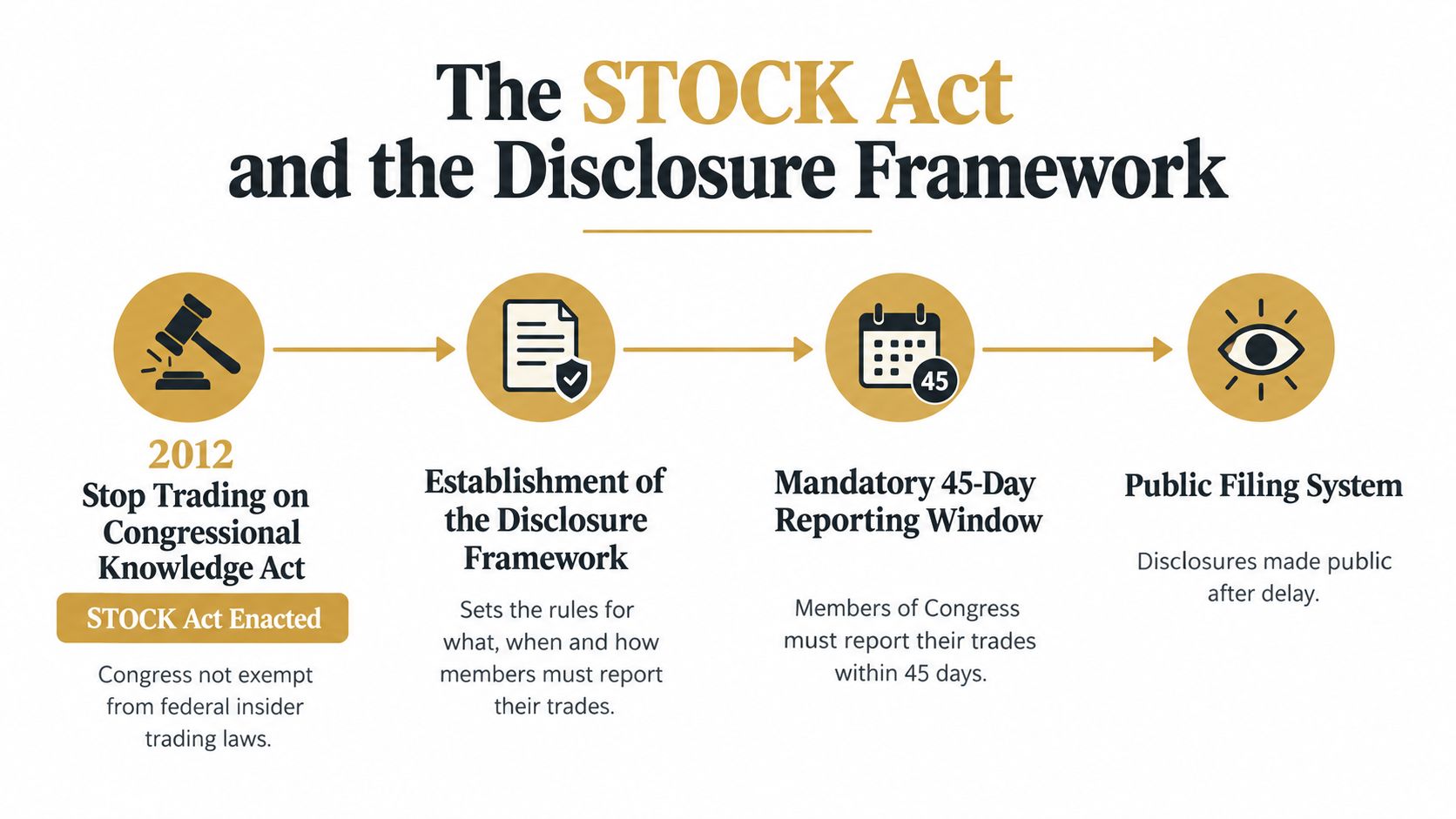
The STOCK Act established periodic transaction reporting. Covered individuals generally have 30 days after receiving notice of a qualifying transaction to report it, and must file no later than 45 days after the transaction. Financial disclosure reports must remain publicly available for six years after a Member leaves office.
That framework creates a public record, but it does not prevent lawmakers from owning or trading securities. It also covers assets beyond ordinary stocks, so the instrument listed in a filing matters when assessing what exposure changed.
For investors, the two dates answer different questions. The transaction date marks when the financial exposure changed; the filing date marks when the public could learn about it. A filing may therefore describe a position that is weeks old, making it evidence of past activity rather than a real-time forecast.
From Disclosure to a Potential Ban
Should lawmakers be allowed to trade securities at all, or should the rules focus on making trades visible and punishing misuse of confidential information? Recent proposals put that choice at the center of the debate.
During the 118th Congress (2023 to 2024), 20 bills or resolutions were introduced to limit or prohibit certain financial activities by Members and covered employees, but none passed either chamber, according to the congressional record for S. 2773 and related 118th Congress measures. The record points to the hard part of reform: lawmakers can agree that tighter rules deserve consideration, yet disagree on whether to restrict ownership, trading, or both, and whether blind trusts offer a workable alternative.
Two Different Theories of Reform
H.R. 1679, introduced March 21, 2023, was called the Bipartisan Ban on Congressional Stock Ownership Act of 2023. It would have barred Members and their spouses from owning or trading stocks, bonds, commodities, futures, and other securities. The bill was referred to several committees, including Financial Services, Agriculture, House Administration, and Ways and Means.
S. 2773, the Ban Congressional Stock Trading Act, was introduced in the Senate and referred to the Committee on Homeland Security and Governmental Affairs on September 12, 2023. The titles can sound alike, but the proposed rules would have different effects:
- Disclosure with enforcement leaves trading legal. Filings create a public record, while prosecutors or ethics bodies must establish misuse in a specific case.
- Ownership or trading bans aim to reduce conflicts by restricting what officials or their households can hold or trade. They would also reduce the flow of transaction data investors can monitor.
- Purchase bans with sale notice would block new positions while allowing existing holdings to be sold after public notice.
Newer proposals, including S. 1879 in the Senate and the House Stop Insider Trading Act, focus on those boundaries. They would reshape what a lawmaker's household may own and when a sale must be disclosed. For investors, the distinction matters: a filing may record past activity, while advance notice signals only an intended sale, not a completed trade.
Key Provisions of the Proposed Bill
The House proposal, H.R. 7008, is where the Congressional insider trading bill stops being a slogan and becomes a set of tradable information rules. It would generally prohibit Members, their spouses, and dependent children from purchasing covered investments, while allowing sales only after advance public notice filed 7 to 14 days before the intended sale and published online by the House Clerk or Senate Secretary, according to the Congress.gov summary for H.R. 7008.
What Changes on Day One
The purchase ban is the cleanest break from current law. Under the STOCK Act, a purchase is disclosed after it happens. Under H.R. 7008, a covered purchase generally shouldn't happen, and a violation can require divestiture, meaning forced disposal of the position.
The sale rule is more interesting for traders. Advance notice creates a statement of intent, not a completed trade. The seller may withdraw the notice, so you'd need separate labels for announced, completed, cancelled, and amended sales. Treating an intention as a done deal would create false signals.
Proposed Congressional Trading Restrictions at a Glance
| Proposal | Purchases | Sales | Penalty |
|---|---|---|---|
| H.R. 7008 Stop Insider Trading Act | Generally prohibited for Members, spouses, and dependent children | Allowed only after advance public notice | Greater of stated minimum or share of value, plus net gain, with possible divestiture |
| S. 1879 | Certain assets directed toward blind trusts | Managed through the trust structure | Depends on final legislative text and enforcement design |
| H.R. 1679 from the 118th Congress | Ownership and trading prohibited for Members and spouses across broad asset classes | Covered by the broader ownership and trading prohibition | Earlier proposal, not passed |
What Might Remain Legal
S. 1879 takes a different route by requiring certain assets to sit in blind trusts, where an independent trustee manages assets without the beneficiary directing trades. That can reduce direct control while preserving ownership economics.
Scope is where investors need to slow down. Does a bill cover existing holdings or only new purchases? Options? Sector funds or only individual stocks? Cryptocurrencies? Private-company holdings and other markets outside the restriction? Answers differ by proposal. A filing after a ban could reflect a legacy position, a permitted diversified fund, or an asset outside the bill's scope. It would not automatically mean a new conflict was created.
Enforcement Mechanisms and Penalties
A penalty changes incentives only if violations can be detected and pursued. H.R. 7008 sets a financial cost for violations: the greater of $2,000 or 10% of the transaction's value, plus any net gain realized during the specified period. A prohibited purchase could also require divestiture. The proposed framework combines purchase restrictions, advance sale notice, and financial penalties, as described in House Report 119-479 on the proposed framework.
The penalty formula raises the cost of a violation, especially when gains can be recovered. Its deterrent effect still depends on the odds of detection, the speed of review, and the capacity of the officials responsible for enforcement.
Public advance sale notices may make missed filings easier to identify. Applying the rules to spouses and dependent children adds a separate challenge: regulators need to connect accounts to the right household members before assessing compliance. Public legislative materials do not establish how often audits would occur or whether enforcement staff could review every covered transaction.
Existing law prohibits trading on material nonpublic information. That addresses the conduct of using confidential information. An ownership or purchase ban instead aims to prevent conflicts by limiting what officials can hold or buy. A violation of an asset restriction would not, on its own, prove that someone traded on inside information.
A separate 2026 Insider Trading Prohibition Act proposal takes a conduct-based approach. It defines unlawful trading around knowledge that information was wrongfully obtained, including through theft, bribery, hacking, or breach of duty, while preserving independently developed information from public sources.
For investors, the distinction matters: an illegal trade, a potential conflict, a late disclosure, and a useful trading signal are different things.
How the Bill Would Change Market Signals
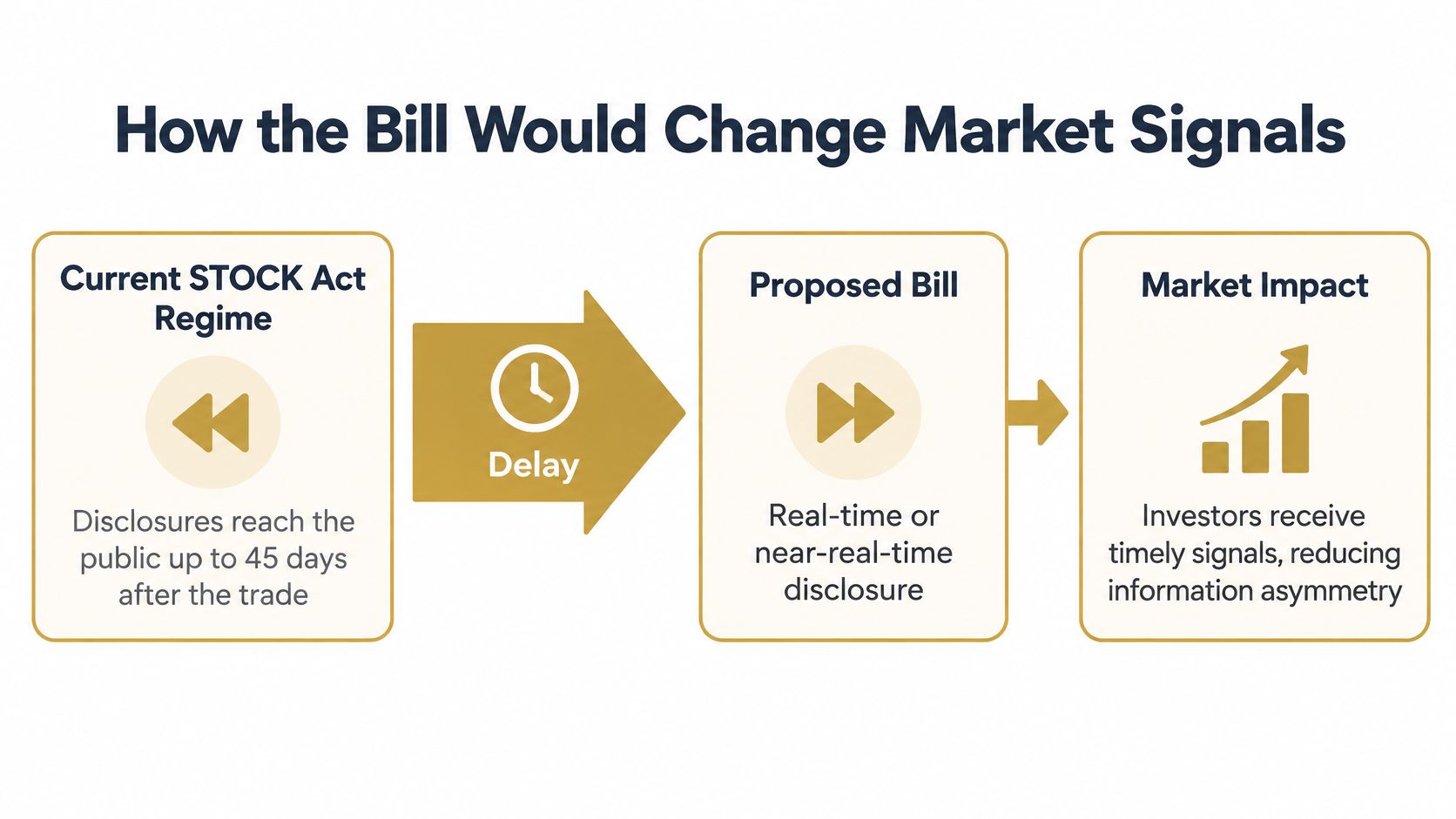
Current congressional data is backward-looking by design. The framework requires reports for covered securities transactions exceeding $1,000, with the filing deadline set at the earlier of 30 days after notice or 45 days after the transaction, as outlined in the Congressional Research Service guide to the current disclosure framework. Your information set begins when the filing publishes, not when the trade clears.
The comparison below shows why execution date and publication date need separate treatment.
A New Forward-Looking but Conditional Signal
Advance sale notice reverses the arrow. You could observe a planned sale before execution, watch whether it converts into a completed transaction, and measure price or volume around the notice rather than around a stale trade date. That's cleaner for event studies, which compare abnormal returns, volume, or volatility after a public event against matched securities.
It still isn't certainty. A notice can be withdrawn. A sale can be tax planning, diversification, divorce, tuition, or simple risk reduction. A purchase ban also removes the most copied signal entirely. You'd no longer track what covered households are newly buying because, legally, they shouldn't be buying covered assets.
Compliance noise matters too. Missing, late, amended, and ambiguous filings change when the market learned something and can distort any backtest that assumes clean timestamps. A responsible signal model labels execution date, statutory deadline, actual filing date, asset class, filer, and confidence level. Collapsing all of that into one red alert called insider trade is how bad research gets manufactured.
This short explainer is useful background before you compare that lag with faster corporate insider filings.
How to Read Congressional Disclosures Responsibly
Treat every filing like a forensic document. Don't start with the ticker. Start with the dates, the filer, and the form.
Under the STOCK Act, covered Members, officers, and certain senior staff must disclose reportable securities transactions exceeding $1,000 on a Periodic Transaction Report (PTR), by the earlier of 30 days after becoming aware of the transaction or 45 days after it occurred, according to House Ethics Committee STOCK Act guidance. The 45-day limit still applies even when the Member learns about the trade late. A covered transaction may also appear later on an annual financial disclosure, and amounts are commonly reported in ranges rather than exact dollars.
A Five-Check Routine
- Separate three dates: Transaction date, notification date, and filing date answer different questions.
- Identify the owner: Member, spouse, and dependent child holdings carry different context, and a broker or adviser may have placed the trade.
- Check asset type: Individual stock, bond, commodity future, option, and diversified fund exposures don't send the same message.
- Cross-check primary sources: Use House and Senate disclosures for politicians, SEC EDGAR for corporate filings, and 13F reports for institutional whale positioning.
- Write down what you don't know: Motive, remaining position size, and whether the trade was discretionary are often absent.
Corporate insider data runs on a faster clock. SEC Form 4 generally must be filed electronically by the end of the second business day after execution, and it can include purchases, sales, derivative exercises or conversions, and grants or awards, as shown in the SEC Form 4 filing record and guidance. An apparent sale may be tax withholding or a mechanical option exercise, not a bearish call. Read the transaction code, price, share count, and footnotes.
Tools can reduce the clerical work. TradeLikeInsiders tracks congressional trades, insider activity, whale moves, and policy signals in one place at TradeLikeInsiders, but aggregation doesn't remove the lag built into the underlying PTR. Use the alert to open the source document, not to skip it.
What Investors Should Take Away
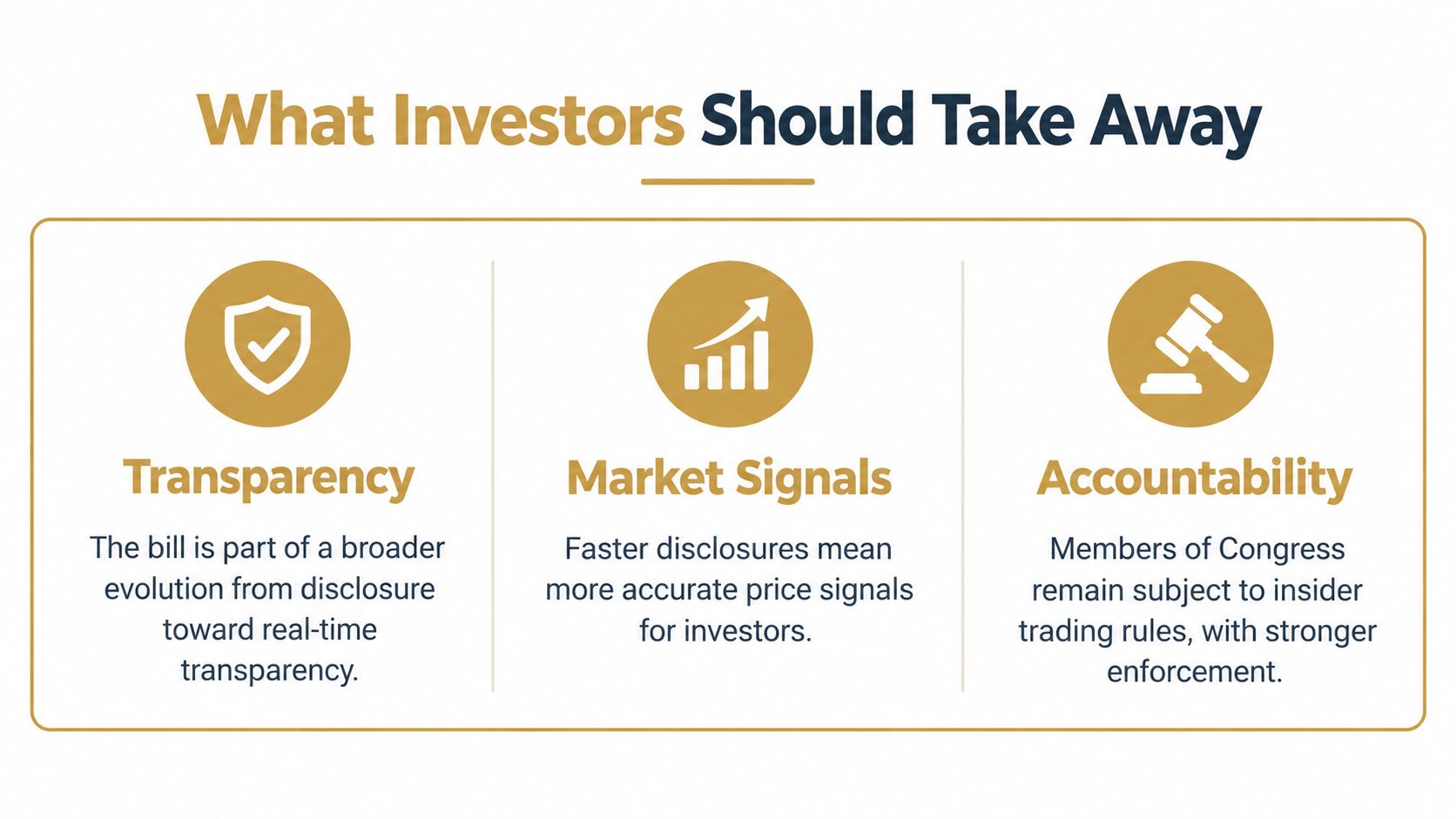
The cleanest mental model is evolution, not revolution. The 2012 law made congressional trading visible after the fact. The latest Congressional insider trading bill proposals try to limit or pre-announce the activity itself. Those goals overlap, but they solve different problems.
The summary graphic below is a useful checkpoint before you turn any filing into a thesis.
What a Ban Would and Would Not Prove
The 2025 Senate proposal S. 1879 would require Members, spouses, and dependent children to place certain assets in blind trusts, while the 2026 House Stop Insider Trading Act would prohibit purchases of publicly traded individual stocks but allow other investment categories, according to the legislative text for S. 1879. The House measure requires seven days of public advance notice for covered sales and uses the greater of $2,000 or 10% of value, plus forfeiture of realized profits.
So ask asset by asset. Existing holdings, sales, options, sector funds, cryptocurrencies, private assets, spouses, and dependent children may not be treated consistently. Unresolved gaps, including private-company holdings and markets outside the restrictions, mean a ban can reduce visible conflicts while leaving lawful policy-sensitive exposure elsewhere.
- Legality isn't predictive value: A legal, disclosed trade can still be stale, small within a reported range, or adviser-driven.
- Transparency isn't proof: A filing shows a transaction occurred. It doesn't prove material nonpublic information caused it.
- A quieter tape isn't a cleaner system by itself: If purchases disappear, you lose a signal. Whether information advantage disappears depends on scope and enforcement.
Your edge isn't copying a politician. It's understanding the clock, the form, and the incentives better than the person reposting a cropped alert. Build a process that checks primary sources, compares Form 4 and 13F context, and treats congressional disclosures as one lagged input among many.
This content is for informational purposes only and is not financial advice. Do your own research.
If you want congressional disclosures, Form 4 filings, whale activity, and policy signals organized with their source dates visible, TradeLikeInsiders offers that consolidated research view through TradeLikeInsiders. Use it to find the original filing faster, compare signals side by side, and practice your interpretation before risking real capital.