Table of Contents
- Count the value, not just the traffic
- Three signals that matter
- Why context beats the headline
- Read alerts as behavior, not prophecy
- A cleaner way to use alerts
- Bitcoin still pulls the crowd
- Ethereum is different, and that matters
- Slow filings still matter
- Institutions are delayed too
- Use a simple decision ladder
- Paper trade before you size up
Despite fewer daily Bitcoin transactions in early 2025, whale transfers became more dominant, and transfers above $100,000 made up 89% of total volume. The old advice to watch raw transaction counts misses the underlying story, because the market can look quieter while big money controls more of the settlement flow.
Why Whale Dominance Is Reshaping Crypto Markets
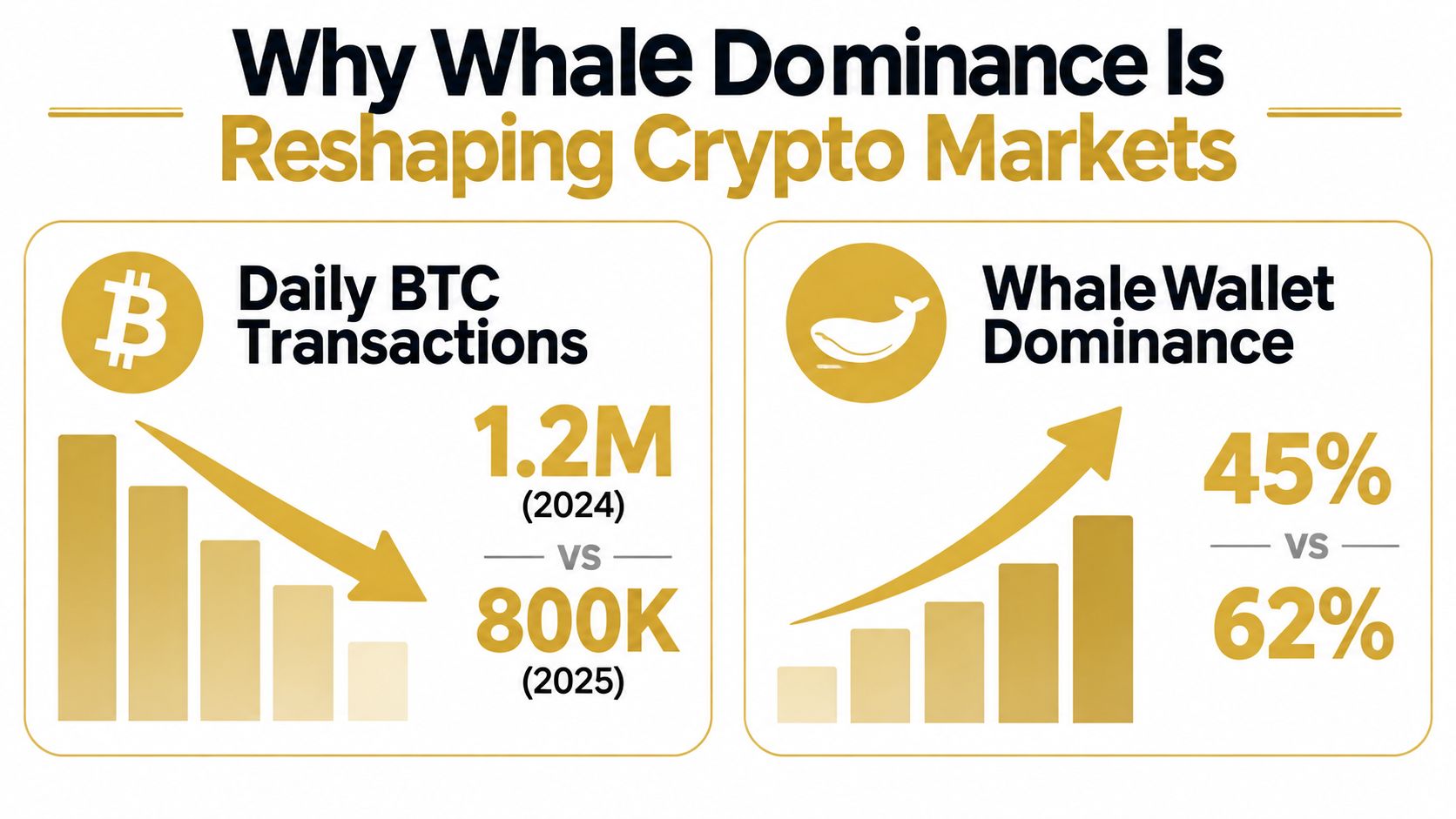
Most traders still read on-chain dashboards the wrong way. They see fewer transactions and assume the market has gone stale. In Bitcoin, that's a bad read. Glassnode data reported in June 2025 showed daily network transactions peaking at roughly 734,000 during 2023 to 2024, then easing to about 320,000 to 500,000 in early 2025, while settled value stayed large, with Bitcoin moving an average of about $7.5 billion on-chain per day and roughly $16 billion during the first break above $100,000 in November 2024 (The Block).
Count the value, not just the traffic
That's the part most dashboards bury. If you only watch transaction count, you miss the fact that the average transfer size rose sharply, with the average transaction around $36,200 and transfers above $100,000 representing 89% of total volume, up from 66% in late 2022 (The Block). In plain English, fewer hands can still move more money.
Practical rule: A lower transaction count is not a bearish signal by itself. If average size and high-value share are rising, the market is concentrating, not fading.
That changes how a trader should read a whale dashboard. A burst of small transfers can be noise, while a few large transfers can signal real settlement pressure, institutional repositioning, or portfolio rotation. The point isn't that whales always push price one way. The point is that capital concentration changes market structure, liquidity, and the odds that a single flow matters more than a hundred small ones.
The right takeaway is simple. Crypto whale activity is less about how busy the chain looks and more about who controls the value moving through it. If you want to follow smart money, stop asking how many transactions happened and start asking how much value changed hands, who moved it, and whether the flow sits on an exchange path or a private wallet path.
What Crypto Whale Activity Signals
A big transfer is not a full thesis. It's a clue. The mistake is treating every large move as either bullish accumulation or bearish dumping when a lot of it is just wallet reshuffling, custody movement, or infrastructure housekeeping.
Three signals that matter
A trader should separate accumulation, distribution, and mechanical movement. A large withdrawal from an exchange can reduce immediately tradable supply, but it doesn't automatically mean the holder is bullish. It can also reflect custody transfers, collateral moves, staking, or OTC settlement. The blockchain pattern looks similar, but the intent behind it isn't.
The most useful checks are practical:
- Net exchange inflows and outflows. Large inflows often raise selling-pressure risk, while sustained outflows can reduce liquid supply.
- Dormant-supply changes. When coins that haven't moved for a long time wake up, that can matter more than another headline-sized transfer.
- Holder concentration. If balances keep clustering in fewer wallets, the market gets more sensitive to big decisions.
A single whale move rarely tells the whole story. A cluster of related signals usually does.
Why context beats the headline
A lot of retail analysis breaks here. A wallet moving coins off an exchange can look bullish, but the same pattern can come from treasury management or a custodial shuffle. If you only react to the transfer itself, you're reading one frame of a longer movie.
That's why the useful question is not “Did a whale move?” It's “Did the move change the supply that can hit the market?” If exchange balances are falling, dormant supply is rising, and spot demand is firm, the signal is stronger. If only one wallet moved once, the signal is weak.
That's also why on-chain alerts work better when they're paired with market context. Whale activity becomes actionable when several things line up at once, not when one large transfer shows up in isolation. For traders who want a structured view of those signals, TradeLikeInsiders' blog is one place that organizes delayed disclosures and crypto flows together.
How to Interpret Whale Alerts Without Getting Trapped
A whale alert is not a buy signal. It's an attention shock. The Philadelphia Fed's work on whale notifications showed that smaller and medium Bitcoin wallets reacted quickly after public whale-buy alerts, which is exactly why chasing the alert can be dangerous. When too many traders respond at once, the alert itself can become part of the move.

Read alerts as behavior, not prophecy
The Federal Reserve's Philadelphia study examined more than 6,600 Bitcoin transactions and 5,000 Ethereum transactions from December 2017 through December 31, 2025. It defined a whale narrowly as a wallet sending more than $50 million, while excluding exchanges and smart contracts to reduce contamination from institutional plumbing. After whale-buy notifications, small and medium Bitcoin wallets increased their buying participation by between 14.81 and 23.72 percentage points in the first 15 minutes. After whale-sell alerts, selling participation rose by 12.95 to 29.52 percentage points, and the effects were statistically significant at the 1% level (Philadelphia Fed coverage).
That doesn't mean the whale was “right.” It means followers moved fast.
A cleaner way to use alerts
Treat the alert as the first line in a checklist, not the final answer.
- Check the asset. BTC, ETH, and WBTC don't react the same way.
- Check the direction. Inflow to exchange, outflow to cold storage, and wallet-to-wallet transfers are not identical.
- Check the holder type. Exchange wallets, smart contracts, and internal treasury movements can distort the signal.
- Check the timing window. The first few minutes matter differently from the next few hours.
- Wait for confirmation. Price, volume, and follow-on flows matter more than one isolated alert.
The point is discipline. Whale alerts often trigger crowd behavior, and crowd behavior can create the short-term move you think you spotted. If you want to build a calmer workflow around those alerts, use the signal to ask better questions instead of rushing into the trade.
BTC, ETH, and WBTC React Differently to Whale Moves
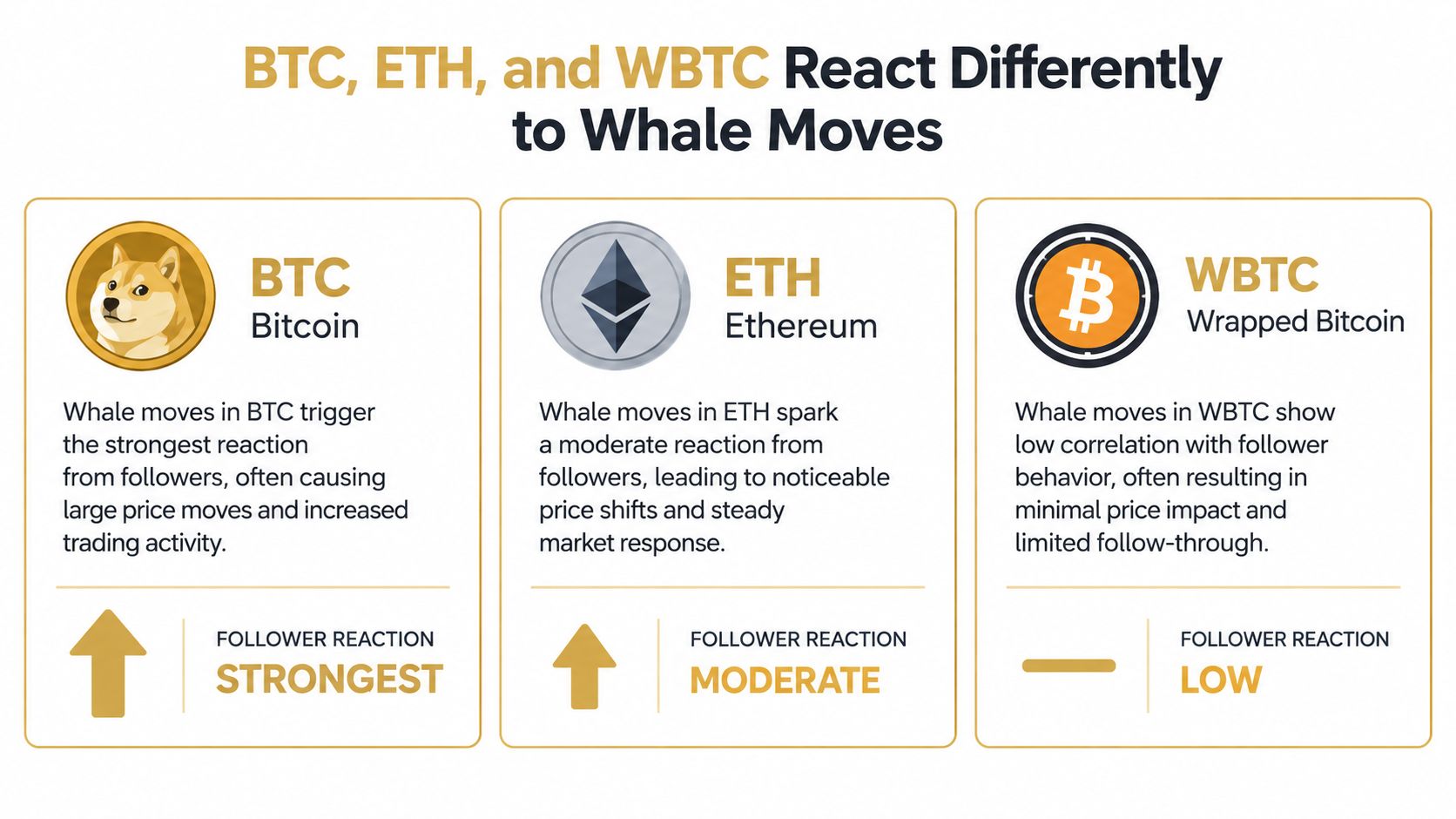
Not every whale move means the same thing across assets. Bitcoin tends to produce the clearest follower response, while Ethereum behaves differently and Wrapped Bitcoin sits in its own lane. If you treat them as one bucket, you'll misread the signal.
Bitcoin still pulls the crowd
The Philadelphia Fed found that large-holder alerts changed the composition of active BTC participants and triggered leader-follower behavior among non-whale traders (Philadelphia Fed). BTC also showed a brief volatility increase over about 24 hours, which is why Bitcoin whale alerts can be useful when you're watching for crowding risk rather than trying to predict a clean directional move.
That's the asset where alert timing matters most. A few minutes can be enough for smaller wallets to pile in, but the follow-through is what tells you whether the market cared.
Ethereum is different, and that matters
The same Philadelphia Fed research found that ETH volatility decreased after alerts, and that ETH's return volatility is driven more by small retail investors than by whales (Philadelphia Fed working paper). That's the opposite of the simplistic “whales move everything” story. For ETH, the alert can be real, but the market response may be muted, reversed, or driven by the crowd rather than the original whale.
WBTC adds another wrinkle. The strongest BTC-volatility response followed WBTC alerts, which is a reminder that wrapped assets can carry their own flow dynamics even when they resemble the underlying coin on the surface (Philadelphia Fed).
Trader's edge: Set different reaction horizons for BTC, ETH, and WBTC. One-size-fits-all whale rules usually fail.
The practical move is to stop using one generic “whale score.” Separate the asset, the token form, and the follow-up window. BTC alerts can flag crowding risk. ETH alerts need more caution. WBTC deserves its own watchlist because its market response can be different again.
Combining On-Chain Whales with Policy and Filing Signals
On-chain activity gives you speed, but disclosures give you structure. The best read on large-money behavior usually comes from combining both, because crypto flows, corporate insider activity, and policy changes all move on different clocks.
Slow filings still matter
Congressional disclosures are useful, but they lag. Under the STOCK Act, covered congressional personnel generally must report a securities transaction over $1,000 within 30 days of receiving notice and no later than 45 days after the transaction occurs. The filing reports values in ranges such as $1,001 to $15,000 and $15,001 to $50,000, so you get an approximate size, not exact exposure. That means the public is often looking at a trade that's already stale by the time it appears.
SEC Form 4 is faster. It generally has to be filed by the end of the second business day after a reportable insider transaction, and it tells you the reporting person, the transaction date, the code, the number of securities, the price, and the resulting holdings. That's enough to separate a real open-market buy from an award, option exercise, tax withholding, or prearranged sale. A congressperson's filing and a CEO's Form 4 are not the same kind of signal, and they shouldn't be read the same way.
Institutions are delayed too
Form 13F has a different problem. A qualifying institutional manager generally files it within 45 days after quarter-end, and the filing reflects holdings as of that quarter-end date. It's a snapshot, not a live book. It can still be valuable for seeing broad positioning and changes in concentration, but it won't show you crypto exposure, short positions, or cash.
That's why policy matters alongside filings. A Congressional Research Service overview of the proposed CLARITY Act describes a structure that would give the CFTC a central role over digital commodities while preserving SEC authority over some primary-market transactions, and it also describes potential exemptions tied to mature blockchains and specific conditions (Congressional Research Service overview). Those mechanics can shift who regulates what, what gets disclosed, and which market segments feel the pressure first.
For a trader, the clean approach is to separate real-time on-chain flow, delayed disclosure flow, and policy flow. HeliosNet LLC at TradeLikeInsiders is one example of a platform that aggregates congressional trades, SEC insider filings, whale activity, and policy signals in one place, which can help if you want the whole stack in one dashboard.
Building a Discipline-First Whale-Tracking Routine
A workable whale routine is boring on purpose. It filters noise, timestamps what matters, and forces you to prove the signal before you risk money on it.
Use a simple decision ladder
Start by asking whether the move is unusual relative to the recent baseline. If the transfer looks big but sits inside normal flow, it may not deserve attention. Then check whether the move changes liquid supply, because the difference between a wallet reshuffle and an exchange inflow is huge.
From there, compare the filing or alert against its proper time frame. A congressional disclosure is historical. A Form 4 is faster but still not a live feed. A 13F is a quarterly snapshot. On-chain whale activity is the closest thing to real time, but even there, the market reaction depends on the asset and who else is watching.
Don't trade the headline. Trade the evidence that survives the next check.
Paper trade before you size up
The cleanest way to test your read is to journal it first. Write down the asset, the wallet type, the venue, the time stamp, and the reason you think the signal matters. Then compare your thesis with what happened after the alert, not just what happened in the first minute.
A few habits help:
- Separate signal from story. A nice narrative isn't proof.
- Use quarter-over-quarter comparisons for 13Fs. Treat them as slow institutional context, not live order flow.
- Look for alignment. Whale flow, policy change, and disclosure timing are stronger together than alone.
- Simulate before you commit. A paper-trading run shows whether your reaction rule is useful or just emotional.
That approach is slower than chasing every alert, but it's better. If you want a place to track these signals and practice with structure, TradeLikeInsiders is built around that workflow.
This content is for informational purposes only and is not financial advice. Do your own research.
HeliosNet LLC offers a market research and alerting platform that combines congressional trades, SEC insider filings, whale activity, and policy updates with AI summaries and paper trading. If you want to follow those signals in one place, visit TradeLikeInsiders and decide whether its alerting and simulation tools fit your workflow.