A crypto whale is an individual, institution, exchange or wallet holding an unusually large amount of a digital asset. For Bitcoin, the common convention is more than 1,000 BTC, and there is no official threshold.
The popular advice is to follow the whales. That skips the hardest question: are you watching an investor make a decision, or a service move somebody else's money? A large wallet is a balance, not necessarily a trader, and a transfer isn't necessarily a trade.
Table of Contents
- What a Crypto Whale Means in Plain English
- Why a Big Wallet Is Not Always One Investor
- How to Detect Whale Activity Step by Step
- Common Whale Moves and How Traders Read Them
- How Stock Market Whale Signals Compare to Crypto
- How Policy Moves Sectors Before Disclosures Catch Up
- Limits of Whale Signals and Common Misreads
- Confirm a Whale Signal Before You Act
What a Crypto Whale Means in Plain English
The simplest way to understand crypto whale meaning is to think about a bidder at a thinly attended auction. A bidder with enough money can move the price because there aren't many competing offers. In crypto, the important relationship is between a holder's size and liquidity, meaning how easily an asset can be traded without substantially changing its price.
There's no universally fixed legal or technical whale category. A Philadelphia Fed working paper discusses the common more-than-1,000-BTC balance convention, another convention based on a transfer of at least $50 million, and Bitcoin's maximum supply of 21 million coins.
Those definitions measure different things. A balance describes assets held at a particular moment; a transfer describes movement. Neither identifies the owner's strategy.
Whale conventions and reference figures
| Convention | Threshold | Source and year | What it tells you |
|---|---|---|---|
| Bitcoin holder by balance | More than 1,000 BTC | Common research and market-analysis convention described in the working paper above | Large holders are material against a 21 million coin cap |
| Single large transfer | At least $50 million in one transfer | Another research convention described in that paper | Measures movement, not holdings |
| Mid-tier Bitcoin whale | 100 to 1,000 BTC | Glassnode, reported by Moomoo, September 2025: average holding approximately 488 BTC | Average balance per address had been falling |
| Large-holder band | 1,000 to 10,000 BTC | IntoTheBlock, reported by Cointelegraph, 2024: 24.17% of total Bitcoin supply | Concentration of supply in a single band |
| Count of 1,000+ BTC entities | 1,678 entities holding at least 1,000 BTC | Glassnode, reported by CoinDesk, October 2024 | Highest level since January 2021 |
Notice that providers don't always use the same boundary. Some classify addresses, while others estimate entities, meaning owners or organizations whose related addresses have been grouped together.
Say a holder controls several thousand coins. That balance matters against Bitcoin's limited supply, but its immediate market influence still depends on whether the holder trades and how much buying interest is available.
Practical rule: A whale label tells you where to look, not what to conclude.
Why a Big Wallet Is Not Always One Investor
A big address doesn't automatically belong to a rich individual. An address is a blockchain destination associated with assets; a wallet is the software or control system used to manage addresses and authorize transactions.
An exchange might pool customer assets at an address it controls. A custodian, a business that safeguards assets for clients, can do the same. Investment funds, corporate treasuries and decentralized finance protocols can also control large balances.
The ownership possibilities look like this:
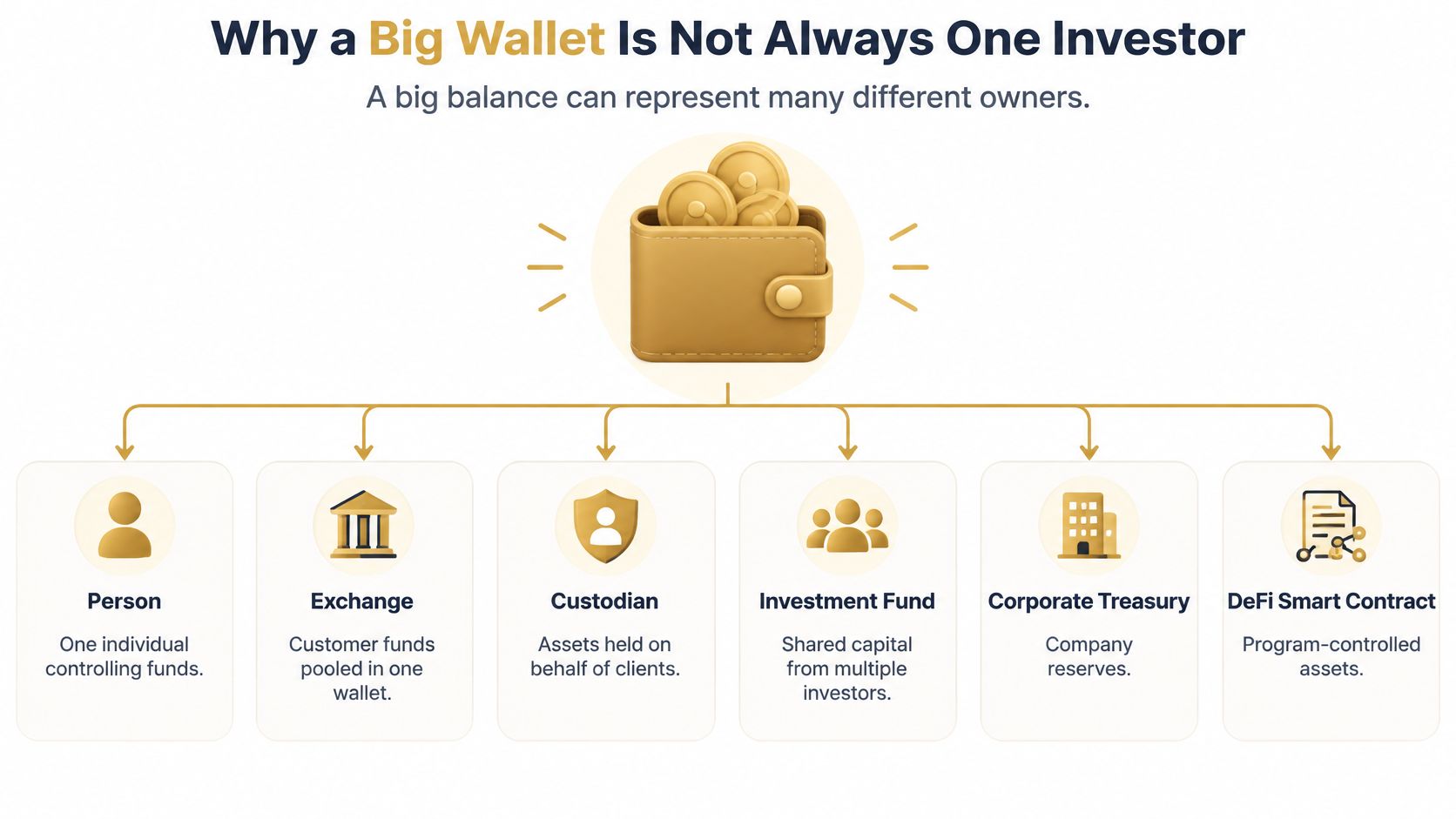
A CoinDesk ownership analysis published in 2025 warns that ownership estimates aren't definitive because custodians aggregate clients, wallet classifications can be wrong and ownership is often opaque; it also describes a separate report finding that more than 30% of circulating Bitcoin was held by 216 centralized entities, including exchanges, funds, custodians, companies, protocols and governments.
Separate balance, control, ownership and intent
Keep these distinctions clear:
- Address size: How much sits at the observed blockchain address.
- Entity ownership: Which organization or person appears to control that address.
- Beneficial ownership: Who ultimately has the economic claim to the assets.
- Transfer intent: Why the controller moved them.
Say a custodian sends assets to a new storage address. Control changes at the address level, but clients' economic ownership may remain unchanged. Treating that transfer as a fresh investment decision would misread the event.
An exchange-traded fund, or ETF, pools investors' money in a product traded on an exchange. Its asset movements might reflect rebalancing rather than a manager's directional bet. Transfers can also support collateral management, meaning moving assets pledged to secure obligations.
That's why attribution needs corroboration from exchange inflows, repeated movements and derivatives positioning. Derivatives are contracts whose value depends on an underlying asset. Raw wallet rankings are weak investor rankings when pooled ownership sits behind the balance.
How to Detect Whale Activity Step by Step
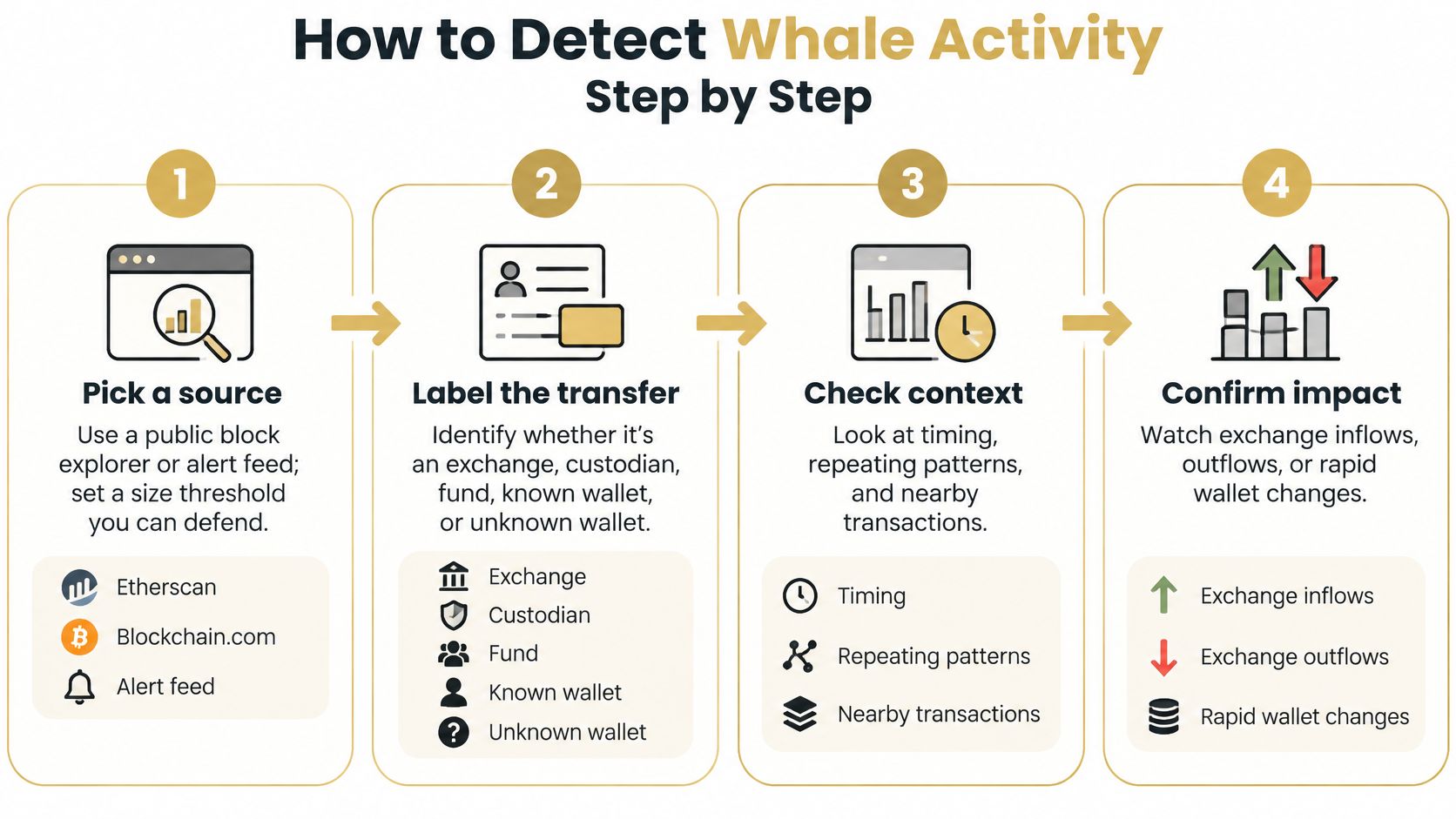
A whale alert tells you that coins moved. It does not tell you why, and it certainly does not tell you what the owner will do next. The job of detection is to close that gap, starting from an event you can verify rather than a screenshot claiming that somebody knows something. A block explorer, a searchable record of blockchain activity, lets you inspect the transaction itself: the amount, both addresses and the confirmation status.
Use this workflow to turn an alert into a testable observation:
- Pick a source and threshold. Use a public block explorer or transfer-alert feed. Set the threshold to the asset rather than copying a Bitcoin filter onto a much smaller market, where a far smaller transfer can dominate the day's volume.
- Label both sides. Classify the sender and recipient as an exchange, custodian, fund, known entity or unknown address. Keep a tentative tag tentative; upgrading a guess into a fact is how misreads start.
- Identify the route. Separate an exchange deposit from a transfer between two addresses run by the same organization. The destination shapes which hypothesis even makes sense.
- Look for a pattern. Pull up nearby transactions and earlier movements from the same labeled entity. A repeated sequence reads differently from a one-off operational shuffle.
- Measure trading conditions. Inspect order-book depth, the quantity of buy and sell orders near the current price, and slippage, the gap between an expected execution price and the price actually received. A transfer that looks huge means little if the market can absorb it smoothly.
- Cross-check market activity. Compare volume against its usual baseline, watch whether exchange balances are rising and check open interest, the value or number of outstanding derivatives contracts.
- Keep an event journal. Record the timestamp, labels, hypothesis, uncertainty and what the price did afterward. Include the signals that failed, because a journal of only winners teaches you to trust noise.
Why context beats raw size
An event study of 2,132 Bitcoin transfers involving at least 500 BTC found that effects varied with size and inferred motive; exchange-linked transfers showed a small average price increase during the 140 minutes before confirmation and a decline during the final 15 minutes.
The aggregate results were ambiguous. Treat that as a warning against turning every alert into the same directional prediction.
A stronger signal combines a verified transfer with deteriorating liquidity, rising exchange balances, leveraged positioning or repeated activity from the same entity.
Even that combination is evidence to investigate, not an instruction to trade. A big address is a balance, and the workflow above is how you find out whether a trader sits behind it. Raw size alone produces too many plausible but wrong interpretations.
Common Whale Moves and How Traders Read Them
| Whale move | Usual reading | First check |
|---|---|---|
| Transfer into an exchange deposit address | Possible intent to sell or hedge, meaning offset another exposure | Is the exchange balance rising, and is order-book depth thin? |
| Withdrawal from exchange to private wallet | Often custody or longer-term holding | Are there repeat withdrawals from the same entity? |
| Transfer between wallets of one entity | Internal reshuffling, not a trade | Is the recipient a known custodian or treasury wallet? |
| Transfer to or from a fund or custodian address | Rebalancing or collateral movement | Do fund flow or exchange data confirm it? |
| Repeated buying from one labeled address over days | Possible accumulation, meaning an increasing position | Did price and volume respond, or did the move follow the news? |
| Coordinated selling across several large addresses | Possible distribution, meaning a reduced position, or hedging | Did liquidity deteriorate on the venues involved? |
Every reading in that table is a hypothesis, not a verdict. In particular, repeated transfers into an address don't establish repeated buying unless the underlying transactions support that interpretation.
A large exchange sale can consume available bids, the standing offers to buy, and push execution prices lower. Moving assets into cold storage, where signing keys are kept offline, may instead be a custody decision with no immediate sale.
Concentration matters, but causation is harder
A Bitcoin market-microstructure study summarizes findings that 1,840 addresses controlled more than 51% of Bitcoin in 2012, while the 100 largest addresses accounted for about 13.52% of supply in 2021; it also cites modeling in which increasing whales' holdings share from 1% to 6% produced a 104% increase in simulated daily volatility.
Those address groups aren't directly comparable, and custodial balances complicate both. The simulation illustrates a possible mechanism, not a forecast of what actual holders will do.
The cause-and-effect story also varies by asset. A Philadelphia Fed discussion of 2025 academic findings reports that large holders of ETH, Ethereum's native asset, tended to add before price increases, yet small retail investors contributed more to ETH-return volatility; another study found whales were predominantly net shock receivers, while smaller minnow and dolphin groups were net shock transmitters.
In plain English, large holders can absorb market disturbances rather than originate them. Positioning ahead of a rise and causing volatility are different claims.
Label the evidence observation, possible accumulation, possible distribution or liquidity movement. Then ask the question that hype usually leaves out: did this activity lead the price move, or follow it?
How Stock Market Whale Signals Compare to Crypto
Crypto monitoring starts with transactions visible on a blockchain. Stock-market monitoring often starts with legally required disclosures, which identify activity more explicitly but arrive after execution.
The comparison is useful because visibility and timeliness aren't the same thing.
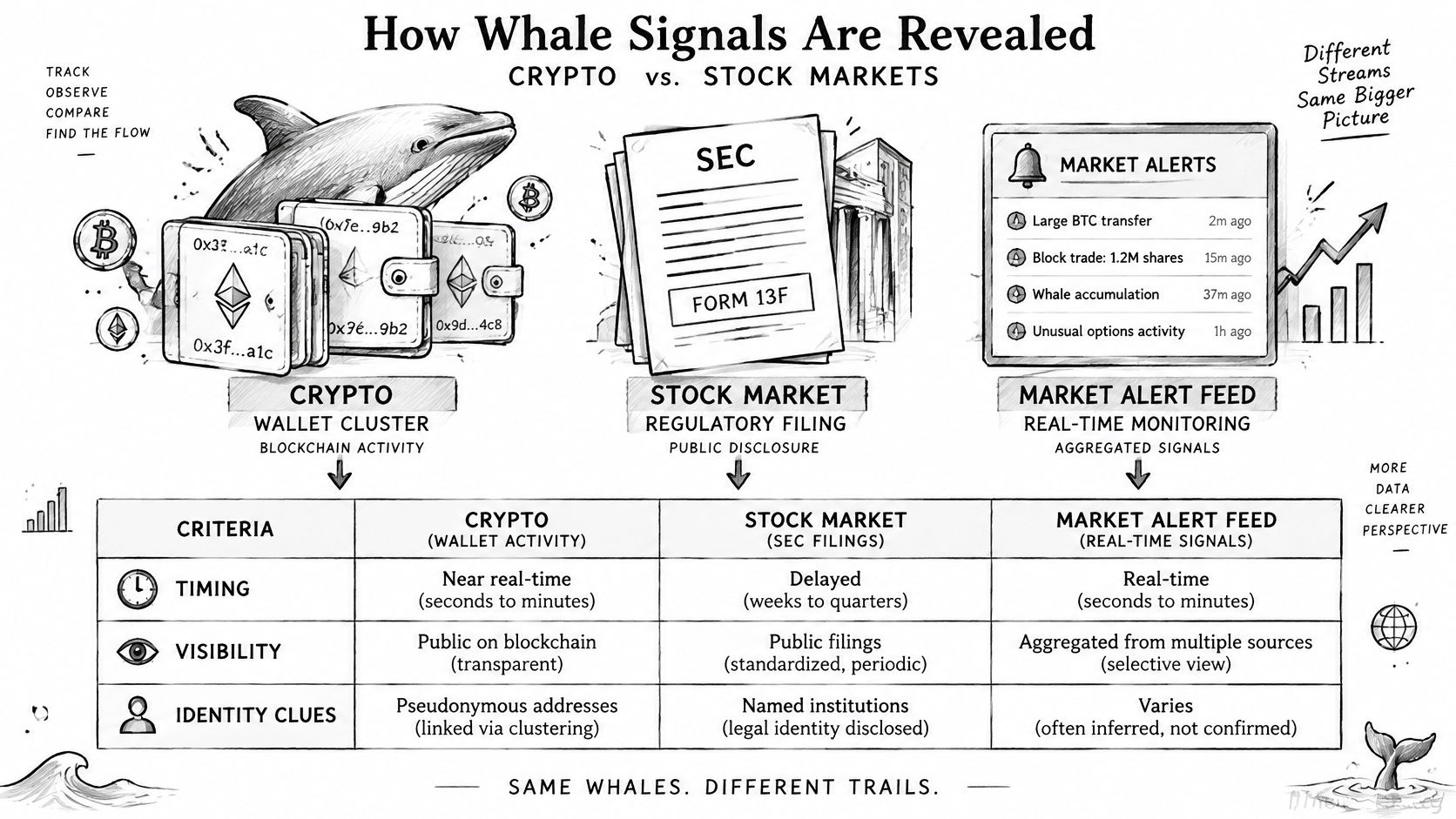
Three disclosure streams compared
| Stream | Who files and threshold | Filing deadline | What the filing shows |
|---|---|---|---|
| Congress, STOCK Act PTR | Members, officers and covered employees; covered securities trades exceeding $1,000 | Earlier of 30 days after notice or 45 days after the trade, under the House financial disclosure guide | Past transaction and value range, not exact profit or loss; the sales threshold uses total transaction value |
| Corporate insiders, SEC Form 4 | Corporate insiders reporting changes in beneficial ownership | Generally before the end of the second business day after the transaction, under the SEC Form 4 instructions | Reporting person, issuer, transaction date, transaction code, securities, price and resulting holdings |
| Institutions, SEC Form 13F | Managers meeting the Section 13(f) reporting requirement | Quarterly, generally within 45 days after quarter end, as described in this SEC-hosted discussion of Form 13F requirements | Certain Section 13(f) securities; a delayed snapshot, not a live portfolio |
A Periodic Transaction Report, or PTR, records covered congressional transactions under the STOCK Act. Its reported amount is a range, so don't treat a tracker's presentation as an exact execution value or a current position.
Form 4 offers more transaction detail. An open-market purchase is more directly informative about a voluntary investment decision than automatic vesting, tax withholding, an option exercise or a planned sale. It still doesn't prove that the insider knows future returns.
Use the accompanying video as additional context, then verify any transaction against the filing itself.
Verify Form 4 and Form 13F records through SEC EDGAR, the SEC's public filing database. Check congressional PTRs through the House and Senate financial disclosure portals.
All these filings are delayed records. The congressional and insider disclosures on TradeLikeInsiders are delayed too, not real-time trades. A faster alert about a filing doesn't make the underlying transaction newer.
How Policy Moves Sectors Before Disclosures Catch Up
A policy event can matter more than a prominent person's trade because it changes the economics of an entire industry. Legislation, agency rules, subsidies, tariffs and enforcement actions can alter expected revenue, costs, competition or demand.
Say a proposed rule raises compliance costs for a group of businesses. Traders may revise their earnings expectations as the proposal advances, before affected companies report any financial impact. A later transaction disclosure doesn't establish who anticipated what.
Build a dated policy timeline
- Map the economic exposure. Identify which sectors could gain revenue, face higher costs or encounter new competition. Separate direct effects from appealing but weak associations.
- Find the public record. Use bill text, a committee schedule, an agency docket or an official release. A proposal, a vote and an effective rule are different events.
- Compare the market response. Check price and volume around the policy event, rather than assuming the disclosure publication date explains the move.
Keep the sequence explicit: policy announcement, market response, transaction date and filing date. A filing shows what was reported, not why the person traded.
Evidence standard: A dated public document is useful. A rumor about somebody's political connections isn't a substitute.
Apply the same method to both parties. Either party's agenda can create winners and losers, and political agreement isn't an investment thesis. Check competing explanations such as earnings releases, broad market moves and company announcements before attributing a price change to Washington.
Limits of Whale Signals and Common Misreads
- A whale bought, so price will rise. The apparent purchase may not represent fresh demand.
- An exchange deposit means a sale is coming. The assets may serve another purpose.
- An insider sale always signals bad news. Personal finances and transaction mechanics matter.
- A congressional trade shows a current position. A past transaction isn't a live account statement.
Say an alert describes a large receipt as buying. If the sender was the same owner's exchange account and the recipient was a custody address, the owner may have changed storage arrangements. There was no demonstrated net new demand.
Similarly, an exchange deposit could support collateral or hedging. An insider might sell to cover taxes, diversify personal wealth or execute an existing plan. A congressional filer could change a holding again before readers see the earlier transaction.
Test the misses, not just the hits
Attribution error means assigning activity to the wrong owner or motive. A confident-looking wallet tag can still be wrong, and several addresses moving together don't establish that independent investors coordinated.
Hindsight bias makes an outcome seem predictable after it happens. Survivorship bias appears when a tracker highlights successful alerts but omits failed or unremarkable ones.
Ask for the full record: how often did similar alerts occur, how many failed, and what counted as success before the outcome was known? Without those definitions, a collection of winning examples isn't a tested strategy.
Ownership concentration can increase exposure to liquidity risk without establishing direction. Whale signals are useful inputs for context and risk assessment, but weak standalone predictions.
Confirm a Whale Signal Before You Act
Before treating an alert as actionable information, check the evidence behind it:
- Verify attribution. Is the label backed by a filing, a documented address relationship or merely a tag?
- Check repetition. Is this isolated, or part of a consistent pattern from the same entity?
- Seek corroboration. Do liquidity, volume and derivatives conditions support the proposed interpretation?
- Read the timestamps. Distinguish transaction time, blockchain confirmation, filing time and alert publication.
- Inspect the catalyst. Does public policy or company news explain the activity more convincingly?
- Test an alternative. Could custody, rebalancing or an internal transfer explain the same observation?
Decide your rules before the alert
No single whale signal justifies a trade by itself. Set your own risk limits, position-sizing rules and exit logic before a dramatic notification tempts you to improvise.
Write down what would disprove your interpretation. Then log the result, including occasions when doing nothing was the sensible decision.
The useful habit isn't copying a large holder. It's separating what you observed, what you inferred and what remains unknown.
At HeliosNet LLC, we bring congressional disclosures, SEC insider filings, on-chain whale flow and policy signals together through TradeLikeInsiders. Visit TradeLikeInsiders to compare those records and use our paper-trading simulator to practice evaluating signals with simulated money.
This content is for informational purposes only and is not financial advice. Do your own research.