
The most popular advice about government insider trading is also the least useful: find out what a politician bought, then copy it. That sounds simple until you notice the filing may arrive weeks after the trade, report the value in a broad range, and reveal nothing about whether the person acted on privileged information.
The better approach is less exciting and more practical. Treat congressional disclosures, corporate insider filings, and institutional holdings as delayed evidence, not live instructions. The public trades on headlines. Insiders, officials, and large funds may trade on information, mandates, hedging needs, or portfolio mechanics that you can't see from one filing.
Table of Contents
- Why Government Insider Trading Is Mostly a Reading Problem
- The STOCK Act and the Rules Congress Actually Follows
- Form 4, Form 13F, and the Corporate Side of the Story
- What Real Cases Tell Us About the Line Between Smart and Inside
- How Policy and Legislation Move Markets Before Anyone Files
- How to Read These Signals Without Fooling Yourself
- What This Can and Cannot Do for Your Portfolio
Why Government Insider Trading Is Mostly a Reading Problem
Government insider trading is usually presented as a question of guilt. Did a lawmaker know something, trade around it, and profit? That question matters, but a public filing rarely answers it by itself. A disclosure tells you that a transaction occurred. It doesn't automatically prove intent, knowledge, illegality, or even that the official personally chose the trade.
The more useful question is: what can a retail investor responsibly infer from a late and incomplete public record?
Congressional disclosures are public, but they aren't designed as a real-time trading feed. The STOCK Act created a formal disclosure regime, and one 2026 tracker reports 44,254 disclosed congressional stock trades across 247 senators and representatives, including 22,761 buys and 21,312 sells. Those figures show the scale of the record, not a ready-made strategy. The Congressional Research Service explains the STOCK Act framework and disclosure requirements.
The signal is real, but noisy
A purchase can reflect long-term conviction, diversification, a spouse's account, an automated investment decision, or a position that is small relative to the household portfolio. A sale can reflect taxes, liquidity needs, rebalancing, or an ordinary change in risk. The filing usually can't tell you which explanation is correct.
Range reporting creates another problem. A Periodic Transaction Report may show a bracket rather than an exact dollar amount, so two transactions displayed in the same range can have very different economic significance. The public record gives you a direction and an approximate scale, but not the full portfolio context.
Practical rule: Read the filing as a clue about exposure, not as proof of a trade thesis.
That distinction also keeps the politics out of the analysis. The same standard should apply to officials from either party. A trade deserves scrutiny because of its timing, policy connection, size, and disclosure history, not because of the official's political label.
The edge is therefore not speed. You won't beat a market reaction that happened before the filing appeared. Your edge, if you develop one, comes from reading the rules correctly, checking the original document, and refusing to turn an ambiguous disclosure into a confident story.
The STOCK Act and the Rules Congress Actually Follows
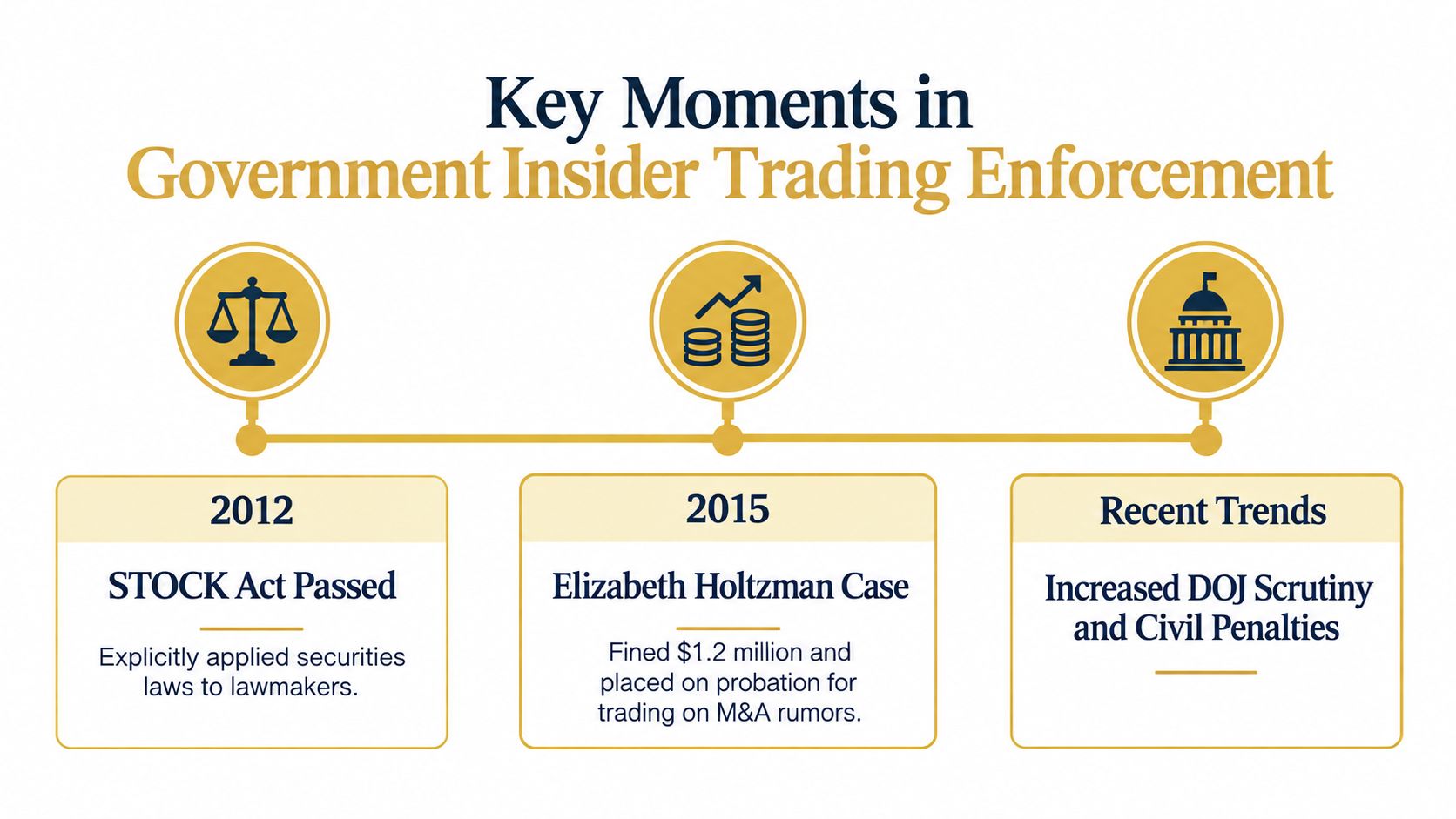
The Stop Trading on Congressional Knowledge Act, commonly called the STOCK Act, became law on April 4, 2012. It extended existing insider-trading prohibitions to members of Congress, congressional staff, and employees in the executive and judicial branches. It also required certain financial transactions to be disclosed within 45 days, replacing a system that relied on annual reporting. The Congressional Research Service describes the law's scope and reporting mechanics.
That last point is the part traders care about most. A transaction that meets the reporting trigger isn't supposed to remain invisible until the next annual filing. For covered officials, trades over $1,000 generally require a Periodic Transaction Report, commonly called a PTR, within the applicable disclosure window. A separate summary of the STOCK Act filing process describes the $1,000 threshold and 45-day deadline.
What the filing does and doesn't prove
The law serves two purposes. First, it makes financial activity visible to the public. Second, it makes clear that holding public office doesn't create a special exemption from general insider-trading law. Disclosure is not permission. An official can comply with a filing requirement and still face questions about whether a trade used material nonpublic information.
The public venue matters. House and Senate financial disclosure systems publish reports that researchers, journalists, and data platforms can search. The original PTR remains the important document because summaries can omit context, use inconsistent labels, or display a transaction without the surrounding holdings information.
The reporting window is also where many retail readers get misled. A filing date isn't necessarily a trade date, and the date you see may be far removed from the date when the decision was made. By the time a transaction becomes searchable, the market may have absorbed the relevant policy news or moved on to a different catalyst.
| Covered Party | Triggering Transaction | Filing Deadline | Public Venue |
|---|---|---|---|
| Members of Congress and certain covered federal officials | A reportable securities transaction over $1,000 | Within the applicable window, generally 45 days for the transaction disclosure | House or Senate financial disclosure systems and Periodic Transaction Reports |
| Congressional staff covered by the Act | A reportable transaction under the applicable disclosure rules | Within the applicable statutory filing window | Relevant congressional financial disclosure records |
| Executive and judicial branch employees covered by the Act | A reportable transaction under the applicable disclosure rules | Within the applicable statutory filing window | Relevant federal financial disclosure records |
The law's operational weakness is simple: delayed information is less useful for timing, and late compliance makes it even less useful. Recent coverage cited a December 2025 study that counted 13,324 congressional trades totaling $635.6 million in the prior year, while a separate 2025 analysis identified more than 1,200 late-disclosed transactions across more than 50 filings by 40 politicians, with some trades hidden for up to two and a half years. The Christian Science Monitor discusses the disclosure-delay and compliance problem.
The honest takeaway isn't that every late filing indicates misconduct. It's that timeliness and compliance are part of the signal. A transaction filed promptly and one filed years late shouldn't receive the same analytical weight.
Form 4, Form 13F, and the Corporate Side of the Story
Congressional PTRs are only one part of the public-trading puzzle. Corporate insiders and institutional managers file different forms, under different rules, with different levels of detail. Mixing them together produces bad conclusions.
SEC Form 4 is the faster corporate-insider signal. Company directors, officers, and certain beneficial owners use it to report transactions that change beneficial ownership. The filing is due before the end of the second business day after the transaction, and the filing appears through the SEC's EDGAR system. The SEC's investor guide explains Forms 3, 4, and 5.
That speed gives Form 4 a major analytical advantage. The filing typically identifies the security, transaction date, number of shares, transaction price, and whether the transaction was a purchase, sale, award, option exercise, or another type of activity. It still requires interpretation. An executive selling shares after an option exercise isn't equivalent to an open-market sale, and a single insider transaction may not represent the view of the broader management team.
Form 13F answers a different question
Form 13F tracks institutional positioning, not executive intent. An investment manager that exercises discretion over at least $100 million in Section 13(f) securities must report qualifying holdings quarterly. The filing is due within 45 days after quarter-end and includes information such as the manager, security and class, CUSIP, share count, and market value. The SEC's Form 13F instructions define the filing threshold, contents, and deadline.
That makes 13F useful for understanding what a large manager held at a reporting date. It doesn't tell you the manager's current position, the exact trade path during the quarter, or whether the holding was a high-conviction bet, an index position, a hedge, or part of a complex strategy. Think of it as a positioning report, not a timing alert.
Congressional PTRs sit between those two forms in practical usefulness. They can expose policy-linked holdings, but they arrive late and often use value ranges. A reader can identify sector exposure and approximate transaction size, yet can't calculate an exact return or confidently reconstruct the portfolio's intraday decision process.
| Filing Type | Who Files | Reporting Window | Data Granularity |
|---|---|---|---|
| Form 4 | Corporate officers, directors, and certain beneficial owners | Before the end of the second business day after a qualifying transaction | Relatively detailed transaction information |
| Form 13F | Investment managers with at least $100 million in discretionary Section 13(f) securities | Quarterly, within 45 days after quarter-end | Holdings, shares, and market value at the reporting date |
| Congressional PTRs | Members of Congress and certain covered officials | Generally within 45 days for reportable transactions | Transaction direction and broad value ranges, with public filing context |
The forms answer different questions:
- Form 4: Did a corporate insider transact, and what kind of transaction was it?
- Form 13F: What did a qualifying institutional manager hold at quarter-end?
- Congressional PTR: What reportable exposure did a covered public official disclose, and when did the public learn about it?
Treating all three as identical “insider buys” is a category error.
What Real Cases Tell Us About the Line Between Smart and Inside
Public officials can trade legally, and a profitable trade isn't automatically insider trading. The legal question turns on more than performance. Prosecutors generally need to establish an unlawful use or disclosure of material nonpublic information, along with the relevant duties and intent. A filing pattern can raise a question, but it rarely supplies every element needed to prove a criminal case.
The historical record shows why the issue remains difficult. A UCLA report cited in financial coverage found that U.S. senators outperformed the general market by about 12% annually from 1993 to 1998, a historical result that intensified debate about informational advantages in public office. Financial coverage discusses that research alongside enforcement examples.
That result doesn't prove that every senator traded unlawfully. It does explain why researchers and the public examine congressional portfolios so closely. Officials can see policy discussions, committee activity, regulatory priorities, and industry concerns that ordinary investors may only encounter later through public announcements.
Enforcement is not the same as suspicion
Former Representative Chris Collins pleaded guilty to insider trading and was sentenced to 26 months in prison. That is a clear example of government-related trading crossing from political concern into criminal enforcement. The case demonstrates that public office doesn't shield a person from ordinary insider-trading consequences.
Former Senator Richard Burr sold between $628,000 and $1.7 million of personal stock on February 13, 2020, prompting scrutiny from the SEC and Department of Justice. The matter ended without charges. The same financial-coverage review describes the Collins and Burr cases.
Those outcomes should make readers cautious in both directions. No charge doesn't prove that a trade was ethically clean, but a suspicious-looking chart doesn't prove criminal intent. Media flags, timing clusters, and policy overlap are reasons to investigate the underlying record, not substitutes for evidence.
The most defensible framework separates three questions:
- Was the trade disclosed? Check the official filing and filing date.
- Was the trade lawful? That requires facts about information, duties, and intent that a public database may not reveal.
- Was the trade ethically defensible? Ethics can involve conflicts and public trust even where prosecutors don't bring a case.
That distinction keeps analysis politically neutral and legally grounded.
How Policy and Legislation Move Markets Before Anyone Files
Policy can move a sector before a politician's trade appears in a database. Committee work, draft language, agency briefings, budget negotiations, and implementation rules can change expectations for companies exposed to defense, energy, healthcare, infrastructure, technology, or financial regulation.
The mechanism is straightforward. A proposed rule can alter revenue opportunities, compliance costs, procurement demand, or the value of a specific business model. Investors then reprice the companies and sectors they believe will benefit or suffer. The eventual congressional disclosure may show that an official traded during that process, but it usually arrives after the market has already processed at least part of the information.
Policy expertise is not automatically inside information
A lawmaker who understands an industry because of committee work may form a legal investment view from public duties and broad economic knowledge. That isn't automatically the same as trading on a confidential draft, a private briefing, or a material fact learned through a duty of trust.
The uncomfortable zone sits between those categories. Policy participants can know which industries are under discussion without knowing the final text, timing, votes, or implementation details. A retail investor should avoid declaring “insider trading” merely because a disclosed holding overlaps with a committee's subject matter.
A quasi-natural experiment surrounding the U.S. Bipartisan Infrastructure Law, announced in March 2021 and implemented in November 2021, found that insider-trading profitability rose when government investment plans were announced. The effect was strongest among firms with high information asymmetry, high growth, opportunistic trades, top executives, and persistently profitable insiders, supporting an attentive mechanism in which insiders used policy information relevant to their firms rather than only private firm-specific news. The cited research discussion describes the infrastructure-policy experiment and its mechanism.
| Policy Signal Type | Typical Market Reaction Window | STOCK Act Disclosure Lag | Who Reports |
|---|---|---|---|
| Public bill introduction or vote | Often begins when expectations change and can continue through implementation | Generally up to 45 days for covered congressional transactions | Covered officials through congressional disclosures |
| Committee attention or draft legislation | Can develop before final public language, with direction depending on market expectations | Generally up to 45 days when a reportable transaction occurs | Covered officials, while the policy record develops through congressional channels |
| Agency rule or regulatory briefing | May affect exposed sectors as investors assess costs and benefits | A related official transaction may appear later in a PTR | Covered officials and, for corporate trades, applicable SEC filers |
| Government investment announcement | Repricing may begin around the announcement and continue as details emerge | Congressional disclosure remains delayed | Covered officials, corporate insiders, and institutional investors under their respective rules |
The practical lesson is to follow the policy channel, not just the person. Ask which industries are exposed, what stage the legislation has reached, what assumptions are already priced in, and whether the filing adds information that wasn't already public.
How to Read These Signals Without Fooling Yourself
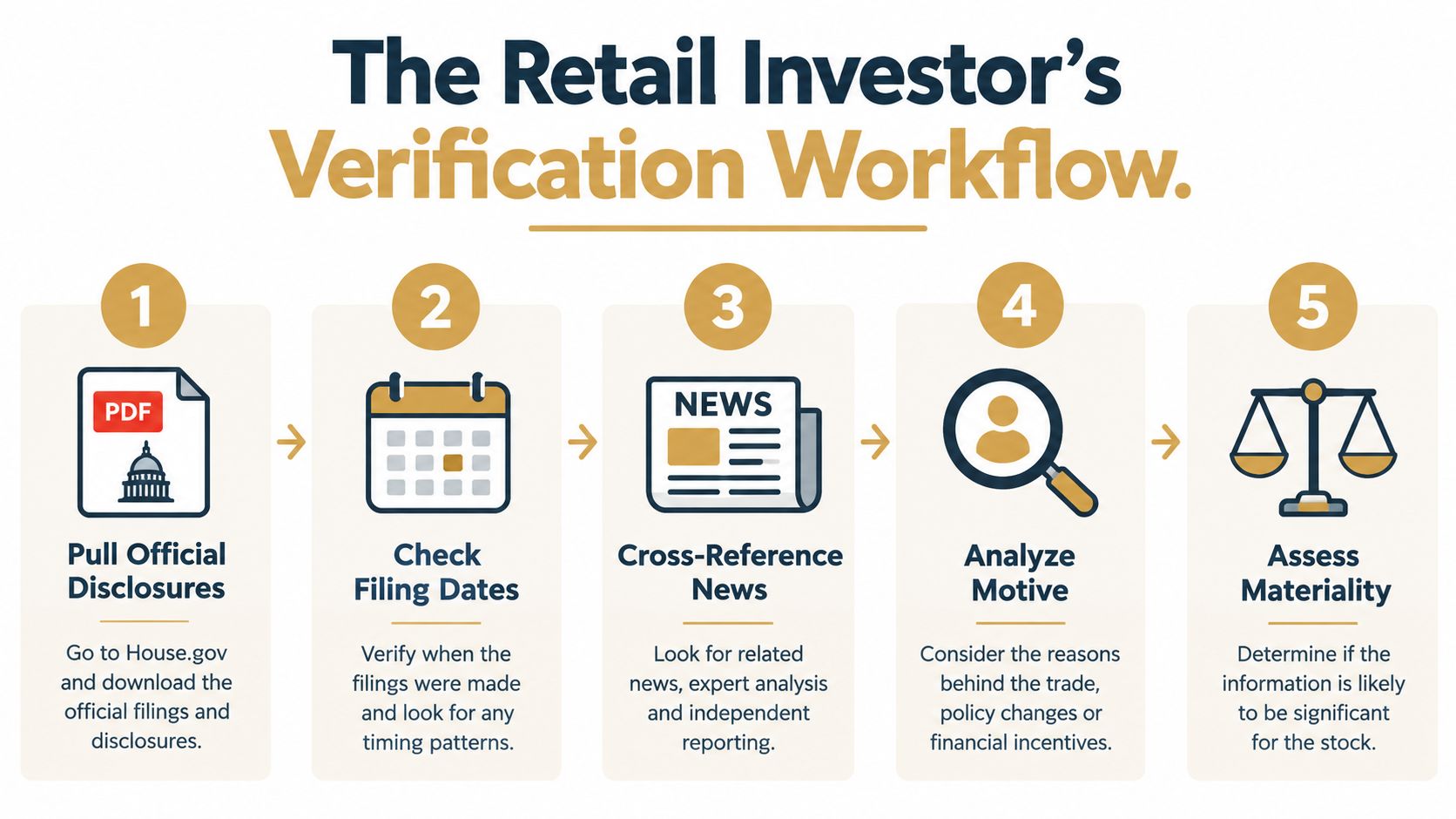
A useful workflow starts with primary documents and ends with restraint. Don't begin with a social-media screenshot or a headline claiming that a politician “bought the next big winner.” Begin with the filing, its dates, its transaction type, and the surrounding public record.
Start with the document
Pull the original congressional disclosure from the House or Senate financial disclosure system. Record the transaction date, filing date, security, buy or sell direction, reported value range, and filer. A data platform can help you find candidates, but the official document should settle the basic facts.
Then compare the timing. A trade made near a public policy announcement may deserve attention, but the filing date itself doesn't establish when the official knew anything. A long gap between transaction and disclosure lowers the value of the filing as a short-term signal.
Next, cross-reference the company and sector with SEC EDGAR. Search for Form 4 activity among directors and officers, and distinguish open-market purchases from awards, option exercises, and automatic sales. A congressional transaction that lines up with broad corporate insider buying is a different signal from an isolated household transaction.
Check the clock first. A delayed disclosure can still reveal exposure, but it can't recreate a real-time trade.
Use a structured filter
The following checklist keeps the analysis from becoming a story built around one memorable name:
- Verify the transaction. Confirm the official filing rather than relying on an aggregator's label.
- Separate trade date from filing date. Treat the gap as a core part of the evidence.
- Read the range carefully. Use the reported bracket as an approximation, not an exact dollar figure.
- Classify the transaction. A purchase, sale, option exercise, award, and reinvestment don't carry the same meaning.
- Check concentration. Look for repeated activity in a sector or theme instead of treating one position as a portfolio mandate.
- Review policy relevance. Ask whether the official's committee or public responsibilities connect to the industry, while avoiding claims about private knowledge.
- Cross-check corporate insiders. Use Form 4 to see whether company insiders are buying or selling, but don't force agreement where none exists.
- Use 13F cautiously. Institutional holdings can provide context, but the quarterly lag makes them poor timing tools.
- Test the alternative explanations. Diversification, liquidity, taxes, and portfolio management can explain a transaction without any policy angle.
- Write down what the filing cannot tell you. Disciplined analysis separates itself from copying.
Survivorship bias is a quiet trap. Readers remember the official whose disclosed trade later looked smart, while ignoring the many transactions that went nowhere or moved against the investor. A handful of large-ticket names can dominate attention even when the underlying portfolio is diversified and the reported range is too broad to estimate its true importance.
The emerging enforcement ecosystem makes this analysis more interesting, but not automatically more certain. One dataset reports 92,715 deduplicated congressional trades matched against 1.27 million roll-call votes, with 195 members trading companies affected by bills they voted on. Those matches can identify structural conflict exposure, but they don't by themselves prove criminal insider trading. The GovGreed project describes this type of cross-linking between trades, legislation, and votes.
A useful dashboard should preserve source timestamps, filing context, and the difference between a confirmed fact and an analytical flag. The TradeLikeInsiders research blog is one example of a place to review this kind of market and disclosure context, but no interface removes the underlying delay or ambiguity.
The STOCK Act disclosure amendment also had measurable market-structure effects. For stocks most held by members of Congress, bid-ask spreads rose by 3.1 to 4.3 percentage points, quoted depth fell by about 17%, adverse-selection costs increased by 5.4 to 7 percentage points, and average dollar price impact rose by 7.6 percentage points relative to the broader market after the amendment. The Journal of Financial Intermediation research examines these liquidity and trading-friction changes.
Those findings don't tell you which trade to copy. They reinforce a broader point: rules can change how information reaches markets, how quickly prices adjust, and how expensive it is to trade. The disclosure is part of a market system, not a magic signal detached from that system.
What This Can and Cannot Do for Your Portfolio
Government disclosures can help you map policy exposure. They can show which sectors receive attention from public officials, reveal repeated themes across filings, and surface potential conflicts worth adding to a research watchlist. Corporate Form 4 filings can add a faster view of insider transactions, while Form 13F can show how large managers were positioned at an earlier reporting date.
They can't predict a short-term price move. A congressional filing may arrive after the catalyst, a range may conceal the transaction's true size, and a diversified portfolio may make one disclosed holding far less important than it appears. A policy connection can explain why a sector matters without telling you whether the market has already priced it in.
The same record can't establish whether a trade was ethical or illegal. It can justify a closer look at timing, committee relevance, disclosure compliance, and alternative explanations. It can't replace financial statements, valuation work, risk analysis, or professional legal review.
The key distinction is signal versus action. A signal can help you ask a better question. It doesn't answer whether you should buy, sell, short, hold, or ignore a security. The delay, range reporting, and noisy portfolio context are not minor caveats. They're the central facts.
You can review consolidated congressional disclosures, SEC insider filings, whale activity, and policy updates through TradeLikeInsiders, but use any such service as a research aid rather than an instruction engine. This content is for informational purposes only and is not financial advice. Do your own research.
HeliosNet LLC offers TradeLikeInsiders as a market research and alerting platform that brings delayed congressional disclosures, SEC insider filings, large-whale activity, and selected policy updates into one place. If you want to compare those signals with source timestamps and practice evaluating them before risking capital, visit TradeLikeInsiders.