
Insider buying alerts aren't real-time trade signals. Congressional disclosures can arrive up to 45 days after execution, while corporate Form 4 filings generally arrive within two business days, so the useful edge is pattern recognition, especially clusters, not instant entry timing.
That challenges the most popular advice about following politicians, executives, and institutional “whales.” The public often trades on headlines after prices move. A filing tells you what someone disclosed, not what they're buying this second, why they bought it, or whether the market still offers the same setup.
The practical question is therefore different: what can a delayed disclosure help you investigate? It can reveal concentrated exposure, repeated buying, possible policy sensitivity, or a corporate insider putting personal capital behind a company. It can also mislead you when the transaction is routine, the filing is stale, or the market has already absorbed the information.
Smart traders use alerts as research inputs, not mechanical copy-trading rules. They check transaction dates, filing dates, transaction codes, company size, policy catalysts, liquidity, and whether multiple independent signals point in the same direction.
Table of Contents
- What Insider Buying Alerts Actually Are
- The SEC Disclosure System Explained
- Three Data Sources Traders Should Know
- What the Research Says About Predictive Power
- Clusters Beat Single Transactions Every Time
- How to Use Alerts Responsibly
What Insider Buying Alerts Actually Are
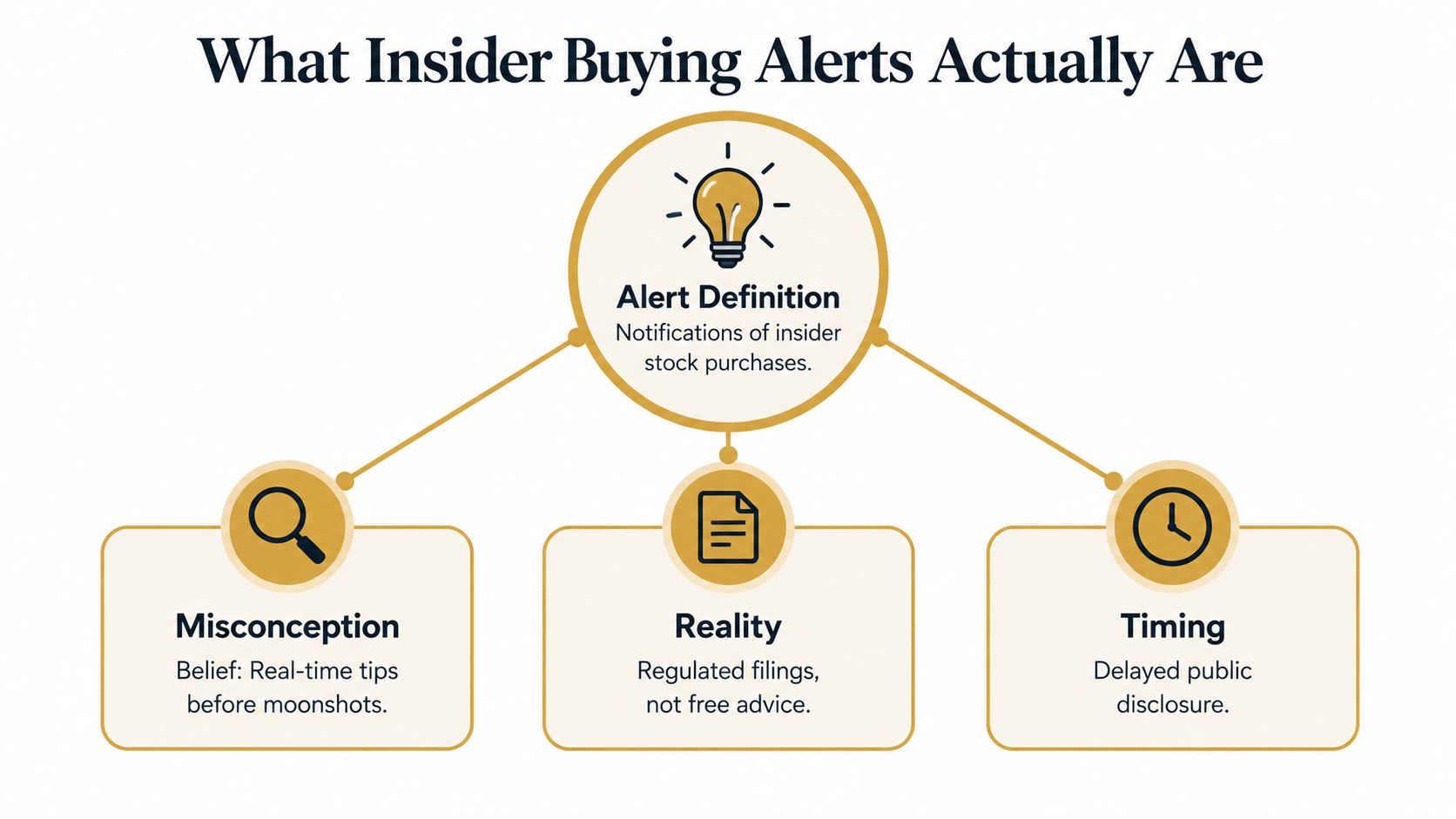
The common assumption is that an insider buying alert gives you a front-row seat before a stock “moons.” It doesn't. An alert is usually a notification generated from a mandatory public disclosure, and that disclosure appears after the transaction has already happened.
Corporate insiders report through the SEC system. Members of Congress and covered employees report through STOCK Act disclosures. Large institutional managers report selected holdings through Form 13F. Each source records a legally disclosed event, but each has a different information lag and a different meaning.
Disclosure is not timing
A corporate Form 4 generally identifies a transaction that occurred within the filing framework, not a live order entering the market. A congressional report can disclose a purchase weeks after execution. A 13F can show a quarter-end institutional position after the manager has already changed it.
That distinction creates two separate forms of value:
- Discovery value: The filing shows who had exposure, what asset they disclosed, and which company, sector, or policy theme deserves research.
- Timing value: The filing tells you whether acting after publication still makes sense. This value is often weaker because the market may have moved before the public disclosure.
Practical rule: Treat the filing date as the date you learned about the event, not the date the trade occurred.
The most useful alert systems preserve both timestamps. They also explain whether the transaction was an open-market purchase, an option exercise, a grant, a gift, tax withholding, or another administrative event.
A plain notification saying “insider bought shares” leaves out the information you need most. Was the buyer a director, officer, or major beneficial owner? Did several people buy? Did ownership change materially? Was the purchase discretionary? Without those details, the alert is closer to a headline than an analytical signal.
For additional market research, traders can use the TradeLikeInsiders research library, but the same discipline applies to any platform. Read the underlying filing instead of treating an automated summary as proof of a trade thesis.
The SEC Disclosure System Explained
Corporate insider alerts in the United States are grounded in a disclosure system created by the Sarbanes-Oxley Act of 2002. Directors, officers, and beneficial owners who hold more than 10% of a registered company's class of equity securities generally report transactions through SEC Forms 3, 4, and 5. The official SEC Forms 3, 4, and 5 guidance describes the framework and filing obligations.
Why Form 4 matters
Form 4 is the central source for routine insider purchase and sale alerts. The SEC requires it to be filed within two business days after the transaction date, a rule that substantially reduced the information lag compared with the pre-2002 regime.
That deadline is useful, but it doesn't turn a filing into a real-time feed. The transaction may have occurred before the filing became public, and the market may react between execution and disclosure. A Form 4 alert therefore confirms a legally disclosed event, not necessarily a current trading opportunity.
Form 4 also contains several transaction types that can look like buying at first glance. A useful alert should distinguish:
- Open-market acquisitions: Purchases made in the market, usually the most relevant category for discretionary buying analysis.
- Option exercises: Shares acquired when an employee exercises an option. This can involve compensation mechanics rather than a fresh bullish decision.
- Stock grants: Shares awarded under a compensation plan, not purchased with personal capital.
- Gifts and transfers: Ownership changes that don't represent an investment decision.
- Tax withholding: Shares withheld to cover tax obligations, which can appear as a disposition or administrative transaction.
Read the code before the story
The transaction code and filing timestamp often matter more than the alert headline. A research workflow should open the original SEC EDGAR filing, inspect the transaction date, identify the reporting person, and determine whether the acquisition occurred in the open market.
The SEC also makes insider-transaction datasets available for research and analysis, with updates provided quarterly. Those datasets can help with historical screening, but they don't remove interpretation risk. The two-business-day framework standardizes disclosure. It doesn't tell you whether the purchase is meaningful, whether the buyer has special knowledge, or whether the relationship between insider activity and future returns will persist.
A strong alert should answer four questions quickly:
- Who filed? Identify the role and ownership relationship.
- What happened? Separate open-market buying from grants, exercises, gifts, and withholding.
- When did it happen? Show both transaction and filing timestamps.
- How meaningful is it? Compare the purchase with prior ownership and look for other buyers.
Three Data Sources Traders Should Know
“Insider buying alerts” often combines three separate streams. They shouldn't be scored the same way because their reporting rules, lag, and informational content differ.
| Data Source | Lag Time | Signal Type | Best Use Case |
|---|---|---|---|
| Corporate insider filings, SEC Form 4 | Generally within two business days after the transaction date | Disclosed purchases, sales, and other ownership changes | Screening for discretionary open-market buying and purchase clusters |
| Congressional STOCK Act disclosures | Up to 45 days after execution under the reporting framework | Public-official transaction disclosure with value ranges | Mapping government-to-market exposure and policy-related research |
| Institutional Form 13F filings | Within 45 days after calendar quarter-end | Quarter-end snapshot of selected institutional holdings | Comparing recurring positions, concentration, and manager exposure |
Corporate insiders
Form 4 is usually the quickest of these three sources. It can provide a relatively narrow gap between execution and public disclosure, but the filing still requires interpretation. An apparent acquisition may be compensation-related, and an isolated purchase may say little about the company's prospects.
Congress and the STOCK Act
Congressional disclosures are especially easy to misuse. Covered members and employees generally must file a Periodic Transaction Report for qualifying securities transactions no later than 45 days after the transaction, or 30 days after receiving notice of the transaction, whichever is earlier. The disclosure reports the transaction value in brackets rather than as an exact amount.
Available recent analysis of trades executed since January 2025 reported a median public-disclosure delay of 25 days, with 22.6% reported within two weeks and 8.8% disclosed after the statutory deadline. Those figures come from CongressStock's analysis of the STOCK Act deadline in practice. The practical conclusion is straightforward: a congressional alert is often retrospective evidence, not a contemporaneous signal.
Check the official House and Senate financial-disclosure systems, and watch for amendments. A filing can identify an asset and transaction type without revealing the exact capital committed.
Institutional whales
Form 13F is different again. It isn't a transaction-by-transaction live feed. It is a quarter-end holdings snapshot from institutional investment managers that meet the SEC reporting threshold for Section 13(f) securities. The public filing can show a position after it has been reduced or eliminated.
Use 13F data to compare repeated filings, spot concentration, and generate questions. Don't assume the manager still holds the position just because it appeared in a public report.
What the Research Says About Predictive Power
Academic evidence supports a cautious version of the insider-buying thesis. Insider purchases can contain information about future returns, but the effect varies by transaction type, company size, time period, and market conditions.
A major study covering NYSE, AMEX, and Nasdaq companies from 1975 through 1995 found that insider purchases, rather than insider sales, had the stronger predictive content. Firms with extensive insider purchases during the previous six months outperformed firms with extensive sales by 7.8%, according to the study published in the Review of Financial Studies.
The same research found that insider activity appeared in more than 50% of stocks in a typical year. Average annual insider purchases equaled about 0.6% of company market capitalization, compared with 1.3% for sales. The combined market effect was approximately 1% for small firms but practically zero for large firms.

Why company size changes the signal
Those findings undermine the lazy version of the strategy, which treats every executive purchase as equally informative. A purchase at a smaller company may carry more information because fewer analysts, institutions, and market participants follow the business closely. At a large company, the same transaction can be immaterial relative to the company's scale and existing information flow.
The research also found that net aggregate insider activity could explain as much as 60% of the variation in one-year-ahead aggregate stock returns in a separate analysis of 1975 through 1989 data published in the Quarterly Journal of Economics. That result describes an aggregate relationship, not a promise about any individual alert.
A useful interpretation is:
- Individual filing: A noisy observation that needs context.
- Repeated discretionary buying: More interesting evidence of conviction.
- Cluster across insiders: A stronger research lead than one isolated purchase.
- Large-company purchase: Potentially less informative when the transaction is small relative to the business.
- Historical result: Evidence to test, not a guarantee that the relationship still works unchanged.
The public often focuses on who bought and what they bought. The better question is whether the purchase is economically meaningful, discretionary, repeated, and supported by other evidence.
The academic evidence is historical, so it can't eliminate regime risk. Market structure, disclosure speed, liquidity, institutional participation, and trading costs can all change how quickly a signal is absorbed.
Clusters Beat Single Transactions Every Time
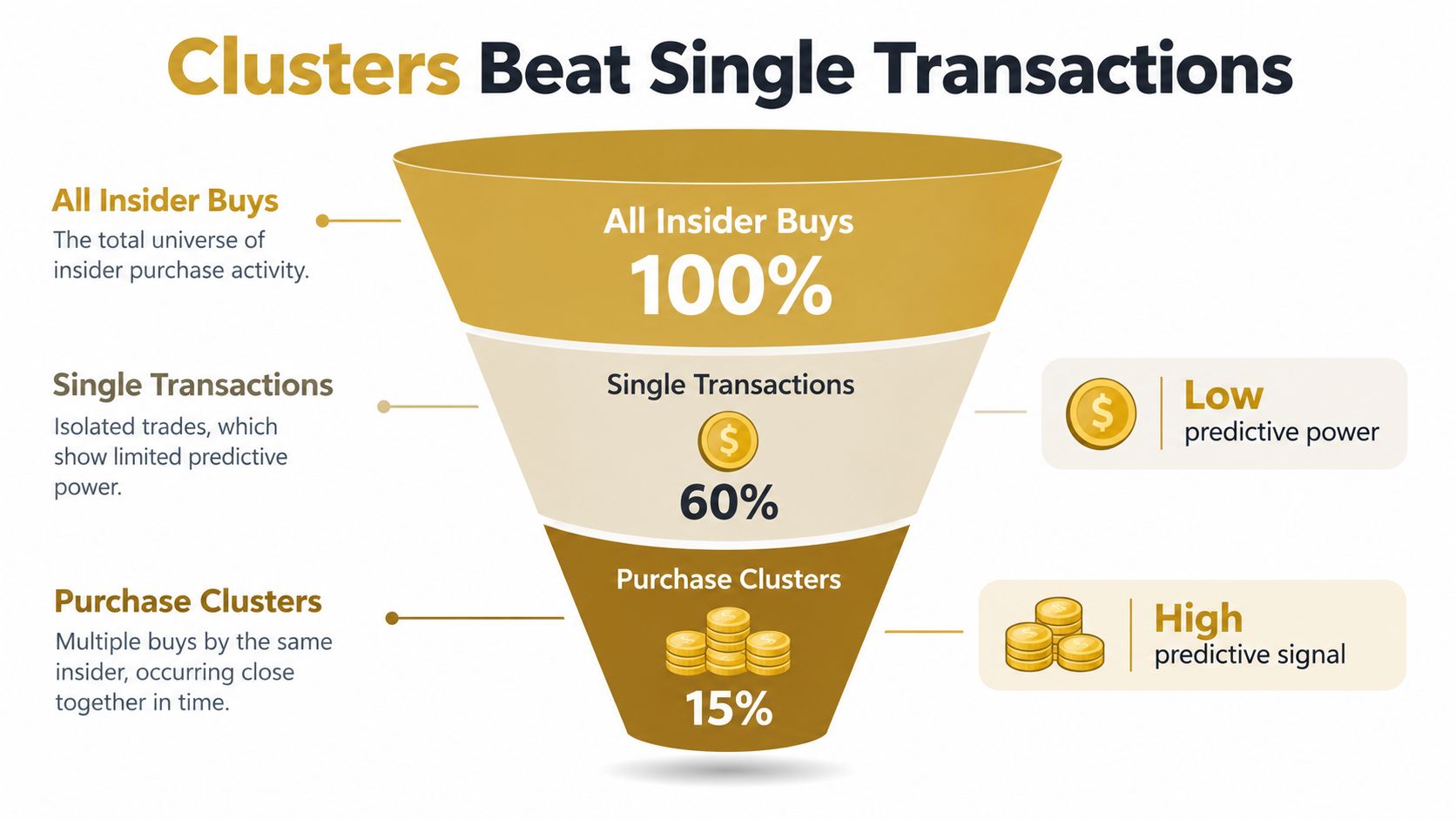
A single insider purchase can be noise. A purchase cluster deserves more attention because several independent buyers are making related decisions within a defined period.
Research summarized from large historical samples reports approximately 37 to 47 basis points of risk-adjusted abnormal return per month for portfolios of insider purchases. Roughly one-sixth of the effect appeared during the first five trading days, while about three-quarters appeared within six months, according to Interactive Brokers' summary of academic evidence on corporate insider buying.
That doesn't mean a trader should buy every cluster. It means the cluster can have greater discovery value than an isolated filing, especially when the buyers are distinct insiders and the transactions are open-market purchases.
What makes a cluster useful
A separate analysis of more than one million transactions found that purchases occurring within two days of another purchase at the same company were followed by approximately 2.1% abnormal return during the next month. About 40% of transactions were classified as clusters, using the same research summary.
The practical lesson isn't that a cluster predicts a fixed return. The lesson is that alert scoring should increase confidence when multiple distinct insiders buy in the same direction within a defined window.
A sensible scoring process also weakens the signal when:
- The transaction is routine: Grants, option exercises, and plan-driven purchases may not represent fresh conviction.
- The ownership change is immaterial: A tiny purchase may not alter the insider's economic exposure in a meaningful way.
- Liquidity is poor: Trading costs and price impact can overwhelm a theoretical signal.
- An earnings announcement is near: The event may distort both execution and subsequent price movement.
- The company is already moving sharply: The filing may be confirmation after repricing, not a new catalyst.
The research also supports controlling for market capitalization, value, momentum, sector, earnings announcements, and liquidity. Without those controls, a backtest can mistake a broader factor or event effect for insider conviction.
Research standard: Test cluster alerts out of sample, include transaction costs, measure filing latency, and control for survivorship bias.
Clusters are useful because they help generate hypotheses. They aren't standalone trading rules.
How to Use Alerts Responsibly
Treat every alert as research input. That mindset fixes the mistake that hurts traders most, which is confusing a public disclosure with a live signal.
The useful distinction is between information lag and timing lag. Information lag is what the filing tells you once it becomes public. Timing lag is the gap between when the trade happened and when you learn about it. An alert can be very good at surfacing who bought, what they bought, and how that fits a broader pattern, while still being weak for immediate execution because the market may have already absorbed the underlying move.
That matters across every source in this article. A congressional disclosure can point you toward a policy-sensitive industry. A corporate filing can show insiders putting personal capital to work. A 13F can reveal that a large manager owned a position at quarter-end. Each of those is retrospective evidence. None of them guarantees that following the disclosed trade at the alert price is sensible.
A practical review process
Use a checklist. Speed matters less than sequence.
- Verify the original source. Check SEC EDGAR for corporate filings, the relevant House or Senate disclosure system for congressional trades, or the SEC database for institutional holdings.
- Separate the dates. Write down the transaction date or quarter-end date, then the filing date. If you blur those together, you will overrate the alert's freshness.
- Classify the event. Confirm whether it was an open-market buy, an option exercise, a grant, a gift, tax withholding, or another administrative item.
- Look for confirmation outside the alert. Check whether there are multiple insiders, a related company filing, an earnings event, or a policy development that makes the trade more interpretable.
- Measure exposure, not just direction. Congressional reports use value ranges, and 13F reports show selected reportable holdings rather than a full portfolio. The filing gives clues, not perfect position sizing.
- Write the thesis before checking the chart. State what the disclosure may mean, what could make that reading wrong, and what you still need to know.
That last step sounds simple. It is also where a lot of sloppy copy-trading ideas die, which is good.
Congress requires a policy lens
Political trade alerts are easiest to misuse because the disclosure can feel dramatic even when the practical edge is thin. The better use is narrower. Ask whether the official's committee work, legislative priorities, regulatory reach, procurement influence, or industry oversight directly connects to the position.
Then ask the harder question. Is the policy catalyst still ahead, or did the market move before the filing became public?
A delayed congressional trade can still be useful if it helps you map incentives, sector exposure, or where to dig next. It often has discovery value. It may have little timing value. That distinction keeps you from treating stale public information as though it were a fresh catalyst.
13F needs patience
The SEC explains that Form 13F reporting requirements apply to institutional investment managers with at least $100 million in discretion over Section 13(f) securities. The filing is due within 45 days after each calendar quarter and generally reports holdings as of quarter-end.
So a 13F is a snapshot. It is not a feed of real-time whale executions. It also leaves out important context, including assets outside the Section 13(f) list and a full view of shorts, cash, or every portfolio hedge. The practical move is to compare repeated filings, sizing changes, and concentration over time instead of copying one disclosed holding as if you were seeing the manager's current book.
Practice without live funds
Paper trading is useful for one reason. It shows whether you keep overestimating how fresh public information is.
A short journal is enough. Log the filing date, the actual transaction date, your interpretation, your hypothetical entry, and what happened next. After a few cycles, patterns show up fast. Some traders discover they are consistently late. Others find they only do well when the alert supports a thesis they already had from fundamentals, policy, or price structure.
If you want one workspace for that process, TradeLikeInsiders by HeliosNet LLC combines delayed congressional disclosures, SEC insider filings, selected whale activity, policy updates, source timestamps, AI summaries, and a paper-trading terminal so you can review alerts in context instead of reacting to a headline.
The best habit is comparative judgment. A corporate buying cluster, a policy tailwind, and recurring institutional ownership can support the same idea and make it worth deeper work. A single congressional trade with a broad value range and a long reporting delay usually gives you a question to investigate, not a rule to follow.
This content is for informational purposes only and is not financial advice. Do your own research.