
“Follow the smart money” is popular advice, but it skips the part that matters: checking what the money did, when it did it, and when you were allowed to know. A purchase alert isn't a live invitation to enter at the insider's price.
If you're researching insider buying stocks, treat each filing as evidence to rank, not a tip to copy. The useful question isn't whether someone important bought. It's whether that transaction adds information you can still use after the disclosure delay.
Table of Contents
- What Insider Buying Really Tells You
- How to Read a Form 4 Line by Line
- Comparing Disclosure Sources and Their Clocks
- Which Insider Purchases Deserve Attention
- Hypothetical Patterns to Test, and How They Can Fail
- Reading Policy Moves and Whale Filings Next to Insider Buys
- Test Insider Signals Before You Risk Capital
What Insider Buying Really Tells You
An insider's purchase is a signal to test, not a shortcut to a trade. A director or executive may know how the business is operating, but a public filing does not reveal their full reasoning or prove they acted on confidential information. A cash purchase shows they chose to commit personal capital at a particular price. It does not show what price they think the shares are worth.
Buying shares with personal savings differs from receiving shares as compensation. Stock awards and open-market purchases must be distinguished because only the latter involves choosing to buy shares at the market price.
For SEC reporting, corporate insiders generally include officers, directors, and shareholders owning more than 10% of a company's equity. Members of Congress and covered congressional staff use a separate disclosure system, outside the corporate insider category described in the SEC's ownership-reporting framework.
A purchase can add context to an investment case, but it cannot settle it. The buyer may expect the business to improve, see the current price as attractive, or have reasons that do not translate into a useful signal for other investors. You still need to assess the company and the timing of the disclosure.

Fresh capital matters more than a purchase label
Transaction screens may group stock awards, option exercises, ownership transfers, and purchases together. An increase in reported shares does not always mean an insider chose to buy at the current market price.
The research on insider trading and repurchases examines insider trading alongside share repurchases. For investors, the practical point is to classify the transaction before treating it as a view on the stock. Compensation and routine activity can raise an insider's reported holdings without a deliberate market purchase.
Practical rule: Check whether the insider put additional personal capital at risk, rather than relying on a higher share count alone.
Even a genuine cash purchase is not a valuation report. It gives you no target price, expected holding period, or measure of the buyer's tolerance for losses. Treat it as one input, then judge whether the business case stands on its own.
How to Read a Form 4 Line by Line
Form 4 is the SEC report used to disclose changes in an insider's beneficial ownership, meaning shares they own or have an economic interest in. Searchable through SEC EDGAR, it's the main public record to examine before trusting a corporate insider alert.
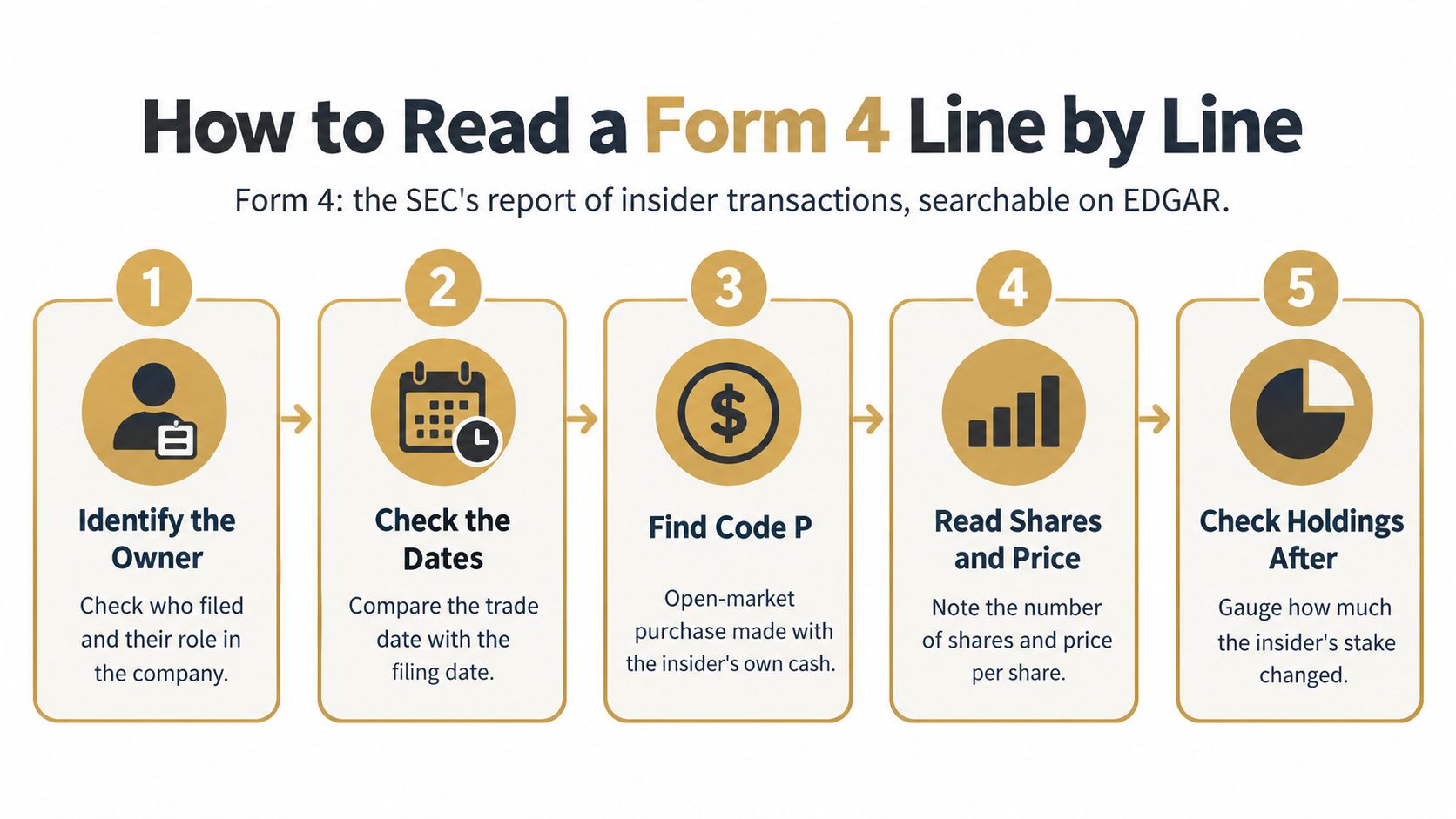
This visual provides a quick orientation before you inspect the actual filing.
Read the transaction before interpreting the motive
Find the original record. Search the company's name or ticker in EDGAR and open its recent Form 4 filings. Check that the issuer and reporting person match the alert, rather than relying on a headline's shortened description.
Locate the transaction code. In Table I, use the code to identify what happened to the non-derivative shares, meaning the shares themselves rather than an option or another related instrument. Prioritize code P, then verify the transaction details and footnotes before calling it discretionary buying.
Identify the owner and role. Check whether the filer is an officer, director, or significant owner, and whether ownership is direct or indirect. Shares held through a trust or another entity shouldn't automatically be treated as identical to shares held personally.
Read shares, price, and resulting holdings together. Calculate transaction value from shares and price, allowing for multiple execution prices described in footnotes. Compare the acquired shares with the prior position, because a conspicuous purchase amount can still represent a modest ownership increase.
Inspect the footnotes and plan disclosures. Look for a Rule 10b5-1 plan, a prearranged trading instruction, along with explanations of trusts, transaction pricing, or linked exercises. A scheduled transaction deserves a different interpretation from a fresh decision made under current conditions.
Separate the transaction date from the filing date. Record both rather than copying the alert's publication time into your journal. Otherwise, you can accidentally assign the insider's earlier entry price to a decision you couldn't have made then.
The SEC's guide to Forms 3, 4, and 5 explains the ownership-reporting structure and why transaction details matter.
| Code | Usual Meaning | Signal Value |
|---|---|---|
| P | Open-market purchase with the insider's cash, subject to checking transaction details | Strongest candidate for discretionary buying |
| S | Open-market sale | Many possible reasons, so weaker as a bearish signal |
| A | Grant or award, often compensation | Usually low, reflects pay design |
| M | Option or derivative exercise | Often compensation-related, check for a same-day sale |
| G | Gift | No direct market-purchase signal |
| F | Shares withheld to pay taxes or exercise costs | Usually not a market purchase |
Check the whole filing, not an isolated row
A clean discretionary purchase has a consistent story: a purchase code, an identifiable cash commitment, a meaningful ownership increase, and no footnote that changes the interpretation. Don't force that conclusion when the filing is ambiguous.
For an additional walkthrough, use the video alongside an actual filing rather than as a substitute for reading one.
The practical habit is simple: classify first, interpret second. An exciting-looking ownership change can become ordinary once you read the explanation beneath the table.
Comparing Disclosure Sources and Their Clocks
A filing can be new while the trade is old. Treat insider disclosures as ranked, conditional signals, and keep the filing clock separate from the trade clock.
| Source | Who Files | What It Shows | Amount Detail |
|---|---|---|---|
| SEC Form 4 | Officers, directors, and significant beneficial owners of public companies | Transaction code, shares, price, and ownership after the trade | Reported shares and price, sometimes with pricing detail in footnotes |
| Congressional Periodic Transaction Report | Members of Congress and covered staff | Asset, transaction type, date, and value band | Dollar range only |
| SEC Form 13F | Institutional investment managers subject to reporting requirements | Quarter-end reportable holdings; changes become visible across quarters | Reported share counts at quarter end |
The records answer different questions. Form 4 reports specific corporate ownership transactions. Congressional disclosures show reported securities activity, while Form 13F shows reportable holdings at quarter end, not a running list of each transaction.
Keep the filing clock separate from the trade clock
The trade happens first. Until it is disclosed, the public cannot inspect the same record. A filing's publication date tells you when information became available, not when the investor made the decision.
For corporate insiders, Form 4 is generally due by the end of the second business day after the transaction and is filed electronically through EDGAR. That is relatively prompt, but it is not real-time. The SEC's discussion of beneficial-ownership reporting obligations sets out the reporting requirements.
Congressional reports can lag longer. Under the STOCK Act, qualifying transactions exceeding $1,000 generally must be reported within 30 days after notice, with an outside limit of 45 days after the transaction. The House Ethics Committee says there are no extensions. Disclosed amounts are value ranges, not exact purchase values, as explained in its STOCK Act reporting guidance.
Form 13F follows a quarterly schedule: reports are due within 45 days after quarter end. A difference between two snapshots shows that holdings changed, but not the execution date or entry price. By the time the filing is public, the manager's position may have changed again.
A newly published filing can describe an old decision. “New disclosure” and “new trade” aren't interchangeable.
Match the question to the record
For congressional activity, check House and Senate financial disclosures rather than relying on a social-media trade card. A value band cannot support an exact position-size claim, and a reported purchase does not prove the official still owns the investment.
Apply the same standard to members of both parties. Committee assignments and pending legislation can guide further research, but they do not prove intent, privileged knowledge, or misconduct.
TradeLikeInsiders aggregates these disclosure sources with timestamps. That can reduce the work of finding filings, but aggregation does not remove reporting delays or replace the underlying documents.
Before treating a disclosure as a signal, identify which record the claim came from and when the reported activity took place. A corporate transaction, a congressional value band, and an institutional quarter-end holding provide different evidence, with different timing limits.
Which Insider Purchases Deserve Attention
A disclosed insider purchase is a lead to test, not a ready-made trade. Rank the patterns by how much evidence they offer, then demand more support from weaker ones. Keep the filing clock separate from the trade clock: a recently published Form 4 can report a purchase that happened earlier.
| Pattern | Typical Strength | Why It Matters |
|---|---|---|
| CEO or CFO buying with personal cash, large relative to prior holdings | Stronger | A meaningful addition by a senior officer merits scrutiny, though it does not predict a particular outcome |
| Several executives buying within a short window | Stronger | Multiple purchases make a single buyer's personal circumstances a less complete explanation |
| Purchase after a sharp run-up in a microcap | Mixed | Favorable average results can coexist with a low chance of outperformance |
| Single small purchase by one director | Weak | It may be planned, symbolic, or too small to show meaningful commitment |
| Option exercise followed by a sale | Weak | This may reflect compensation mechanics rather than a fresh decision to invest personal cash |
This is a research-priority table, not a trading rule. Start with the stronger patterns and work down. A mechanical exercise followed by a sale offers little evidence of a new investment decision; an isolated small purchase needs substantial support before it deserves much weight.
A cluster deserves a closer look because several people committed capital. Check whether the transactions were voluntary and made independently, rather than assuming that filings close together prove separate decisions. A CEO or CFO adding substantially to existing holdings also merits scrutiny, but neither pattern replaces valuation or financial-risk analysis.
What the research numbers actually mean
A study of U.S. microcap insider purchases examined 17,237 open-market purchases across 1,343 issuers during 2018–2024 and reported an out-of-sample AUC of 0.70. AUC measures how well a model ranks outcomes across classification thresholds. It is not the percentage of trades that will make money.
In the same study, distance from the 52-week high accounted for 36% of model feature importance. That describes how much the model relied on a feature. It does not show that distance from the high caused an outcome or provide a weighting investors should copy.
Purchases disclosed after price appreciation exceeding 10% produced a 6.3% mean cumulative abnormal return, but only a 36.7% probability of outperformance, according to the study. Abnormal return measures performance against a specified benchmark or expected-return model.
Those findings can coexist. A favorable average may reflect a small number of stronger outcomes alongside many disappointing ones. Treating the mean return as the likely result for each purchase can therefore mislead.
Rank the evidence without manufacturing certainty
Use relative commitment, not a universal purchase-value threshold. Compare the transaction with the insider's existing position and trading history, then ask whether the purchase is unusual for that person. Role adds context, but it cannot confirm intent or predict what happens next.
- Role: Is the buyer an operating executive or a less directly involved owner?
- Independence: Are several people buying voluntarily, or are they participating in the same program?
- Price path: Is the stock depressed, recovering, or already in a crowded run-up?
- Execution friction: Could spreads, delayed entry, and price impact erase the apparent advantage?
Microcap findings should not be assumed to apply to larger companies. A high-ranked signal earns more research time, not a larger position by default. Ranking improves research discipline; it doesn't guarantee outcomes.
Hypothetical Patterns to Test, and How They Can Fail
A contrarian insider purchase during a market shock is not automatically a reliable signal. The 2025 insider-trading literature review describes research finding that, during the COVID-era shock, insider purchases made while broader investors were selling were associated with subsequent one-year stock performance. That summary does not provide a sample size, effect magnitude, or enough detail to estimate how often the pattern worked. Treat it as a research lead, not proof that buying into any selloff pays.
The practical question is whether a purchase merits further testing under the conditions in which it occurred. A signal can rank higher in a broad market downturn than in a company-specific crisis, but neither setting guarantees a favorable result.
Hypothetical cluster after a selloff
Suppose a company's stock drops sharply, then an executive and several directors report open-market purchases around the same week. The pattern may warrant attention, but the filings alone do not establish that the buyers acted independently or that their decisions reflect the same view.
Check each transaction's details and footnotes. Confirm that the purchases used personal funds, then compare each buyer's addition with their existing holdings and past trading. A cluster's combined dollar value can obscure a small commitment from one buyer and a significant one from another.
Next, identify the reason for the decline. Broad market pressure and a company-specific financing problem call for different analysis. Without a defined measurement period and a benchmark, there is no defensible claim that this hypothetical pattern held up. Track subsequent performance against both, and record whether the entry price available after disclosure still made the signal actionable.
Hypothetical congressional sector purchase
A congressional purchase disclosed weeks after execution may attract attention if the official serves on a committee connected to the sector. The filing's delay separates the disclosure clock from the trade clock: a reader sees the report later than the official's execution date.
A value band does not reveal exact position size, investment reasoning, or whether the holding remains unchanged. Compare the execution date with the public policy timeline. If a related proposal was already public, the purchase could reflect an interpretation available to other investors. Timing can justify investigation, but it does not establish foresight or privileged information.
A persuasive story still needs evidence that could disprove it.
Patterns can fail for mechanical reasons. Scheduled buying may follow a prearranged plan rather than a fresh response to conditions. A hypothetical purchase in a thinly traded stock may be followed by a reversal before a follower can enter at a similar price. Several reported ownership increases may also stem from one compensation event, not coordinated conviction. Test each explanation before treating a filing cluster as a signal.
Reading Policy Moves and Whale Filings Next to Insider Buys
Government decisions can change the investment case for a sector before individual companies publish new operating results. A funding decision, regulatory proposal, bill, or committee hearing is therefore context to investigate, not background decoration.
Large institutional investors, often called whales, provide another perspective. Their disclosed holdings can help identify exposure, but a large position alone doesn't establish a directional forecast.
Build a policy timeline before a market story
Identify the actual policy event. Consult Congress.gov for legislation and the Federal Register for regulatory documents. Record what happened and distinguish a proposal, hearing, or announcement from an enacted or effective measure, because those aren't equivalent milestones.
Map the economic exposure. Identify affected firms, then consider suppliers and customers rather than stopping at the most obvious industry label. Ask whether the measure changes expected revenue, costs, competition, or access to funding.
Compare the purchase with the public timeline. Use the insider's execution date, not the date an alert reached you. A purchase after a widely discussed policy development may reflect the buyer's assessment of public information rather than an undiscovered catalyst.
Compare institutional snapshots. Use Form 13F to examine reported additions and reductions across reporting periods. Don't infer a precise entry price, and remember that index activity or a broader hedging strategy can complicate a simple conviction story.
Require independent agreement. Raise a research candidate's rank only when the insider transaction, policy exposure, and institutional evidence support a compatible explanation. Several dashboards repeating the same underlying event don't constitute independent confirmation.
Judge the measure, not the party
Apply identical standards to proposals and trading disclosures involving either party. A sponsor's affiliation doesn't tell you which companies benefit, how much uncertainty remains, or what investors have already anticipated.
Keep an alternative explanation beside the attractive one. Institutional additions might reflect portfolio mechanics; a policy proposal might change substantially; an insider might be willing to wait through a drawdown you haven't modeled.
Agreement across records strengthens a research question. It doesn't turn that question into a recommendation.
Test Insider Signals Before You Risk Capital
Insider buying is a research signal to test, not a shortcut to a trade. A filing can arrive after the transaction, and a reader may learn about it later still. Keep that filing clock separate from the trade clock: a disclosure can support a historical test without giving you a live entry.
A useful workflow leaves an auditable record, including persuasive ideas that failed. Without one, standout winners are easy to remember and losing or ordinary cases disappear from view.
Paper trading means recording simulated decisions without committing live funds. It lets you test how you interpret a filing, when you could act, and what execution might cost before treating an appealing story as a repeatable method.
Build a journal you can challenge
Start from the filing. Save the original document and record its execution, filing, and discovery timestamps. Set a simulated entry using only information available when a public reader could have acted, not the insider's earlier opportunity.
Separate discretionary purchases from ownership mechanics. Track awards, exercises, gifts, and tax-related transactions in their own categories. Otherwise, shifts in transaction types can make a purchase screen look stronger without showing that insiders chose to buy shares on the open market.
Score each event consistently. Record the insider's role, clustering, purchase size relative to prior holdings, and unusual trading volume. Set the criteria before checking later performance. That reduces the temptation to classify a past winner as a stronger signal than it appeared at the time.
Record market context. Note distance from the annual high, company size, liquidity, and whether the purchase coincided with a selloff, earnings period, or regulatory development. These details help show whether a pattern works only in particular conditions.
Add congressional and policy context when relevant. Log committee exposure, related legislation, and disclosure lag without assuming a causal link. Keep plausible alternative explanations in the record so the journal captures uncertainty, not just the most compelling narrative.
Compare simulated results with a benchmark. Define a simulated starting balance, consistent holding rules, and realistic execution assumptions. Track the share of successful observations by pattern as well as benchmark-relative performance. An attractive average can conceal an inconsistent run of outcomes.
Make alerts earn their place. Keep alerts tied to patterns you can measure in the journal. If results weaken, record that plainly and retire a rule when the evidence stops supporting it. Don't keep changing the definition to protect its past performance.
Test what a follower could actually capture
A sound test distinguishes the insider's execution from the public reader's possible entry. Include spreads and slippage, the gap between an expected price and one realistically available to a trader. A filing timestamp alone cannot show what price a follower could have obtained.
For systematic testing, walk-forward validation means developing rules on earlier observations, then testing them on later ones. Prevent information about the same issuer from leaking improperly between training and test samples. Compare results across liquidity groups and holding periods to see where the signal holds up, and where it does not.
TradeLikeInsiders.com brings congressional trades, insider activity, whale moves, and policy signals together for context checks and journal research. The consolidated view appears below. Verify underlying records before relying on them.

The aim is a defensible research process, not a promise of returns. Insider buying is conditional evidence. A useful test must be able to reject the signal as well as support it.
HeliosNet LLC offers consolidated disclosure research and an educational paper-trading environment for examining insider, congressional, institutional, and policy activity. Its tools can help users investigate a filing, preserve its timing context, and document a thesis before risking capital.
This content is for informational purposes only and is not financial advice. Do your own research.