The most popular advice about insider trading alerts is also the least useful: follow the trade and get ahead of the market. A public alert can't take you back to the moment the trade happened. It tells you that information has entered the public record, and the gap between those moments can change what the signal is worth.
That doesn't make alerts pointless. It means you should read them as dated evidence, not instructions. Congressional disclosures, corporate filings, institutional reports, and policy headlines each arrive on a different clock, and each answers a different question.
Table of Contents
- Why Insider Trading Alerts Arrive Late
- Reading Form 4 Congress and Whale Signals
- Building an Alert Setup You Can Trust
- Spotting False Positives Before You Act
- Comparing Alert Tools and Paper Practice
- A Practical Next Step and a Clear Disclaimer
Why Insider Trading Alerts Arrive Late
An insider trading alert isn't a live feed of private trades. It's an organized notice that a filing, institutional report, or policy item has become public. It doesn't establish misconduct, explain why someone traded, or tell you to buy or sell.
The public often reacts to headlines, while corporate insiders may trade before the public knows what is coming. But a legal disclosure clock sits between an insider's transaction and your alert. For officers, directors, and shareholders who own more than 10% of a company, U.S. rules generally require reporting covered transactions on SEC Form 4 by the end of the second business day after the transaction. The SEC describes that timing in its Form 3, 4, and 5 reporting materials.
That deadline makes a Form 4 alert a public-disclosure alert, not a real-time trade alert. If a transaction happens late in the trading week, intervening non-trading days can mean the filing appears after a weekend. The transaction date tells you when the insider acted; the filing or acceptance timestamp tells you when you could first have known about it from the public disclosure.
The timestamp is the starting line
Use SEC EDGAR, the primary source for corporate filings, to check the filing itself and its acceptance details. An alert service can make a document easier to find, but the underlying filing is what you need to interpret. Treating the trade date as your alert date creates a false impression that you could have acted sooner than was possible.
The distinction also matters for research. A platform can improve discovery and organization of legally public transactions, but it can't remove the statutory reporting lag. Grouping activity by company, insider, or clusters of insiders may add context; an isolated filing still doesn't tell you what the stock will do next.
Enforcement history is another reason not to confuse reported activity with wrongdoing. In a 2014 statement, the SEC said it had charged more than 570 defendants in civil insider-trading cases during the preceding five years, and that approximately 20% of its insider-trading charges since October 2009 involved parallel criminal prosecution (SEC statement on insider-trading enforcement). A Form 4, by contrast, is a public report of ownership activity. Its existence alone is not an allegation.
The useful habit is simple: start your clock when the disclosure becomes public. Before adding anything to a watchlist, separate congressional Periodic Transaction Reports, Form 4 transaction codes, quarterly institutional reports, and policy headlines. They aren't interchangeable signals.
Reading Form 4 Congress and Whale Signals
Once a filing is public, the next job is classification. A corporate Form 4, a congressional Periodic Transaction Report, a quarterly institutional report, and a policy update differ in what they disclose and how fresh that information is.
A Form 4 identifies the reporting person and issuer, transaction date, transaction code, number of securities, price, and resulting holdings. An open-market purchase is often a cleaner indication of voluntary exposure than a sale, because sales can reflect taxes, vesting, an option exercise, diversification, or a prearranged Rule 10b5-1 plan. Neither type guarantees a future price move. See the SEC Form 4 instructions and filing requirements.
Four signals, four different clocks
Congressional trades are disclosed through House and Senate financial disclosures as Periodic Transaction Reports, or PTRs. A covered official generally has to report a qualifying transaction within 30 days of receiving notice and no later than 45 days after the transaction. Reportable transactions are over $1,000, and the amounts appear in broad ranges rather than exact values. House Ethics guidance says late PTRs don't receive extensions (House Ethics STOCK Act guidance). A PTR documents a reported transaction, not an official's motivation or current position.
Institutional 13F reports offer a slower view of certain large managers' holdings. They're useful for broad portfolio context, but they aren't a same-week tape of trades. A reported position doesn't tell you the precise moment a manager bought or whether the position remains unchanged.
Policy signals range from a bill to an enacted law, agency rule, or effective date. Government action can affect sectors through funding, eligibility, regulation, or market access. A headline doesn't establish which companies benefit, whether the proposal will take effect, or whether the market has already priced it in. For example, the Congressional Research Service describes legislation intended to ease some regulatory requirements, broaden retail access to private-market investments, and encourage public-market participation; the actual impact depends on the final provisions and their implementation (CRS analysis of the legislation).
| Signal | Primary source | Typical public timing | Useful question | What it does not prove |
|---|---|---|---|---|
| Form 4 | SEC EDGAR | Generally by the end of the second business day after execution | Was this an open-market trade, and who made it? | That the insider expects a particular price move |
| Congressional PTR | House and Senate financial disclosures | Up to 45 days after the transaction | What security and transaction range were reported? | Exact transaction value, motivation, or current position |
| Institutional 13F | SEC filings | Quarterly reporting cycle | What holdings did a large manager report? | A recent trade or a current position |
| Policy item | Bill, agency, or government source | Depends on legislative or regulatory progress | Which industries are directly affected, and when? | That a headline is enacted or bullish |
Record the trade date, disclosure date, security, and transaction type before comparing a filing with later prices. Add a share count for Form 4 or the reported range for a congressional PTR. That basic record helps prevent a slow, partial disclosure from masquerading as a current recommendation.
Building an Alert Setup You Can Trust
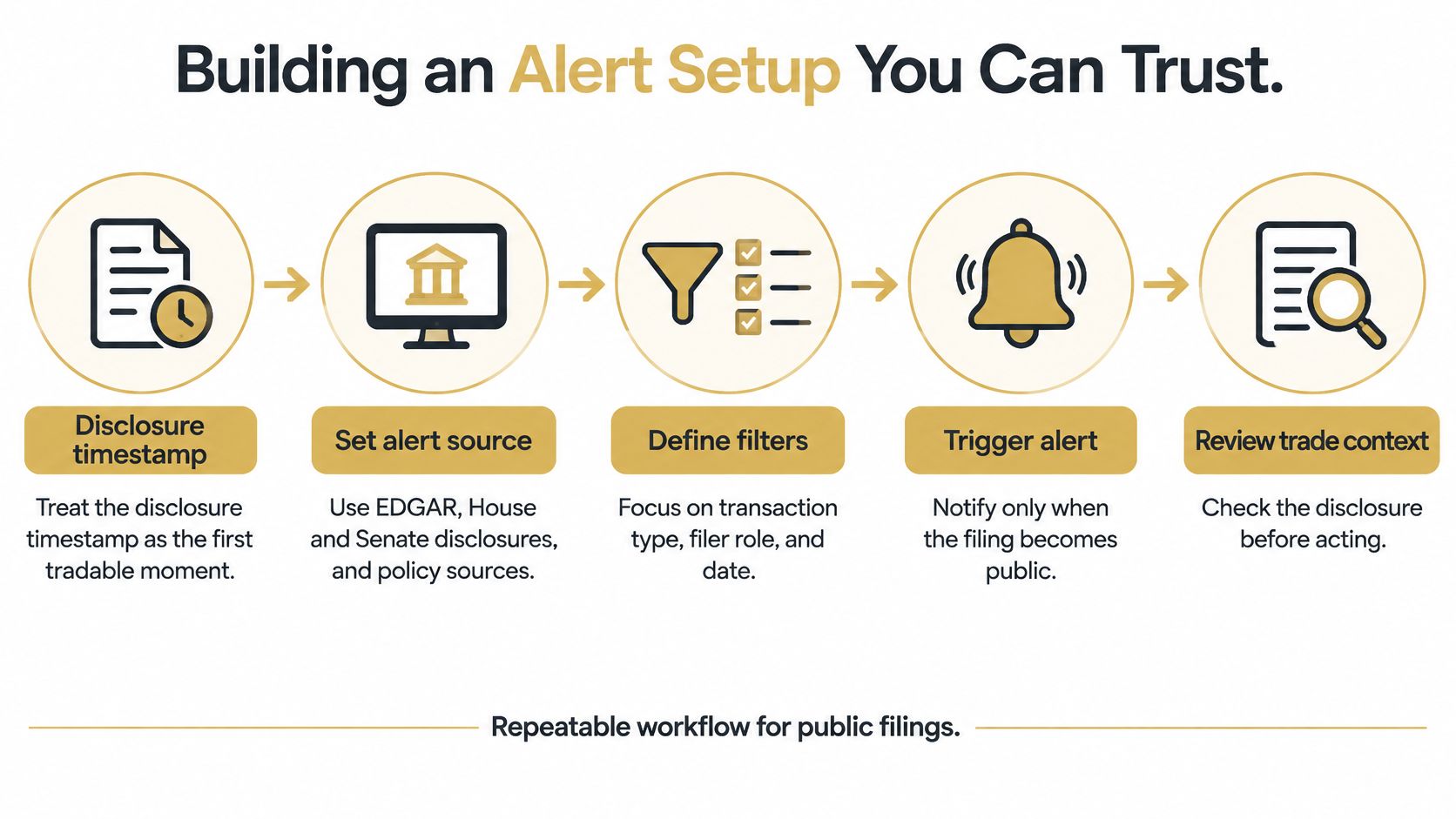
A useful alert setup starts with the moment the public could see the filing. If your system ranks signals from the execution date, it may give old information the appearance of freshness. Build the queue around disclosure time, then make the transaction details do the filtering.
Start with clean records
Capture the filing's public acceptance or accession timestamp. Normalize the transaction code, price, share count, ownership type, and whether the security is a derivative. Keep grants, gifts, option exercises, automatic plans, and routine tax-withholding sales in a separate bucket unless you intend to model them. Mixing these with open-market purchases creates a noisy feed that looks more informative than it is.
Group filings by issuer and person within a defined window. Multiple transactions by one insider shouldn't look like several independent votes of confidence. A cluster of clearly separate insider purchases may deserve review, but it still isn't a forecast.
For congressional disclosures, require both the transaction date and the disclosure date, plus the reported range. Mark how old the filing is and lower its priority as it approaches or passes the 45-day outer limit. The date gap is part of the information, not a footnote.
Rank what deserves attention
For corporate purchases, weigh the insider's role, prior trading pattern, size relative to existing holdings, and the issuer's liquidity. Liquidity means how easily a security can be traded without materially moving its price. A signal that looks attractive on paper may be difficult to act on in a thinly traded stock.
Keep policy in its own lane. Surface a bill, law, agency rule, or effective date only when it maps to a sector already on your watchlist. Then check what stage the policy has reached and which businesses are directly exposed. Don't promote a broad headline into a trade alert just because it mentions an industry.
Practical rule: A ranked watchlist is a research queue, not an order ticket.
Close the workflow by reviewing the filing before deciding whether it belongs in a paper journal. Measure outcomes from the first feasible post-disclosure moment and account for spreads, slippage, commissions, and market impact. Historical research reported that insider-purchase portfolios earned more than 50 basis points per month on average, while insider-sale portfolios didn't earn abnormal returns; the result isn't a guaranteed alert success rate, and the study is vulnerable to issues such as look-ahead and survivorship bias (historical insider-purchase portfolio research). Use it as a reason to test carefully, not as a promise that your filtered alerts will repeat the finding.
Spotting False Positives Before You Act
A real filing can still be a weak signal. The best quality checks are visible in the source document: transaction type, filer role, size relative to holdings, whether other insiders acted independently, and whether the security is liquid enough to trade after disclosure.
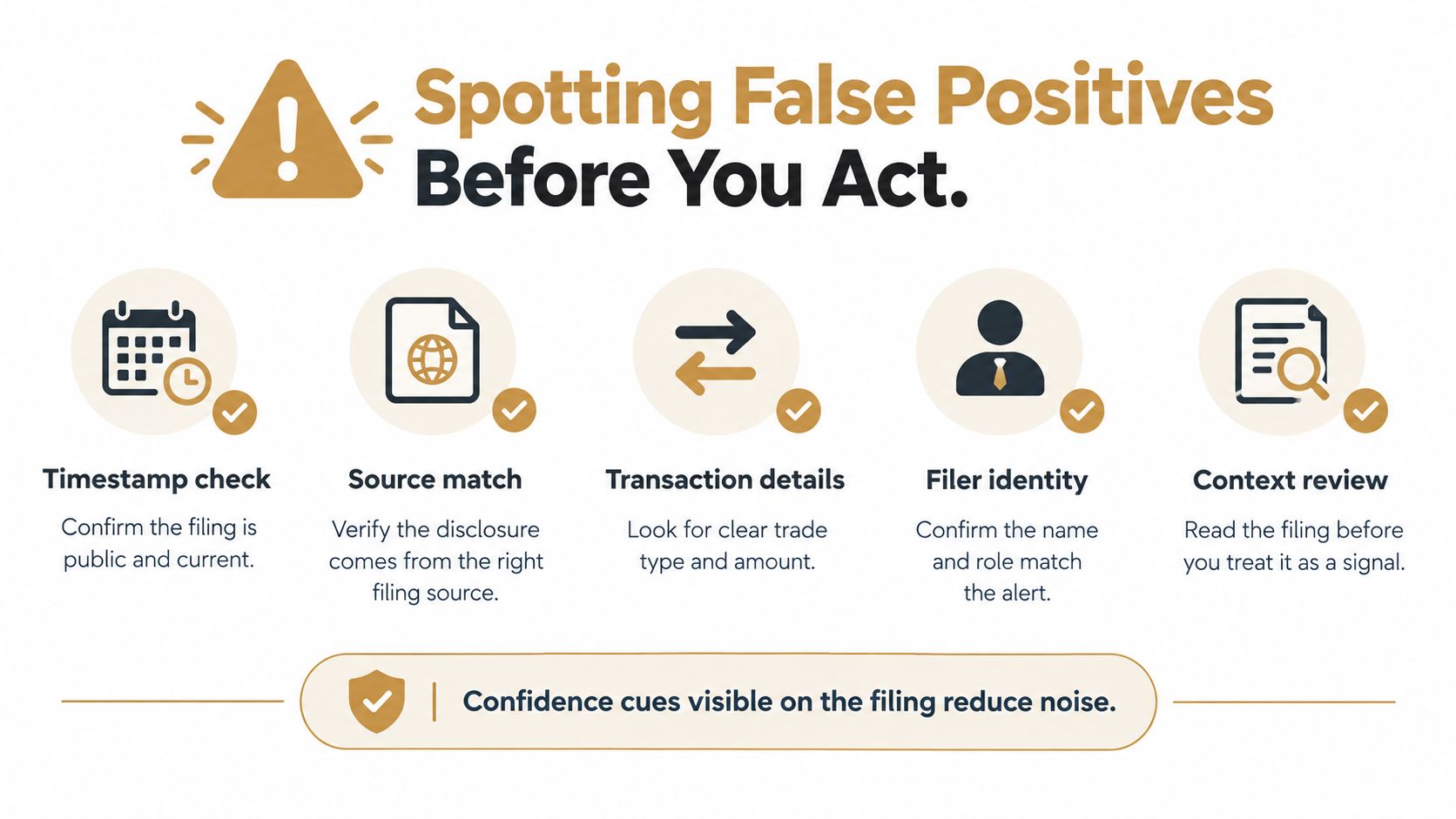
An open-market purchase by an influential officer may merit closer review, especially if it's large relative to the officer's holdings and other insiders independently buy around the same period. A sale is harder to interpret because it may be routine. Grants, vesting, tax withholding, and prearranged trading plans also need a different treatment from discretionary open-market activity.
Don't confuse that filtering with an accusation. A Form 4 records reported ownership activity. It doesn't establish that someone traded on material nonpublic information; that requires a separate allegation and evidence. The SEC's enforcement history shows that public enforcement has been an ongoing feature of the market, but a filing by itself says nothing about whether conduct was unlawful.
Costs can erase an apparent edge
A backtest can make an alert look strong by measuring abnormal returns without asking whether a trader could capture them. One FTSE-350 analysis found average round-trip trading costs of about 2.9%, enough to eliminate modest signals (research on insider trading and market efficiency). Another review estimated that outsider returns after published insider-trade summaries disappeared after assuming 2% transaction costs and controlling for predictable effects. Those figures are a warning to test net outcomes, not gross price moves.
Judge an alert system using net return, drawdown, and whether a high-confidence label proves useful over time. Hit rate alone can flatter a strategy that makes small gains often and loses heavily when it misses. Also test for multiple comparisons: trying many filters and time windows can produce attractive results by chance.
Put congressional staleness in plain sight
For each congressional alert, display the trade date, disclosure date, legal deadline, and an ordinary-language staleness note. Publicly reported data for 2025 indicate that 13.9% of machine-readable congressional trades were disclosed more than 45 days after the transaction; the median lag was 28 days, and the mean was 43.1 days (reported congressional disclosure-lag statistics). These are freshness warnings, not proof of a current trading opportunity.
A technically timely filing can still arrive after the market has reacted. A late one may matter for transparency or oversight while offering little value for entry timing. Keep the question clear: does this alert describe a past event, or does it contain information that remains useful now?
Comparing Alert Tools and Paper Practice
You can follow public signals by checking primary documents manually, assembling separate spreadsheets and feeds, or using a workspace that puts sources and timestamps together. Manual checking is the control: SEC EDGAR, House and Senate disclosures, and official policy sources remain the primary records. The other approaches change how you organize those records, not what they prove.
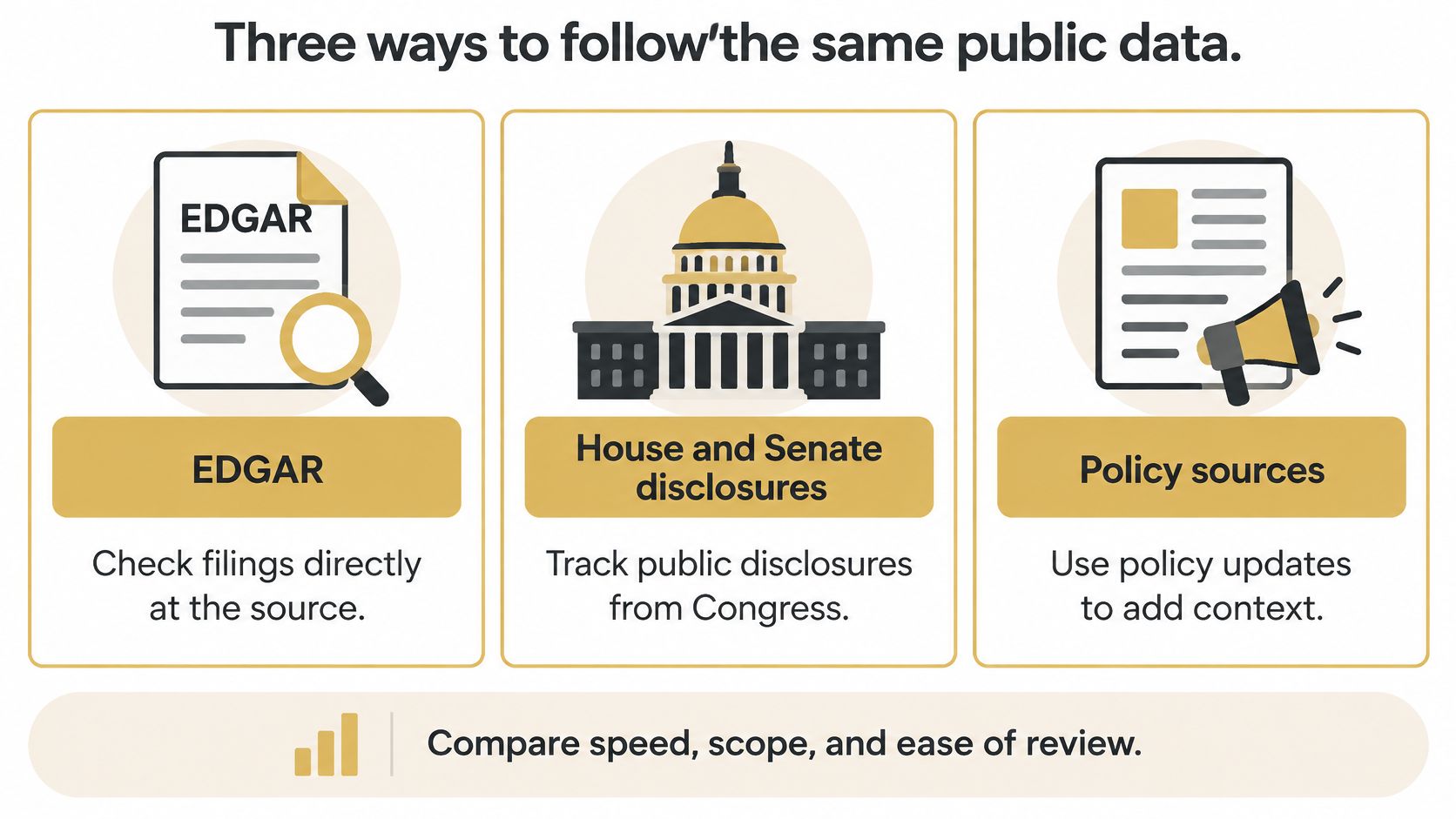
Separate spreadsheets can help, but they often leave a Form 4, a congressional range, a quarterly institutional report, and a policy headline in different tabs. Without a shared freshness label, it's easy to compare a recent corporate filing with a much older congressional disclosure as if both just happened.
One workspace, still verify the source
TradeLikeInsiders, published by HeliosNet LLC, aggregates delayed congressional disclosures, SEC insider filings, whale activity, and selected macro and regulatory updates. Its features include AI summaries, Plain English and Experienced views, watchlists, and a paper-trading terminal with a simulated balance and trade journal. Pro at $9.99 per month and Elite at $19.99 per month are published plan gates, not evidence of performance.
A practical paper test is more useful than a glossy alert score. Sync a watchlist, arm only open-market purchases and clearly fresh congressional filings, and log the disclosure age before entering a simulated order. Include spread and trading costs in the journal. You don't need a brokerage connection to find out whether your rules produce a coherent record.
The tool should make the source and its age easier to inspect, not make you forget to inspect them.
Compare any workspace against manual source-checking: can you verify the underlying filing, distinguish transaction types, and see when the information became public? If the answer is no, the consolidated feed has made the process faster but not more reliable.
A Practical Next Step and a Clear Disclaimer
A delayed filing earns its keep only when you can prove what you knew and when you knew it. So run a one-week drill that forces the timestamp into every decision.
Pick a small watchlist of companies and sectors you already follow. Pull the latest Form 4 filings and any relevant congressional disclosures from the primary sources, then write down four fields for each: transaction type, trade date, disclosure date, and either the share count or reported dollar range. That third field is the one that matters. The clock on your alert starts at disclosure, not at the trade.
Set aside grants, gifts, tax sales, and anything outside your review window. If a policy item touches the same sector, record whether it's still a bill, an enacted law, a proposed rule, or an effective date. Status can matter more than the headline.
Take one observation into a paper journal after the filing goes public. Note the available price, spread, and estimated costs, then review the outcome without treating any historical pattern as a forecast. If you'd rather keep congressional disclosures, insider filings, whale activity, and policy updates in one place, TradeLikeInsiders is one dashboard option.
You're building a record of what was knowable, when it became knowable, and whether your read held up after costs. Stay neutral across political parties and treat every signal as something to investigate, not a command.
This content is for informational purposes only and is not financial advice. Do your own research.
HeliosNet LLC brings delayed congressional disclosures, SEC insider filings, whale activity, and selected policy updates into one research workspace, with summaries and paper-trading tools for tracking how signals age. The platform is one way to test a public-data workflow on paper before risking capital.