
Insider trading isn't illegal as a category: disclosed insider trades that meet the rules are legal. It becomes illegal when someone trades, or tips someone who trades, while holding material nonpublic information in breach of a duty of trust or confidence.
The popular advice to “just copy the insiders” skips the questions that matter. Was the trade disclosed? Was it lawful? Does it tell you anything useful now? Those are separate questions, and a public filing rarely answers all of them.
Table of Contents
- Why the Answer Depends on What the Trader Knows
- Legal vs Illegal Insider Trading at a Glance
- The Legal Test Behind Every Insider Trade
- How Old Your Disclosure Data Really Is
- Reading a Form 4 Without Overreading It
- Reading Whale Moves and Policy Signals Responsibly
- Enforcement Cases and What They Cost
- Pitfalls and a Filing Routine That Stays Legal
Why the Answer Depends on What the Trader Knows
The public trades on news; insiders trade on information. The legal question is what information they used and what duty they owed.
Corporate executives can understand their businesses better than outside investors without breaking the law. Experience, industry knowledge, and careful analysis of public information aren't the same as access to confidential earnings or an unannounced acquisition.
When people ask, “Is insider trading legal?” they often confuse being an insider with misusing inside information. An executive's job title doesn't automatically prohibit trading, and an ordinary investor's lack of a corporate title doesn't automatically protect them.
The questions behind the label
- Material information: Would a reasonable investor consider the fact important when deciding whether to trade? An unexpected earnings shortfall is different from routine office gossip.
- Nonpublic information: Has the information been broadly released, or is it still confined to employees, advisers, or a private conversation?
- A broken duty: Did someone misuse information entrusted to them through employment, a client relationship, or another relationship of trust?
The Supreme Court's decision in Dirks v. SEC explains why fiduciary duty and wrongful disclosure matter, rather than treating every informational advantage as unlawful.
For retail research, the public records are familiar: SEC Form 4 for corporate insider transactions, STOCK Act Periodic Transaction Reports for congressional activity, and Form 13F for institutional holdings. They describe different actors and different kinds of activity.
A disclosed trade is a record, not proof of wrongdoing. It's also not an instruction to follow the trader. The useful approach is to separate the legal analysis from the investment interpretation, while remembering that this is education, not advice about any security.
Legal vs Illegal Insider Trading at a Glance
| Scenario | Legal status | Deciding test | Public record |
|---|---|---|---|
| Officer buys shares on the open market | Legal when properly reported and not based on material nonpublic information | Voluntary trade without a breached duty | Form 4, generally within two business days |
| Insider sells under a Rule 10b5-1 plan adopted in advance | Generally legal if the plan satisfies applicable conditions | Plan established before the trader held material nonpublic information, with other requirements satisfied | Form 4 with applicable trading-plan disclosure |
| Insider sells before an unannounced earnings miss known only internally | Illegal when the insider knowingly trades on material nonpublic information in breach of duty | Confidential earnings knowledge and breached duty | A required Form 4 may disclose the sale; the unlawful basis may emerge through enforcement |
| Insider tips a friend who trades for personal benefit | Illegal if the tipper breached a duty for personal benefit and the tippee knew or should have known | Tipper's personal benefit and recipient's knowledge | Friend's trade appears on Form 4 only if the friend independently has a reporting obligation |
| Attorney trades on a client's confidential deal information | Illegal under the misappropriation theory when its elements are met | Deception of the information source | No automatic public transaction report merely because the trader is an attorney |
| Member of Congress buys a stock | Legal if otherwise lawful, with disclosure required for qualifying transactions | Reporting compliance and no unlawful misuse of information | Periodic Transaction Report, potentially up to 45 days later |
| Investor trades only on public Form 4 or 13F data | Generally legal | Public information used without a separate unlawful information source | The underlying filings, not necessarily a public record of the investor's trade |
Disclosure isn't legal clearance
The same-looking sale can have a different legal character depending on information, duty, and timing. Selling to fund a household expense isn't equivalent to selling after privately learning that a company's announced outlook is false.
A filing doesn't cure an unlawful trade. Conversely, a suspicious-looking price chart doesn't establish that a lawful transaction was criminal.
The distinction also matters for foreign-company investors. According to Debevoise's insider-trading disclosure update, the Holding Foreign Insiders Accountable Act, signed December 18, 2025, extended Section 16(a) reporting to directors and officers of foreign private issuers beginning March 18, 2026. It requires Forms 3, 4, and 5 reporting without extending Section 16(b)’s short-swing-profit disgorgement regime or Section 16(c)’s short-sale prohibition to those insiders.
More reporting improves visibility. It doesn't automatically supply evidence of unlawful information use, and mandatory disclosure doesn't itself establish illegality.
The Legal Test Behind Every Insider Trade
A disclosed trade, a legal trade, and a useful signal are three different things. Disclosure records activity; it does not prove wrongdoing or show that copying the trade would be profitable. To assess legality, start with what the trader knew, how they got it, and whether they had a duty concerning that information.

The building blocks
The analysis generally asks whether the information was material, meaning significant to an investment decision, and nonpublic, meaning not broadly available to investors. It also asks whether the trader owed a qualifying duty of trust, confidence, or loyalty to shareholders or to the information's source, and whether a trade or tip involved misuse of that information.
There isn't one overarching U.S. insider-trading statute. The Congressional Research Service's legal overview traces the principal framework to Section 10(b) of the Securities Exchange Act of 1934 and SEC Rule 10b-5, alongside foundational decisions in Cady, Roberts (1961), Chiarella (1980), Dirks (1983), and O'Hagan (1997).
How the cases draw the boundary
In re Cady, Roberts & Co. established the disclose-or-abstain principle. A person subject to the relevant obligation generally must disclose material information before trading or refrain from trading. That duty doesn't give an employee permission to release company secrets independently.
Chiarella v. United States rejected the idea that possessing confidential information automatically establishes liability. The duty matters, so an informational advantage by itself doesn't complete the legal analysis.
Dirks v. SEC addressed tipping. A recipient's liability depends on whether the insider breached a duty for personal benefit and whether the recipient knew or should have known of that breach. Passing information through a friend doesn't necessarily break the connection to its source.
United States v. O'Hagan endorsed the misappropriation theory. A person may commit securities fraud by deceptively using confidential information entrusted by a source, even without owing duties directly to the traded company's shareholders.
Practical rule: Ask where the information came from before asking how profitable it might be.
Trading plans aren't blanket immunity
Rule 10b5-1 addresses when trading is on the basis of material nonpublic information and provides an affirmative defense for qualifying advance trading arrangements. Adopting a plan doesn't, by itself, establish that the defense applies. The arrangement must meet the applicable conditions.
Rule 14e-3 separately governs certain tender-offer information, and tender offers involve specialized rules, so the general duty framework shouldn't be treated as a universal safe harbor.
How Old Your Disclosure Data Really Is
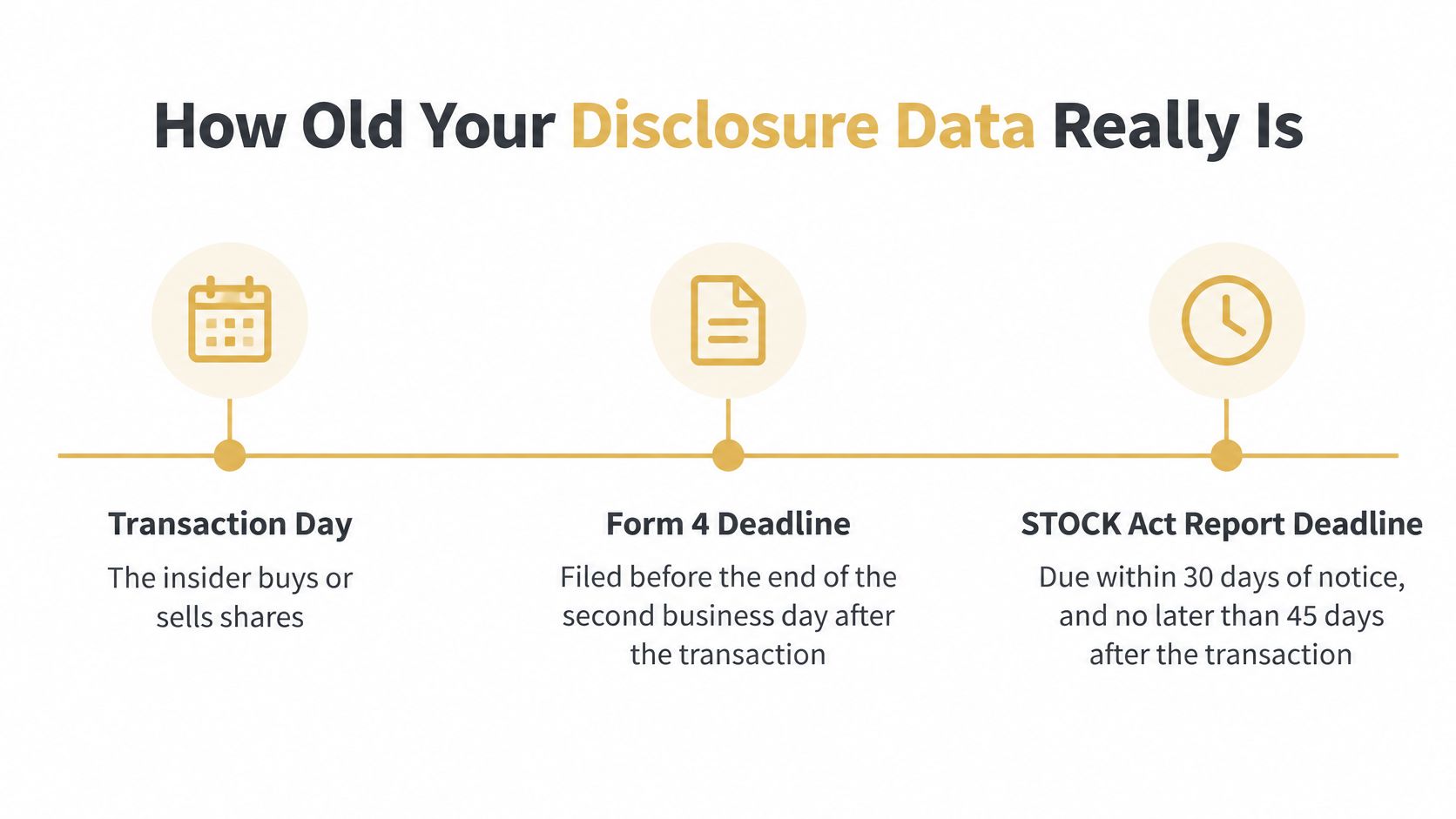
Execution time and publication time aren't interchangeable. Corporate transaction reports generally arrive much sooner than congressional disclosures, while institutional holdings reports follow a separate quarterly schedule.
The reporting windows below come from the SEC's Forms 3, 4, and 5 guide, House Ethics STOCK Act guidance, and the SEC's Form 13F guidance, respectively.
| Filing | Who files | Deadline | What you learn |
|---|---|---|---|
| SEC Form 4 | Directors, officers, and beneficial owners above the statutory threshold | Before the end of the second business day after the trade, generally | Price, share count, transaction code |
| STOCK Act Periodic Transaction Report | Members of Congress, officers, and certain legislative employees | Earlier of 30 days after learning of the transaction or 45 days after the transaction date | Trade date, asset, and a value range for qualifying transactions over $1,000 |
| SEC Form 13F | Institutional managers exercising discretion over at least $100 million in qualifying Section 13(f) securities | Within 45 days after quarter end | Quarter-end holdings, not individual trades |
House Ethics guidance also says the law provides no extensions for late PTRs. A filing arriving late doesn't become timely because a tracking service only just discovered it.
The timeline makes the difference between transaction and disclosure visible.
Read the timestamps before the headline
Track the trade date, filing date, and viewing date separately. A platform alert marks when you learned about the record, not necessarily when the investor acted.
Say a congressional report appears after a sector has rallied on a public policy announcement. The filing doesn't show that today's price resembles the filer's entry price, and it doesn't establish that the position remains open.
Congressional amounts are reported in ranges, not exact dollars. Don't convert a range into a precise position size or pretend you can reconstruct exact portfolio weights from it.
Institutional reports introduce another distinction: a quarter-end holding might have been acquired much earlier. The age of the snapshot and the age of the investment aren't the same.
Our congressional and insider disclosures on TradeLikeInsiders are delayed records, not real-time trades. Faster delivery of a filing doesn't remove the delay built into the underlying reporting system.
Reading a Form 4 Without Overreading It
Classify the transaction before interpreting the insider's intentions. A compensation award, an option exercise, and a voluntary purchase can all change ownership, but they don't express the same economic choice.
The SEC's Form 4 and transaction-code instructions identify the reporting person, issuer, transaction date, transaction code, securities involved, and resulting ownership. The signal weights below are research judgments, not SEC ratings or promises of performance.
| Code | Meaning | Signal weight | Why |
|---|---|---|---|
| P | Open-market or private purchase | Strongest for a verified voluntary open-market purchase | Insider commits their own money |
| S | Open-market or private sale | Variable | Could be routine, plan-driven, or discretionary |
| A | Grant or award | Weak | Usually compensation rather than a market purchase decision |
| M | Exercise or conversion of a derivative security, including an option | Weak alone | Check whether the acquired shares were retained or sold |
| F | Shares delivered or withheld for exercise costs or tax liability | Weak | Often a mechanical compensation-related transaction |
| G | Gift | Weak | Transfer may reflect personal or estate planning |
Read the footnotes, not just the code
An apparent purchase deserves closer attention when the insider chose to spend personal funds. Even then, stronger interpretive interest isn't the same as demonstrated predictive power.
A sale needs more context. An executive might be diversifying, meeting personal expenses, or following a previously established trading arrangement. Read the trading-plan checkbox and explanatory footnotes rather than assuming every sale represents a fresh valuation judgment.
- Role: Does the reporting person run the business, oversee it as a director, or hold a significant ownership stake?
- Relative size: Compare the transaction with the person's resulting holdings, not merely its headline dollar value.
- Related activity: Check whether other insiders acted independently in the same direction.
- Market context: Compare the execution price with the price available when you read the filing.
A hypothetical executive who exercises options and immediately sells shares presents a different question from one who purchases shares outright and retains them. Combining those events into a single “insider buying” total can make a dashboard look more informative than it is.
For foreign issuers, check the company's reporting status and the individual's covered role before assuming coverage. Newly visible activity may reflect a reporting obligation rather than a sudden change in insider behavior.
The filing shows an ownership event, not the complete motive behind it.
Reading Whale Moves and Policy Signals Responsibly
Form 13F is a holdings snapshot, not a live whale-trading feed. It doesn't provide every execution, the manager's complete short book, cash balance, or current portfolio.
A visible long position might sit beside an undisclosed hedge. A portfolio change might reflect client flows or a mandate rather than a manager's conviction about a company's next announcement.
A useful institutional reading routine
- Compare the holding across successive quarterly reports before describing a sustained position change.
- Confirm that the security falls within the filing's coverage, particularly when researching foreign or digital assets.
- Read the manager's stated strategy and other public filings to understand the portfolio's purpose.
- Test alternative explanations, including index rebalancing, sector allocation changes, hedging, or a thesis already reflected in prices.
Share counts and portfolio context usually deserve more attention than a dramatic headline about position value. A holding's dollar value can increase because the security appreciated, without the manager buying additional shares.
Policy is a separate public-information signal
Legislation, regulatory proposals, and government spending can affect healthcare, defense, energy, and banking through different channels. Ask whether a proposal changes revenue opportunities, operating costs, competition, or the probability of approval for a business activity.
Trading on published bill text, hearing schedules, and agency notices is generally lawful when no separate unlawful information source is involved. Read proposals from both parties with the same skepticism, and distinguish a proposal from an enacted law or implemented rule.
When using TradeLikeInsiders, keep congressional records, corporate filings, and on-chain whale flows in separate analytical categories. A blockchain transfer isn't automatically a securities purchase, and a policy headline isn't a completed catalyst.
A whale move or policy announcement is a question to investigate, not a verdict.
Enforcement Cases and What They Cost
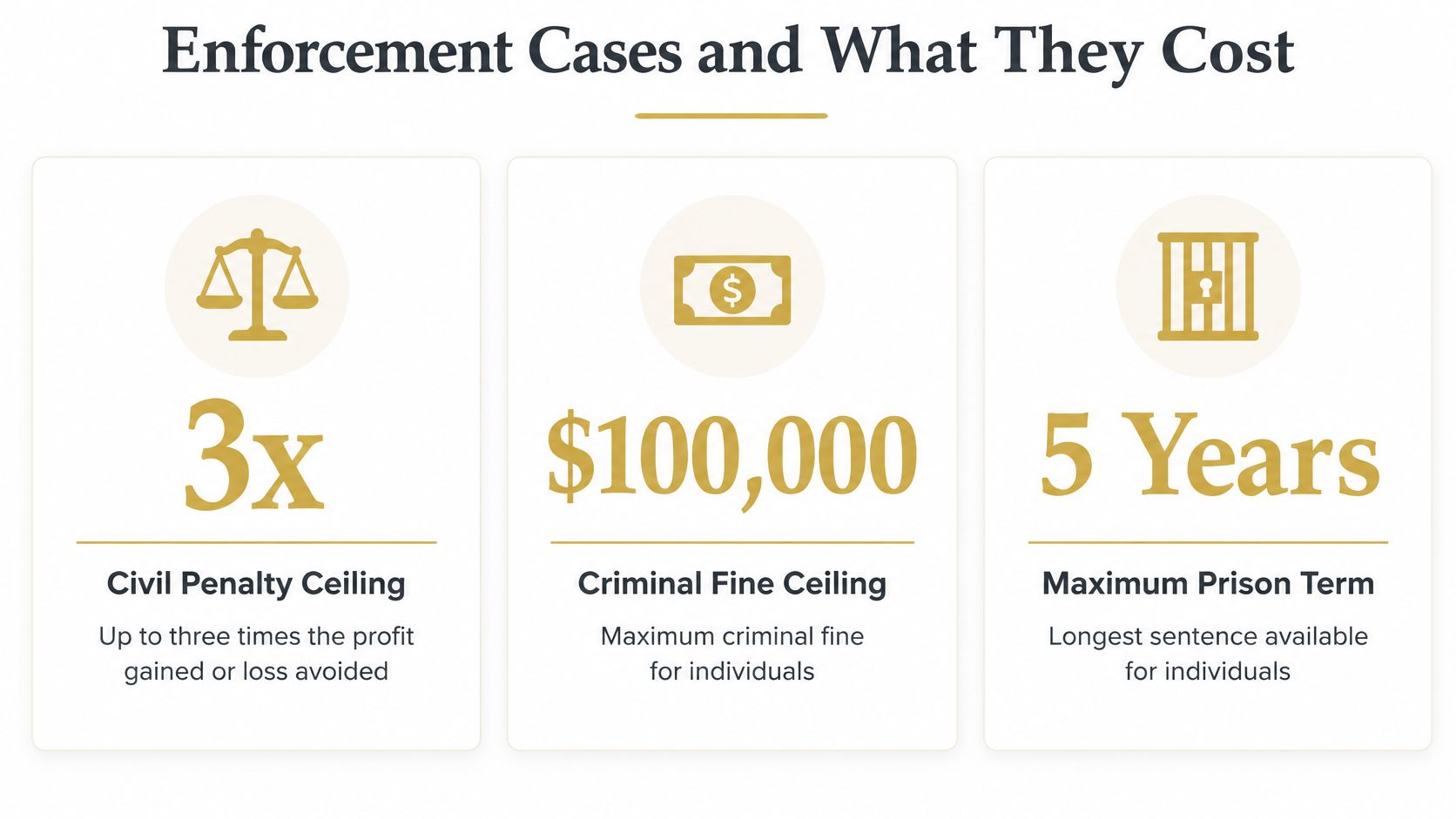
The financial consequences extend beyond returning a trading profit. The SEC's historical account of the Insider Trading Sanctions Act of 1984 describes civil penalties of up to three times the profit gained or loss avoided and the increase in the criminal fine ceiling from $10,000, established in 1934, to $100,000.
Those criminal-fine figures describe a historical change, not today's universal maximum. Congress subsequently broadened enforcement through the Insider Trading and Securities Fraud Enforcement Act of 1988.
The graphic below shouldn't be used as a current sentencing guide. Its criminal-fine and prison-term labels aren't a reliable statement of current maximum exposure; the applicable charge and statute control.
Large networks and small profits
A Morgan Lewis enforcement roundup describes SEC charges against 21 individuals in an alleged international scheme involving attorneys who misappropriated confidential information about at least a dozen pending transactions between 2018 and 2024, with alleged profits in the tens of millions of dollars. The same roundup describes a 2026 case involving approximately $10,006 in alleged gains, followed by matching disgorgement and civil penalties plus prejudgment interest.
The contrast matters more than the size of either headline. In the network case, entrusted deal information allegedly traveled beyond its proper purpose. In the smaller case, modest proceeds didn't prevent monetary enforcement consequences.
A separate Department of Justice announcement from the Southern District of Florida states that a defendant's 2025 insider-trading matter involved more than $420,000 in illicit profits and $316,044 forfeited. Those are distinct measures, not interchangeable descriptions of the same amount.
Different consequences serve different purposes
- Disgorgement: Relinquishing improperly obtained gains.
- Civil penalties: Monetary sanctions separate from repayment.
- Criminal prosecution: A separate process that can involve additional sanctions.
- Professional consequences: Employment, licensing, and director-or-officer repercussions can create additional exposure.
Charges remain allegations unless established through the relevant legal process. Neither a large profit nor a suspicious account relationship eliminates the need to prove the required elements.
For additional context, the following video discusses the subject.
Profit size isn't a safe-harbor test. Automated execution, another person's account, derivatives, or an indirect route to a trade don't automatically remove legal exposure.
Pitfalls and a Filing Routine That Stays Legal
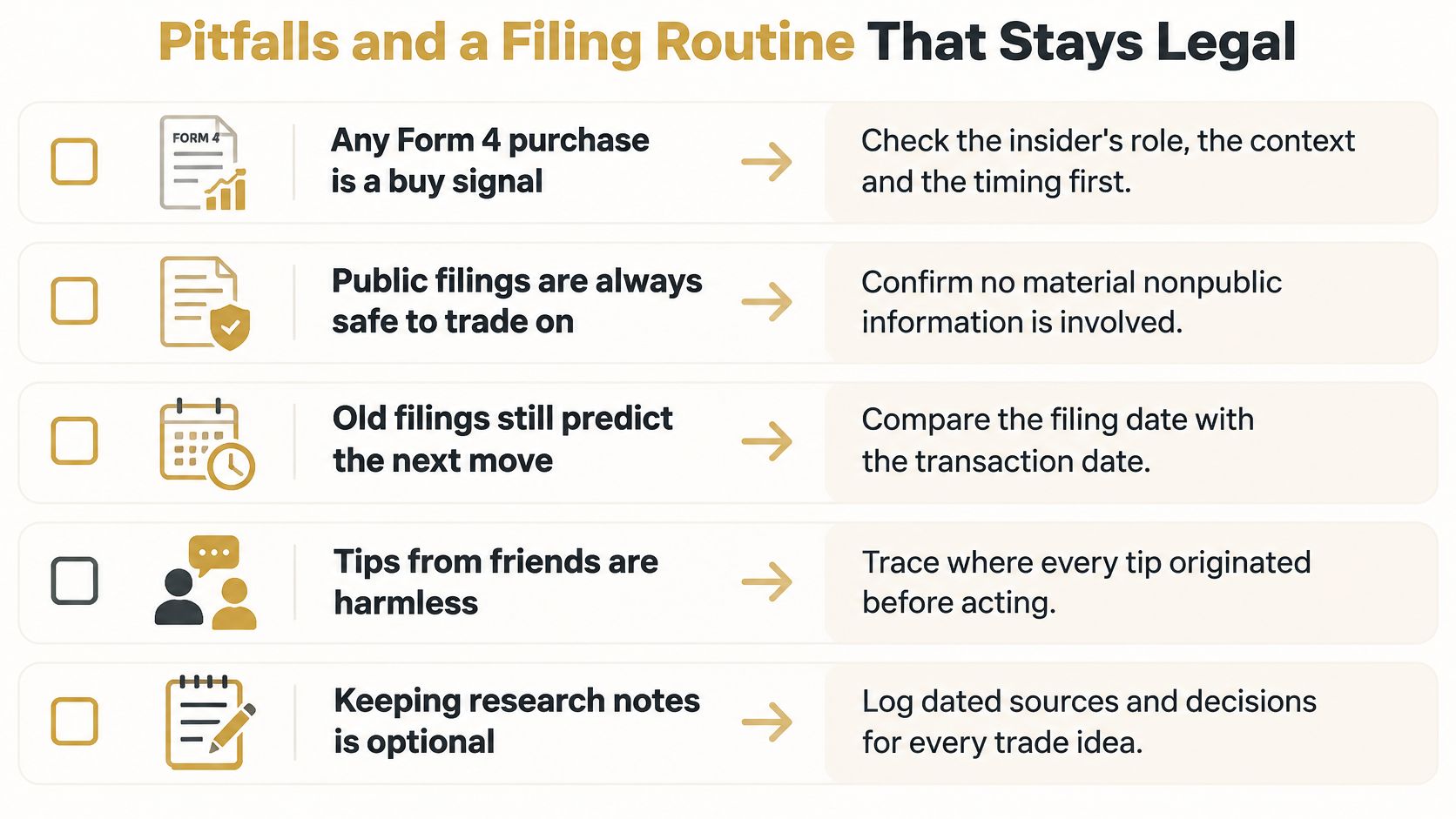
Most mistakes begin when a trader treats an incomplete record as a complete explanation. Correct these beliefs before building a watchlist:
- Any Form 4 purchase is a buy signal: Check the reporting person's role, transaction context, and available price before assigning significance.
- Copying a public congressional trade makes the idea safe: Public availability doesn't establish investment quality or protect separate misuse of confidential information.
- Passing a tip is harmless if I never trade: A wrongful disclosure used by someone else can create liability.
- Small or indirect trades won't matter: Account structure and trade size don't automatically defeat an enforcement case.
- Private briefings and unreleased drafts are fair game: Pause when potentially material information isn't public, and follow applicable employer policies and blackout restrictions.
The checklist reinforces the distinction between collecting records and making an unsupported inference.
Build a source-first research habit
- Retrieve the original record from SEC EDGAR for corporate and institutional filings, or the House or Senate financial disclosure systems for congressional reports.
- Log the relevant dates in a journal so the execution, filing, and viewing events remain distinguishable.
- Classify the transaction using its code, trading-plan disclosure, footnotes, and any amendment.
- Compare institutional snapshots across successive quarters rather than treating a single position as a complete strategy.
- Write a falsifiable thesis explaining why the activity matters and what evidence would contradict your interpretation.
- Practice in a paper-trading journal before putting actual capital behind the idea.
Keep the original document alongside your notes. An aggregator's label can help organize research, but it shouldn't replace the filing's wording.
For example, your thesis might be that several discretionary purchases support confidence in a turnaround. Evidence against that interpretation could include compensation-related transactions misclassified as purchases, material dilution, or operating results that contradict the turnaround assumptions.
Simulation helps evaluate your process, but it doesn't create legal clearance or guarantee that a strategy will work with real money. If someone gives you potentially confidential information, don't use paper trading as a reason to circulate it or test a live transaction.
Legality depends on the facts and jurisdiction. If you face a specific information-access, tipping, or trading-plan question, consult a securities lawyer before acting.
HeliosNet LLC offers TradeLikeInsiders, which surfaces STOCK Act congressional disclosures, SEC Form 4 insider filings, and on-chain whale flow, alongside educational AI analysis and a paper-trading simulator using simulated money. Visit TradeLikeInsiders to compare those records, document your interpretation, and practice evaluating signals before committing funds.
This content is for informational purposes only and is not financial advice. Do your own research.