Insider trading is not legal for Congress. Trading on material nonpublic information from official duties is illegal, ordinary investing on public information is generally allowed, and a covered trade above $1,000 still has to be disclosed, often as many as 45 days after it happened.
Copying a member's latest buy is the advice that sounds sharpest and fails fastest. A Periodic Transaction Report is a late, range-based record. It isn't a live order, a statement of what the member knew, or proof the shares are still held. People in the market trade on news. People with unusual access can see information earlier, and the statute cares about that gap, not the title on the door.
Headlines still flatten this into a single yes or no. The workable screen is narrower. Was the information already public, and did the filing rules get met? Break either condition and the comfortable story falls apart.
Table of Contents
- Legal Investing Versus Illegal Insider Trading in Congress
- How the STOCK Act Draws the Line Between Legal and Illegal Trades
- Why Proving Congressional Insider Trading Is So Hard
- Who Must File and Where the Public Data Stops
- How to Read a Congressional Trade Disclosure Step by Step
- Enforcement Gaps and the Reform Bills Now Moving
- Congressional Trading Numbers and What They Show
- Weigh Insider and Whale Signals Before Drawing Conclusions
Legal Investing Versus Illegal Insider Trading in Congress
Members of Congress may generally buy and sell securities. They don't get a pass on insider-trading law. Before you treat any filing as clean or dirty, ask where the information came from and whether the public already had it.
Walk one lawmaker through both doors. She reads a public earnings release, pulls the latest report on SEC EDGAR, and buys the next morning. That's ordinary research, and it's generally legal. The same lawmaker leaves a closed-door briefing on an unannounced regulation that would hit that company's revenue, then buys before the public hears a word. If the briefing is material and still nonpublic, the second trade is illegal insider trading.
Reporting sits on top of that test. It doesn't replace it. A qualifying securities transaction over $1,000 has to go on a Periodic Transaction Report. Skip the filing and you've got a compliance problem even when the trade itself was lawful. File on time after using material nonpublic information and the trade is still illegal. The Congressional Research Service explainer makes the structure plain. Congressional and staff trading isn't exempt, and a case turns on the information source, materiality, nonpublic status, and the link to the official role.
| Scenario | Legal status | Why |
|---|---|---|
| Buying stock after reading public news and filings | Generally legal | Public information and ordinary research are not the problem |
| Trading on material nonpublic information from official duties | Illegal insider trading | The STOCK Act confirms officials remain subject to insider-trading law |
| Trade over $1,000 that is not disclosed | Compliance violation | Covered officials must file a Periodic Transaction Report |
| Trade of $1,000 or less | Not reportable on a PTR | Reporting applies to transactions exceeding $1,000 |
| Trade disclosed on time but based on nonpublic information | Still illegal | Filing does not legalize a trade made on material nonpublic information |
The law looks at the source of the information, not the trader's job title.
So is insider trading legal for Congress? Only in the ordinary-investing row. Party doesn't matter, and a committee seat doesn't matter. A disclosed purchase in a sector the member oversees can look ugly and still be lawful. A small trade can look harmless and still be illegal if the facts behind it were material and nonpublic. Appearance and legality are different columns.
How the STOCK Act Draws the Line Between Legal and Illegal Trades
The STOCK Act, signed by President Barack Obama on April 4, 2012, ended a real argument. Before that date, it was unclear whether traditional insider-trading doctrines covered Members of Congress. The statute answered by keeping members, congressional employees, and other federal officials under those laws. It didn't create a trading privilege, and it didn't ban every legislator from owning a stock.
The two paths are easier to see side by side.
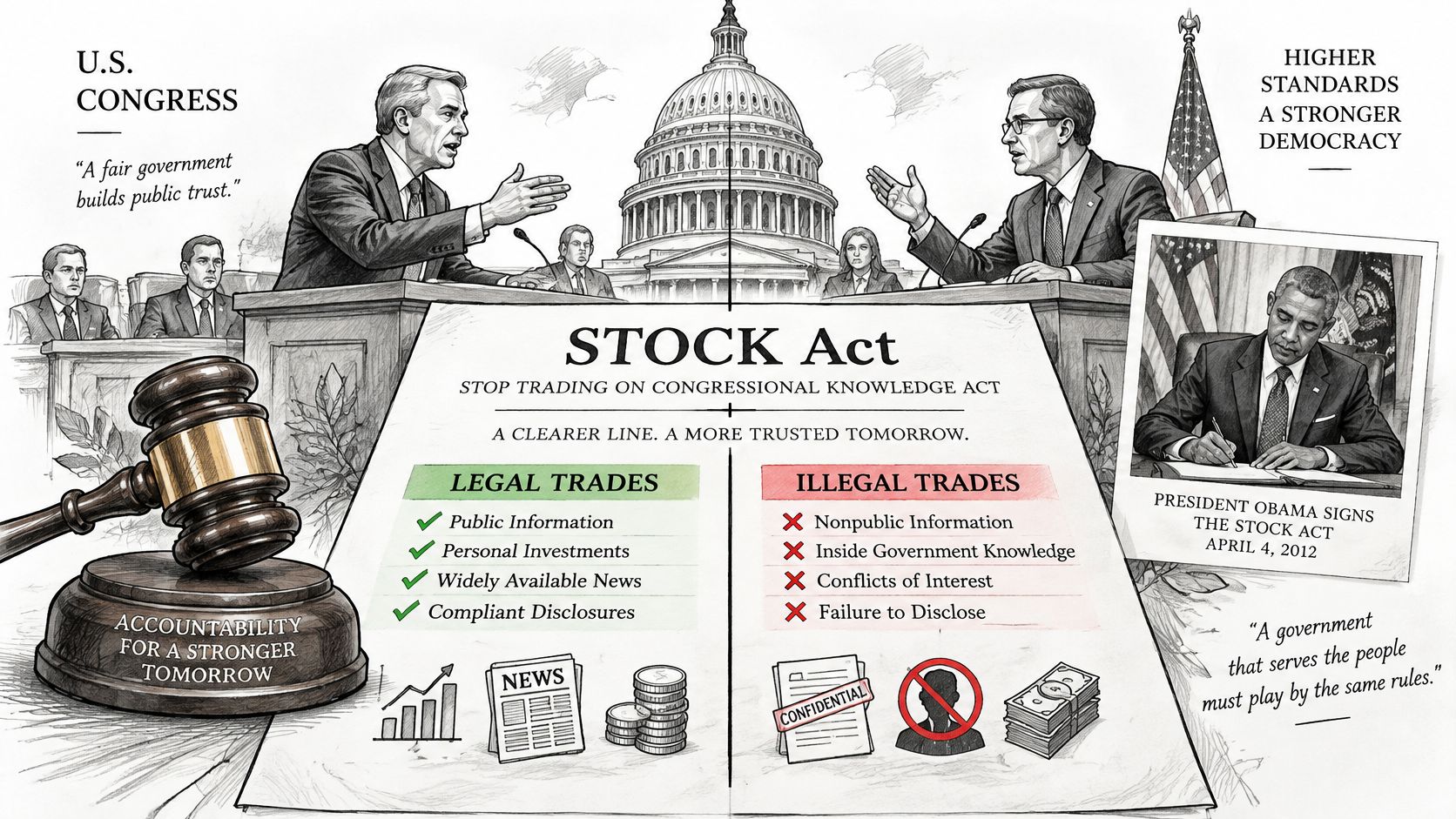
Public information can support a lawful trade. Material nonpublic information taken from official duties cannot.
The Congressional Research Service account of the STOCK Act states that officials remain subject to insider-trading laws, and that legislators owe a duty of trust and confidence to the United States and its citizens when they obtain material nonpublic information through official duties. That same account records the Securities and Exchange Commission's statement that penalties can reach three times the profit gained or loss avoided under the Insider Trading Sanctions Act of 1984. Civil and criminal consequences both sit under existing securities and federal law.
The four working parts
Material means a reasonable investor would care. A change that would reprice a company's main product can qualify. Chatter about a hearing that changes nothing usually doesn't.
Nonpublic means the market doesn't have it yet. A weather forecast posted for everyone is free to use. The same forecast, handed to one person before release, isn't. Hearings, classified briefings, committee work, and draft decisions can all open that private window.
Duty is the trust obligation the statute names. A member can't shrug because the facts arrived through legislative work rather than a corporate job.
Personal benefit is the trade, or a tip made for the official's own gain. Miss any one of these and you don't have the offense. Hit all four and the office doesn't save the trade.
A plain walk-through of how that line gets discussed in public is worth a few minutes.
A legislator's order is judged by the information behind it, not by the fact that the trader holds office. Lawful investing stays lawful. Misuse of confidential government information doesn't.
Why Proving Congressional Insider Trading Is So Hard
One camp says a legislator's trade is automatically legal. The other says it's automatically illegal. Both camps are wrong. Members and certain employees are covered when they use material nonpublic information from official duties. A trade that merely sits near a policy issue isn't a crime by itself.
Where each element gets slippery
Materiality, nonpublic status, a qualifying duty, and intentional or reckless misuse are hard to pin down when the facts come from Capitol Hill. Congress handles information that can move whole industries. The law doesn't clearly mark the moment when broad policy knowledge becomes material nonpublic information. A prosecutor has to point to a specific market-moving fact, not a hunch about where a bill is heading.
The Speech or Debate Clause adds a constitutional limit. It can restrict questioning about legislative acts. It doesn't create a blanket exemption from securities law. Investigators can hit a wall on what was said in a committee room without the member becoming untouchable for a brokerage order placed the same week.
Say a purchase prints two days before a committee announcement. The calendar looks bad. A public news item that same morning, or a sale the broker was told to make months earlier, can still explain the ticket. The filing shows timing and sector exposure. It doesn't show what the member knew, or why the order went in.
A Washington University Law Review analysis lands the point that headlines skip. Congressional trading isn't broadly immune, yet proving an offense is much harder than showing the appearance of a conflict. Disclosures flag possible timing and conflicts. They don't establish that a member held a specific nonpublic fact or traded because of it.
Who Must File and Where the Public Data Stops
Check coverage before you read a single trade. The Senate public disclosure office describes the Periodic Transaction Report requirement as covering Senators and senior staff, with qualifying transactions above the statutory threshold reported promptly. The detailed form covers Senators, officers, and employees who meet the pay threshold for the required period. House members and other covered officials file under the same transaction rule through House ethics channels.
The filing duty itself sits with the covered filer. The Senate Ethics Committee's financial disclosure page lays out the forms and instructions that obligation runs through.
A missing name isn't a clean bill of health. A public congressional-trading dataset isn't a complete record of every federal employee's investments, only of the people and transactions the reporting rule captures. Someone can sit outside the PTR list and still face liability for misusing material nonpublic information picked up through official duties. Who has to file, and who can be charged, are separate questions.
That gap cuts both ways. An empty filing history doesn't clear anyone, and a busy one doesn't convict anyone.
Before you interpret a name:
- Identify the filer. Member, officer, or staff.
- Confirm the role and pay tier. Senior staff and employees have to meet the statutory tests.
- Confirm the reporting period. Match the year the form covers.
- Confirm the information source. Official duties are a different problem from a public filing.
If the person is out of scope, stop. You don't have a PTR story yet.
How to Read a Congressional Trade Disclosure Step by Step
A PTR is a dated, approximate observation. Read it in order. Don't skip a step because the ticker in the headline is familiar.
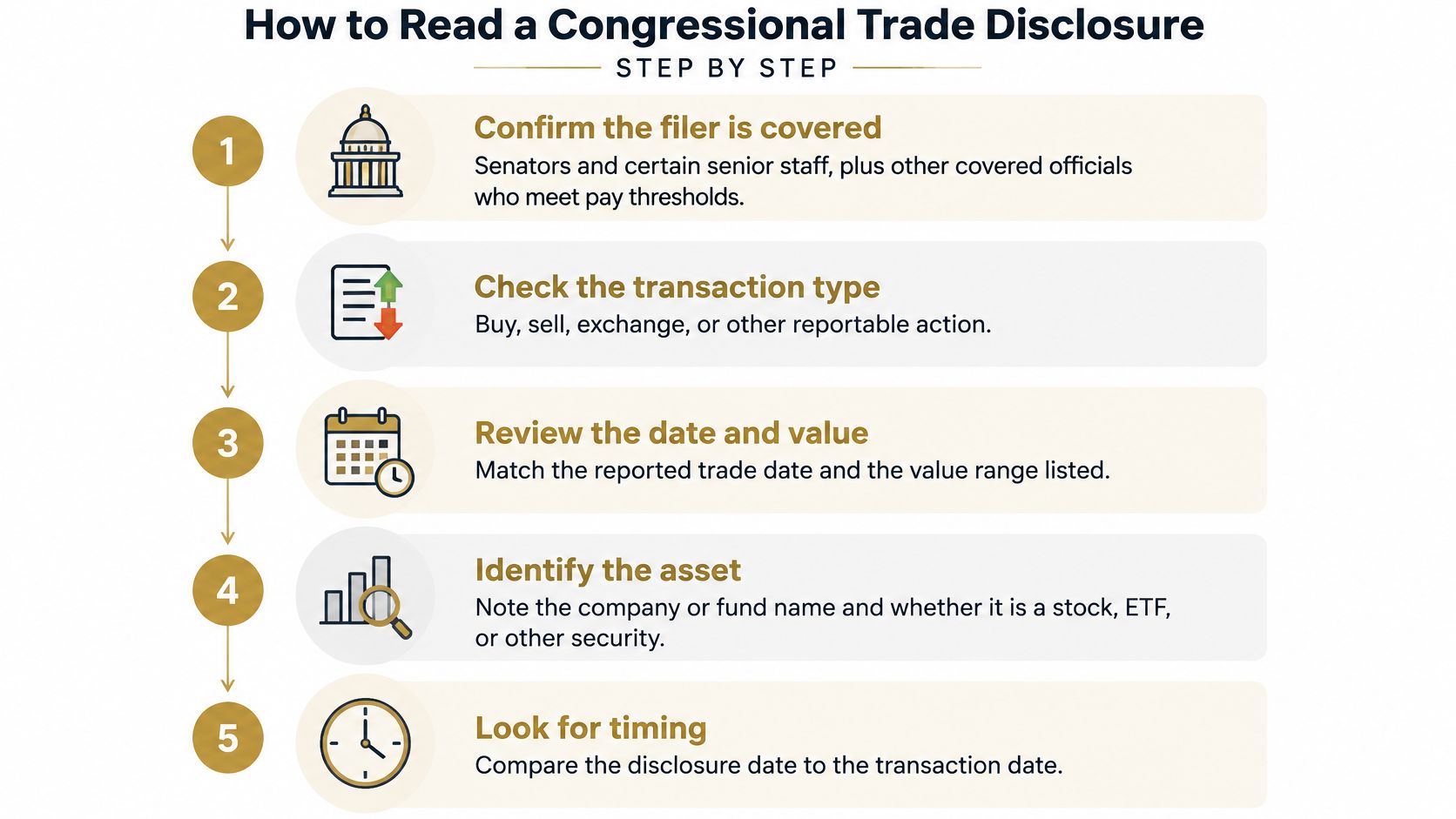
Six checks, in order
Confirm the filer is covered. Senators, certain senior staff, and other officials who meet the pay and service tests belong in the set. A name outside that set shouldn't be treated as a missing report.
Separate the transaction date from the filing date. Mixing them makes an old trade look like fresh news. Anchor any chart to the day the trade happened.
Name the asset and the action. Stocks, bonds, commodity futures, and other non-excepted securities are in scope. Note buy, sell, or exchange before you guess at intent.
Read the amount as a range. The CY2024 financial disclosure instructions require the asset, the transaction date, and a category of amount once a transaction clears the reporting line. You don't get an entry price, a share count, or a profit-and-loss figure. A band can hide very different exposures, and a sale doesn't prove the whole position was closed.
Match the filing to the calendar. Compare the trade date with bill status, agency releases, and later PTRs. One print isn't a pattern.
Treat lateness as paperwork. The 2018 Periodic Transaction Report instructions state that a PTR filed more than 30 days after its due date draws a $200 penalty. That stamp isn't a market signal.
What the clock actually does
| Stage | Rule or deadline | What it means for readers |
|---|---|---|
| Trade executed | Transaction date recorded on the filing | Anchor your analysis to this date, not the filing date |
| Filer receives written notice of the transaction | Starts the 30-day filing clock | Notice timing sets the earliest due date |
| Periodic Transaction Report due | Within 30 days of notice and no later than 45 days after the trade | The public may see the trade weeks after it happened |
| Late filing | $200 penalty if filed more than 30 days after the due date | Lateness is a compliance issue, not a market signal |
| Public visibility | Often weeks after the trade | A disclosure is historical evidence, not a live alert |
Policy can still move a sector through taxes, subsidies, procurement, or rules. The filing alone doesn't prove the member caused the move or broke the law. On TradeLikeInsiders, the congressional and insider disclosures we show are delayed and aren't real-time trades.
A clean read sounds boring on purpose. Covered filer, two dates kept apart, named security, amount left as a range, calendar checked, lateness ignored as a signal. Anything louder than that is a story you added.
Enforcement Gaps and the Reform Bills Now Moving
The disclosure rule is clearer than the machinery enforcing it. Oversight is split across chambers, and most of what the system documents is paperwork.
On the House side, the Office of Congressional Conduct can investigate, but its inquiries are private and it lacks subpoena power. The Senate Ethics Committee oversees Senate compliance, and no independent body broadly handles Senate accountability. In November 2025 testimony before the House Committee on House Administration, a witness stated that no Member had been prosecuted under the STOCK Act. The same testimony described earlier analysis documenting thousands of disclosed congressional transactions in a single year and dozens of members who failed to report properly. Documented violations cluster around missed deadlines and administrative errors rather than proven misuse of nonpublic information.
That last point is the enforcement gap.
A system can count late filings precisely while never building an insider-trading case, because a disclosure records that a trade happened. It does not record what the filer knew when they placed it.
Proposals, not current law
Lawmakers have floated tougher rules, and bills discussed for 2025 and 2026 would tighten disclosure and trading restrictions beyond what the STOCK Act requires. Every one of them is a proposal. The enforceable standard today remains the statute as written, so treat any proposed change as pending until it becomes law.
For a reader of disclosures, the practical takeaway is narrow. A filed report can surface a conflict and reveal timing or sector exposure. What it cannot show is why the trade was placed, and that unanswered question is exactly where enforcement stalls.
Congressional Trading Numbers and What They Show
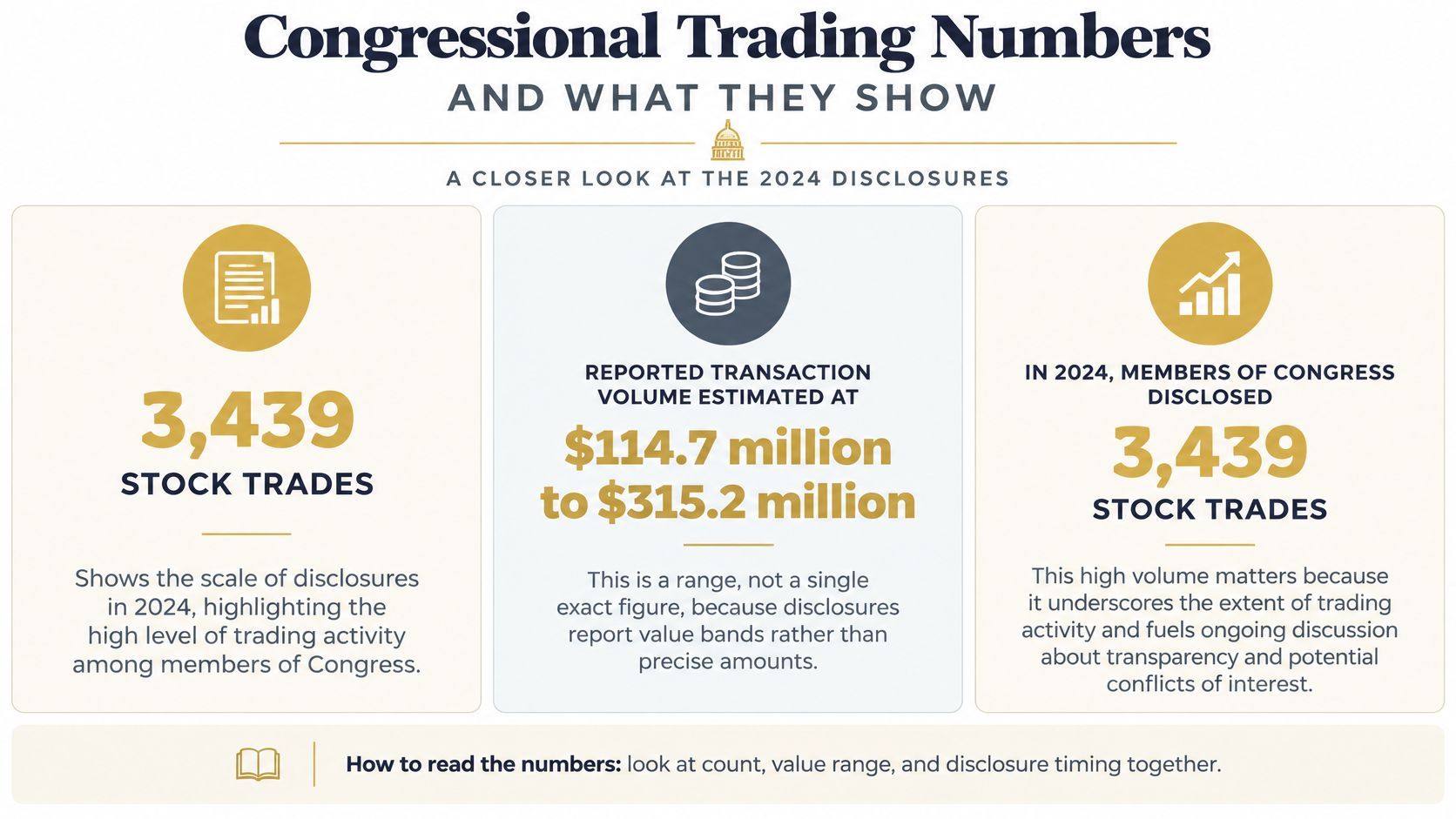
In 2024, members of Congress disclosed 3,439 stock trades, with reported transaction volume estimated between $172,749,272 and $670,008,841, according to CapitolExposed's compilation of official STOCK Act data. Read that band carefully. Every periodic transaction report logs a value range rather than an exact amount, so an annual total can only be bounded, never summed to a single dollar figure. The gap between the low and high ends is a property of the reporting rules, not evidence of hidden profit.
One month isn't a trend
September 2024 produced 473 disclosed trades, 164 purchases against 309 sales, in ColdPine's monthly compilation of periodic transaction reports. Sales outnumbered purchases by a wide margin that month. A sell-heavy stretch can reflect portfolio rebalancing, an option exercise, or activity in a spouse's account, all of which appear in the same filing format as a speculative trade. Nothing in the count tells you whether any order rested on nonpublic information.
Public opinion is a different kind of number. In 2024, 72% of nationally surveyed adults supported prohibiting members of Congress and their live-in family members from trading individual stocks, in polling from the University of Maryland's Program for Public Consultation. That figure measures reform pressure. It cannot score a single filing.
| Metric | Value | Year |
|---|---|---|
| Stock trades disclosed by members of Congress | 3,439 | 2024 |
| Estimated reported transaction volume | $172,749,272 to $670,008,841 | 2024 |
| Trades disclosed in September | 473 (164 purchases, 309 sales) | 2024 |
| Adults supporting a ban on members trading individual stocks | 72% | 2024 |
These figures measure disclosure activity and public sentiment. They don't measure profit, intent, or misconduct. What a filing shows is what traded, when it traded, which direction the order went, and a size band around the amount. It never shows the information behind the order. One September doesn't make a trend, and a wide dollar band isn't a profit figure you can annualize.
Weigh Insider and Whale Signals Before Drawing Conclusions
Congressional filings are only one delayed feed. Corporate insiders report on SEC Form 4 through EDGAR, usually within two business days. That's much faster than a PTR, and it still isn't a live tape. Large managers report holdings on Form 13F, a quarterly snapshot filed weeks after quarter-end, so the positions you see are already old. Both feeds can be incomplete. Neither proves intent or future performance.
Use the same discipline on every feed.
- Split the dates. The transaction date and the filing date answer different questions.
- Check the security and the size. Share counts on a Form 4 are exact. Congressional amounts are bands. Don't pretend they match.
- Lay the timing on the news calendar. Bills, agency rules, and earnings can all explain a cluster of orders.
- Demand a pattern. One print is an anecdote. Several filings in the same name, over time, are a record.
- See whether the position closed. A partial sale isn't an exit.
TradeLikeInsiders surfaces STOCK Act congressional disclosures, SEC Form 4 insider filings, and on-chain whale flow in one place, and it adds educational AI analysis so you can read those feeds together. That's a research view, not a recommendation.
No filing, congressional or corporate, is an instruction to buy or sell a security. This content is for informational purposes only and is not financial advice. Do your own research.
HeliosNet LLC runs TradeLikeInsiders for readers who want delayed congressional disclosures, insider filings, and policy signals studied side by side. Our paper-trading simulator lets you practice those reads with simulated money, so you can test a thesis before it touches a brokerage account. Visit TradeLikeInsiders and work through the filings on your own terms.