A large crypto transaction isn't a guaranteed buy or sell signal. Even a 500,000 BTC transfer can reflect market plumbing rather than conviction, while a much smaller move can matter more if it changes available liquidity or reveals realized profits.
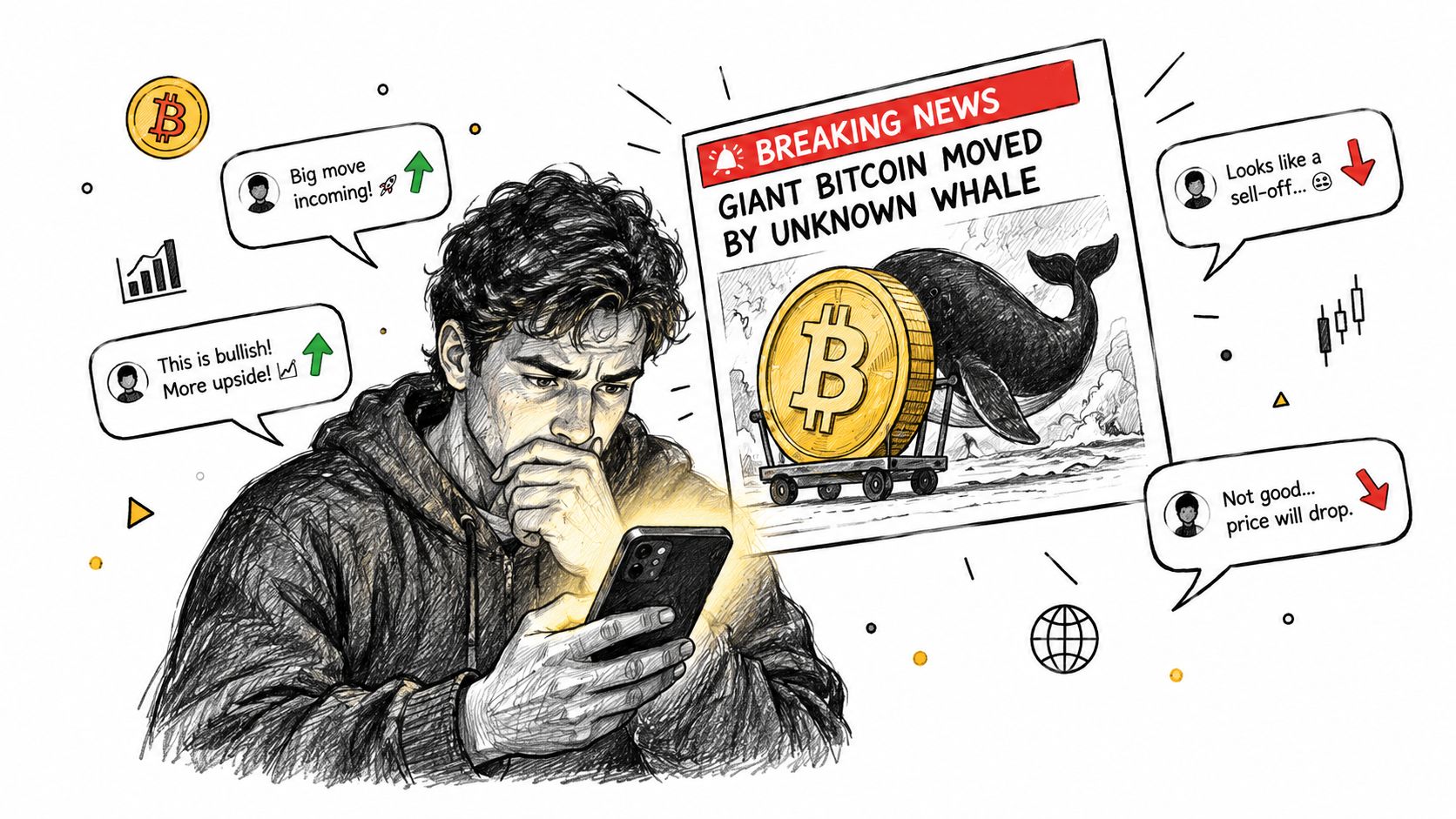
You've probably seen the alert. A wallet reportedly moved a huge amount of Bitcoin or Ethereum, the notification hits social media, and traders immediately split into two camps. One calls it accumulation. Another calls it a dump. Both may be reacting to the same transaction without knowing who sent it, who received it, or why it moved.
That's the central problem with tracking whale activity. Large crypto transactions are attention signals, not automatic trade signals. The useful edge comes from identifying the source, checking the destination, measuring confirmation status, and comparing the move with the asset's market structure.
The same discipline applies to congressional stock disclosures, corporate insider filings, and institutional holdings. Public information can be useful, but timing and context determine whether it's actionable or already stale.
Table of Contents
- Why Large Crypto Transactions Matter to Active Traders
- What Large Crypto Transactions Indicate
- On-Chain Sources for Tracking Large Transfers
- Interpreting Large Transfer Context Before You Trade
- Real-World Examples That Show How to Read Whale Moves
- Common Mistakes That Waste Time and Money
- A Practical Framework for Trading Whale Signals
- Frequently Asked Questions
Why Large Crypto Transactions Matter to Active Traders
A news alert flashes across your phone: a whale has moved a huge amount of Bitcoin. The market feed fills with predictions before anyone has checked the receiving address. That reaction is understandable, but it's also where many traders create risk for themselves.
Large transfers matter because they can reveal changes in custody, exchange liquidity, collateral, or wallet behavior. They can also help traders investigate whether a market move has a plausible on-chain explanation. They don't prove intent. A blockchain records movement, not the private agreement behind that movement.
Start with three checks before forming a view:
- Verify the transaction: Confirm the hash, asset, amount, block status, and sending and receiving addresses through a blockchain explorer or reputable monitoring dashboard.
- Classify the destination: An exchange wallet, known custody address, staking contract, bridge, or fresh wallet can imply very different operational purposes.
- Compare with market behavior: Look for changes in order-book liquidity, derivatives positioning, realized profit activity, or exchange balances instead of treating the alert as a standalone event.
A transfer into an exchange may increase the possibility of future selling, but it isn't proof that the owner is selling. A withdrawal may indicate self-custody or accumulation, but it may also be a custody reshuffle. The transaction becomes more informative when several independent signals point in the same direction.
Practical rule: Don't trade the headline. Trade only after you understand the transaction's likely economic purpose.
Attention still has value. Rare transfers can justify closer monitoring, especially when they involve a known market participant, arrive during stressed liquidity, or coincide with a meaningful policy or regulatory development. But the first response should be investigation, not imitation.
What Large Crypto Transactions Indicate
A whale alert can show a dramatic number while saying little about market direction. “Large” has two separate meanings in crypto: a high coin count or a high fiat value. Treating them as interchangeable creates bad comparisons and faster reactions than the evidence supports.
In November 2011, one Bitcoin transaction moved 500,000 BTC, worth about $1.5 million when Bitcoin traded near $3. The coin count mattered more than the dollar value because the network and market were still small. In September 2019, 94,504 BTC moved in one transaction valued at nearly $1 billion. A 2013 transfer of 194,993 BTC was worth about $150 million, reflecting Bitcoin's lower price at the time. These historical figures are covered in Ars Technica's report on the billion-dollar Bitcoin transfer.
The same number of coins can carry very different market implications across eras. Dollar value helps frame economic scale, while coin quantity shows how unusual the movement may be relative to supply, liquidity, and typical wallet behavior. Neither measure identifies intent by itself.
Rarity changes the information value
Extreme transfers deserve attention because they occur infrequently. A quantitative analysis of Bitcoin's blockchain recorded only 364 transactions larger than 50,000 BTC in its dataset, according to the Bitcoin transaction graph study. That finding supports investigation, not a bullish or bearish conclusion.
A rare transfer may indicate a meaningful liquidity shift, especially if the counterparties are identifiable and the destination has an active market role. It may also be an internal movement between addresses controlled by the same exchange, custodian, fund, or organization. Source attribution changes the interpretation.
Use four questions before assigning a trading signal:
- Measure coin quantity. Compare the transfer with supply and normal wallet activity.
- Measure dollar value. Estimate its economic scale at the time of movement.
- Check the era and market. Historical coin counts need context from price, liquidity, and market maturity.
- Identify the counterparties. Ownership, destination, and operational purpose matter more than the headline number.
A large transfer confirms movement of assets. It does not confirm a change in economic exposure, an impending sale, or a directional trade.
On-Chain Sources for Tracking Large Transfers
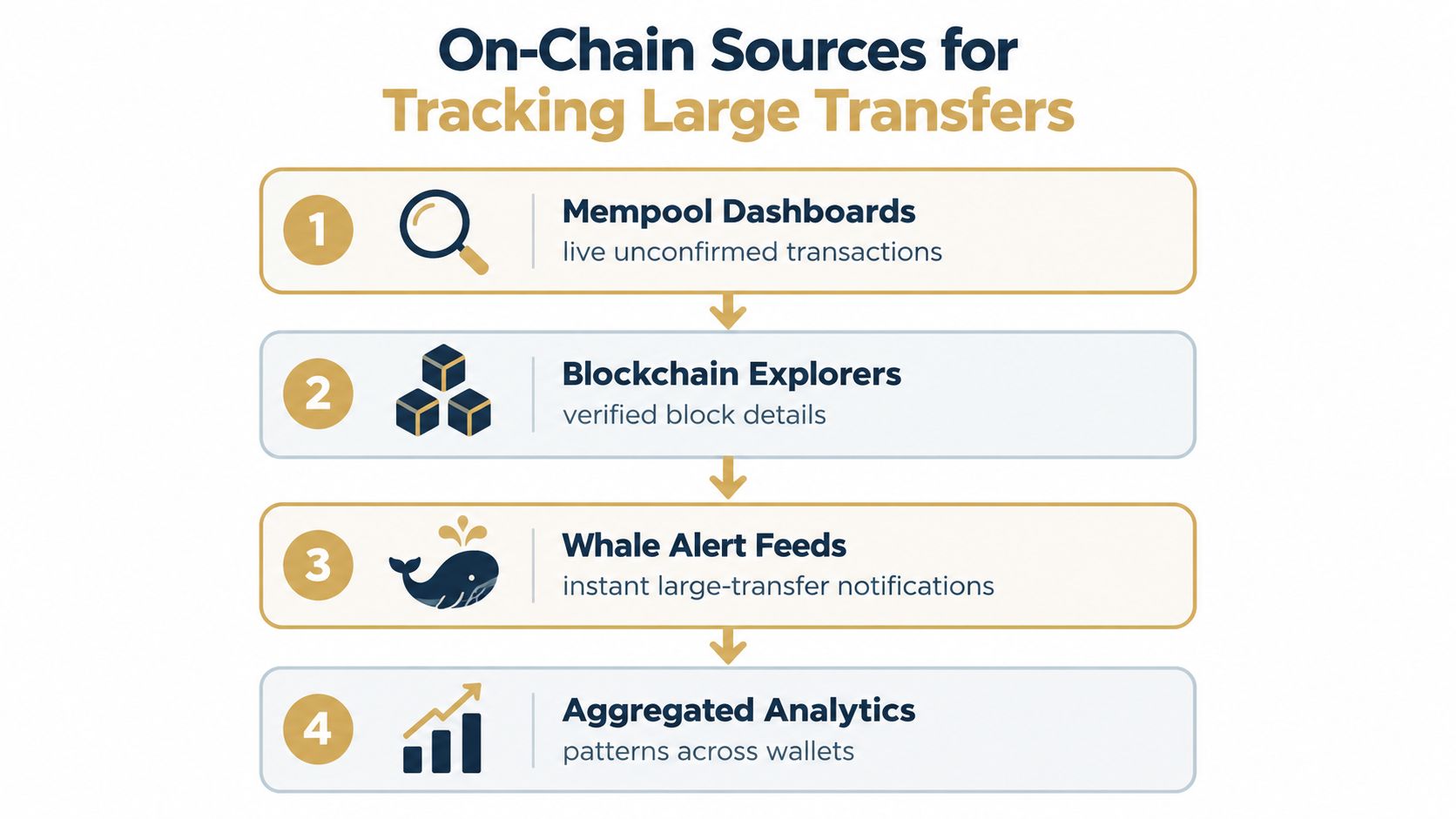
Different tools answer different timing questions. A mempool dashboard can show an unconfirmed transaction before it enters a block. A blockchain explorer gives you verified details after confirmation. Aggregated analytics can then help determine whether the move belongs to a broader pattern.
For Bitcoin, one live dashboard defines a whale event as a confirmed or mempool transfer worth at least 100 BTC, a mega-whale event as a single transfer of at least 1,000 BTC, and whale-SOPR as a profit-and-loss metric calculated only on large UTXOs of at least 10 BTC. The definitions are available on the Bitcoin whale intelligence dashboard. These thresholds aren't universal market rules. They're filters that help separate broad activity from larger capital movements.
Match the source to the decision
Mempool dashboards are useful when timing matters. One monitoring system reports whale events as soon as they reach the mempool, with detectors surfacing transfers seconds before confirmation. Its dashboard variables refresh every 15 to 60 seconds, according to the live whale-monitoring platform. That speed can help you investigate a possible exchange deposit or custody movement before final settlement, but it also means the transaction can still be replaced, delayed, or interpreted incorrectly.
Blockchain explorers work best for verification. They show the transaction hash, inputs, outputs, fees, block inclusion, and address history. Explorers are slower than a mempool alert by design, but confirmed data is more reliable for an audit trail.
Whale alert feeds are efficient for discovery. They're useful for finding events you might otherwise miss, but automated labels can be incomplete or wrong. Treat an alert as a prompt to inspect the underlying transaction, not as a finished conclusion.
Aggregated analytics help with pattern recognition. Wallet clusters, realized profit metrics, exchange flows, and historical behavior can provide context that a single transaction lacks. For broader research workflows, traders can also use the TradeLikeInsiders research blog to connect market events with policy and disclosure context.
Choose the tool based on the job. Use live monitoring for early awareness, explorers for confirmation, and cohort analytics for interpretation. No dashboard can identify private intent with certainty.
Interpreting Large Transfer Context Before You Trade
A whale transfer on its own is noise. The tradeable question is whether it changes real economic exposure, or just moves coins from one wallet to another.
Use four checks in order: Who sent it? Who received it? Why did it likely move? What usually follows this kind of movement? The answer gets stronger when the address history, destination type, and market reaction line up.
Compare the main transfer contexts
| Context | What the movement may indicate | What it does not prove |
|---|---|---|
| Exchange deposit | Funds may be available for trading or selling | That the holder has sold |
| Exchange withdrawal | Funds may be moving into self-custody or another venue | That the holder is accumulating |
| Custody rebalancing | An institution may be reorganizing wallet storage | A change in market exposure |
| OTC settlement | A private trade may be settling away from public order books | Immediate open-market pressure |
| Collateral movement | A borrower or trading desk may be repositioning security | Directional conviction |
| Realized-profit distribution | A holder may be sending proceeds to multiple destinations | That the entire position is being exited |
A large Bitcoin transfer can be an internal exchange move, a custody reshuffle, collateral repositioning, or OTC settlement rather than a clean buy or sell signal. That's the main lesson in an analysis of what crypto whales are buying and how transfers are classified. Size alone is dramatic. It is not evidence.
Destination analysis usually matters more than sender analysis. A known exchange deposit deserves attention because the recipient can turn the coins into market access. A transfer between two wallets controlled by the same custodian may have little immediate price meaning. A new wallet receiving funds needs more caution because its next step is unknown.
Asset context matters too. A large Bitcoin signal should not be copied onto Ethereum or a token with different liquidity, custody, and trading structure. A Philadelphia Fed working paper on whale-trading alerts found that after those alerts, BTC volatility rose while ETH volatility fell, with the strongest effect tied to WBTC alerts on BTC. That points to a simple rule. Large-transfer signals are asset-specific, not universal market commands.
Wait for confirmation when the setup is unclear. Compare the transfer with price, volume, spreads, derivatives, and the next wallet actions. If nothing follows, the move was probably operational rather than directional.
Real-World Examples That Show How to Read Whale Moves
A large transfer can look bearish on the surface and still be routine back-office work. A whale moving Bitcoin from cold storage to an exchange wallet deserves attention because it may create sellable supply. The same size transfer between two custody addresses may mean nothing for price.
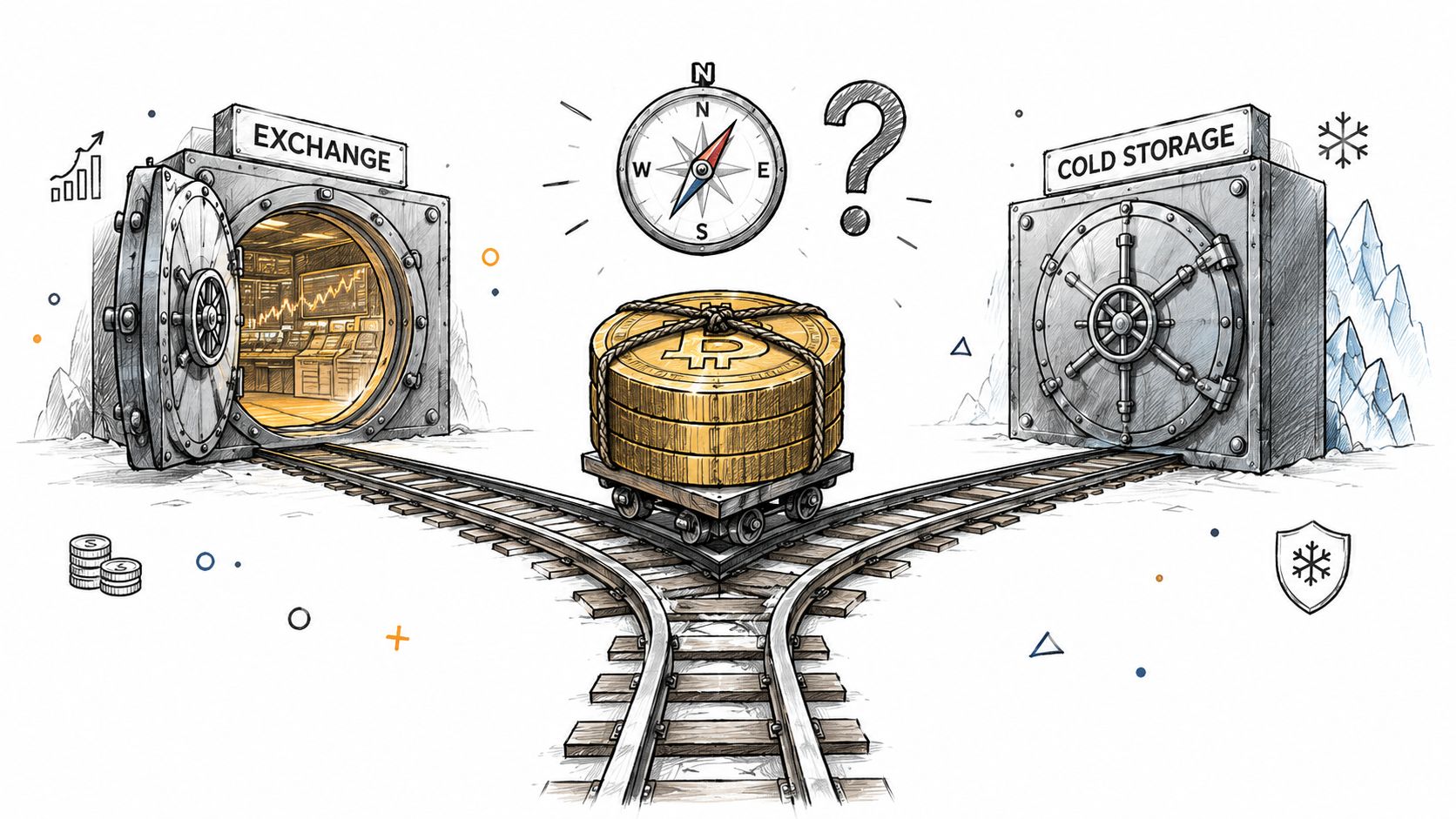
Start with the destination. If a transfer lands in a known exchange wallet, check whether the funds later reach an active deposit address, whether similar wallets are moving at the same time, and whether spreads or order book depth start to shift. That is the practical difference between a storage move and a possible supply event.
A custody-to-custody transfer calls for a different read. If the coins move from one institutional wallet to another, the size still looks dramatic, but the trade implication is weaker because there is no clear route to market. The right question is whether the sender, the recipient, or the control structure changed in a way that affects future selling.
Timing changes the response
Mempool alerts give traders an early look, but they also create false urgency because the transfer is not final yet. Use the alert to inspect the address history, then wait for confirmation before treating the move as settled evidence.
Context can flip the meaning of the same flow. A whale moving funds after a long price run may be trimming risk, adding liquidity, or rebalancing treasury wallets. You need the next wallet actions, not just the first headline.
The same discipline applies to disclosures and research notes. A filing or report can show what was stated, not always what was still true at the moment you saw it. For a worked example of reading market signals alongside disclosure context, see a worked example of reading market signals alongside disclosure context. The point is simple. Source, timing, and destination decide whether the transfer matters.
Common Mistakes That Waste Time and Money
A whale alert can look decisive in the moment. It usually isn't. Traders lose money when they react to size alone and skip the part that matters, where the coins came from, where they are going, and what the market can do with them.
Mistake one, counting coins without context. A large coin count can mean very different things depending on the asset and the market regime. Track both the coin amount and the fiat value, then check the counterparties before you read anything into it.
Mistake two, assuming every exchange deposit means selling. Exchanges also receive funds for collateral, market-making, internal settlement, and custody moves. Follow the destination wallet and look for later order flow or spending evidence before calling it bearish.
Mistake three, treating an automated wallet label as fact. Labels are shortcuts, not proof of ownership or intent. Check address history, related clusters, and the transaction itself before you trust the tag.
Mistake four, chasing an unconfirmed alert. Mempool data is fast, but the transfer is still pending. Use the alert to research the wallet, then wait for confirmation before treating it as settled evidence.
Mistake five, treating one transfer as a trend. One move is a data point. A pattern across related wallets, repeated exchange flows, and the market's response carries more weight than a single headline.
Large transfers attract attention because they are uncommon, and that scarcity cuts both ways. Rarity is a reason to inspect the flow carefully, not a reason to assume the first narrative is right. It also means traders should stay skeptical when the headline tries to do too much work.
A Practical Framework for Trading Whale Signals
Use a simple evidence score before reacting to any alert:
- Size: Is the transfer large in coins, fiat value, or both?
- Destination: Is it an exchange, custodian, contract, fresh wallet, or related internal address?
- Asset: Does the signal apply to this specific asset and its liquidity conditions?
- Confirmation: Is the transaction in the mempool or included in a confirmed block?
- Follow-through: Do price, volume, wallet activity, or other disclosures support the same interpretation?
A strong signal has independent confirmation. A weak signal is large but unexplained.
For U.S. market context, separate on-chain timing from public disclosures. Congressional trades are filed under the STOCK Act through Periodic Transaction Reports, and covered lawmakers and staff must disclose transactions over $1,000 within 45 days, according to the Congressional Research Service summary. The reports are delayed and amounts are reported in ranges, so they're useful for research, not real-time copying.
Corporate insiders file SEC Form 4 by the end of the second business day after a trade. The form reports the shares bought or sold and the price per share, as described in the SEC Forms 3, 4, and 5 guide. Institutional positioning arrives later through Form 13F. Managers with at least $100 million in Section 13(f) securities must file within 45 days after each quarter-end, according to the SEC's Form 13F explanation.
Use TradeLikeInsiders to keep these different signal types in one research workflow, but verify the original filing or transaction before making a decision.
Frequently Asked Questions
Are large crypto transactions bullish or bearish?
Neither by default. The direction depends on the sender, recipient, asset, custody relationship, market liquidity, and what happens after confirmation. A large exchange transfer may deserve monitoring, but it doesn't prove an imminent sale.
Should I trust a whale alert immediately?
Treat it as a lead. Confirm the transaction hash, block status, address labels, and destination before drawing a conclusion. Alerts are useful for speed, while explorers and wallet history provide the verification layer.
What's more important, coin count or dollar value?
You need both. Coin count shows the transfer's scale in the asset, while dollar value shows its nominal economic size at that moment. Historical Bitcoin transfers demonstrate why either measure alone can mislead.
Can congressional trades predict crypto prices?
Congressional disclosures can provide policy and market context, but they're delayed and concern reported securities transactions rather than real-time crypto flows. Use them as one research input, not a timing mechanism.
Are Form 4 filings better than 13F reports?
They serve different purposes. Form 4 is faster and identifies specific insider transactions, while Form 13F offers a delayed snapshot of qualifying institutional holdings. Neither filing explains every motivation behind a position.
What should I do after a whale alert?
Pause, verify, classify the destination, compare other signals, and define what evidence would invalidate your initial interpretation. If the transaction remains unexplained, waiting is a valid analytical decision.
HeliosNet LLC offers TradeLikeInsiders, a market research and alerting platform that brings congressional disclosures, SEC insider activity, whale moves, and policy signals into one workflow. Visit TradeLikeInsiders to research these signals with source context and practice decisions in an educational paper-trading environment. This content is for informational purposes only and is not financial advice. Do your own research.