The popular advice is to use a paper trading account until you're profitable, then switch to real money. That skips the most important question: did your strategy make money, or did the simulator give you prices you couldn't trade?
Practice is useful when you treat it as an execution test, not a scoreboard. For traders following congressional disclosures, corporate insiders, and institutional moves, the hidden variable is the fill model, the rules the simulator uses to decide when an order executes and at what price.
Table of Contents
- What a Paper Trading Account Actually Is
- How Simulated Balances and Positions Work
- Order Journals and What to Record Each Trade
- Why Practice Results Overstate Live Performance
- How Form 4, 13F and Congressional Filings Become Testable Signals
- How to Set Up and Run Your First Practice Trades
- Deciding When Practice Results Are Ready for Real Money
What a Paper Trading Account Actually Is
A paper trading account is a practice account where you place trades with virtual money while the platform tracks positions, cash, and profit or loss as if they were real. Like a flight simulator, it lets you rehearse procedures before the consequences become financial.
The idea predates trading apps. Traders recorded hypothetical purchases and sales in notebooks and ledgers long before digital platforms automated the process, as described in Flattrade's paper-trading glossary.
Paper trading account vs live brokerage account
| Feature | Paper trading account | Live brokerage account |
|---|---|---|
| Starting money | Simulated balance, often a preset amount | Real deposited funds |
| Losses | Virtual, no money is lost | Real money is lost |
| Order fills | Simulated using the simulator's model | Executed through brokers and market venues |
| Fees and spreads | Often omitted or simplified | Commissions, spreads, and applicable financing charges |
| Emotional stakes | Usually low, no capital at risk | Higher, real financial consequences |
| Market data | May be delayed or simplified | Live quotes available, sometimes at a cost |
| Best use | Learning mechanics and testing a process | Executing a strategy with real capital |
Simulation is a serious educational tool. The SIFMA Foundation's Stock Market Game has operated in US educational settings since 1977 and serves more than 600,000 students annually, according to this Worcester Polytechnic Institute document.
Choose your purpose: Learn order mechanics, test a repeatable process, or prepare to commit capital. Those are different jobs, and simulated profit alone doesn't prove you've completed any of them.
How Simulated Balances and Positions Work
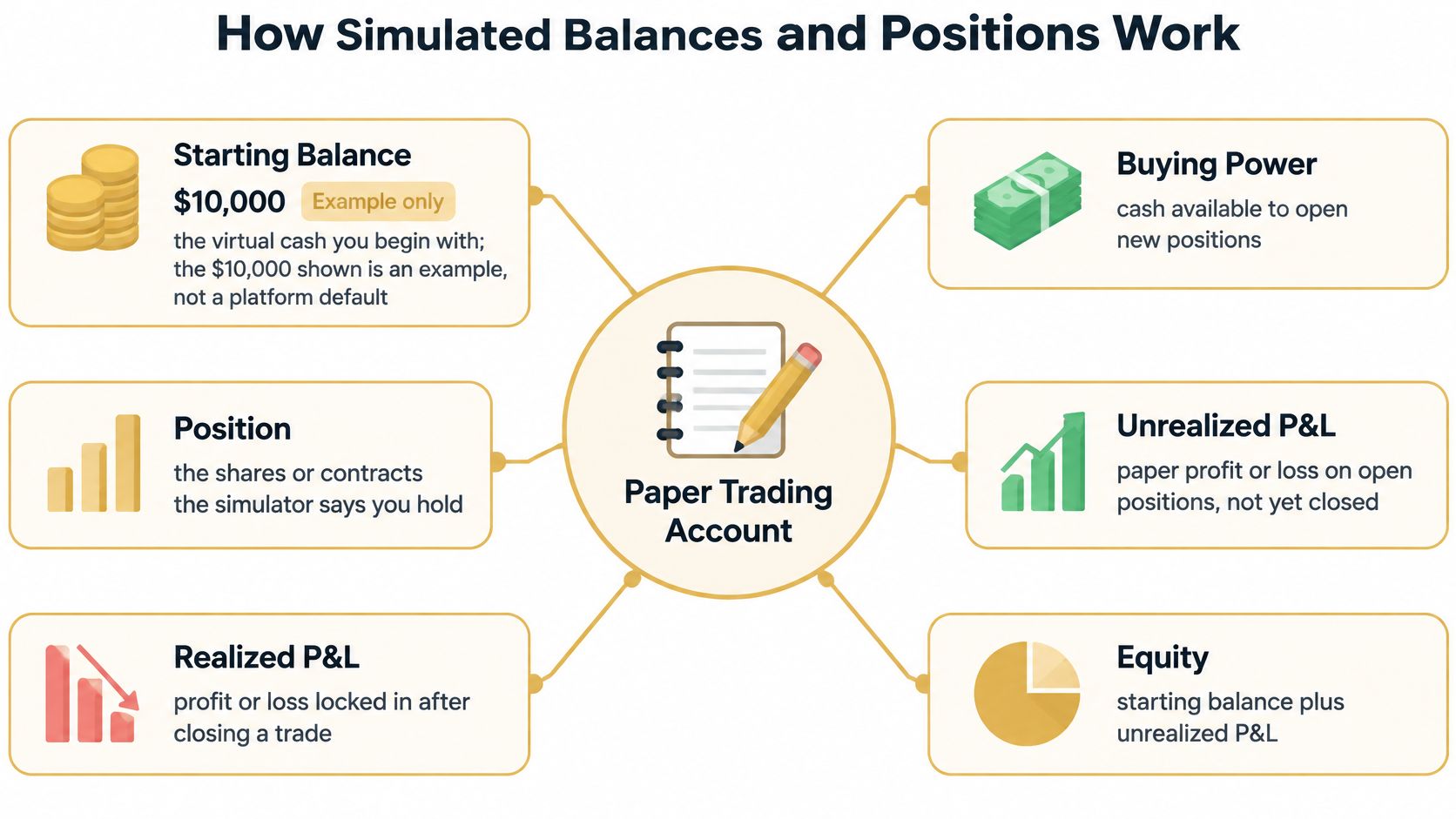
Say you open a hypothetical account with $10,000. That's an example, not a platform default. You buy 50 shares at $40, spending $2,000 and leaving $8,000 in cash, before any assumed costs.
If the price rises to $44, your shares are worth $2,200. You have $200 in unrealized profit, and total account equity is $10,200. Selling the entire position at that price converts the gain into realized profit and returns the proceeds to cash.
Read the account without double-counting
Think of cash as money in your bank account and open positions as money you've put to work in the market. That analogy describes the bookkeeping, not a promise that the market will repay you.
- Cash balance: Money not currently invested. A purchase reduces cash; a sale adds proceeds back.
- Position: The shares, contracts, or units the simulator says you hold, valued using its selected market price.
- Unrealized profit or loss: The difference between an open position's current value and its cost. It isn't locked in.
- Realized profit or loss: The gain or loss booked when you close some or all of a position, adjusted for modeled costs.
- Buying power: What the account permits you to use for new orders. Pending orders may reserve some of it.
- Equity: Cash plus the current value of positions, less applicable liabilities. Cumulatively, it reflects both realized and unrealized results.
The distinction between cash and buying power matters. An unfilled order can leave cash unchanged while reducing the amount available for another order. Don't interpret an accepted order as a completed purchase.
Check the arithmetic and the price
In the example, selling doesn't create another profit on top of the unrealized gain. It changes the gain's status from open to realized. Afterward, the account has no position and holds $10,200 in cash, assuming no costs or other activity.
A displayed valuation also isn't an executable offer. The simulator might mark a position using a recent trade while applying a different price when you close it.
Reconcile the account by hand each week: beginning cash, purchases, sale proceeds, costs, remaining positions, and ending equity.
If those amounts don't reconcile, resolve the discrepancy before trusting the performance report.
Order Journals and What to Record Each Trade
Memory makes a poor trading record. After a winning trade, it's easy to remember a clear thesis and forget the late entry, changed stop, or oversized position.
A written order journal separates the decision you intended to make from the execution you received. Create it in a spreadsheet or use the simulator's history, with a separate field for your reasoning.
Order journal fields and why each one matters
| Field | What to record | Why it matters |
|---|---|---|
| Signal source | Where the idea came from, with its public timestamp | Establishes whether the information was available before you acted |
| Entry time and price | Order submission time and actual fill | Reveals the delay between idea and execution |
| Order type | Market, limit, or stop | Each type has different execution behavior |
| Position size | Shares or units and share of account equity | Exposes concentration risk |
| Exit rule | Target, stop, and any time-based exit set before entry | Prevents rewriting the plan afterward |
| Costs assumed | Commission, spread, and slippage used | Makes the result comparable with executable trading |
| Outcome | Realized and unrealized profit or loss, plus drawdown | Shows risk taken, not just profit earned |
Write the plan before the order
Record the signal, entry condition, size, and exit rule before submitting anything. Add the fill and outcome afterward, preserving the original entry rather than replacing it with a better explanation.
The most important field is often the public timestamp. Record when the underlying filing became available, when your alert arrived, and when you acted. Those are separate events.
For a hypothetical journal entry, say a signal was published at 2:14 pm, you submitted a limit order at 2:40 pm, and the order never filled. Your balance might show no change, but the journal records a missed opportunity and a meaningful delay.
Review the trades that didn't happen
Keep canceled, rejected, and unfilled orders. Otherwise, you'll evaluate only the opportunities the simulator allowed into your portfolio and ignore the ones your rules couldn't execute.
A useful monthly review includes:
- Activity: Count completed trades and unfilled orders.
- Discipline: Count rule breaks, including moved stops and unauthorized additions.
- Execution: Compare signal-to-entry delays and costs assumed.
- Risk: Check whether losses clustered in oversized positions or late entries.
Keep corrections as dated additions. An honest record should show what you knew at the time, not what became obvious afterward.
Why Practice Results Overstate Live Performance
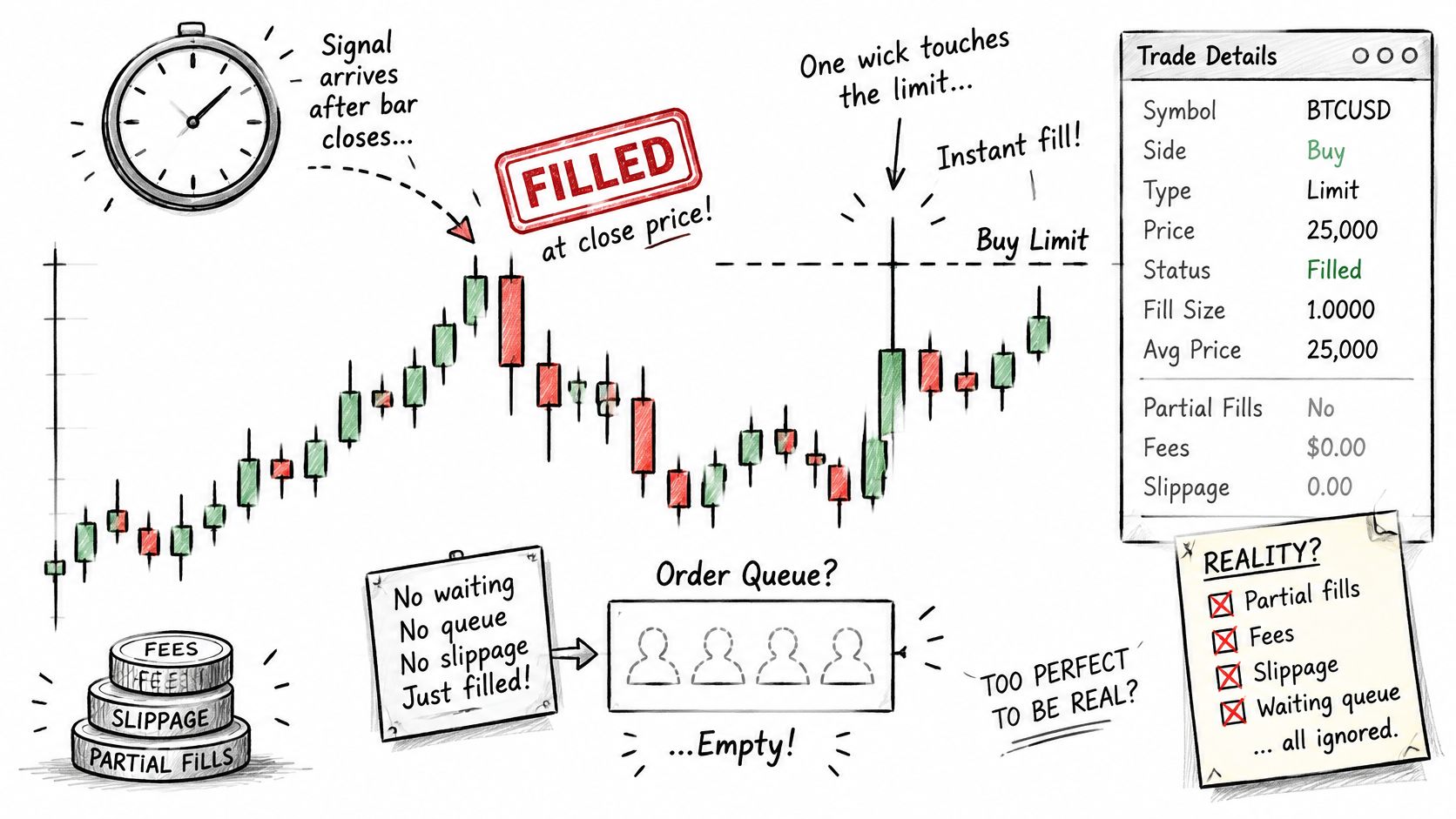
A flattering simulator can fill your order at a price bar's closing value even when your signal arrived after that bar ended. That isn't fast execution. It's an entry you couldn't have placed using the information available.
The FinRL paper identifies transaction costs, market impact, and market dynamics as important considerations in evaluating trading strategies. For practical testing, execution must occur after the decision timestamp, with costs applied to entry and exit.
A price touch isn't a guaranteed fill
A limit order specifies your worst acceptable price, but it doesn't reserve your place ahead of everyone else. If other orders are waiting at that price, a brief touch may leave yours unfilled.
The GB Capital explanation of simulation limits highlights queue priority, partial fills, spreads, latency, and liquidity as execution assumptions that can flatter results. A conservative test shouldn't award a complete limit fill merely because a chart touched the price.
Other differences matter too:
- Spread: The ask is the price sellers offer; the bid is what buyers offer. Buying at the ask and selling at the bid creates a cost even without a commission.
- Slippage: An executable price can be worse than the price you saw when submitting the order.
- Liquidity: Available shares or contracts may cover only part of your order.
- Market impact: A large order can move the price against its own execution.
Delayed disclosures require delayed entries
The House financial-disclosure guidance establishes an outer congressional reporting deadline of 45 days after a transaction and uses reported value ranges rather than exact transaction amounts. A filing-based simulation must therefore begin from public availability, not the historical trade date.
Don't turn the midpoint of a reported range into a supposedly exact position size. Size your simulated order using your own predefined risk rule instead.
Our congressional and insider disclosures on TradeLikeInsiders are delayed and are not real-time trades. An alert about a filing doesn't erase the interval between the underlying transaction and publication.
Before trusting a simulator, answer three questions: What price fills the order? When does the information count as public? Which execution costs are included?
If the platform doesn't explain those assumptions, treat its profit figure as provisional.
How Form 4, 13F and Congressional Filings Become Testable Signals
A disclosure becomes testable when you can establish what it says and when a reader could first act on it. The identity of the filer doesn't remove that requirement.
Match the signal to the document
- SEC Form 4: Use SEC EDGAR to inspect reported transactions by corporate officers, directors, and other covered insiders. Record EDGAR's acceptance timestamp and examine the transaction type and explanatory footnotes before classifying activity as discretionary buying or selling.
- Form 13F: Treat institutional holdings as a quarter-end snapshot, not a current trade ticket. A reported position doesn't establish the manager's entry date or confirm that the manager still holds it.
- Congressional PTRs: Verify the transaction against the House or Senate financial-disclosure record. Preserve the transaction type, publication timing, asset, and reported value range.
The House Committee on Ethics financial-disclosure guidance also explains why covered transactions don't represent an official's complete portfolio. An isolated security purchase isn't proof of a broad sector bet.
Separate policy from ownership
Log a legislative proposal, agency announcement, or regulatory decision as its own signal. Explain the possible business mechanism, such as procurement demand, compliance expense, or market access, without assuming a politician's holding proves intent.
For every test, verify the primary document, save its public timestamp, add a realistic reaction delay, then apply your execution assumptions. Keep disclosure types separate in the journal so one category's results don't conceal another's weaknesses.
How to Set Up and Run Your First Practice Trades
Start with a test you can finish and audit. A tightly defined practice account is more useful than a virtual portfolio filled with unrelated ideas and improvised exits.
The workflow below combines platform checks with a written trading process.
Configure the test before collecting results
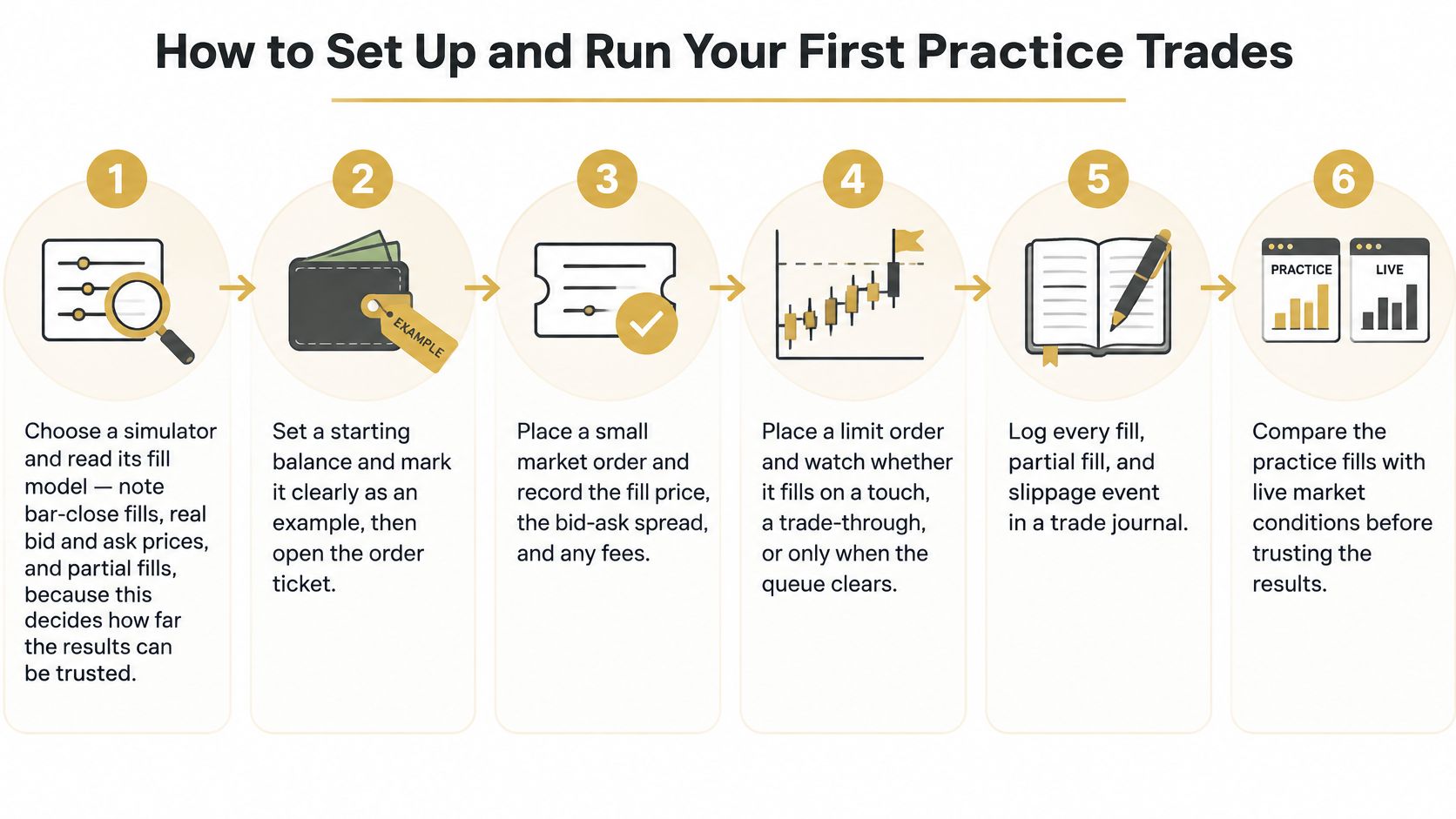
Choose the simulator by its execution rules. Inspect its documentation for bar-close fills, bid-and-ask pricing, partial fills, and cost settings. Apply the price, timestamp, and cost questions to an actual order ticket rather than accepting a general claim of realistic simulation.
Use a plausible starting balance. Match the virtual balance to the capital you would realistically consider allocating, rather than accepting an oversized preset. Otherwise, a position that feels trivial in practice could represent uncomfortable concentration live.
Write a one-page plan. Specify the eligible signal, entry condition, account allocation, exit target, stop, and conditions that invalidate the idea. For a policy-driven trade hypothesis, identify the public policy event separately from any associated insider or congressional filing.
Build the journal before submitting orders. Create fields for source documents, public timestamps, order status, fills, costs, and deviations. Save the simulator settings with the test so later changes don't make earlier and later results incomparable.
Execute without rewriting the experiment
Trade only when the written conditions are met. Record signal time and fill time, then inspect the final order status rather than assuming submission means execution. Moving a stop because the position feels uncomfortable changes the strategy; record it as a deviation instead of disguising it as discretion.
Reconcile and review weekly. Pull realized results, list open positions, and count trades that broke the plan. Check whether apparent success depends on one position, unusually favorable fills, or losses still sitting unrealized.
Finish the sample you agreed on in advance. Set a fixed observation period and trade-sample requirement before starting, then resist stopping immediately after a strong run. If you materially change the rules, label the revised test separately instead of merging both versions.
A healthy first month doesn't require an impressive return. It requires a complete journal, reliable account arithmetic, rules followed on most decisions, and every exception recorded.
Use small practice orders to inspect market-order execution and limit-order behavior before running the full strategy. If the platform can't model an important cost or rejected order, record a conservative adjustment separately and show both the platform result and the adjusted result.
Deciding When Practice Results Are Ready for Real Money
Practice results should influence a move to live capital only when the passing criteria were established before the test began. A profitable ending balance is not a readiness standard by itself.
Use a checklist that includes both execution quality and behavior:
- Completed sample: Reach the observation period and trade count you committed to, without cherry-picking the stopping point.
- Tolerable drawdown: Evaluate the largest peak-to-trough decline in account value in terms of actual money and emotional strain.
- Conservative net results: Include spread, commissions, slippage, and applicable borrowing or funding costs.
- Documented discipline: Follow the written plan on most trades and preserve every deviation.
- Different conditions: Separate quieter periods from volatile ones, and liquid opportunities from difficult fills.
- Signal-specific results: Check each disclosure category and entry-delay group independently.
Real losses change decisions
A TradingView discussion summarizing experimental evidence reports that, among 93 participants, 44 became significantly more risk-averse when real payoffs replaced hypothetical ones, while 7 became more risk-seeking. That's a warning against treating simulated discipline as proven live behavior.
If you choose to move beyond practice, I would use a small live allocation as a separate behavioral test before considering any increase. Watch whether you still follow exits, accept missed trades, and avoid changing size after losses.
A successful practice test earns another test under different constraints. It doesn't establish a guaranteed return.
Skipping practice isn't evidence of readiness either. A 2025 Alpaca analysis found that 67.2% of its Trading API users who placed a live trade between June 1, 2024, and May 31, 2025, began trading live rather than through paper trading. That describes one vendor's user base, not traders generally.
Our TradeLikeInsiders platform combines an educational simulator using simulated money with STOCK Act disclosures, SEC Form 4 insider filings, on-chain whale flow, and educational AI analysis. Use those tools to test a documented hypothesis, not to substitute an alert or generated explanation for verification.
HeliosNet LLC offers TradeLikeInsiders, bringing disclosure research, whale activity, policy signals, and educational paper trading into one workflow. Visit TradeLikeInsiders to build a practice test, record your execution assumptions, and compare signal ideas against a written journal. This content is for informational purposes only and is not financial advice. Do your own research.