The usual advice is to practice until your paper account makes money, then consider trading live. That sets the wrong test. A profitable simulation can reflect generous fills, hindsight, or risks you'd never take with actual savings.
A better paper trading app helps you test a repeatable decision process. That's especially important when you follow congressional trades, corporate insiders, institutional whales, or policy developments. You need to know what information was available, when you could act on it, and whether your reasoning held up afterward.
Table of Contents
- What a Paper Trading App Actually Is
- Core Features Every Paper Trading App Needs
- Why Simulated Practice Works for Beginners
- Testing Strategies and Where Simulated Fills Mislead
- Behavioral Traps Practice Accounts Cannot Show
- Comparing Practice Environments and Policy-Driven Signal Feature Sets
- Testing Policy Signals in a Practice Account and Next Steps
What a Paper Trading App Actually Is
A paper account isn't just a free stock-market game. It's a practice environment where you place buy and sell orders with virtual money, track positions, and review decisions without putting real capital into those trades.
Think of a flight simulator. A pilot can rehearse procedures without risking an aircraft, but completing the exercise doesn't prove they'll handle every emergency. Trading practice deserves the same distinction between rehearsing a process and proving real-world readiness.
What the app simulates
A practice account starts with a simulated balance. When you submit an order, the software applies its execution rules, updates your holdings, and calculates profit and loss, meaning how much your positions have gained or lost.
The useful parts usually include:
- Order entry: Practicing how to submit, change, and cancel trading instructions.
- Position management: Seeing how an open trade affects your available balance and exposure.
- Decision review: Comparing what you expected with what happened.
For a disclosure-driven investor, the exercise might begin with a publicly available congressional filing. The point isn't to pretend you traded alongside the filer. It's to practice evaluating the information available to you.
What remains outside the simulation
Market depth means the quantities buyers and sellers offer at different prices. A simplified simulator may not reproduce that depth or the difficulty of executing a large order.
It also can't put your savings at risk. That changes the emotional stakes, even when the screen looks convincing. Educational analysis of paper trading's execution and psychological limitations identifies gaps involving spreads, slippage, partial execution, and emotional pressure.
Treat the account as a rehearsal space, not a certificate of trading ability.
That distinction gives you a useful buying criterion: choose an app that makes its assumptions visible, rather than one that makes simulated trading feel effortless.
Core Features Every Paper Trading App Needs
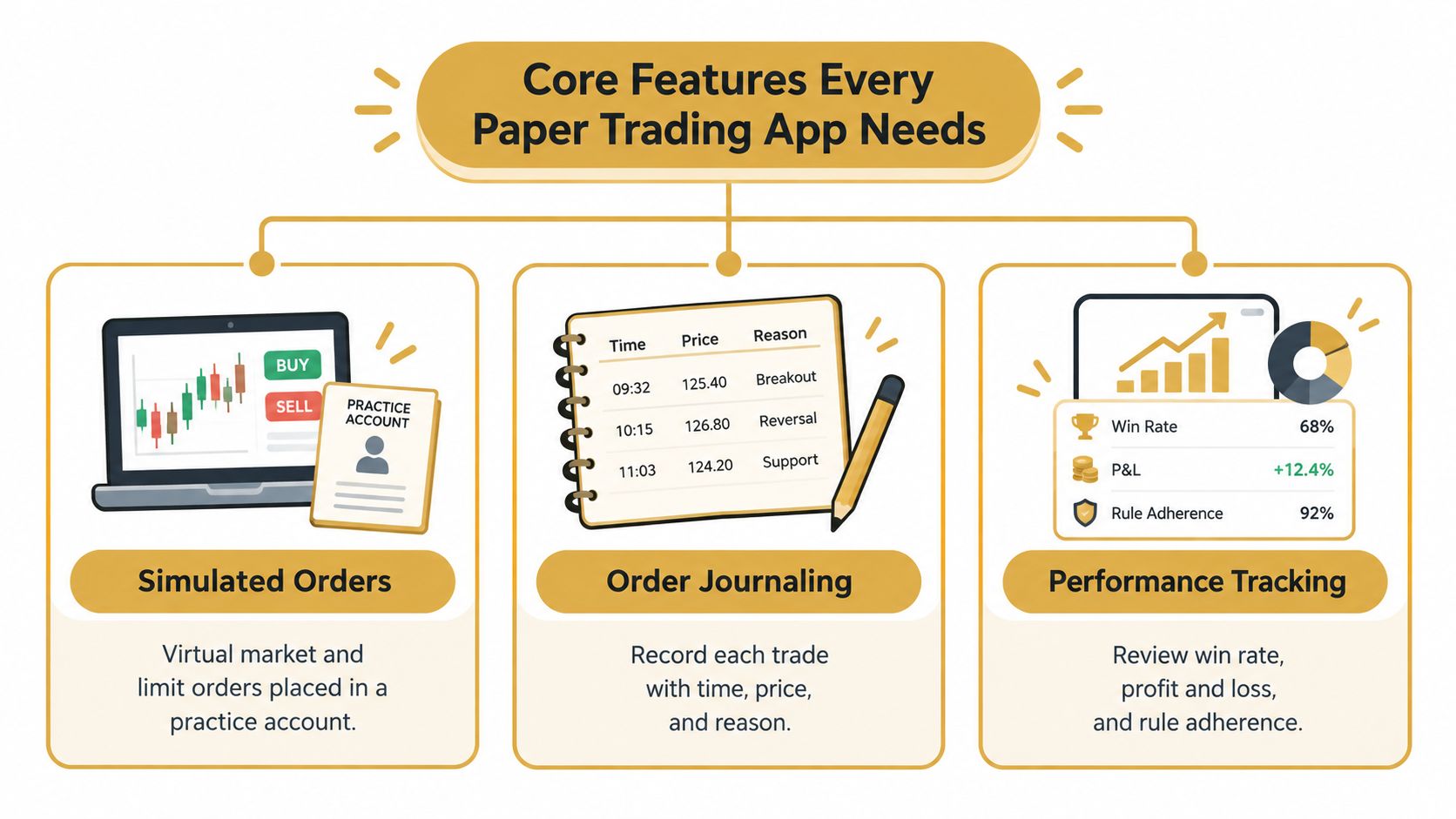
A useful paper trading app connects simulated orders, order journaling, and performance tracking. Orders record what you attempted, the journal preserves why, and the performance history lets you investigate the outcome.
Without that connection, you're left with a balance and a memory. Neither is enough to audit a trading decision.
Simulated orders and a usable journal
A market order prioritizes execution at the available price. A limit order sets the highest price you'll pay or the lowest price you'll accept. The app should let you practice that distinction against a visible starting balance, while retaining submitted, canceled, rejected, and filled orders.
In the flight-simulator analogy, this is the control panel. You need to understand what each instruction does before judging the quality of your flight.
The journal is your decision log. It should capture more than a ticker and a note saying the chart looked strong.
- Thesis: What do you believe, and why might the current price not reflect it?
- Signal source: Was the idea prompted by a congressional disclosure, SEC Form 4 filing, institutional report, or policy announcement?
- Expected catalyst: What event could make your thesis relevant?
- Invalidation condition: What evidence would show your reasoning was wrong?
- Intended holding period: How long does the idea reasonably need to develop?
- Post-trade review: What happened, which rules did you follow, and what needs changing?
For example, a hypothetical policy-related entry might anticipate that a proposed rule will affect a sector's costs. Its invalidation condition should address that policy thesis, not merely an uncomfortable price move.
Performance tracking as an audit trail
The dashboard should preserve trade-by-trade history, holding periods, exposure, and strategy changes. It should also show drawdown, the decline from an account's previous peak, and win rate, the share of completed trades that were profitable.
Neither metric tells the whole story. Frequent small gains can coexist with occasional large losses, while a positive account balance says little about whether you followed your plan.
| Record | Question it helps answer |
|---|---|
| Entry and exit history | What did I actually do? |
| Holding periods | Did I give the thesis its planned time? |
| Drawdown and exposure | How much risk did I carry? |
| Rule adherence | Did I execute the process I intended? |
Ask for an exportable history, too. A permanent record lets you review mistakes without rewriting your explanation after seeing the result.
Why Simulated Practice Works for Beginners
Consider a hypothetical beginner who sees a corporate insider filing and wants to understand whether it matters. Instead of immediately committing money, they open the underlying document, write a thesis, and enter a simulated order.
Their first useful discovery might be procedural rather than profitable. They realize they can't explain their intended exit, or that their position would dominate the practice account. That's a learning outcome worth keeping.
What classroom evidence actually shows
Paper trading has a genuine educational foundation. A Journal of Financial Education study of an equity-trading simulation followed 61 students over nine weeks at a Midwestern liberal-arts college and found that average test scores increased by 14 points out of 100.
The exercise covered U.S. equities, including American depositary receipts, and used a 20-minute execution delay. In the same study, 66% described the simulation as effective or very effective for increasing investment knowledge, while 86% said it increased their interest in investments and equity markets.
Research became part of the practice. 64% regularly used the supplied educational resources, and 97% used outside resources when making decisions.
Those findings support structured learning, not a promise of investment performance. Better test scores don't establish that participants could generate superior live returns.
Turn curiosity into a practice routine
A beginner benefits most when each session answers a specific question:
- Order mechanics: Can I explain why I chose this order type?
- Position sizing: Does the proposed trade fit within my planned risk constraints?
- News interpretation: What changed in the underlying business or policy outlook?
- Research quality: Did I read the original disclosure rather than rely on a summary?
Learning target: Finish practice able to explain your decisions, including the ones that lost simulated money.
The hypothetical beginner's progress isn't just a rising balance. It's moving from copying an alert to asking sharper questions about evidence, timing, and uncertainty.
That habit matters for experienced investors, too. A new signal category can require beginner-level practice even when someone already understands trading mechanics.
Testing Strategies and Where Simulated Fills Mislead
A strategy test starts with a rule you can write down before seeing the outcome. For example, a hypothetical disclosure strategy might require confirming the original filing and documenting a separate investment thesis before considering an entry.
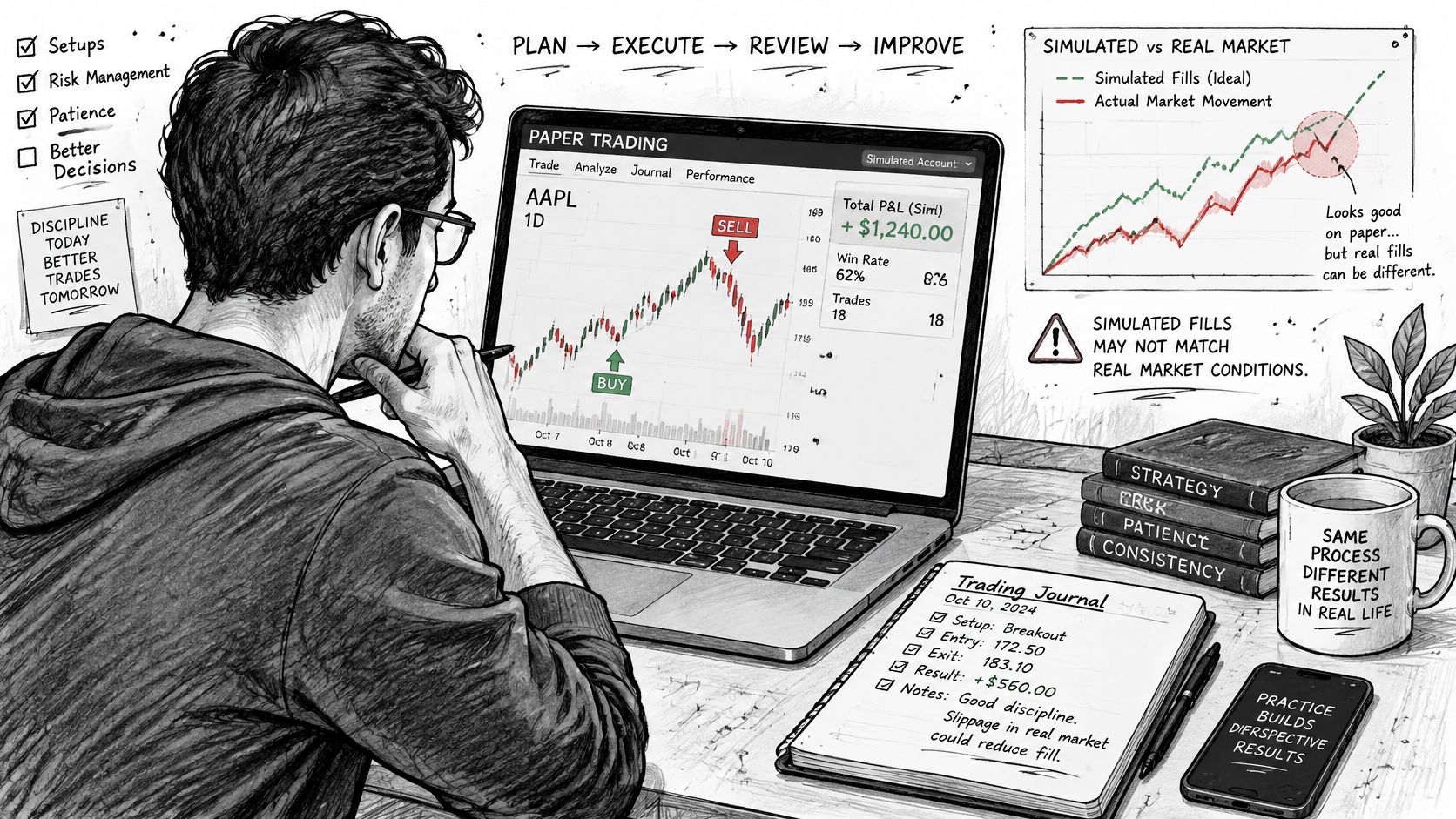
The test becomes misleading when the app credits you with prices you couldn't reasonably obtain. A displayed price isn't necessarily an executable fill.
Separate the quote from the execution
The bid-ask spread is the gap between what buyers offer and sellers ask. Slippage is the difference between your expected execution price and the price assumed or obtained when the order executes.
A credible market-order simulation should account for the spread and modeled price impact. A limit order shouldn't receive an automatic fill merely because a chart touched its price. Available liquidity, queue assumptions, and partial fills matter.
Research on market simulation and execution environments describes systems using public order-book information, timestamped transactions, and continuously updated position and risk records. That's a more demanding standard than assigning every order the latest displayed price.
Instrument-specific assumptions deserve attention as well. Stock simulations should disclose relevant fees and borrowing assumptions; crypto practice involving borrowed funds should address funding payments and exchange-specific liquidity.
Keep the information clock honest
A congressional transaction may become public well after it occurred. Crediting your practice account with the original transaction-date price would test hindsight, not your ability to interpret a public disclosure.
Look-ahead bias means using information that wasn't available at the simulated decision time. Prevent it by distinguishing the transaction date, public filing or publication time, platform ingestion time, order submission, and assumed fill.
Before trusting a result, check:
- Pricing basis: Does execution use bid and ask data, a last trade, or a simplified midpoint?
- Liquidity limits: Can an order fill partially or remain unfilled?
- Costs: Are results shown before and after applicable execution costs?
- Timing controls: Does the app prevent entries before the source became public?
- Stale data: Are delayed feeds and snapshot prices clearly identified?
If the result depends on an entry price you couldn't have accessed, reject the result before debating the strategy.
A stronger test reruns the same rules under less favorable execution assumptions. If a small change in those assumptions overturns the conclusion, the strategy needs more investigation.
Behavioral Traps Practice Accounts Cannot Show
An unconstrained practice account can rehearse the wrong behavior. If you repeatedly rescue losing positions with unlimited virtual buying power, you're practicing a habit, but not necessarily a useful one.
The absence of financial consequences can conceal hesitation, fear of loss, and the temptation to abandon a plan. You can document simulated discipline without knowing how you'll respond when a loss affects your actual finances.
Activity isn't the same as learning
The Hong Kong Investor and Financial Education Council's 2025 investor study reported that 73% cited short-term trading for quick profits, compared with 45% in 2023. Long-term capital growth remained the leading motivation at 79%.
Those findings don't establish that simulators cause impulsive trading. They do make impulse control a relevant practice objective rather than an optional psychological extra.
Digital engagement also deserves scrutiny. An Ontario Securities Commission randomized experiment involving 3,509 Canadian adults tested mechanisms including social discussion, copying another user, and return leaderboards in a simulated investing environment.
The practical question is what an app encourages you to rehearse. Research and patience are different behaviors from chasing a ranking.
Put constraints around the rehearsal
Set guardrails before placing practice orders:
- Realistic capital: Use a balance broadly consistent with the funds you might eventually allocate.
- Position limits: Define maximum exposure before an appealing alert appears.
- Loss boundaries: Decide when to stop opening new positions and review.
- Cooldown rules: Pause after losses instead of trying to recover immediately.
- Separate scoring: Assess rule-following independently from profit.
Watch for revenge trading, meaning taking another trade mainly to recover a loss. Also record skipped setups and impulsive entries, not just completed positions.
A winning streak deserves scrutiny, too. Ask whether you increased size because your evidence improved or because recent success made you feel invulnerable.
Paper practice can reveal whether you follow written constraints when compliance is easy. It can't establish that those constraints will feel equally manageable under real financial pressure.
Comparing Practice Environments and Policy-Driven Signal Feature Sets
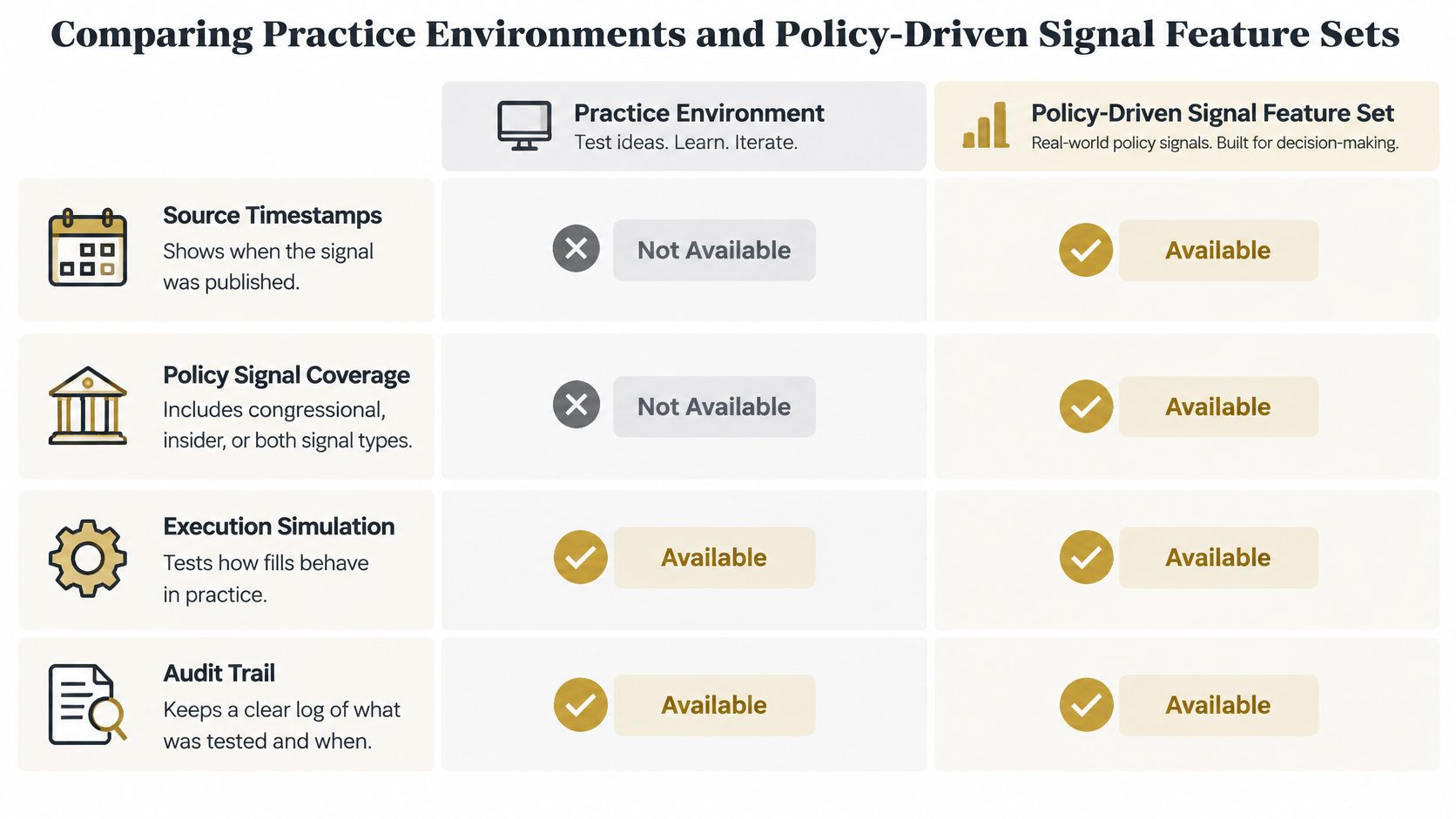
A paper trading app can help test a process, but it cannot prove a signal will make money. Start by matching the tool to the question: order-entry practice needs different features from testing whether a public policy announcement changes an investment decision.
Policy research needs more than a chart. You need to see when information became public, open its original source, and record how it shaped your decision. That record helps separate a useful signal from a trade that only looks good in hindsight.
Compare capabilities, not interface polish
Compare tools side by side. A polished screen may make practice easier, but it does not tell you whether the app preserves the evidence and timing needed to test a strategy.
| Criterion | Order-practice priority | Policy-signal research priority |
|---|---|---|
| Source timestamps | Identifying the quote used | Establishing when information became public |
| Source context | Understanding order conditions | Opening the original filing or agency release |
| Journal connection | Recording execution choices | Connecting evidence to a written thesis |
| Execution model | Rehearsing order behavior | Testing whether a signal remains useful after friction |
| Reporting scope | Reviewing personal history | Comparing strategies and account cohorts |
A cohort is a group followed from a common starting point. Cohort reports can mislead if they show only accounts that stayed active. People who stopped using a platform may have left after poor results.
A nine-year study of individual investor records found that investor learning included both improved performance and withdrawal by people who recognized limited ability. Leaving inactive investors out can make improvement look faster than it was.
Check whether a platform's performance summaries include discontinued accounts. For your own tests, keep abandoned strategies in the record. Deleting them is like removing losing pages from a trading journal: the remaining results no longer show the full process.
Match policy coverage to verifiable evidence
HeliosNet LLC runs TradeLikeInsiders.com, a market research and alerting platform that aggregates delayed congressional trade disclosures, SEC insider filings, whale activity, and selected macro and regulatory updates. Its educational paper-trading terminal offers a simulated starting balance, order journaling, and performance history, without requiring live funds.
Assess the research feed and the simulator as separate features. A signal may arrive after the original transaction or announcement, and a simulated fill does not establish that the signal was sound or that a real order would have executed at that price.
For policy research, keep proposals distinct from final actions. Proposed legislation is not enacted law, just as an agency proposal is not a final decision. If a hypothetical measure could affect procurement, reimbursement, or compliance costs, write down how that change might reach a company's business model.
- Primary evidence: Can you inspect the original public record?
- Causal reasoning: Can you explain how the policy might affect revenue, costs, or demand?
- Uncertainty: Have you recorded what still needs to happen?
Use the same standards across political parties. A filer's identity or party affiliation cannot replace a clear investment thesis.
Testing Policy Signals in a Practice Account and Next Steps
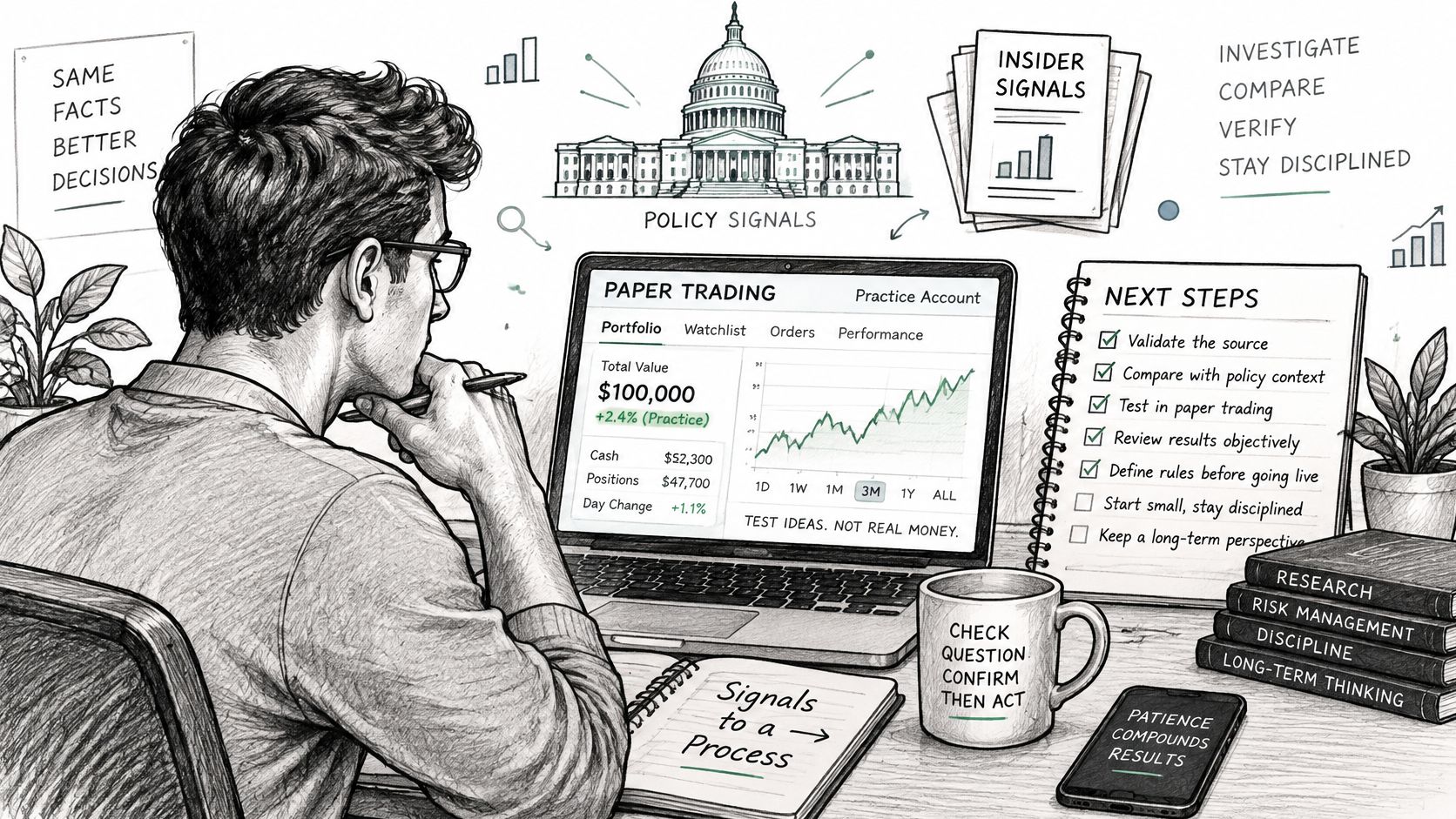
A policy alert can arrive after the market has already reacted. That timing gap is part of what a practice account should test. Start with the original document, then ask what it could reasonably tell you at the time it became public. Congressional disclosures, corporate insider filings, and institutional holdings reports each have different limits, so one trading rule won't fit them all.
The goal is to test whether a source changes a decision, not to treat simulated profits as proof that the signal works.
Read each disclosure on its own terms
Congressional transactions appear in Periodic Transaction Reports filed with the relevant ethics office, generally the House Ethics Committee or Senate Select Committee on Ethics. Covered transactions above $1,000 generally must be reported within 30 days after the filer receives notice or 45 days after the transaction, whichever comes first, according to the Congressional Research Service explanation of STOCK Act requirements.
Reported amounts are ranges. Don't treat a band as an exact purchase amount or a delayed disclosure as a live instruction. The STOCK Act also makes clear that covered officials remain subject to federal insider-trading laws.
For corporate insider activity, check the original SEC Form 4 through SEC EDGAR. Read the transaction code and any explanation. A reported acquisition can have different meanings depending on its circumstances, so a headline alone can't establish the insider's motive.
Form 13F covers certain institutional holdings. Managers with investment discretion over at least $100 million in Section 13(f) securities must file, with reports due within 45 days after year-end and each of the first three calendar quarters, as explained in the SEC's Form 13F instructions.
Treat each filing as a delayed snapshot, not a current portfolio. It may not show when a position was bought, and it cannot confirm that the manager still holds it.
Run an auditable practice workflow
Choose one clearly defined signal type and keep its rules consistent during the test. For example, record when a disclosure became public, when your alert arrived, and when your simulated order could reasonably have been placed. That sequence helps expose whether a result depends on acting earlier than the information allowed.
- Save the evidence: Keep the original record and its public availability timestamp.
- Write your reasoning: State what the disclosure adds beyond what was already known.
- Record the alternative: Would you have made the same decision without the signal?
- Check execution: Apply the timing and fill standards established earlier.
- Review the result: Compare your reasoning, rule-following, and outcomes with a relevant benchmark over several weeks.
A benchmark is a reference investment or portfolio for comparison. Review sector exposure, volatility, drawdown, and turnover, or how often you trade. These checks help separate a useful research prompt from gains caused by broader market moves or frequent trading.
Sometimes a disclosure improves your research but does not justify a trade. That is a useful result. A practice account can test your process and reveal timing or discipline problems, but simulated fills cannot prove how real orders would execute.
HeliosNet LLC offers research on congressional trades, insider activity, whale moves, and policy signals alongside an educational paper-trading environment. Try the practice account before risking real money, and keep a written record of the evidence behind each decision. This content is for informational purposes only and is not financial advice. Do your own research.