The popular advice is to find a politician stock tracker app, follow the biggest purchases, and copy the trade. That skips the most important question: when could you have known about it? A fresh notification can describe an old transaction, and a large-looking entry can represent a broad value range rather than a precise investment.
Start with the timestamps, not the ticker. You'll get more from these tools by treating each alert as a document to investigate than as a shortcut to someone else's supposed advantage.
Table of Contents
- What a Politician Stock Tracker App Actually Shows
- The Disclosure Fields a Good Tracker Should Show
- Reading Value Ranges Without Overreading Them
- Why the 45-Day Delay Changes the Signal
- What Research Says About Following Politician Trades
- Form 4 and 13F Beside Congressional Trades
- Setting Up Alerts and Checking Each One
What a Politician Stock Tracker App Actually Shows
A congressional trading feed is more like a scoreboard after a game than a live camera on the trading floor. You can see the reported result, but you weren't watching the decisions unfold.
A politician stock tracker app collects public financial disclosures, organizes them into searchable records, and lets you filter activity or receive alerts. Say a notification identifies a purchase in a healthcare company. The useful starting point isn't whether the headline sounds bullish. It's whose account appears in the filing, what asset was reported, and when the transaction became public.
Disclosure isn't evidence of motive
The legal foundation is the Stop Trading on Congressional Knowledge Act, usually called the STOCK Act. It clarified that members of Congress and covered officials aren't exempt from federal insider-trading laws and established structured transaction reporting.
The House Ethics STOCK Act guidance explains why disclosure matters: officials can encounter material nonpublic information about a company or an entire sector, including energy, telecommunications, or healthcare. Material nonpublic information means information that could matter to an investment decision and isn't publicly available.
That makes government policy relevant. It doesn't establish that a particular transaction resulted from privileged knowledge.
A filing documents reported activity. It doesn't reveal the investment thesis behind it.
A purchase could reflect diversification, an existing investment plan, or activity in a spouse's account. Apply the same standard to both parties: examine the record before assigning a story to it.
At TradeLikeInsiders, we surface STOCK Act congressional disclosures, SEC Form 4 insider filings, and on-chain whale flow. Putting these records together can simplify research, but it doesn't turn their different reporting systems into a live view of everyone's portfolio.
The practical takeaway is straightforward: an app shows what was reported and when it became visible, not why someone traded or what they hold today.
The Disclosure Fields a Good Tracker Should Show
Use this field guide to evaluate a congressional trade record.
| Field | What It Means | Why It Matters |
|---|---|---|
| Filer | Member or covered official who filed the report | Establishes whose disclosure you're reviewing |
| Transaction date | When the trade reportedly occurred | Starts the transaction-based reporting clock |
| Notification date | When the filer learned of the transaction, if shown | Anchors the awareness-based deadline |
| Filing date | When the report was submitted | Records submission, which shouldn't automatically be equated with public availability |
| Public posting date | When the report appeared on the public site | Shows when a public-source alert could first fire |
| Days late | Filing date measured against the applicable deadline, including its outer limit | Flags a potentially overdue report |
| Asset description | Name and ticker as written in the filing | Helps identify the asset; verify it against the original |
| Transaction type | Purchase, sale, or exchange | Establishes the reported action, not its exact size |
| Amount band | A dollar range, not an exact figure | Defines the disclosed transaction-value interval |
| Amended flag | Whether the filing was corrected | Signals that you should compare the correction with the original |
The House Ethics PTR instructions describe the Periodic Transaction Report system under the Ethics in Government Act, as amended by the STOCK Act, covering purchases, sales, and exchanges of stocks, bonds, commodity futures, and other securities. For interpreting those reports, transaction time and disclosure time answer different questions.
Think of a receipt and a delivered message. The receipt records when something happened. The delivery record establishes when another person could learn about it. A tracker that preserves only the transaction date loses the distinction that matters most to a public-information strategy.
Check the record before interpreting it
Use this sequence whenever you open a filing:
- Confirm the filer and transaction type. Identify the reporting official, then inspect any ownership designation. Don't assume the filer personally directed the transaction.
- Find the transaction date. Read the date on the original record rather than relying solely on the feed's sorting order.
- Identify submission and public availability. If the platform provides only a filing date, don't assume it also knows the precise posting time.
- Calculate the gap and inspect amendments. Separate elapsed time since the trade from lateness against the legal deadline.
Verify the asset description against the original filing, particularly when an app has supplied a standardized ticker. A similar company name, an incomplete description, or a different security type can change your interpretation.
An amendment deserves its own inspection. It may correct a value band, date, or asset description. It doesn't automatically mean that every detail became public for the first time when the correction appeared.
Reading Value Ranges Without Overreading Them
A transaction-value band isn't a position size. It also isn't a cost basis, a portfolio weight, or evidence that the filer committed a particular share of their wealth.
The House PTR form includes the following bands, from $1,001–$15,000 through $1,000,001–$5,000,000. These are the listed intervals, not exact transaction amounts.
| Band | Dollar Range | How to Read It |
|---|---|---|
| Band 1 | $1,001–$15,000 | Lowest tier shown; wide relative to its floor |
| Band 2 | $15,001–$50,000 | Lower-middle tier; still a broad range |
| Band 3 | $50,001–$100,000 | Middle tier; treat it as an interval |
| Band 4 | $100,001–$250,000 | Upper-middle tier; compare across filings |
| Band 5 | $250,001–$500,000 | Upper tier; check timing before weighting it |
| Band 6 | $500,001–$1,000,000 | High tier; inspect amendments |
| Band 7 | $1,000,001–$5,000,000 | Top listed tier; still not an exact amount |
Don't turn an interval into false precision
The smallest listed interval has a ceiling about fifteen times its floor. The high-tier interval immediately below the top listed tier spans nearly half a million dollars. Those differences are calculated from the form's endpoints, and they explain why identical band labels can conceal substantially different transactions.
Moving up the table establishes greater reported dollar scale. It doesn't establish greater conviction. Without the rest of the portfolio, you can't know how consequential a transaction was to its owner.
Be especially skeptical when a dashboard converts bands into precise-looking totals. A midpoint can support an explicitly labeled estimate, but it isn't the amount the filer reported.
Use bands alongside asset type, repeated appearances, and relevant committee or policy exposure. Each adds context; none supplies the missing investment rationale.
Keep a compact log:
- Preserve the interval. Record the label and both dollar endpoints.
- Attach the dates. Include the filing date and the platform's lateness assessment.
- Inspect corrections. Note whether an amendment changed the band.
- Tag repeat appearances. Distinguish recurring activity from an isolated record.
Why the 45-Day Delay Changes the Signal
The reporting timeline begins before your phone lights up. A transaction occurs, the filer learns about it, a report is submitted, the report becomes public, and a tracker detects it.
The Congressional Research Service explanation of the STOCK Act identifies its signing by President Barack Obama on April 4, 2012, and explains that qualifying transactions exceeding $1,000 generally must be reported within 30 days after notification, and no later than 45 days after the transaction. The earlier deadline controls.
The sequence below separates the underlying event from the notification you receive.
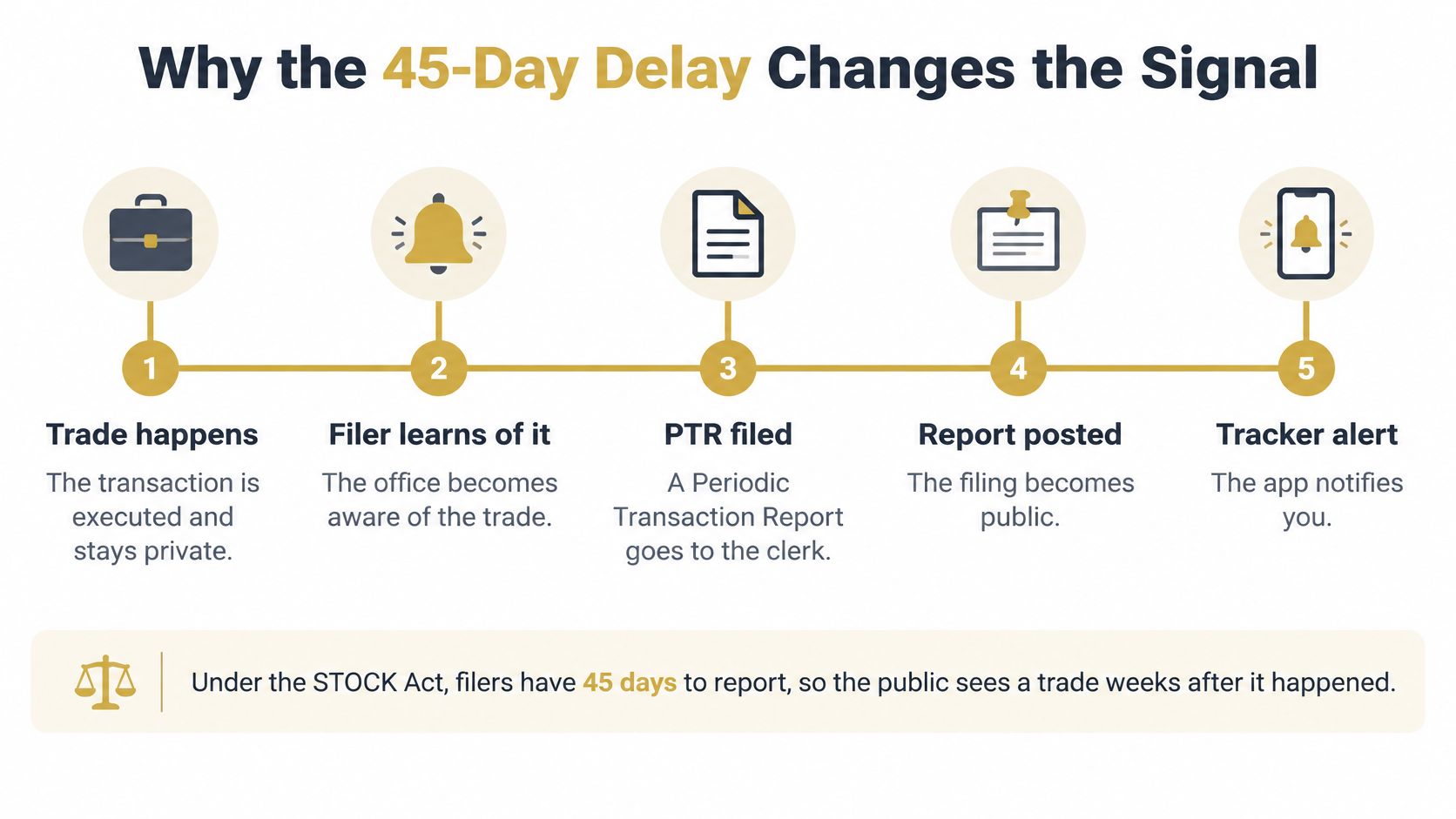
The graphic's outer-limit shorthand isn't permission to ignore the notification-based deadline. A report can fall inside the outer window and still miss an earlier applicable deadline.
A compliant filing can still be old information
Consider a hypothetical transaction on day zero. Suppose the filer learns about it on day twenty, files on day forty, and the tracker alerts you on day forty-one. The filing is within both applicable windows, but your notification concerns a transaction already more than a month old.
Change the awareness date to the transaction date, and the same filing would miss the earlier deadline. That's why you can't determine compliance from the transaction-to-filing gap alone when awareness information is missing.
The House Ethics transaction-reporting guidance also makes clear that qualifying activity can require disclosure even when the covered person didn't personally conduct or direct it. An account relationship isn't the same thing as a personal trading decision.
Practical rule: Freshly published doesn't mean freshly executed.
The contrarian point is that an alert can feel most urgent when it's least useful as an entry-timing signal. You're responding to a publication event, while the original transaction belongs to an earlier market environment.
Separate age, lateness, and correction
These labels answer different questions:
- Age tells you how long ago the transaction reportedly occurred.
- Lateness compares submission with the applicable reporting deadline.
- Amendment status tells you whether a previously submitted record changed.
A late filing isn't automatically evidence of an illegal trade. A timely filing isn't automatically useful information for today's price. And a newly amended record isn't automatically a new transaction.
Our congressional and insider disclosures on TradeLikeInsiders are delayed disclosures, not real-time trades. Use them to investigate past activity and its public context, not to assume you're entering alongside the original trader.
What Research Says About Following Politician Trades
The claim that politicians consistently beat the market sounds cleaner than the evidence. The historical results depend heavily on which period and portfolio method you examine.
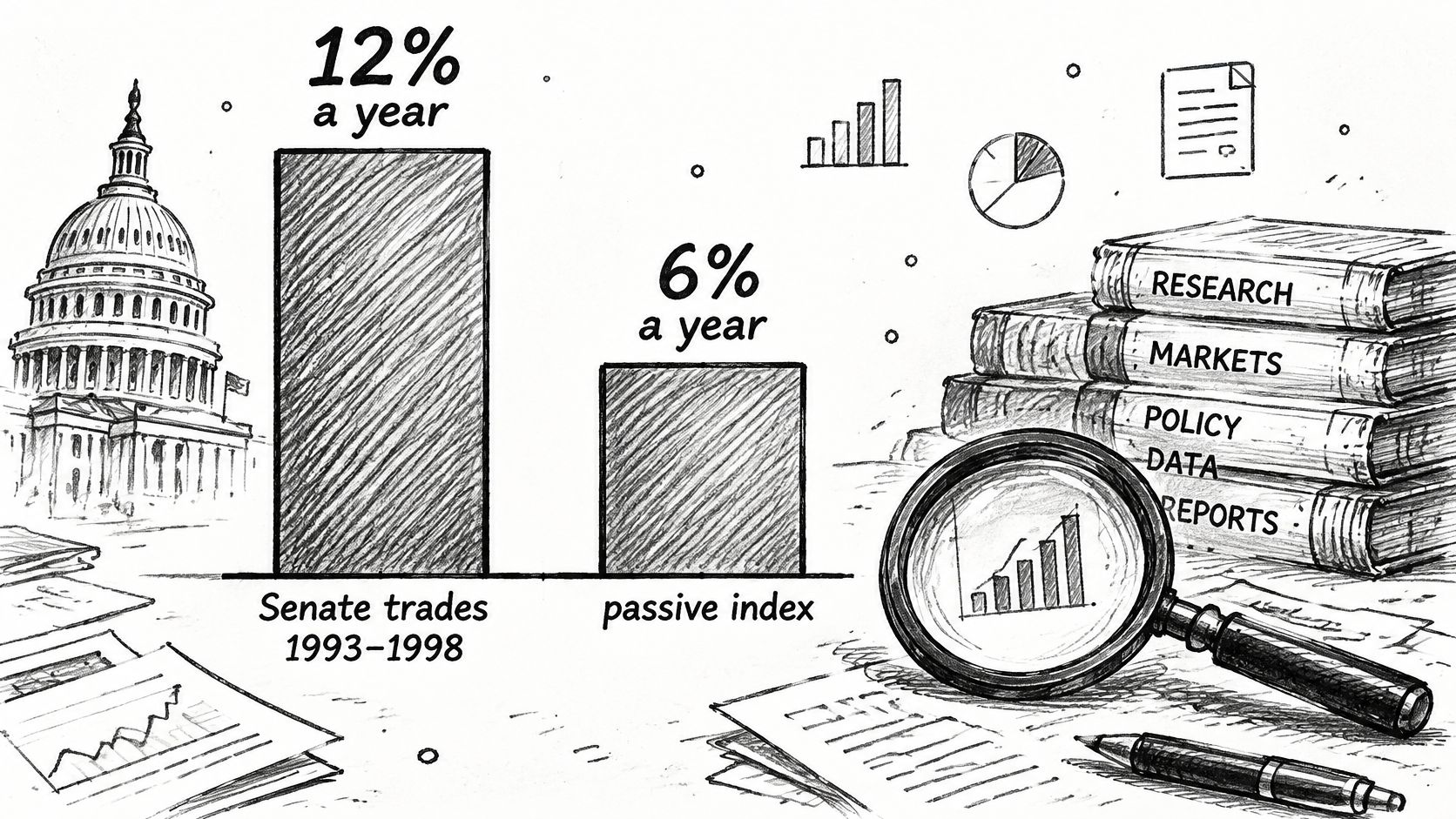
The academic paper examining congressional investment performance discusses earlier synthetic-portfolio estimates of approximately 12% annual outperformance for Senate trades during 1993–1998 and 6% for House trades during 1985–2001, alongside later evidence of weaker performance. The comparison below preserves the different samples and measures.
| Study or dataset | Period | Reported result |
|---|---|---|
| Earlier Senate synthetic portfolios | 1993–1998 | About 12% a year above a passive index |
| Earlier House synthetic portfolios | 1985–2001 | About 6% a year above a passive index |
| Congressional portfolio study | 2004–2008 | About −0.23 percentage points per month, roughly −2.8% annualized; 95% confidence interval about −4.9% to −0.5% |
| Large congressional and immediate-family dataset | 2012–2023 | Portfolios, on average, underperformed or at best matched benchmarks after the STOCK Act |
Read the historical illustration with care: the Senate finding above measures outperformance relative to an index, not an absolute Senate return compared with a separately established index return. The image's labeling shouldn't substitute for that distinction.
A historical portfolio isn't a tradable strategy
A synthetic portfolio is a portfolio researchers reconstruct using stated rules. Its results depend on those rules, including which transactions enter the sample and when the hypothetical investor can act.
The later negative estimate and post-STOCK Act dataset don't support treating congressional activity as a persistent, automatic advantage. Nor do they establish that every official or every transaction performs poorly. They describe samples, not universal outcomes.
The accompanying video offers another discussion of the subject. Evaluate any performance claims using the same checks you apply to a written backtest.
Before accepting a strategy's headline result, ask:
- Compared with what? A benchmark is the reference investment used to judge performance.
- Over which period? A favorable historical sample isn't a timeless property of the strategy.
- Using which availability date? Entering on the transaction date can give a backtest information the public didn't have.
- With which selection rules? Highlighting memorable winners isn't the same as evaluating every qualifying record.
A politician stock tracker app is most defensible as a disclosure-research and event-monitoring tool. Any claim of an investing edge needs separate evidence that survives realistic timing assumptions.
Form 4 and 13F Beside Congressional Trades
Congressional disclosures, corporate insider filings, and institutional holdings reports aren't interchangeable signals. Compare what each document records before comparing whether the activity looks bullish or bearish.
| Record | What to inspect | What not to assume |
|---|---|---|
| Congressional PTR | Filer, ownership, transaction, dates, and amount band | That the official personally directed the trade |
| SEC Form 4 | Reporting insider, transaction code, shares, price, and explanatory notes | That every reported acquisition is an open-market purchase |
| Form 13F | Reporting manager, reporting period, listed holdings, and amendments | That a reported position is a live trade or a complete portfolio |
SEC EDGAR is the primary place to verify Form 4 and Form 13F records. House and Senate financial disclosures serve a different reporting system, so don't import congressional assumptions into SEC documents.
Transactions versus holdings snapshots
A Form 4 reports corporate insider transactions. Read the transaction code and footnotes before interpreting direction: a share acquisition, an award, and an option exercise don't communicate the same thing.
A Form 13F reports institutional holdings for a reporting-period snapshot. A position appearing in that snapshot doesn't tell you precisely when the manager acquired it or whether the manager still holds it when you read the filing.
On-chain whale activity is different again. A large transfer records movement between addresses, not necessarily a purchase or sale, and an address label isn't proof of the owner's motive.
Policy context isn't a common motive
Say a bill draws attention to a sector. An institutional report shows a manager held sector exposure at the reporting-period end, while a later insider filing records an officer's sale.
Those records answer different questions. They don't establish that the manager anticipated the bill, that the officer rejected its prospects, or that either event caused the other.
- Establish sequence. Compare reporting periods, transaction dates, and availability dates.
- Inspect the policy mechanism. Ask whether a proposal concerns costs, demand, eligibility, competition, or implementation.
- Separate proposals from outcomes. A hearing, introduced bill, enacted law, and agency action represent different stages.
Committee and sector tags can help you locate relevant documents. They can't establish access to specific information or prove that a trade anticipated a policy development.
Setting Up Alerts and Checking Each One
An alert should shorten your search, not your judgment. Set up the feed so it brings you records you can evaluate, rather than a constant stream of emotionally persuasive headlines.
Start with a narrow watchlist and a written purpose. Monitoring an industry's regulatory exposure is a useful research objective. Following whichever official attracted attention today is much harder to evaluate consistently.
Build a feed you can audit
Configure alerts around filing or public-posting time, not a transaction date that predates public availability. If an app distinguishes submission from posting, preserve both and use public availability when evaluating what you could have known.
Then choose filters deliberately:
- Member or committee exposure. Follow a defined area of interest and apply the same criteria across party affiliations.
- Repeated activity. Flag recurring asset appearances, but check that amendments or duplicate imports haven't inflated the pattern.
- Corrections. Enable amendment notifications so your notes don't preserve a superseded interpretation.
- Minimum value band. Reduce distracting entries without pretending that the remaining records reveal conviction.
This checklist captures the habit to build. Treat committee relevance as a reason to investigate, not as proof that a transaction deserves greater investment weight.
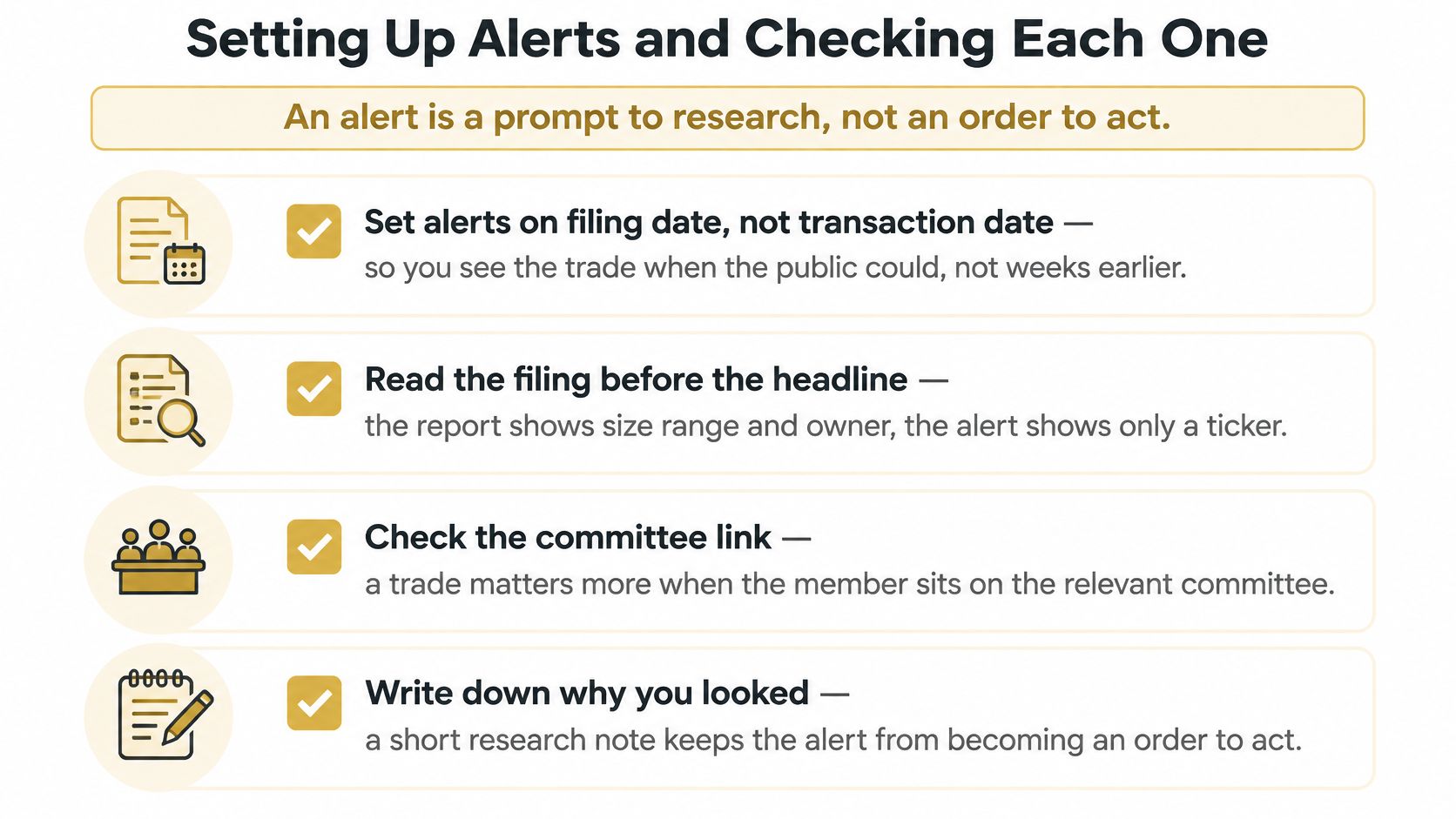
Turn each notification into checked questions
Open the underlying document before reading commentary about it. For congressional records, verify the original House or Senate financial disclosure, using House Ethics PTR guidance to understand the fields. For corporate and institutional records, inspect the Form 4 or Form 13F in SEC EDGAR.
Your research note should answer:
- Who filed, and whose account appears? Distinguish the reporting person from the account owner or decision-maker where the document allows.
- What happened, and when? Preserve the reported action, transaction date, submission date, and public-posting date when available.
- Is the lateness label supported? Check the platform's definition and note missing awareness information.
- Was anything corrected? Compare the original and amended records rather than replacing one without explanation.
- What scale and repetition are documented? Retain the band and distinguish separate transactions from duplicate records.
- What policy connection is on record? Name the actual committee role, proposal, hearing, or agency action. Avoid filling gaps with a plausible story.
Write down what would weaken your interpretation before checking subsequent prices. A corrected asset description, an unrelated ownership designation, or a performance claim that fails against its benchmark should change your conclusion.
Keep separate notes for what the filing says, what you infer, and what you still don't know.
Practice the process without risking capital
Our platform brings congressional trades, insider activity, whale moves, and policy signals together. We also offer educational AI analysis and a paper-trading simulator with simulated money, so you can practice documenting decisions without committing live funds.
Use AI summaries to identify questions, then verify the answers against the filing. In simulation, record the alert's availability time, your interpretation, and why you accepted or rejected it. Don't judge the process solely by whether the next price movement happened to agree with you.
The useful habit is repeatable: locate the record, establish its timing, test the interpretation, and preserve uncertainty. Alerts organize questions. They don't time trades.
HeliosNet LLC offers TradeLikeInsiders, with delayed congressional disclosures, SEC insider filings, on-chain whale activity, educational AI analysis, and simulated-money practice. Visit TradeLikeInsiders to investigate a filing, document its timestamps, and practice evaluating the signal before putting real money at risk.
This content is for informational purposes only and is not financial advice. Do your own research.