Investors often expect politician stock trades to function as a shortcut. Buy what a senator bought, sell what a representative sold, and let the public filings do the work. That's the wrong mental model. Congressional disclosures are usually lagging signals, while the best edge comes from separating stale political noise from faster corporate insider data and institutional flow.
The public trades on news. Insiders trade on information. That distinction matters because the STOCK Act makes congressional trades public only after a delay, while corporate insiders and large managers file on faster timelines and give you a cleaner read on what's still fresh.
Table of Contents
- The Reality of Political Market Signals
- Decoding the STOCK Act and SEC Filings
- Filtering Noise from Actionable Disclosures
- Mapping Legislation to Sector Catalysts
- Tools for Tracking the Smart Money
- Risk Management and Compliance Boundaries
- Building Your Daily Signal Routine
The Reality of Political Market Signals
The first mistake is treating every politician stock trade like a tradable tip. A disclosure can look smart on paper and still be useless in real time, because the filing often arrives long after the decision was made. Under the STOCK Act, covered officials must report trades over $1,000 within about 45 days of the transaction, and congressional reports are periodic rather than instant Congressional Research Service on STOCK Act reporting.
That delay changes the game. One NBER study found congressional trades slightly underperformed the broad CRSP value-weighted market by about 5 basis points over 10 trading days and about 26 basis points over longer horizons, with abnormal returns near zero on the disclosure date for a typical trade NBER working paper. In trader language, that means the average filing is not a magic signal, it's often a late echo of a decision that the market has already digested.
What the average filing really tells you
A congressional trade can still matter, just not in the way hype accounts describe it. It can confirm where attention is building, show what industries lawmakers are exposed to, or highlight repeat behavior that deserves a deeper look. But it should be treated like sentiment confirmation, not a standalone entry signal.
Practical rule: if a disclosure arrives after the move, it's not an entry. It's a clue.
That's why the best traders don't ask, “What did they buy?” They ask, “Was that already obvious to the market by the time the filing became public?” If the answer is yes, the trade is mostly history. If the answer is no, the disclosure may deserve a second look alongside faster data.
Decoding the STOCK Act and SEC Filings
Three disclosure systems matter most if you're tracking public money. They serve different players, move on different timelines, and reveal different parts of the same market picture. Mix them together, and you end up treating stale information like fresh flow.
The STOCK Act covers congressional periodic transaction reports. Members of Congress must disclose trades over $1,000 within 45 days, and the amounts are reported in ranges rather than exact figures. That makes the filing useful for pattern recognition, but weak for precise sizing. The disclosure timing is set out in the STOCK Act itself and related congressional guidance, so the value is in the trail it leaves, not in immediate execution.
SEC Form 4 is different. It is the main insider-trading disclosure for corporate insiders, and it must be filed within two business days after the transaction date SEC Form 3, 4, 5 instructions. That speed matters. When management buys or sells, the market sees it while the information is still relatively fresh.
SEC Form 13F sits at the other end of the spectrum. It is the quarterly filing for large institutional managers with discretion over $100 million or more in Section 13(f) securities, due within 45 days after each quarter-end SEC Form 13F FAQ. It is slower, but it helps track bigger positioning shifts and crowded ownership.
| Filing Type | Who Files | Deadline | Trader Utility |
|---|---|---|---|
| STOCK Act disclosure | Members of Congress and covered officials | About 45 days | Best as a lagging political sentiment check |
| Form 4 | Corporate insiders | 2 business days | Best for fresh insider buying or selling |
| Form 13F | Large institutional managers | 45 days after quarter-end | Best for whale positioning and portfolio drift |
Policy can move sectors too. Congress and regulators can change the rules of the game. Back in 2020, the SEC floated raising the 13F threshold from $100 million to $3.5 billion, a proposal that was never finalized but shows how the visibility map traders rely on can shift SEC press release. That is not just a compliance detail. It changes who shows up in the data, and who stays hidden.
Filtering Noise from Actionable Disclosures
Most political filings are background static. The useful ones tend to share a few traits, and you can screen for them fast if you stop staring at the headline and start checking context.
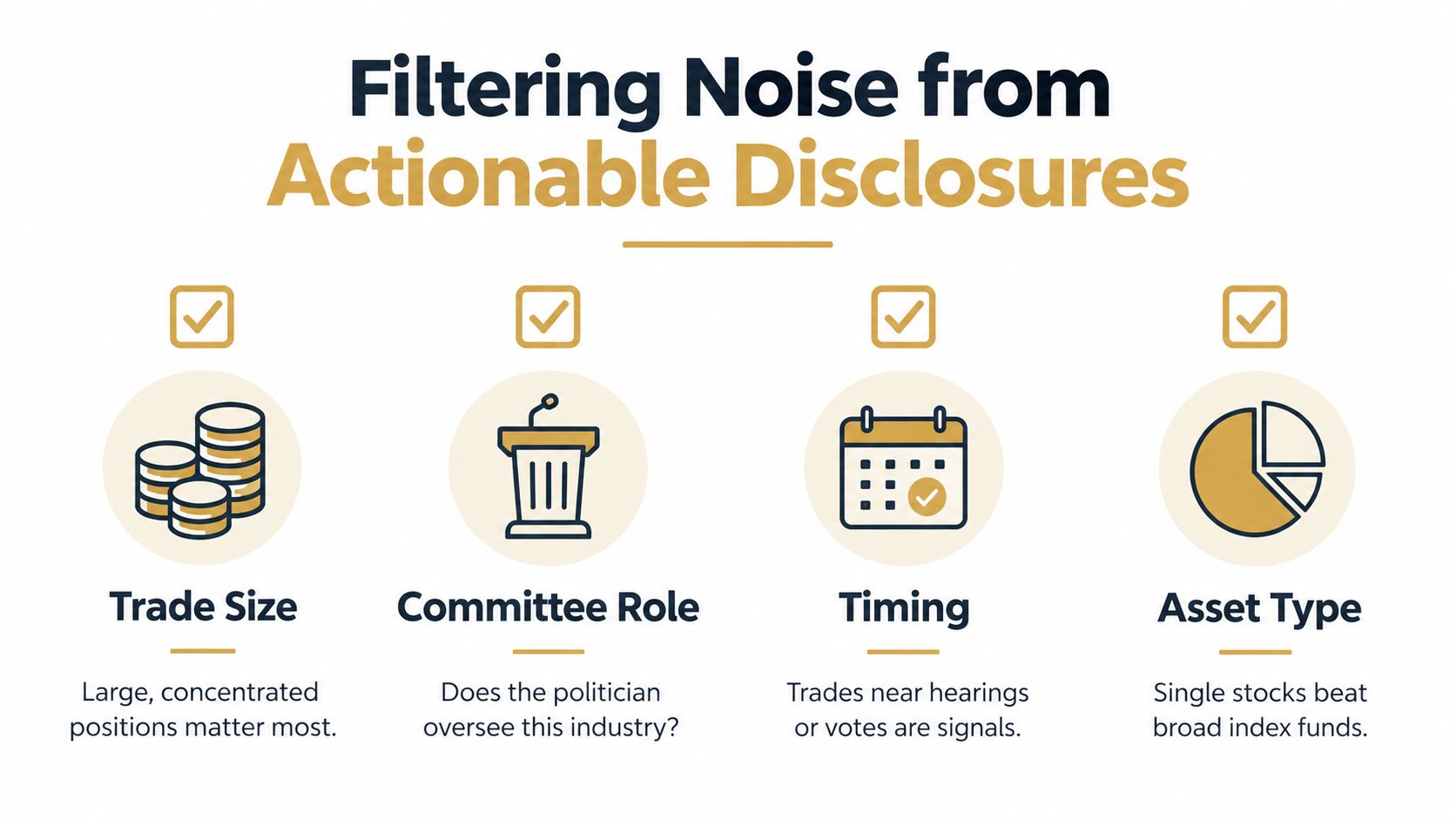
Four filters that matter
- Trade Size: A larger, concentrated position is usually more worth attention than a tiny, mechanical transaction.
- Committee Role: If the member sits on a committee tied to the industry, the disclosure deserves more scrutiny.
- Timing: Trades clustered around hearings, policy deadlines, or market-moving headlines often tell you more than random calendar noise.
- Asset Type: Single-stock trades are easier to analyze than broad index-like exposure.
The point isn't that committee membership proves anything improper. It's that oversight proximity changes how you interpret the filing. A trade made by someone who helps shape the rules around an industry is a different kind of signal than a generic portfolio update.
Late filings matter for another reason. They tell you the public saw the trade after the market had time to move, which makes the disclosure more useful for research than for instant execution.
You also want to be skeptical of broad asset baskets and family-related holdings. Those positions can blur intent, reduce conviction, and make the signal weaker. The practical move is to sort disclosures into buckets: likely noise, worth watching, and worth cross-checking against faster insider or whale data.
Recent dataset work reinforces why that filter matters. One 2026 Congressional Trading Report found 5,134 total trades with 4,924 filed past the 45-day deadline, and about 25% of congressional trades were made by a member sitting on a committee that directly oversees the company's industry Congressional Trading Report. That doesn't make every late filing actionable, but it does tell you where the higher-friction, higher-interest cases tend to sit.
Mapping Legislation to Sector Catalysts
Politicians don't just trade stocks, they move the frame that stocks trade inside. Lawmakers write bills, schedule hearings, and shape regulatory pressure, so the edge is often in connecting policy motion to sector behavior before the broader press catches up.
A cluster of trades in one industry can be a clue, but it's not the whole story. If committees are holding hearings, agencies are preparing rule changes, or spending priorities are shifting, the trade may be less about a single politician and more about a sector preparing for a new backdrop. That's where traders start thinking in catalysts, not personalities.
Read the policy map, not just the ticker
- Legislative momentum can point to sectors that may get attention, budget support, or new constraints.
- Committee activity can matter more than floor speeches because it's where details get shaped.
- Regulatory updates can change the odds for industries that trade on compliance, subsidies, or enforcement.
- Government spending signals can lift suppliers, contractors, or theme baskets before consensus catches on.
The useful habit is simple. When a filing lands, ask what policy environment surrounded the trade window. If the answer lines up with a sector that already had a reason to move, the disclosure may be confirming a broader thesis instead of creating one.
Political activity and market structure meet here. A trade can look like a personal bet when it's really a shadow cast by legislative timing. The best traders don't chase the shadow, they check the light source.
Tools for Tracking the Smart Money
Manual browsing of government disclosure portals is a poor use of time. The data is fragmented, hard to search, and rarely organized around the way traders read signals. You can still do it, but you spend more time rebuilding context than finding an edge.
Consolidated tools solve that workflow problem. When congressional disclosures sit next to corporate insider activity and whale positioning, the first question becomes simple, does one filing confirm the other, or are you chasing a stale headline? That cross-check matters because political disclosures are usually lagging sentiment, while Form 4 buys and large positioning changes can arrive sooner.

That is the gap TradeLikeInsiders is built to close. When a congressional filing lands, the useful check is whether a Form 4 or a 13F move agrees with it. TradeLikeInsiders.com puts those inputs on one screen, so the comparison takes seconds instead of an afternoon of portal-hopping. AI summaries and committee exposure views help filter out the filings that matter from the ones that just look busy.
Search still matters. Public sites are often easier to browse by form than by trade logic, which pushes you into manual comparison and slows down review. A unified dashboard makes it easier to ask the right question fast, whether the move is isolated or part of a repeating pattern.
A good tool does not hand you a trade. It helps you sort delayed disclosures, fresh insider activity, and institutional positioning into a watchlist that you can work from. For traders, that means less noise, less guesswork, and a cleaner path to comparing political filings with faster market data.
Risk Management and Compliance Boundaries
Trading public filings is legal. Treating them like certainty is where people get hurt.
The first boundary is simple. Congressional filings report amounts in ranges, not exact conviction, so you should never read a reported band as if it were a precise sizing signal. A broad range can hide a modest position, a family account, or a routine rebalance, and the filing itself won't tell you which one you're looking at.
The second boundary is risk. A delayed disclosure can be useful and still be a poor trade setup if the market has already moved. Position sizing matters more here than in many other event-driven setups because the signal is weaker, later, and easier to misread.
Do not size up just because the source is public. Public doesn't mean fresh, and fresh doesn't mean profitable.
Paper trading is the right way to test this kind of workflow. Run the process on delayed congressional filings, compare them with Form 4 and 13F data, and keep notes on what helped and what just felt clever in hindsight. That kind of discipline catches overconfidence before it turns into a real loss.
Ethically, the clean line is also the safest line. Use the disclosures as research inputs, not as a shortcut to assume wrongdoing or certainty. The goal is better decision-making, not story time.
Building Your Daily Signal Routine
The traders who get value from this space usually follow a repeatable routine. They don't refresh one headline and call it research. They check the slower political layer, then confirm it against faster information before they do anything else.
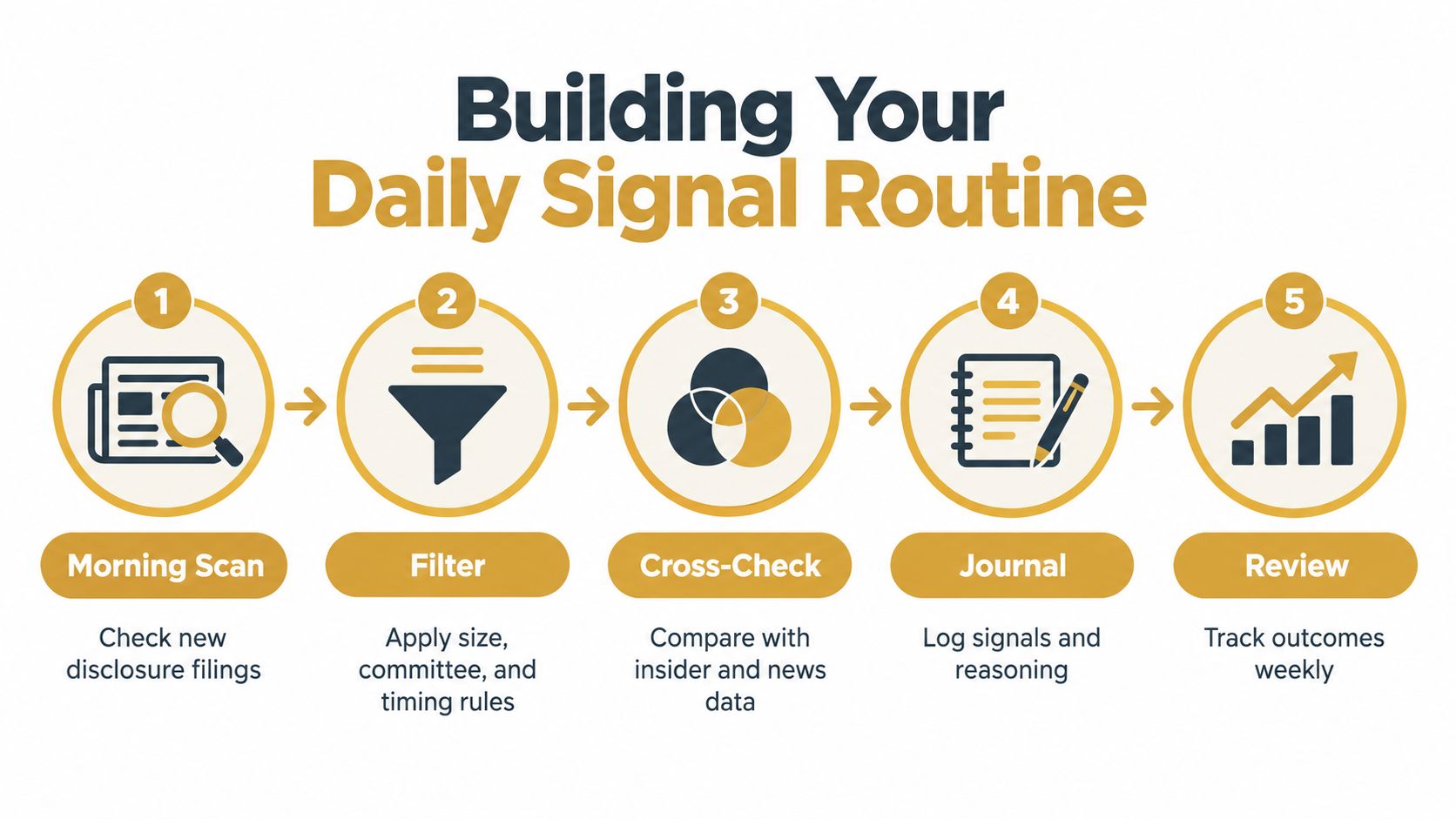
A workable morning flow
- Morning scan. Check new congressional disclosures, fresh Form 4s, and the latest 13F context.
- Filter. Separate small, routine, or late filings from the ones with real context.
- Cross-check. Compare the move against insider activity, whale positioning, and relevant policy headlines.
- Journal. Write down why the signal matters, or why it doesn't.
- Review. Revisit outcomes weekly so you can see which filters improved decisions.
That process keeps you from overreacting to a single filing. It also forces you to think in layers. A congressional trade can confirm sentiment, a Form 4 can show fresh management conviction, and a 13F can tell you how the larger institutions are leaning.
For a practical dashboard view, use TradeLikeInsiders blog to keep the research loop tight and organized. The best workflow is the one you'll follow every day, not the one that looks smartest on paper.
HeliosNet LLC operates TradeLikeInsiders, a research platform that brings congressional trades, insider filings, whale moves, and policy signals into one place. If you want a cleaner way to compare delayed political disclosures with faster market data, visit TradeLikeInsiders and see how the workflow fits your research. This content is for informational purposes only and is not financial advice. Do your own research.
Created with Outrank