The most repeated advice in this corner of the market is to get your alerts faster. Faster feeds, faster push notifications, faster dashboards. It's the wrong first question.
Speed is the easiest thing to measure about an alert and the least useful thing about it. A notification that hits your phone in a fraction of a second can be describing a trade that happened six weeks ago, and no amount of engineering on the delivery side changes that. The age of the event decides whether you're reading news or reading history.
So ask a different question first. Which record did this alert come from, when was that record created, and how much has changed since? Get that straight and most of the noise disappears on its own.
Table of Contents
- Which Data Sources Real Time Scanning Covers
- How an Alert Travels from Filing to Your Screen
- Why Congressional Trades Show Up Weeks Late
- Reading Insider Form 4 Filings by Transaction Code
- 13F Filings and Whale Moves Are Not Live Trades
- How Policy Moves Sectors Before the Filings Land
- Reading Real Time Alerts Without Overreacting
- Set Up Your Watchlist Before the Next Alert
Which Data Sources Real Time Scanning Covers
Six kinds of records sit behind most market alerts, and each one ages on its own schedule. A scanner can poll all six at the same speed, so poll speed alone tells you nothing useful. Real time scanning measures how fast software reads a source. How fresh the event inside it is runs on a separate clock, and that clock decides whether you are early or late.
The second clock is the one worth tracking. Better engineering shrinks the gap between a record posting and an alert reaching you, but the age of the event inside the record is fixed by filing deadlines and the source itself. A faster feed never touches it.
Three abbreviations come up constantly, so here they are in plain English:
- PTR (Periodic Transaction Report): the form a member of Congress files after buying or selling a covered security, published on the House or Senate disclosure portal.
- Form 4: the SEC filing a corporate insider uses to report a change in ownership.
- 13F: the quarterly SEC filing where a large institutional manager lists what it holds.
Here's how the six sources a market scanner typically watches compare on timing.
| Source | What It Covers | Typical Timing | Primary Record |
|---|---|---|---|
| Congressional PTR | Member trades over $1,000 | Filed within 30 days of learning, no later than 45 days after the trade | House and Senate financial disclosure portals |
| SEC Form 4 | Insider buys and sells by directors, officers and 10%+ owners | Generally within 2 business days of the transaction | SEC EDGAR |
| SEC Form 13F | Institutional manager holdings | 45 days after calendar quarter end, values as of quarter end | SEC EDGAR |
| Agency and regulatory releases | Rule, policy and enforcement announcements | At publication; the release can post the same day as the action or later | Issuing agency website |
| On-chain whale transfers | Large crypto wallet movements | Visible once confirmed on the blockchain | Blockchain explorer |
| Market quotes | Exchange and vendor prices | Depends on the vendor; the IEX standard treats under 15 minutes as real-time | Exchange and vendor timestamps |
Read down the timing column and the rows fall roughly in order from stalest to freshest. A congressional PTR can describe a trade from up to 45 days ago. A 13F reports positions valued at quarter end and is filed weeks after that date, so the snapshot is old before it even posts. A Form 4 runs about two business days behind the transaction. Only the bottom two rows describe events that are close to current.
The last row is the one people misread. That IEX benchmark comes from a proposed standard the SEC described, not a rule in force market-wide, so treat it as a reference point rather than law.
The habit worth building is simple. For every alert, name the record it came from and put a rough age on the event before you do anything else. If you can't do both, you don't have information yet. You have a notification.
How an Alert Travels from Filing to Your Screen
A letter takes minutes to write and days to arrive. Nobody calls the recipient slow because the envelope landed late, and nobody confuses the date on the letter with the date it hit the mailbox. Every alert carries the same two timestamps, and almost nobody checks the older one.
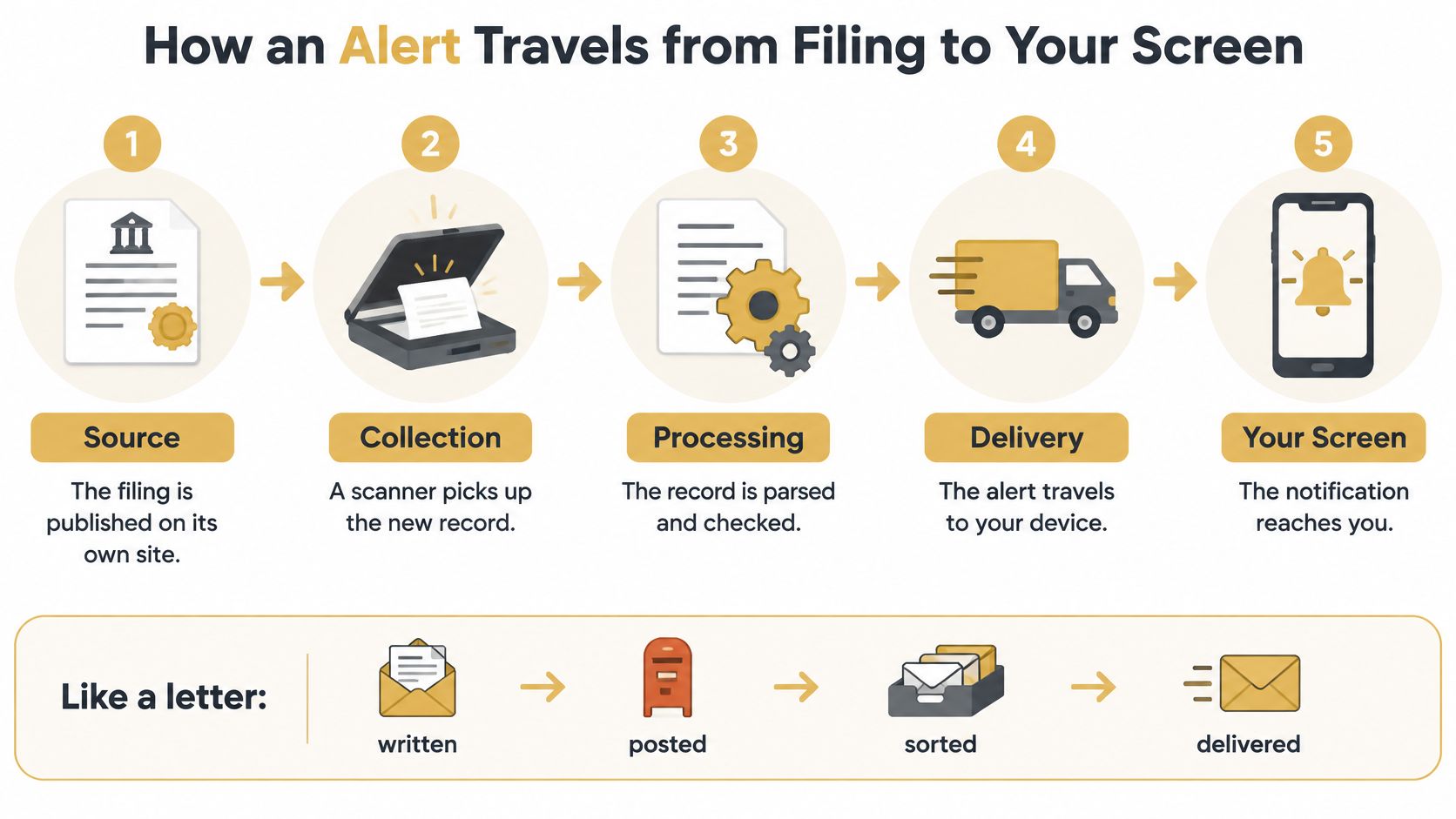
The chain from filing to screen has five stages, and each one adds time:
- Source publication. The filing, release or transaction posts publicly, carrying its own timestamp. This is the birth of the record.
- Collection. A scanner pulls the new record into its own system. This is usually fast, measured in seconds.
- Processing. Software parses the fields that matter: issuer, insider, transaction date, share count, stated amount. Messy formatting and scanned PDFs slow this down.
- Alert generation. Rules and thresholds decide whether the record deserves a notification, a downgrade, or silence.
- Delivery. The alert reaches your screen or phone, through a push service or an email queue.
Why a Live Alert Can Describe an Old Trade
Nearly all the delay in that chain sits in stage one. A scanner can be close to instant on stages two through five and still be reporting an event from last month.
Even the official line on real-time data leaves room for lag. Under a proposed IEX standard the SEC described, data accessed less than 15 minutes after publication counts as real-time, while data accessed 15 minutes or more after publication is delayed, as set out in the SEC's order on the proposed standard. Fifteen minutes is the regulatory reference point for live market data. Disclosure records move on a far slower clock, because the clock starts at the trade or event itself, long before anything posts.
That gap is what matters for disclosure alerts. The congressional and insider disclosures on TradeLikeInsiders are delayed and are not real-time trades. No label on a push notification turns a filed PTR into a live order ticket.
The Only Latency Number That Matters
Record five timestamps for every alert: source publication, ingestion, processing start, alert generation, and delivery. Then subtract the first from the last. End-to-end delay is the number that tells you how fresh the alert really is, and a benchmark of distributed stream processing makes the same case: latency measured from event production to processed output is more meaningful than broker or processor time alone.
Set percentile targets, not averages. A p95 or p99 figure for each stage exposes tail delays that an average hides, which is exactly what produces a cluster of alerts landing after the market has already repriced the news.
Last step: sort each alert by how old the underlying event is. An alert is actionable when the event is recent and the price has yet to absorb it. It is confirmatory when it backs a thesis you already hold. It is research only when the filing is useful context with no time pressure attached. Most disclosure alerts land in the third bucket. Treating them that way keeps the rare first kind visible.
Why Congressional Trades Show Up Weeks Late
The trade you just got an alert about is already old. Not by seconds. By weeks.
Under the STOCK Act, House Members, officers and certain employees generally must file a Periodic Transaction Report when they buy, sell or exchange covered securities in a transaction exceeding $1,000. The report is due within 30 days after the filer learns of the transaction, but never later than 45 days after the transaction date, as the House Committee on Ethics explains in its financial disclosure guidance. Run that clock forward and the arithmetic is unforgiving.
A Timeline Worth Keeping in Your Head
Say a member buys a stock on the 3rd of the month and learns of the fill a few days later. The 30-day window runs from that point of learning. The 45-day outer limit runs from the trade date itself. File near the end of either window and the public sees a trade from more than a month back, sometimes closer to six weeks.
Nothing about that is deceptive. It's the rule working as written, and it applies to both chambers and both parties, because the Senate operates under the same STOCK Act framework. This isn't a partisan story. It's a paperwork story. Any alert that implies otherwise is selling you a villain instead of a fact.
Two more details change how you read a filing. The $1,000 test applies to the value of the transaction, not to the profit or loss on a sale, so a small reported range doesn't mean a small position. And PTRs report amounts in broad ranges set by the disclosure rules, not exact prices, so you're working with buckets rather than precise fills.
A PTR tells you what someone did, on a date, in a size bracket. It does not tell you what they think, what they still hold, or what they'll do next.
That's the list of things a filing doesn't prove: that the official still owns the security, that they had any material information, or that a position is still open. A sale can close out a position or trim one. A purchase can be a rebalance inside a managed account.
Practical rule: treat a PTR as a dated record of an activity, then open the original filing on the House or Senate disclosure site before you draw any conclusion from it.
Reading Insider Form 4 Filings by Transaction Code
An "insider selling" headline is a filing compressed into one sentence by someone who may never have read past the first line. The first line rarely carries the meaning.
Form 4 is the primary filing for reporting many transactions by corporate insiders, including directors, officers and large shareholders, and it reaches the SEC within a short window after the trade. That makes it the fastest disclosure source an alert can come from, which matters when you sort alerts by source timing: the filing still carries a transaction date, and the event is always older than the moment it hits your screen. Each filing identifies the issuer, the insider, the transaction date, the transaction code, the number of securities acquired or disposed of, the price where applicable, and the insider's resulting ownership.
The code is where the signal lives, or dies.
| Code | Meaning | How Much It Tells You |
|---|---|---|
| P | Open-market purchase | Strongest signal of an insider's own market view |
| S | Open-market sale | Mixed; may reflect diversification, taxes or a plan, so check context |
| M | Option or derivative exercise | Often compensation-related; check whether shares were sold afterward |
| A | Grant or award | Compensation; reflects pay decisions rather than market conviction |
| F | Shares withheld for taxes | Administrative; weak signal |
| G | Gift | Transfer outside the market; little trading signal |
The price field sharpens the read. A grant can show no open-market price because the shares arrived as compensation, while a code P shows the actual level the insider chose to pay with their own money.
The Checklist I Use on Every Form 4
- Open the filing itself on SEC EDGAR. Aggregators, screenshots and alert text are all secondhand; the filing is the record.
- Read the code before the dollar figure. A code G and a code P can involve similar share counts and mean opposite things.
- Follow a sale back one step. If an M exercise came first, the sale may be the mechanical second half of a compensation event rather than a change of heart.
- Check for a prearranged plan. Sales under a 10b5-1 trading plan are scheduled in advance, which weakens the timing signal considerably.
- Count the insiders, not just the dollars. A cluster of open-market purchases by several insiders in the same window usually says more than a single administrative transaction.
One caution applies to every row in that table. A cluster of insider buying can be informative, and it still guarantees nothing about future performance; insiders misread their own stock with some regularity. Even the fastest disclosure describes a decision that already happened, so treat each filing as dated evidence and weigh it against everything else you know before you act on it.
13F Filings and Whale Moves Are Not Live Trades
Whale watching gets sold as a live feed of what big money is doing. For institutions, it isn't one, and never has been.
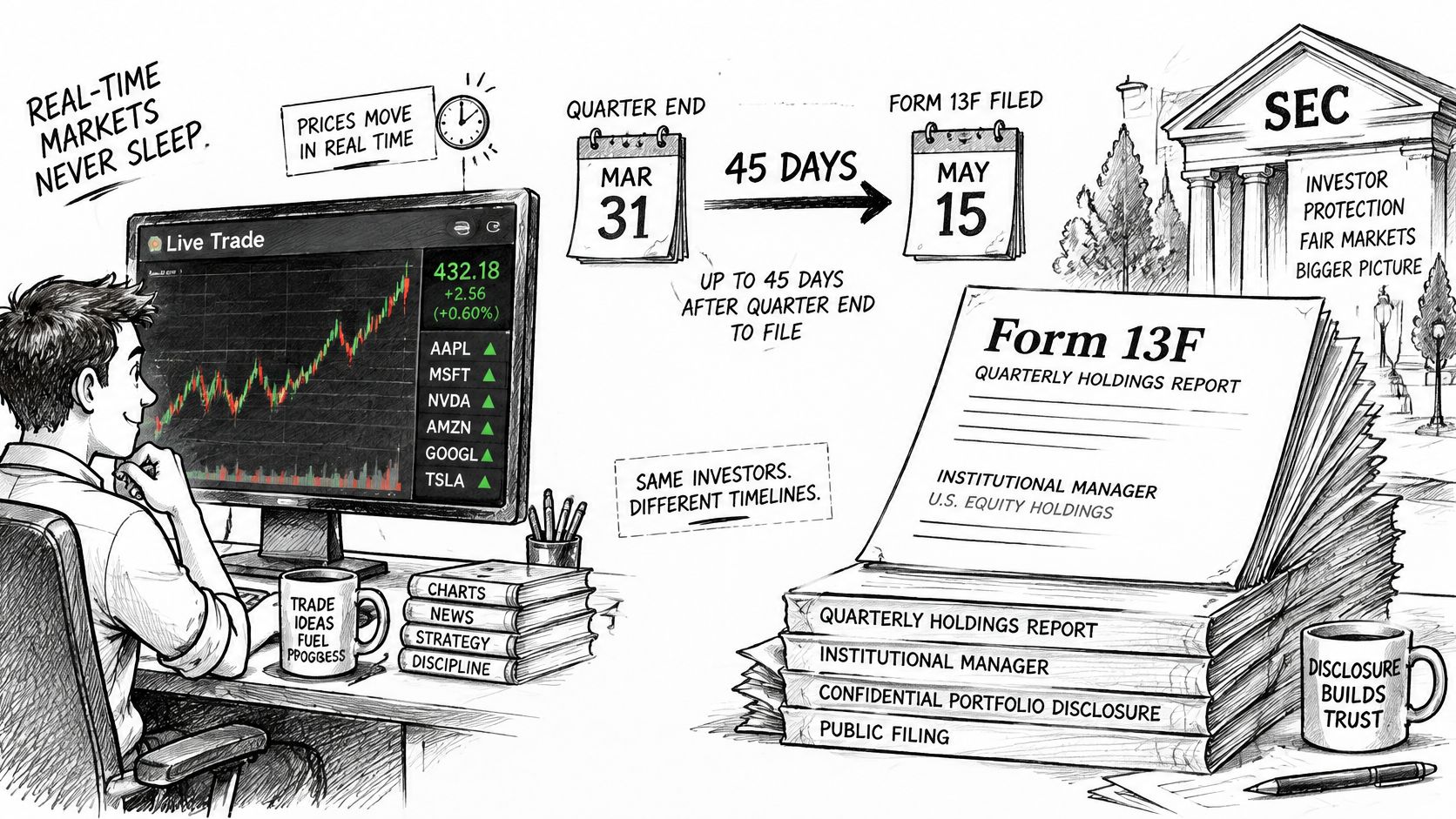
A Form 13F is a quarterly holdings report. Institutional investment managers subject to Section 13(f) generally report qualifying U.S.-listed securities to the SEC, and the filing is due within 45 days after the end of each calendar quarter, with values as of quarter end. It shows issuer, class, share count and market value at a single moment. It does not provide a continuous record of trades, and it may omit short positions and many non-reportable instruments.
Read that again with the calendar in hand. A 13F published in mid-February describes a portfolio as it stood on December 31. Six and a half weeks of trading can happen before you see it, and a position that looks enormous in the filing may have been halved the following week.
A 13F is a photograph of a portfolio, not a livestream of one. You're comparing snapshots, not watching trades.
The useful work is comparison across quarters. Line up successive filings for the same manager and look for four things: new positions, full exits, large size changes, and rising concentration. A manager who has never owned a sector suddenly holding a top-five position is telling you something, even if the information is stale by the time it prints.
On-chain whale flow is the other half of the picture, and it's live once a transfer is confirmed on a blockchain. The catch is meaning. A large transfer can be a custody change, an internal wallet shuffle, a collateral move, or a hedge, and the chain shows you the coins moved without showing you why. Treat 13F changes as historical evidence of institutional positioning, and treat whale transfers as a prompt to go find context. Neither is a timestamped instruction to copy anyone.
How Policy Moves Sectors Before the Filings Land
The earliest signal in most sector moves isn't a disclosure at all. It's a public government action that anyone can read for free, days or months before the trades get filed.
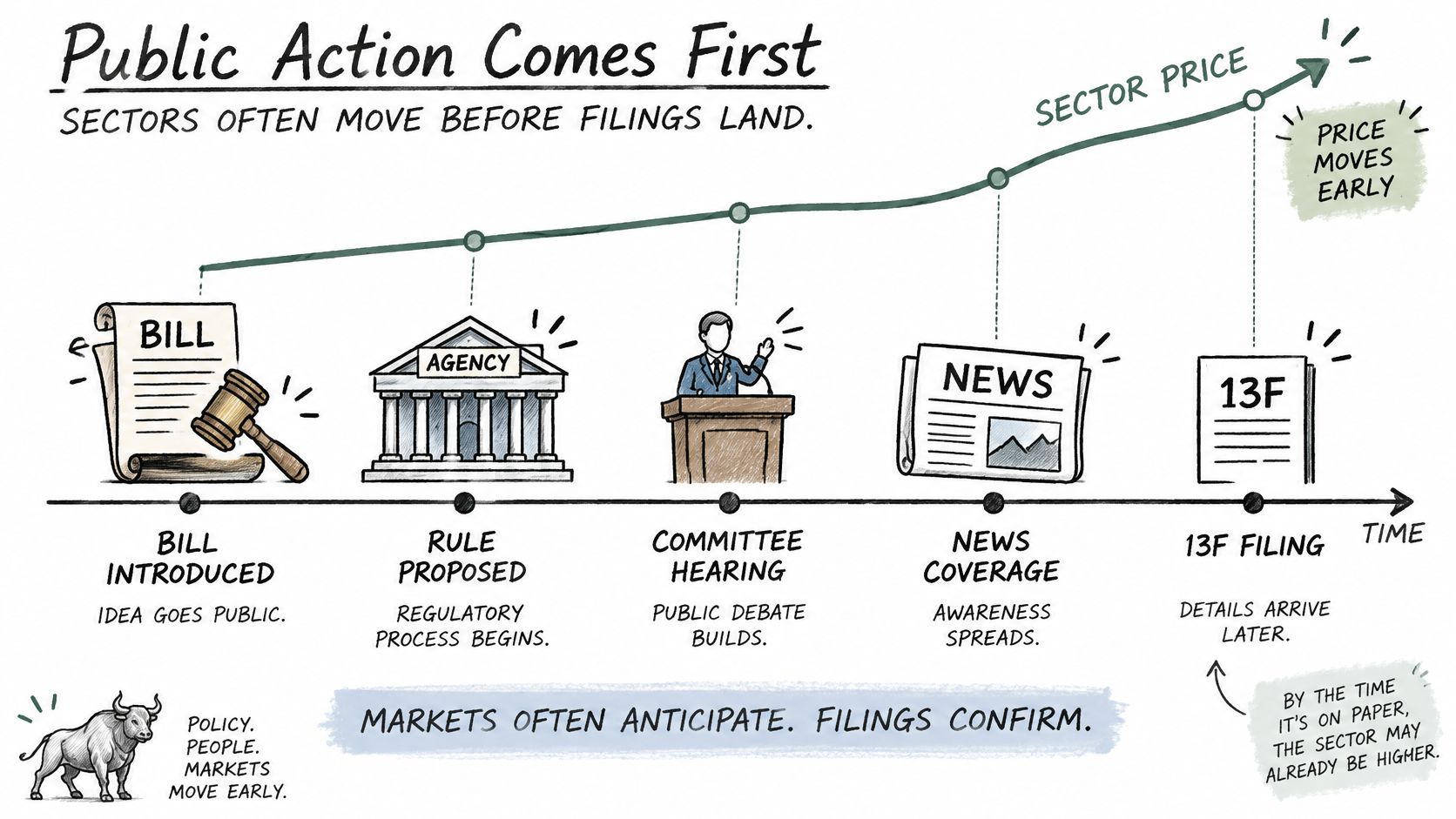
Watch the sequence rather than the headline. A bill gets introduced and assigned to committee. A committee takes a public step, a markup or a vote. An agency publishes a proposed rule and opens a comment period. A final rule or a signed law lands. Each of those stages is visible and dated, and the market reprices affected companies along the way, not at the end.
The event types that move sectors are consistent across administrations. Tariffs and trade measures hit importers, exporters and anyone with a supply chain crossing a border. Subsidies and tax credits revalue entire build-outs. Licensing and approval decisions decide which projects exist at all. Procurement contracts are single-company events with long tails. Changes to reporting or safety rules reset compliance costs for a whole industry.
None of that belongs to one party. Both parties propose and pass rules that move industries, and a reader who only watches one side of the aisle is filtering out half the signal.
Here's where to verify each stage yourself. Bill text and status live on congress.gov. Proposed and final rules appear in the Federal Register, which is where you find out whether a rule is proposed, final, or delayed. Agency press releases on the agency's own site carry the enforcement and approval decisions that never make it into a bill at all.
The trap is treating a policy headline as a rule in effect. Markets price the likely outcome long before final text exists, which means the biggest move often happens at the proposal stage and the final signing produces a shrug. Before you decide a policy item is fresh, find out which stage it's in: introduced, proposed, finalized, or in force. Four different stages, four different reactions.
Reading Real Time Alerts Without Overreacting
The public trades on news. Insiders trade on information. Once you accept that, a real-time alert stops looking like a head start and starts looking like the public's version of an event insiders already knew about.
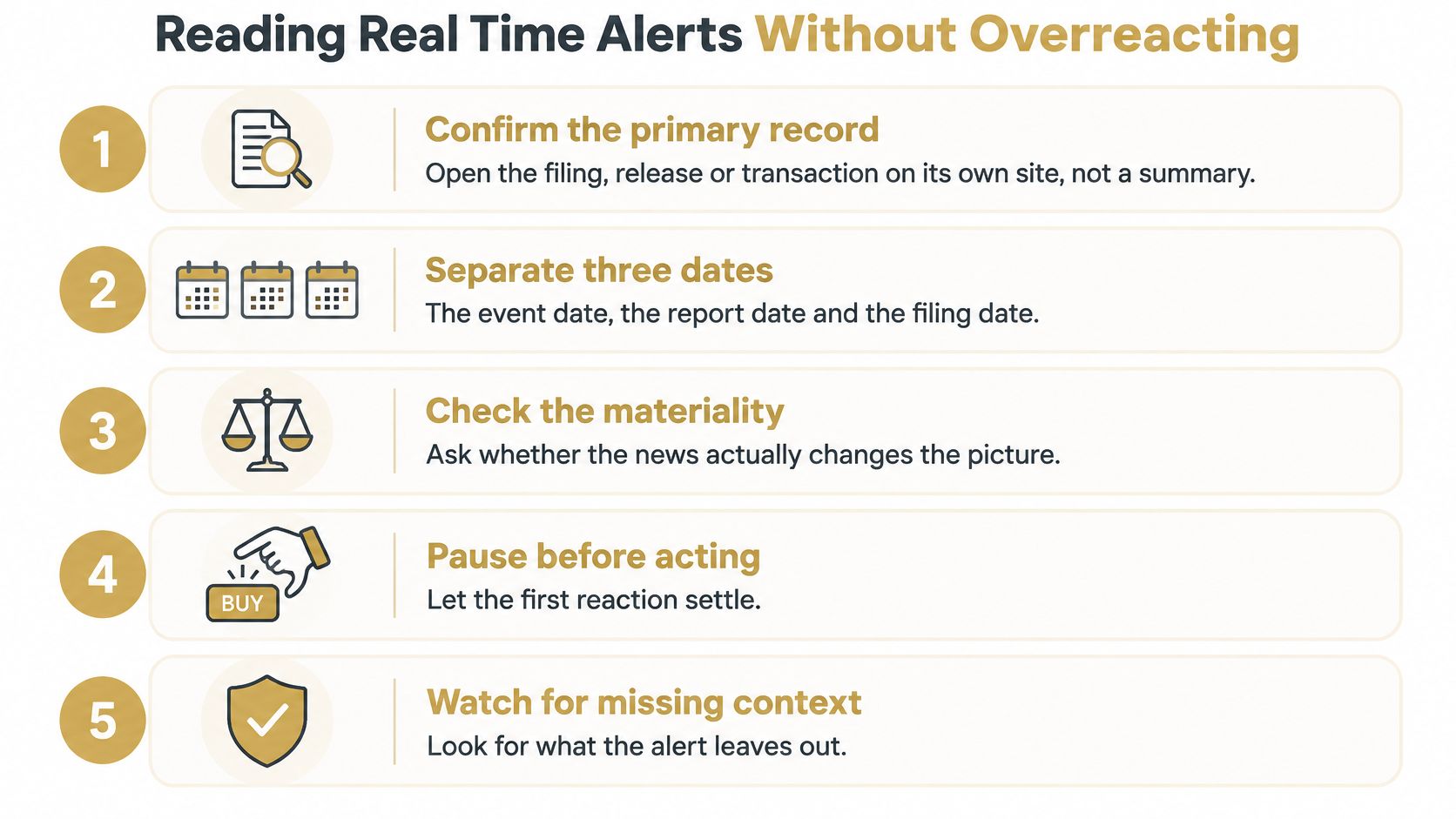
Before any decision, age the alert from its underlying event, then run these checks in order:
- Confirm the primary record. Open the filing, release or transaction on its own site. A summary is a claim about a document, not the document.
- Separate three dates. The event date, the filing date, and the moment the alert reached you. The spread between the first and third is the actual lag, and sorting alerts by that spread separates fresh news from disclosures that are weeks old.
- Check the action type. Code P versus code M, or a PTR amount range versus an exact figure, changes the interpretation entirely.
- Look for independent confirmation. One record rarely settles a question. Two unrelated sources agreeing is a different situation from one feed repeating itself.
- Check the price. If the stock has already moved through the level the alert implies, the information is priced in and you're late by definition.
- Suppress repeats. One disclosure appearing in three feeds is one signal, not three. Duplicate suppression is cheap and it keeps the important alerts visible.
- Hold back what's stale or ambiguous. Write down the timestamp and the reason. A withheld alert with a note is worth more than a fired alert with an apology.
There's a technical reason alerts often arrive in clumps. Scanners trade throughput against latency, and a review of Apache Kafka benchmarking practice found median latency below 25 milliseconds in the runs it evaluated, with moderate producer batching of roughly 5 to 10 milliseconds of linger time improving throughput by up to about 2x. Batching suits aggregated whale transfers and duplicate suppression. It works against a newly published disclosure that needs to move now, which is why priority lanes exist and why your fastest and slowest alerts often come from the same platform.
Baseline noise matters more than any single event. Feeds produce a steady background hum of low-value signals, and the value sits in spotting a shift away from that background. Reacting to every tick costs attention without adding signal.
The harder discipline: a scanner that withholds weak or redundant alerts is more useful than one that fires on everything.
Automation needs a human brake. EU guidance on prohibited AI practices notes that systems producing consequential results shouldn't rely solely on automated output and highlights the need for human assessment of potential false positives. That guidance concerns biometric AI rather than trading alerts, and the design lesson carries over: the faster the output, the more you need review controls, logging and escalation rules.
Set Up Your Watchlist Before the Next Alert
Pick two or three source types and stop trying to watch everything. Congressional PTRs, Form 4 filings and quarterly 13F changes cover most of what a self-directed investor can act on, and each has a different rhythm.
For every alert you log, record three dates: the event date, the filing date, and the time you saw it. That single habit turns a vague feeling of being late into a number you can compare across sources.
Match the review cadence to the source. Check PTRs as they post, since a filing can describe a trade from weeks back and there's no freshness left to protect. Review Form 4s within a few days of filing, while the two-business-day reporting window still means something. Compare 13F holdings once a quarter, after the 45-day window has closed and every manager has reported.
Keep a short note on each alert covering four things: the source record, the age of the event, the action type, and whether you classed it as actionable, confirmatory or research only. After a month you'll have a personal hit rate, which is more useful than any latency claim on a sales page.
TradeLikeInsiders surfaces STOCK Act congressional disclosures, SEC Form 4 insider filings and on-chain whale flow in one place, with delay labels on alerts that link back to the primary records, alongside educational AI analysis and a paper-trading simulator for practicing with simulated money. You can build a watchlist and start logging at TradeLikeInsiders.
Start with the slowest source and the oldest alert on your screen. If you can read those correctly, the fast ones take care of themselves.
This content is for informational purposes only and is not financial advice. Do your own research.
HeliosNet LLC built TradeLikeInsiders for exactly this problem: too much market noise, too little context about how old the underlying event really is. Every congressional disclosure, Form 4 filing and whale transfer on the platform carries a delay label and a link back to the primary record, so you can check the age of an alert before you decide what it means. Visit TradeLikeInsiders to see how the alerts are labeled and start building a watchlist that tells fresh news apart from filings that are already weeks old.