“Just follow what insiders buy” is popular advice. It's also incomplete. The public trades on news. Insiders and policymakers operate on different clocks. By the time a congressional trade becomes public, the official may have changed the position, the policy debate may have shifted, and other investors may already have repriced the stock.
The useful edge isn't pretending public filings reveal secret instructions. It's knowing the source, the reporting lag, and the business exposure before drawing a conclusion. Congressional disclosures, corporate insider reports, institutional holdings, drug reviews, merger decisions, and tariffs leave different paper trails. They shouldn't be treated as interchangeable alerts.
A fresh alert can describe an old transaction. Always separate when something happened from when you learned about it.
These regulatory policy examples connect those paper trails to practical research decisions. Some rules force investors to disclose activity. Others change a company's financing, project economics, product access, or supply-chain costs. Both matter, but through different mechanisms.
For each signal, ask what changed, which companies bear the consequences, and which official document confirms it. Then compare that evidence with company filings and existing expectations. This is educational research, not a real-time tip service, and a compelling narrative still isn't proof of an attractive trade.
Table of Contents
- 1. STOCK Act of 2012 and Congressional Trade Disclosure
- 2. SEC Form 4 and Corporate Insider Buying and Selling
- 3. 13F Filings and Institutional Whale Holdings
- 4. Dodd-Frank and the GENIUS Act in U.S. Financial Regulation
- 5. The Inflation Reduction Act and CHIPS and Science Act
- 6. FDA Drug Decisions and PDUFA Goal Dates
- 7. Antitrust Review and FTC/DOJ Merger Enforcement
- 8. Section 232 and Section 301 Tariffs
- 8 Regulatory and Disclosure Signals at a Glance
- How to Read Any Policy Signal Without Getting Burned
1. STOCK Act of 2012 and Congressional Trade Disclosure
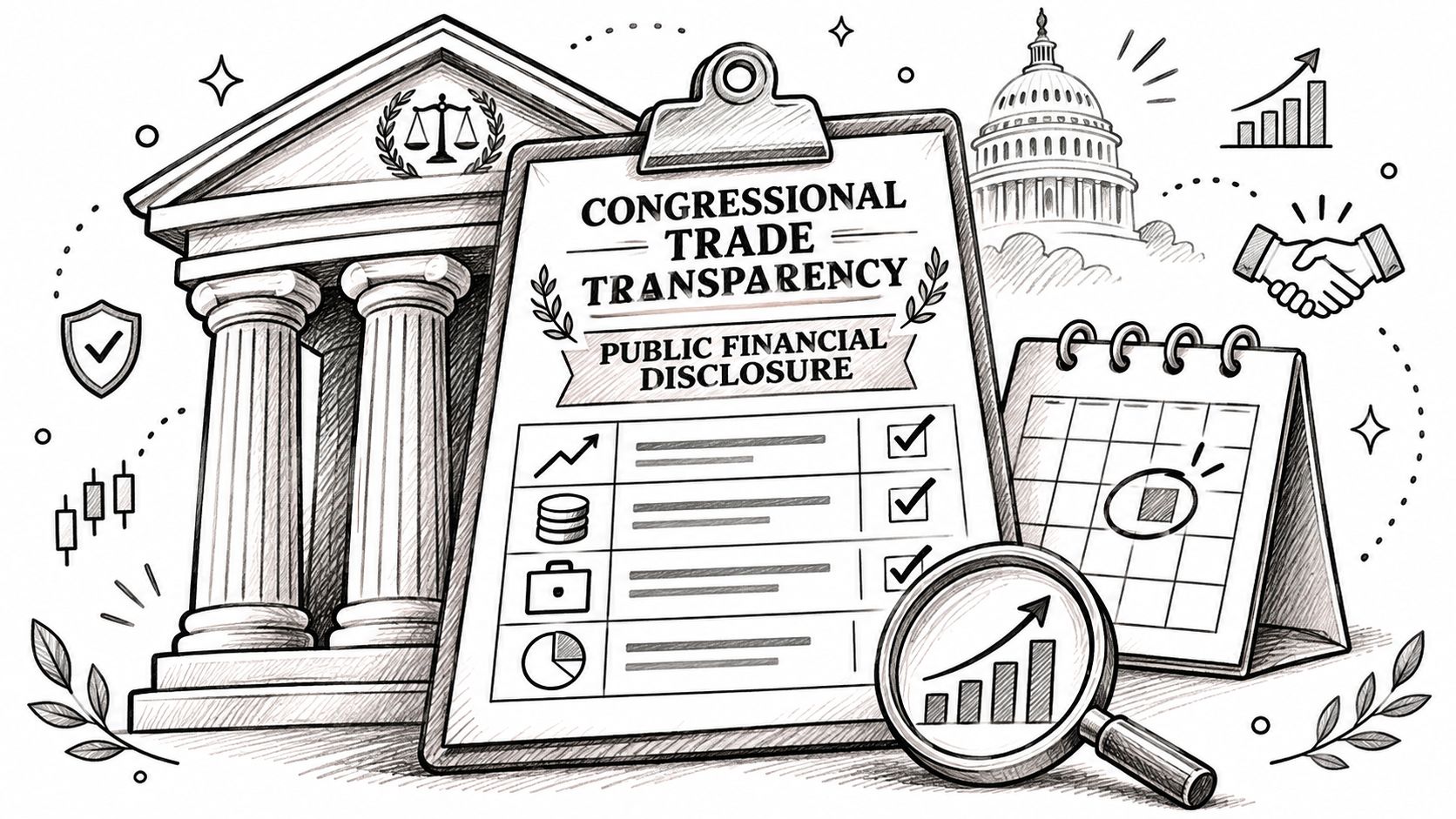
A congressional trade headline tells you less than the underlying Periodic Transaction Report, usually shortened to PTR. You need the transaction date, disclosure date, ownership category, and reported amount range before interpreting the activity.
Under the House Committee on Ethics' STOCK Act guidance, covered securities transactions exceeding $1,000 must be reported by the earlier of 30 days after awareness or 45 days after the transaction. Reported amounts use ranges rather than exact dollar figures, so a disclosure isn't a precise account statement.
Read the Record, Not the Political Narrative
Primary sources to check: the House Clerk's financial disclosure portal and the Senate Office of Public Records' eFD search. Annual financial disclosures provide additional holdings and income context, but they aren't substitutes for reading the transaction report.
Say an official discloses a purchase involving a semiconductor company during a debate about manufacturing support. Check whether the transaction preceded the relevant legislative development, whether the holding belongs to the official or a spouse, and whether subsequent reports change the picture. Committee assignments add context, not proof of privileged information.
- Match the dates: Record the transaction date separately from the date the filing became public.
- Respect the range: Don't turn a disclosure bracket into an invented exact investment.
- Check ownership: A spouse's holding or managed account changes what you can infer about personal decision-making.
- Use the same standard: Evaluate officials from both parties with identical evidence requirements.
The tactical takeaway is pattern tracking, not politician copying. A filing can help identify policy exposure worth researching, but it doesn't establish wrongdoing, continued ownership, or a profitable entry point today.
2. SEC Form 4 and Corporate Insider Buying and Selling
A compensation grant and an open-market purchase can both appear in an insider feed. Treating them as the same signal is a basic research mistake.
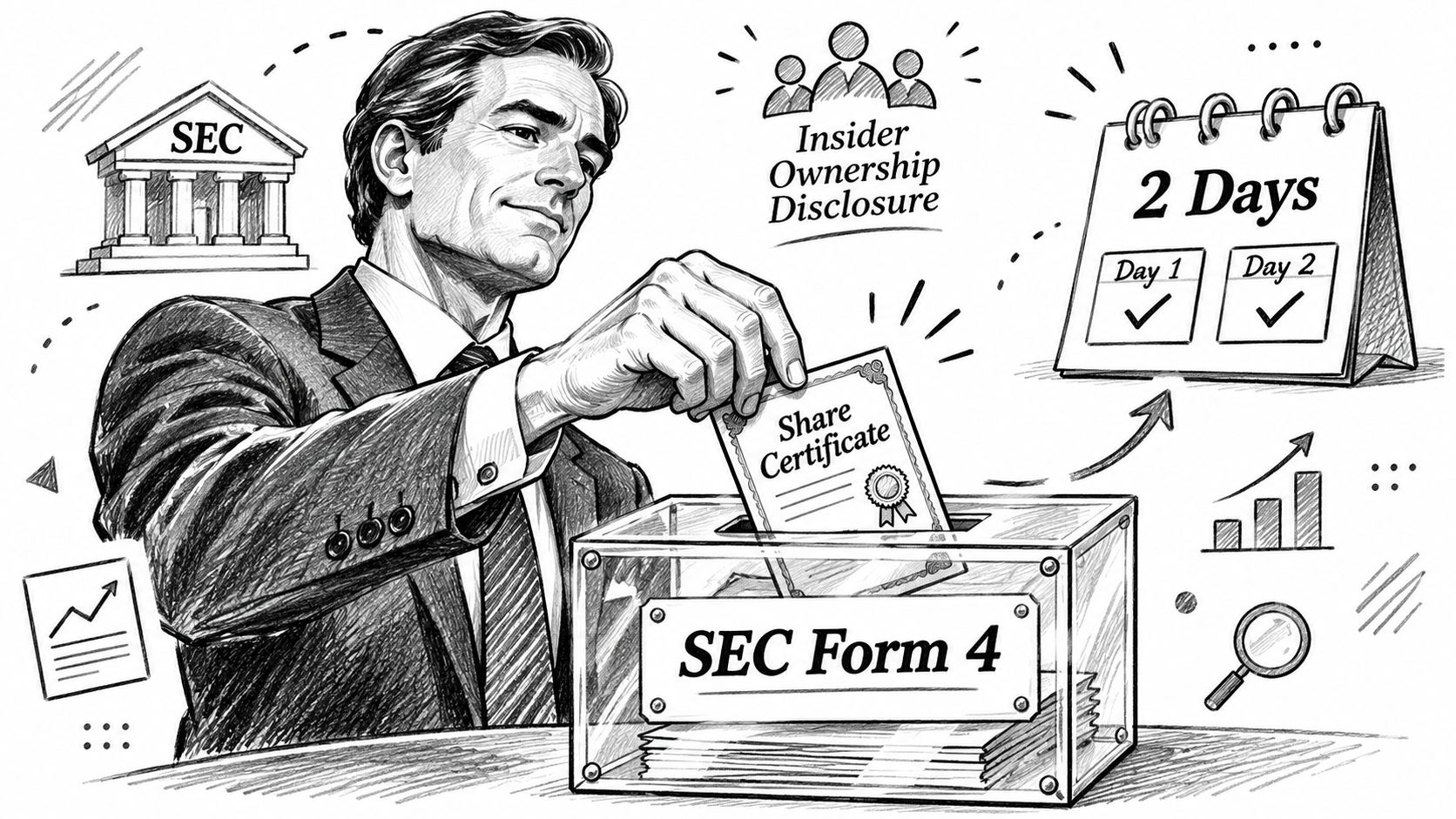
The SEC's Form 4 instructions generally require covered insiders to report ownership-changing transactions before the end of the second business day after execution. The filing identifies the reporting person, transaction details, and resulting ownership, while codes and footnotes explain what happened.
Classify Before Interpreting
Primary source to check: SEC EDGAR, using the company's filings and the reporting insider's Form 4. Code P identifies an open-market or private purchase, while S identifies a sale; exercises, awards, and tax-related disposals require different interpretations.
Say several directors purchase shares after a disappointing earnings release. That deserves closer inspection than an isolated compensation award, but you still need to compare the purchases with existing holdings, prior behavior, and the company's financial condition. A purchase doesn't cancel deteriorating cash flow or financing risk.
Practical rule: Read Form 4 as a transaction-mechanics document first and a confidence signal second.
Sales require particular care. Diversification, taxes, and scheduled trading arrangements can explain activity without implying a negative company forecast. Form 144 is a separate notice concerning proposed sales of restricted or control securities, not a replacement for completed-transaction analysis.
For an educational starting point, the TradeLikeInsiders homepage provides access to our research platform. We surface STOCK Act congressional disclosures, SEC Form 4 insider filings, and on-chain whale flow, but those are different evidence types and shouldn't be scored identically.
Finish by checking the company's annual report, quarterly report, and recent event filings. Insider context strengthens fundamental research; it doesn't replace it.
3. 13F Filings and Institutional Whale Holdings
A headline saying a fund bought a company can imply a recent trade. A Form 13F usually supports a narrower statement: the manager reported holding a position at quarter-end.
The SEC's Form 13F guidance generally covers managers exercising investment discretion over at least $100 million in Section 13(f) securities, with reports due within 45 days after each calendar quarter. That makes the filing a delayed holdings snapshot, not a transaction feed.
It also isn't a complete portfolio. You won't see every asset, short position, cash balance, or purchase price, and a disclosed holding may sit beside hedges you can't reconstruct.
Compare Shares Before Reading Conviction
Primary source to check: the manager's Form 13F and any amendments on SEC EDGAR. Read the information table, not just a media summary of the biggest positions.
- Compare share counts: A higher reported market value can result from appreciation rather than additional buying.
- Check continuity: Compare successive filings using consistent security identifiers and share classes.
- Understand the mandate: An index allocation, hedged strategy, or specialist mandate can explain holdings without a discretionary bullish call.
- Keep crypto separate: On-chain whale transfers aren't institutional equity holdings reports.
Say a manager increases reported holdings across semiconductor equipment suppliers while manufacturers discuss domestic expansion. That creates a research question about capital spending and policy exposure. It doesn't prove the manager bought because of subsidies or still holds the same exposure.
Use the TradeLikeInsiders research blog for further educational reading, then verify the underlying filing yourself.
The replicable tactic is change analysis with explicit blind spots. Record additions, reductions, and apparent exits, but label them as quarter-end comparisons. Don't invent execution dates or assume the visible position reveals the fund's entire strategy.
4. Dodd-Frank and the GENIUS Act in U.S. Financial Regulation
Financial regulation can alter what institutions must hold, what activities they can conduct, and how much compliance work sits between a product announcement and a launch. Those effects differ sharply across banks, payment companies, and stablecoin issuers.
The Congressional Research Service's Dodd-Frank overview explains that the law initially applied enhanced prudential standards above $50 billion in bank holding company assets, while subsequent legislation raised the automatic threshold to $250 billion. The practical point is segmentation: a headline about banking regulation doesn't establish identical exposure across every bank.
Dodd-Frank's systemic-risk framework and the GENIUS Act's payment-stablecoin framework also address different problems. For stablecoin research, examine issuer eligibility, reserve backing, redemption obligations, and the division of regulatory oversight. Don't assume passage alone means every implementing requirement is operational.
Follow the Transmission Mechanism
Primary sources to check: Congress.gov for enacted text, the Federal Register for implementing rules, and Federal Reserve, FDIC, Treasury, and other relevant regulator releases. For banks, connect supervisory developments with capital disclosures and management's distribution plans.
- Bank capital: Ask whether requirements affect lending capacity, funding, dividends, or buybacks.
- Stablecoin operations: Check reserve composition, redemption terms, attestations, and issuer eligibility.
- Legal status: Separate proposed rules, final rules, effective obligations, and transition arrangements.
Say a payment company announces a stablecoin initiative after legislation passes. Verify whether it plans to issue directly, partner with an eligible issuer, or supply infrastructure. Those models have different costs and revenue opportunities.
Related Cleveland Federal Reserve research on capital rules found differing bank balance-sheet responses and examined how borrowers could obtain credit elsewhere. That's the trade-off investors should investigate: tighter requirements may constrain an affected lender without eliminating the customer's financing options.
Regulatory clarity isn't automatically earnings growth. Trace the rule to an actual balance-sheet or operating change.
5. The Inflation Reduction Act and CHIPS and Science Act
Subsidies can make a project financially attractive without making the recipient's stock attractive at any price. Investors need to distinguish policy support, awarded funding, construction progress, and eventual earnings.
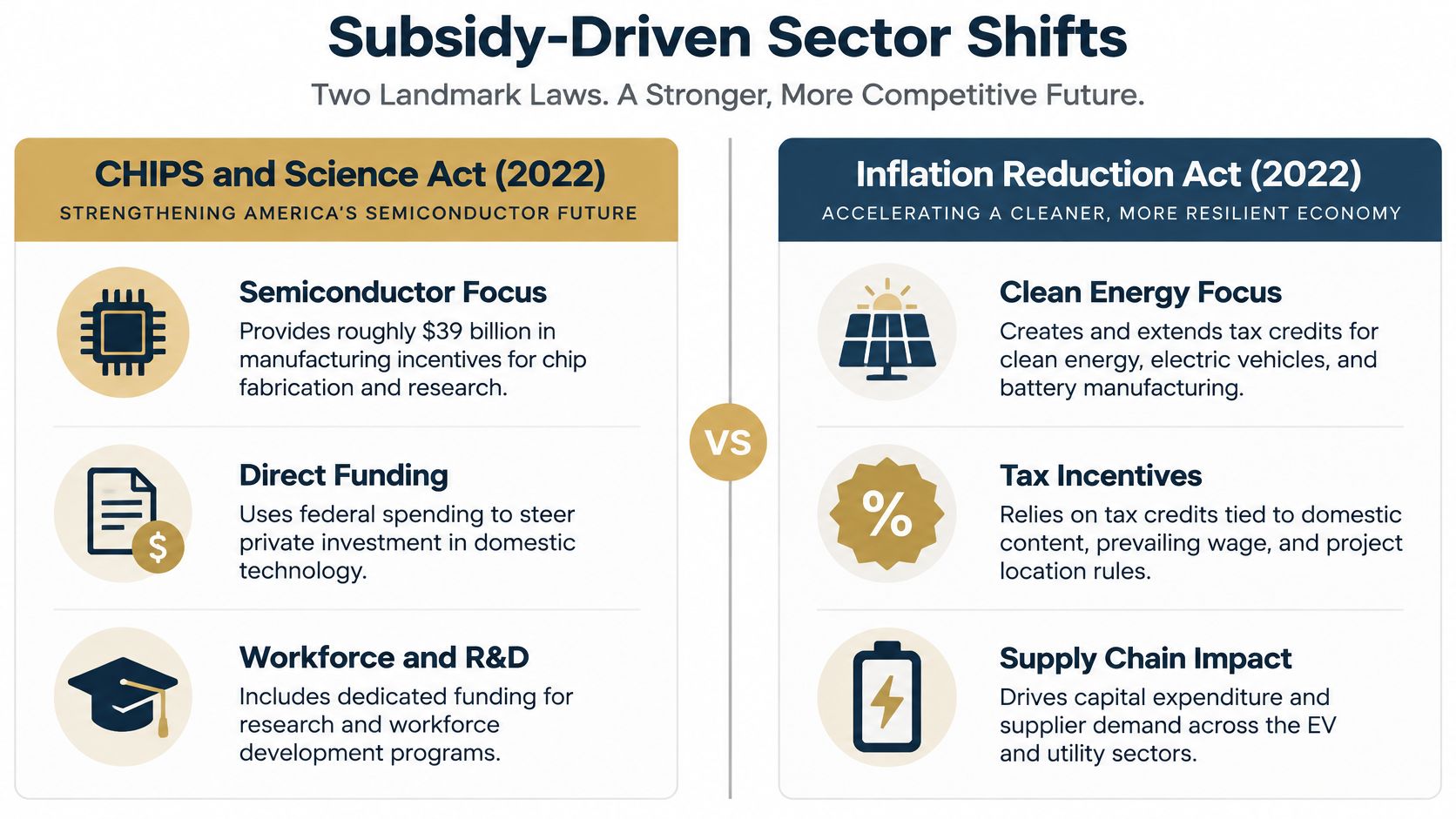
The Inflation Reduction Act and CHIPS and Science Act illustrate how tax incentives and public support can influence clean-energy investment and semiconductor manufacturing. Relevant businesses include fabrication plants, equipment suppliers, battery manufacturers, utilities, and companies supplying construction or infrastructure services.
Test Whether Support Reaches the Numbers
Primary sources to check: Commerce Department award materials, Treasury and IRS guidance, enacted legislation, and the recipient's SEC filings. Historical eligibility isn't enough; verify the rules applicable to the project and tax period you're examining.
Say a battery manufacturer announces a domestic facility. Map the conditions attached to support, the company's funding commitments, construction milestones, and customer contracts before treating the announcement as future profit.
- Funding certainty: Distinguish an application, preliminary agreement, final award, and money received.
- Eligibility: Identify domestic-content, labor, production, or other conditions affecting the benefit.
- Execution: Check permitting, equipment delivery, utility access, and financing.
- Economics: Compare the supported project with a scenario involving reduced or delayed assistance.
Physical constraints deserve equal attention. The International Energy Agency's analysis of AI and electricity systems identifies grid integration and infrastructure policy as material considerations for data-center expansion, a useful reminder that legal approval and usable power aren't the same thing.
A semiconductor facility can have government support and still face an operational bottleneck. Suppliers may benefit earlier than the plant owner, while the owner absorbs construction spending before meaningful production.
The tactical takeaway is to follow cash-flow milestones and dependencies, not a list of companies associated with a favored policy theme. Confirm whether management includes the benefit in guidance and what happens if assumptions change.
6. FDA Drug Decisions and PDUFA Goal Dates
A date on a biotech catalyst calendar isn't a promise of approval. It's a starting point for investigating the application, the evidence, and what investors already expect.
Under the Prescription Drug User Fee Act, commonly called PDUFA, drug reviews use goal dates that companies may disclose publicly. Possible developments include approval, a complete response letter explaining deficiencies, or an extended review. Advisory committee discussions and manufacturing issues can matter before the scheduled decision.
Primary sources to check: FDA approval documents, Drugs@FDA, advisory committee materials, and the applicant's SEC filings. Company disclosures are especially important for review correspondence that isn't available as a complete public FDA record.
Separate the Decision From the Commercial Outcome
Say a small biotechnology company depends heavily on its lead drug. An approval might remove a regulatory obstacle while leaving difficult questions about the permitted patient population, safety language, reimbursement, launch spending, and competition.
- Confirm the application: Check the proposed indication and whether the filing concerns a new drug, biologic, or supplemental use.
- Read the evidence: Review trial endpoints, safety findings, and advisory committee briefing materials.
- Inspect operations: Look for disclosed manufacturing or inspection issues.
- Assess financing: Compare available cash with launch plans and continuing development obligations.
A favorable regulatory decision and a favorable stock reaction are separate outcomes.
That distinction prevents a common mistake: treating approval as an uncomplicated earnings event. A narrower label than investors expected can change the commercial case even when the agency allows marketing.
Drug-review timelines also shouldn't be applied indiscriminately to medical-device companies, which use different pathways. Identify the actual regulatory route before borrowing a catalyst template from another subsector.
The replicable tactic is a document-backed event sheet. Record the application, disclosed goal date, unresolved issues, plausible outcomes, and financial consequences. If you can't explain the downside scenario without referring to the stock chart, the research isn't finished.
7. Antitrust Review and FTC/DOJ Merger Enforcement
A merger offer isn't cash in the shareholder's account. Until closing, the transaction remains subject to contractual conditions, financing where applicable, shareholder approvals, and regulatory review.
The Hart-Scott-Rodino framework, usually shortened to HSR, requires qualifying transactions to undergo premerger notification and review. Check current FTC guidance rather than reusing an old transaction threshold. A request for additional information, often called a second request, can change the expected timetable and research burden.
Primary sources to check: the target's merger agreement, proxy materials, and SEC event filings, followed by FTC or DOJ complaints, court documents, and official announcements. The full HSR submission generally isn't a public investor document.
Read the Contract Alongside the Complaint
The deal spread is the gap between the target's trading price and the announced consideration. Investors use it to assess a mixture of closing risk, timing, and other deal terms, not as a guaranteed return.
Say an acquirer offers cash for a healthcare business and regulators challenge the combination. A wider spread may reflect a lower perceived chance of closing, a longer wait, or both. You need the legal and contractual details to distinguish them.
- Outside date: Identify when either party may have rights to terminate.
- Remedy obligations: Check what divestitures or concessions the buyer has agreed to pursue.
- Consideration: Determine whether payment is cash, stock, or a combination.
- Standalone exposure: Assess the target's prospects if the transaction fails.
Enforcement rhetoric alone isn't a case outcome. Read the alleged competitive harm, proposed remedies, procedural stage, and court rulings rather than assuming every challenge ends the same way.
The tactical takeaway is scenario analysis instead of spread chasing. A large gap can compensate investors for substantial uncertainty; it isn't evidence that other traders overlooked easy money.
8. Section 232 and Section 301 Tariffs
Tariffs can help a domestic producer while hurting a domestic manufacturer that buys the same input. That's why a broad industrial-sector label is too crude for trade-policy research.
Section 232 concerns national-security-related import measures, while Section 301 addresses trade practices through a different legal process. Historical steel and aluminum measures illustrate the distributional problem: protection for upstream producers can create cost pressure for downstream users. Historical rates shouldn't be treated as current rates without checking the operative notices.

Map the Product Before the Ticker
Primary sources to check: Federal Register notices, U.S. Trade Representative materials, Commerce Department releases, and Customs and Border Protection implementation guidance. Match the product classification, origin, effective date, and any exclusions to the company's actual imports.
Say a retailer imports finished appliances while a domestic manufacturer imports components. The same headline may affect them differently because their goods, sourcing arrangements, inventory, and ability to raise prices differ.
- Direct cost: Identify which imported products fall within the measure.
- Pass-through: Examine whether the business can raise prices without losing customers.
- Inventory timing: Check whether existing stock delays the reported earnings effect.
- Substitution: Assess whether alternative suppliers have capacity and acceptable economics.
- Retaliation: Consider exposure among exporters and agricultural suppliers.
Research discipline: An announcement, a legally effective measure, and a reported earnings impact belong on separate dates.
Company annual reports and earnings discussions help connect legal text with commercial exposure. Look for procurement changes, supplier negotiations, pricing actions, and margin commentary rather than assuming every cost increase gets passed through.
The replicable tactic is a company-specific exposure map. Identify who pays initially, who may ultimately absorb the cost, and how quickly contracts or sourcing can change. A national policy headline becomes useful only when you can explain its path to revenue, expenses, or capital spending.
8 Regulatory and Disclosure Signals at a Glance
| Signal | Primary Source | Disclosure Lag or Timing | Sectors Affected |
|---|---|---|---|
| STOCK Act congressional trade disclosures | House Clerk and Senate eFD portals | Generally within 45 days of trade | Sectors linked to officials' trades and committee assignments |
| SEC Form 4 insider transactions | SEC EDGAR | Generally within two business days | Individual companies and their industries |
| Form 13F institutional holdings | SEC EDGAR | Up to 45 days after quarter-end | U.S. equities, ETFs, and sectors held by institutions |
| Dodd-Frank and GENIUS Act regulation | Federal Register and relevant agency releases | Each final rule takes effect on its stated effective date | Banks, asset managers, lenders, payments, crypto, Treasury securities |
| Inflation Reduction Act and CHIPS Act subsidies | Treasury and Commerce Department guidance | Support follows award milestones and department guidance | Semiconductors, clean energy, EVs, batteries, utilities |
| FDA decisions and PDUFA dates | FDA website; company SEC filings and releases | Event-driven; dates are often disclosed in advance | Biotechnology, pharmaceuticals, medical devices, contract manufacturers |
| HSR merger review and antitrust enforcement | FTC, DOJ, and company SEC filings | Typically a 30-day initial waiting period; reviews may extend | Technology, healthcare, telecom, media, consumer goods |
| Section 232 and Section 301 tariffs | Federal Register, USTR, and Commerce Department | Tariffs apply from the effective date stated in each Federal Register notice | Steel, aluminum, autos, manufacturing, retail, agriculture |
How to Read Any Policy Signal Without Getting Burned
The strongest lesson across these regulatory policy examples is that public information has different clocks. A filing alert, a quarter-end holding, a proposed rule, and an enforceable obligation describe different things. Combining them without preserving those distinctions creates false confidence.
For congressional reports, allow for the disclosure delay and range-based amounts. For Form 4, verify the transaction mechanics before reading intent into the filing. For institutional holdings, remember that a reported position is a dated snapshot with important portfolio omissions.
Policy events require another distinction: legal progress versus commercial impact. A bill's passage may reduce uncertainty while leaving implementation unresolved. A final rule may create an obligation without materially affecting a particular company, while a proposal can prompt management to change investment plans before enforcement begins.
Key Takeaways Checklist
- Find the original: Start with House Clerk or Senate disclosures, SEC EDGAR, agency documents, or the Federal Register.
- Preserve the timestamps: Record the transaction or event date, publication date, and applicable implementation date separately.
- Label the limitations: Note ranges, missing holdings, amendments, conditional awards, and unresolved legal questions.
- Map the mechanism: Explain whether the event changes costs, financing, market access, project timing, or liability.
- Check expectations: Ask what outcome investors and management already appear to anticipate.
- Write the alternative: State what evidence would weaken your interpretation.
- Keep an audit trail: Save the original document and distinguish your inference from what it says.
A practical research note doesn't need an elaborate forecast. It needs a clear claim, the supporting document, the affected business activity, and the next milestone that could confirm or challenge the claim. That makes the process repeatable instead of dependent on whichever headline feels persuasive.
Keep political preference outside the analysis. Apply the same timing checks to officials from either party, and the same skepticism to institutional managers and corporate executives. A recognizable name doesn't improve the quality of incomplete evidence.
TradeLikeInsiders can serve as a consolidated dashboard starting point for congressional disclosures, SEC insider filings, whale moves, and policy signals. Verify important conclusions against official sources yourself, and don't confuse an alert delivered promptly with an underlying event disclosed promptly.
This content is for informational purposes only and is not financial advice. Do your own research.
HeliosNet LLC offers TradeLikeInsiders, a market-research and alerting platform that brings delayed congressional disclosures, SEC insider filings, whale activity, and selected regulatory updates into a shared research workflow. Visit TradeLikeInsiders to organize the signals you follow, examine their source timestamps, and practice documenting your decisions in an educational paper-trading environment.