Public trades get the headlines, but SEC filing alerts are about something more useful, delayed evidence. If you treat every filing like a live tip, you'll misread the tape. The smarter read is simpler, insider activity, congressional disclosures, and whale filings each tell you what was reported, when it was reported, and how old that information already was when you saw it.
That sounds obvious until you watch people react to a Form 4 or a congressional trade as if it just happened. It usually didn't. The public sees the filing. The trade happened earlier. That gap is the whole game.
Table of Contents
- Why SEC Filing Alerts Matter More Than Headlines
- What SEC Filing Alerts Actually Track
- How Fast Different Filings Really Arrive
- How to Read Insider Buys and Sells Like a Pro
- How Policy Signals and Whale Moves Fit Together
- Setting Up High Signal Alerts Without the Noise
- Using Filing Alerts Responsibly From Here
Why SEC Filing Alerts Matter More Than Headlines
The market reacts fast to news. Filings move slower, but they often show the cleaner version of what happened. That makes SEC filing alerts better raw material than headlines when you care about corporate insider activity, congressional disclosures, and whale moves.
A headline tells you what someone wants the market to notice. A filing shows what a filer had to disclose under a rule. That gap matters because commentary adds spin, while the filing usually keeps the facts intact.
Where the edge actually sits: the lag
The mistake is treating every alert as fresh. Some alerts are research first and trading material second. The useful read starts with timing, then context, then action.
Treat every alert as evidence about a trade, never as the trade itself.
A filing becomes much more useful once you separate the four timestamps that matter: when the trade happened, when the filing was due, when the SEC received it, and when your system sent the alert. That is the difference between seeing live activity and reading delayed evidence.
Source quality comes first. EDGAR gives you corporate filings directly from the SEC, congressional disclosures sit in official government records, and large-holder snapshots come from institutional filings. TradeLikeInsiders can sit on top as a watchlist and alert layer, but the habit stays the same. Read the filing before you read the chatter.
What SEC Filing Alerts Actually Track
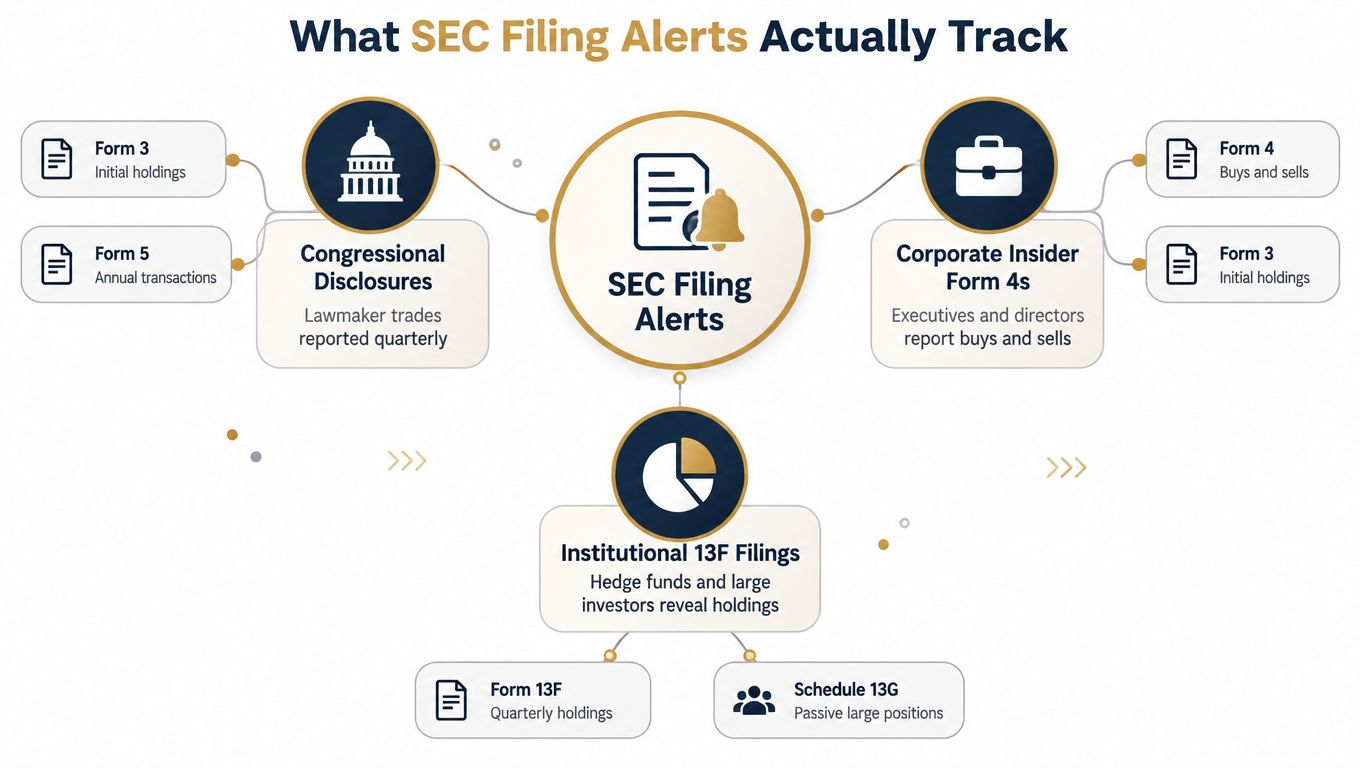
At a basic level, SEC filing alerts track three different lanes of public disclosure. Congressional trade reports show what covered officials disclosed. Form 4s show corporate insider transactions. Institutional filings, including 13F-style holdings snapshots, show what large holders reported after the fact.
Each lane lives in a different place. Corporate filings flow through EDGAR, which the SEC describes as a continuously updated public disclosure system with free access to millions of filings, including ownership Forms 3, 4, and 5, and with latest-filings and daily index views that organize submissions as they arrive SEC EDGAR browse page. Congressional records sit on official House and Senate disclosure systems. Institutional filings sit in the public reporting stack that big holders use to reveal positions.
Read the timestamps, not just the headline
Every alert should answer four questions. When did the trade happen? When was the filing due? When did the SEC receive it? When did your system send the alert?
That's the difference between a live stream and security-camera footage. The filing may be public, but it isn't always current. A clean alert should preserve execution date, statutory due date, SEC receipt time, and alert-distribution time so you can tell whether you're looking at fresh action or delayed disclosure.
A single timestamp hides too much.
If you see only one date, you're likely to misread the signal. A Form 4, for example, can look urgent when it reports an event that already happened earlier. Congressional reports can be even older by the time they hit the screen. That's why the source matters as much as the notification.
How Fast Different Filings Really Arrive
A filing can be public and still not be current. The useful question is simple: was the trade old enough to matter when you saw it, or is it fresh enough to guide a decision?
Corporate insiders have a tighter clock than politicians. Under Section 16, a director, officer, or more-than-10% owner generally must report a transaction that changes beneficial ownership on Form 4 by the end of the second business day after execution SEC Form 4. The form identifies the issuer, the insider, the trade date, the securities bought or sold, the transaction code, the share count, the price, and the post-transaction ownership. That is what makes it useful for reading behavior, but not the same as seeing the trade happen live.
Congressional disclosures move slower. Covered officials report qualifying securities transactions over $1,000 through a Periodic Transaction Report, which covers purchases, sales, and exchanges involving stocks, bonds, commodity futures, and other securities by the filer, spouse, or dependent child. The PTR is due within 30 days after notice, and no later than 45 days after the transaction itself House STOCK Act guidance.
| Filing type | Max delay | Detail shown |
|---|---|---|
| Form 4 | Typically two business days after execution | Issuer, insider, transaction date, shares, price, ownership |
| Congressional PTR | Up to 45 days after the transaction | Reported transaction with ranges and delayed public visibility |
The point is not to rank one filing as “good” and the other as “bad.” It is to read the age of the disclosure before you read the signal. A congressional trade may be historical evidence by the time it surfaces. A Form 4 can also be stale enough that the stock has already moved.
If you cannot tell whether a filing is stale, you cannot judge whether it is actionable.
A Friday trade reported on Form 4 before Monday's open is a good example. The filing may arrive fast by rule, but the market still had time to digest the move before your alert hit. That turns the alert into research on what an insider did, not a clean chance to front-run the trade.
How to Read Insider Buys and Sells Like a Pro
A Form 4 alert only becomes useful when you stop reading the word sale as if it means one thing. It doesn't. The economic meaning depends on the transaction code, the footnotes, the insider's role, and whether the trade stands alone or shows up in a cluster.
Start with the transaction code and footnotes
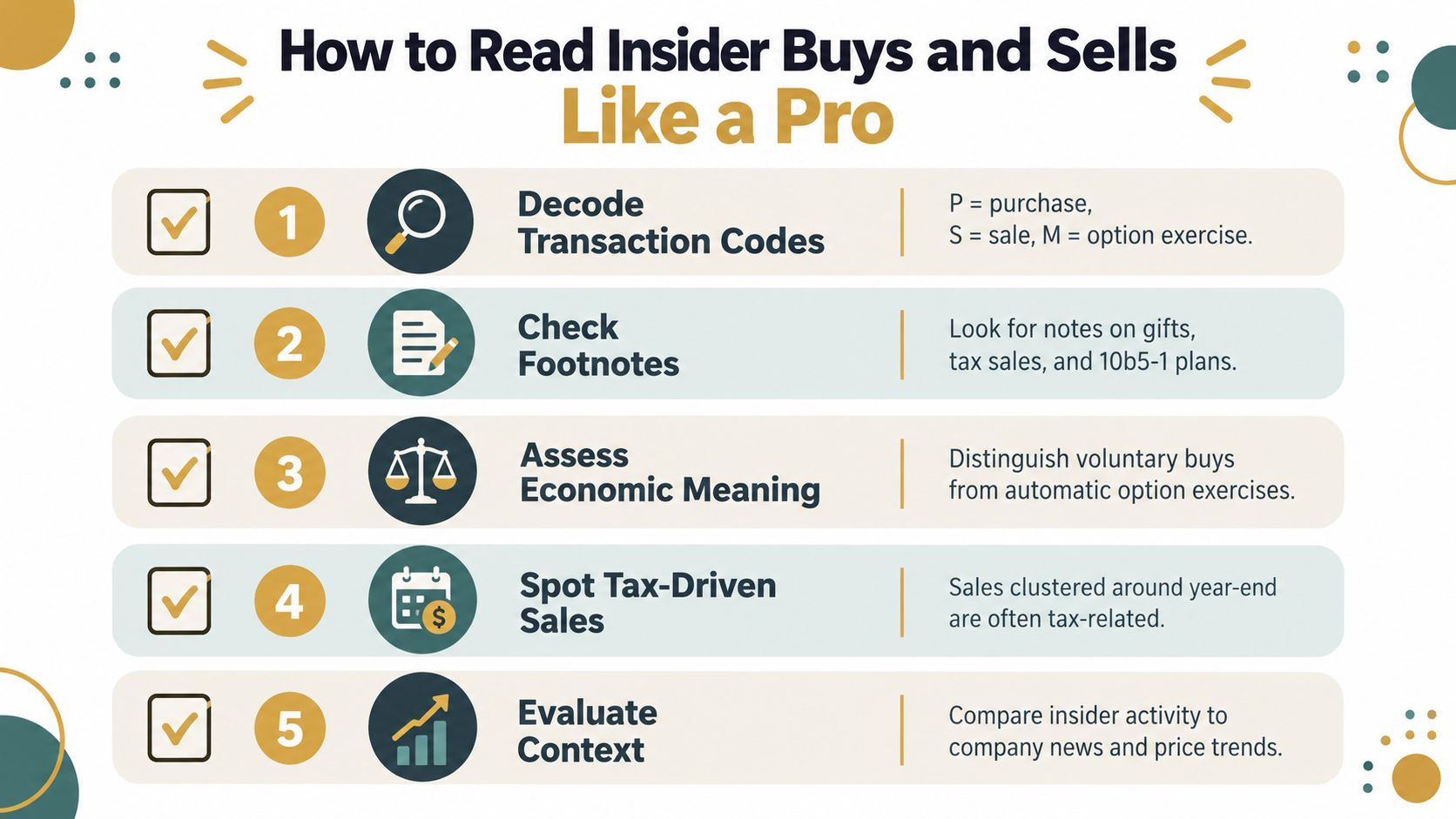
The code tells you the basic shape of the trade. A purchase is not the same as a sale. An option exercise is not the same as a discretionary exit. The footnotes can tell you whether the trade was tied to a gift, a tax event, a derivative exercise, or a 10b5-1 plan, which is one of the reasons naked alerts are so noisy.
The SEC filing structure matters here because Forms 3, 4, and 5 each capture ownership changes and transaction circumstances differently. If you only look at the alert headline, you miss the filing's actual mechanics. That's how traders end up overreacting to routine compensation activity.
Then ask who traded and how much
An insider's role matters. A CEO buying shares carries a different message than a lower-level executive following routine compensation. Size matters too, but only relative to holdings and history. A small trade by itself can be meaningless, while repeated activity across multiple insiders can be more informative than a single eye-catching print.
A useful filter looks like this:
- Who filed: CEO, CFO, director, or another covered insider.
- What happened: buy, sell, option exercise, gift, or tax-related move.
- Why it might matter: discretionary action versus automatic or routine mechanics.
- Whether others joined in: clustered buying or selling often deserves more attention than a one-off report.
- Whether the footnote explains the trade: if the note says it was mechanical, treat it differently.
One large study cited in the Columbia Law School blue sky analysis found that discretionary sales by top executives were associated with an average 1.31% decline at announcement Columbia Law School analysis. That's not a forecast. It's context. A historical pattern is not a promise.
The signal is rarely “insider sold.” The signal is “which insider, under what mechanism, at what scale, and with what explanation?”
That's the right standard. It keeps you from treating option exercises, tax sales, and gifts like they're the same as a discretionary open-market sale. It also keeps you from turning one filing into a story it can't support.
How Policy Signals and Whale Moves Fit Together
Policy moves stocks differently from insider trades. A bill can matter because of its legal status, not because somebody on Capitol Hill traded around it. A whale filing can matter because it shows where a big holder stands, not because it proves a policy thesis. Keep those lanes separate and the signal gets clearer.
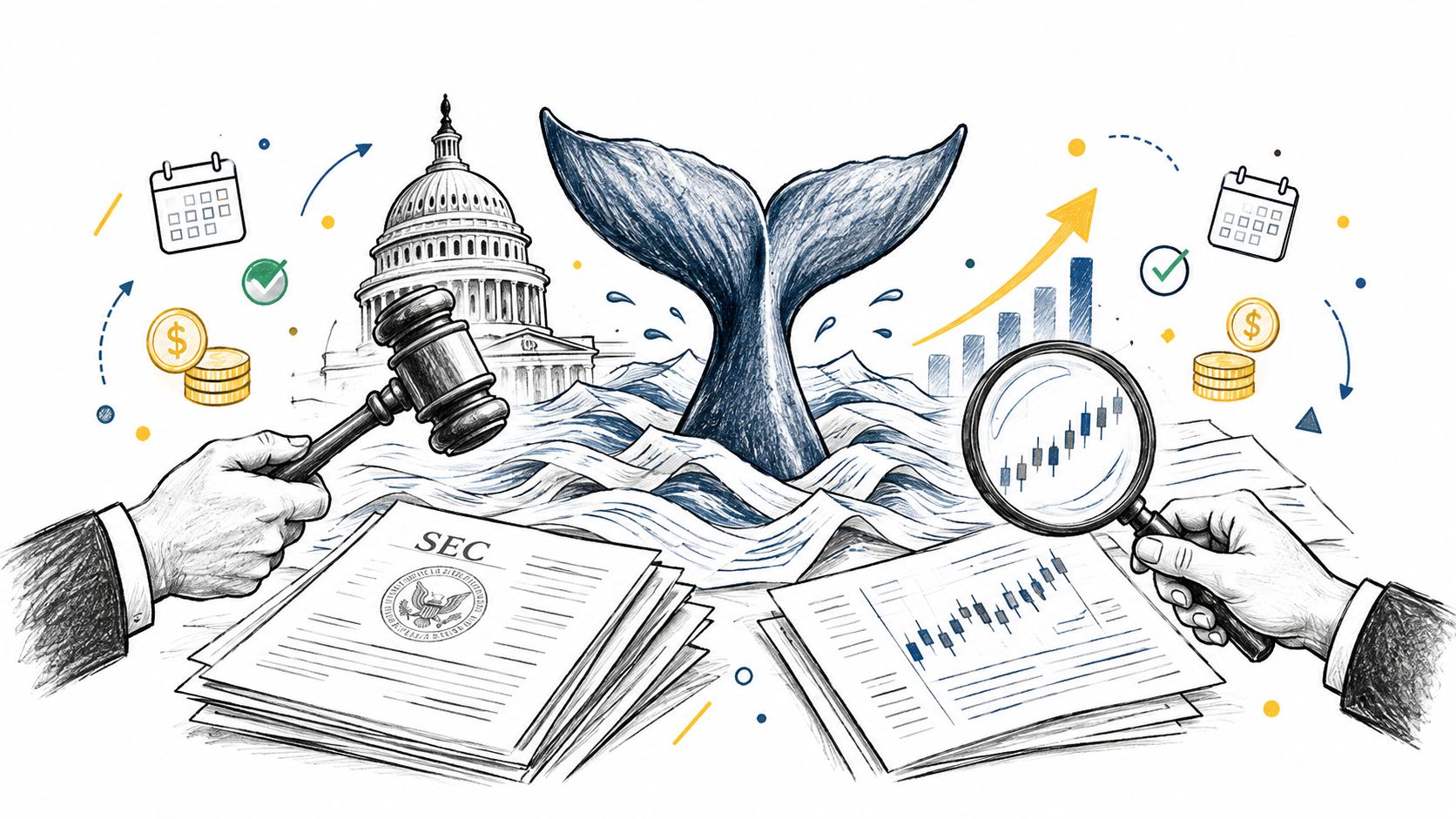
Policy can move sectors without proving causation
Congress's official bill system tracks the status of legislation, including referral to committees, hearings, amendments, and passage. That matters because a proposal is not the same as an enacted law Congress bill status. A policy action can change expected revenues, compliance costs, subsidies, taxes, procurement, or permitted products, and the same event can help one industry while pressuring another.
That means the smart read is sector-level, not headline-level. If a rule affects reimbursement, one set of companies may benefit while another loses. If an agency action changes the compliance burden, the exposure can sit in the supply chain, not the obvious ticker everyone's talking about.
Whale snapshots help, but they don't confirm the story
Institutional filings show where large holders reported exposure after the fact. That can help you test a policy thesis, but it doesn't prove intent. A position can reflect hedging, rebalancing, or plain old benchmark management. Same with a politician's trade. The trade and the policy event are separate observations.
The clean way to use this is to map policy action, legal status, and likely affected sectors first. Then look at whether any insider or large-holder activity lines up with that map. If it does, you've got an added clue. If it doesn't, that's still useful because it keeps you from forcing a narrative.
Setting Up High Signal Alerts Without the Noise
Good alerting is mostly subtraction. You do not want everything. You want the right filer, the right filing type, the right context, and the right delivery speed. Skip the filters and you get a pile of noise with very little edge.
Build the filters around the filer, not the ticker
Start with role. Corporate insider alerts should prioritize directors, CEOs, and CFOs before everyone else. Congressional alerts work better when you group them by chamber, committee exposure, or issue area. On the institutional side, large-holder snapshots matter more when you already know which names belong on your watchlist.
Then add transaction filters. A clean setup often focuses on open-market buys and sells, not every mechanical action. That keeps option exercises, routine grants, and low-signal disclosures from burying the moves that deserve attention.
Handle latency like a trader, not a newsletter reader
The SEC says its submissions API updates in real time as filings are disseminated, with typical processing delay of less than one second, and its XBRL APIs generally update in under a minute SEC API guidance. The same guidance also says automated searches should stay at no more than 10 requests per second across machines, so bounded concurrency and backoff are part of the job, not optional extras SEC API guidance.
Use accession number and CIK for deduplication. Store acceptance timestamp, filing date, source URL, parser version, and ingestion latency so you can separate SEC delay from your own delay. Amendments deserve their own status, because a correction can supersede the first version instead of adding a fresh trade signal.
That gives you four timestamps to compare, the trade date, the filing date, the acceptance time, and the alert time. The gap between them is the whole point. If the filing arrived quickly but the trade happened days earlier, the alert is evidence, not a live signal. If the filing is an amendment or a disclosure with routine mechanics, treat it as research first and possible action only after you read the underlying document.
Test before you trust
The cleanest way to sanity-check alerts is with a watchlist, a paper journal, and a habit of writing down what the filing said before you form an opinion. An alert that cannot survive a quick paper-trading review was never high signal.
If you want a single place to manage that workflow, TradeLikeInsiders blog brings together congressional trades, insider activity, whale moves, and policy signals in one place. Use it as a research layer while you still read the source filings yourself.
Using Filing Alerts Responsibly From Here
The cleanest takeaway is also the most annoying one. Faster alerts don't always mean fresher information. Repeated discretionary activity matters more than one flashy filing. Policy and holdings need separate evidence. Once you accept that, the noise drops fast.
A short checklist for better judgment
- Check the timestamp gap: compare execution date, filing date, and alert time before you react.
- Read the footnotes first: the explanation often matters more than the headline.
- Look for repetition: one filing is weaker than a pattern across insiders or across time.
- Separate policy from position: a bill, a rule, and a trade are not the same thing.
- Use alerts as research: treat the filing as a prompt to investigate, not a command to trade.
That's also why delayed congressional reports still matter. They're historical evidence of activity, not proof of current holdings or current intent. The same logic applies to insider trades and institutional snapshots, just with different time windows and different levels of detail.
If you want to keep building a cleaner workflow, start with primary sources and test your process in simulation before you trust it with real money. A structured platform like TradeLikeInsiders can help you organize that research, but the discipline has to come from you, not the alert.
This content is for informational purposes only and is not financial advice. Do your own research.
HeliosNet LLC provides market research and alerting around congressional trades, SEC insider filings, whale activity, and policy signals in one place. If you want to explore a workflow built around those disclosures, visit TradeLikeInsiders.