
The SEC Form 4 filing deadline is before the end of the second business day after execution, not two calendar days and not the settlement date. That's the part most quick explainers get wrong, and it's why plenty of filings that look late on your phone calendar are on time.
Stop counting 48 hours. The public trades on news. Insiders file on a business-day clock, with weekends, federal holidays, time zones, and an Eastern Time cutoff sitting between the trade and what you see on EDGAR. If you don't count it right, you'll mislabel fresh signals as stale and stale signals as fresh.
Table of Contents
- The Two-Business-Day Form 4 Deadline on a Real Calendar
- Time Zones and the EDGAR Cutoff
- Who Must File and Which Trades Count
- What a Late Form 4 Actually Costs
- Form 4 Versus Congress and 13F Lags
- Check the Dates Before You React
The Two-Business-Day Form 4 Deadline on a Real Calendar
The rule is short, but you need to read every word of it. A Form 4 reporting a change in beneficial ownership, meaning a change in who benefits from owning the shares, must be received before the end of the second business day after the transaction is executed. The SEC's official Form 4 instructions state that a report covering a transaction that changes beneficial ownership must be filed before the end of that second business day, rather than within a fixed number of calendar hours. Received is the key word. Drafted doesn't count. Sent to an assistant doesn't count. Handed to a filing agent doesn't count.
I would start here every time: execution starts the clock. Execution means the trade goes through. It doesn't mean the insider decided to trade over coffee, called a broker, signed an internal form, or watched cash settle into an account. If those events happen on different days, only one of them matters for the deadline, and it's the execution date.
Count Business Days Not Calendar Days
A business day skips weekends and federal holidays. You count forward from the execution date, not counting the execution day itself, and you stop at the end of the second day that qualifies.
Say a director buys shares on Monday. Tuesday is business day one, Wednesday is business day two, and the form is due by the end of Wednesday. No hourly math, no settlement math, no allowance because the insider was traveling or the broker sent paperwork slowly.
The SEC rule at 17 CFR 240.16a-3 puts the due point before the end of the second business day after the transaction is executed for most Section 16 insiders, not merely after the trade is economically settled. That one sentence kills the most common shortcut I see retail traders use, which is counting from settlement. Settlement is plumbing. Execution is the legal event.
For a normal week with no federal holiday, the calendar looks predictable. Use this table as your default before you call anything late.
Form 4 due dates from common execution days
| Execution day | Due by the end of | Business days that count |
|---|---|---|
| Monday, no holiday | Wednesday | Tuesday and Wednesday |
| Tuesday, no holiday | Thursday | Wednesday and Thursday |
| Wednesday, no holiday | Friday | Thursday and Friday |
| Thursday, no holiday | The following Monday | Friday and the following Monday |
| Friday, Monday is a business day | Tuesday | Monday and Tuesday |
| Wednesday when Thursday is Thanksgiving | The following Monday | Friday, then Monday |
| Friday when the next Monday is a federal holiday | Wednesday | Tuesday and Wednesday |
Look at the Thursday and Friday rows closely. A Thursday trade gives you Friday as day one, then the weekend doesn't count, then Monday becomes day two. A Friday trade pushes the whole count into the next week, with Monday as day one and Tuesday as day two. If you're scrolling filings on a Sunday and don't see a Friday trade yet, you haven't found a scandal. You've found a weekend.
Practical rule: Mark execution day as day zero, skip Saturday, Sunday, and federal holidays, then land on the second counted business day.
The Two Holiday Skips That Trip People Up
Holidays don't pause the clock in some vague way. They never enter the count.
Take a Wednesday trade when Thursday is Thanksgiving. Thursday is a federal holiday, so it gets skipped. Friday is business day one, even though lots of offices feel half empty and markets run a short session. Monday is business day two. The form is due Monday, not Friday, and not Tuesday just because the week felt broken up.
Now flip it. An insider trades on Friday and the following Monday is a federal holiday. Monday doesn't count. Tuesday becomes business day one and Wednesday becomes business day two. The form is due Wednesday. A trader using plain calendar math would call a Wednesday filing late. Under the actual SEC Form 4 filing deadline, it can be right on time.
That's the contrarian point worth internalizing. A filing date that looks early or late means nothing until you rebuild the count. Two forms can show the same gap between transaction date and filing date, and one can be timely while the other isn't, purely because a holiday sat in the middle of one count.
Which Transactions Run on This Clock
The fast clock isn't limited to open market buys and sells, the trades commonly pictured. It also covers specified transactions that sit in other covered categories, including bona fide gift dispositions and exercises or conversions of derivative securities. A derivative security is an instrument whose value comes from another security, like an option that turns into shares. When that exercise or conversion happens, the same second business day logic applies to the covered report.
Don't read that as meaning every line on every form carries the same information. A gift, an option exercise, and an open market purchase can share a deadline while telling you very different things about intent. The clock tells you when the public should see it. The transaction details tell you what happened. Confusing those two jobs is how people overreact to routine filings.
- Execution date: The day the trade, gift, exercise, or conversion happens. This starts the count.
- Transmission time: When someone sends the filing toward EDGAR, the SEC's electronic filing system.
- EDGAR acceptance: When the SEC system receives and accepts it. This is what decides timeliness.
Keep those three separate in your notes. If you only track the date a news site or social account flagged the filing, you're adding another delay on top of the legal one and calling it signal freshness. It isn't.
What Doesn't Start the Clock
Three timestamps routinely fool readers. The day an insider instructs a broker isn't the execution date, because an instruction can sit unfilled or fill later. The day a confirmation email lands in an inbox isn't the execution date either, since confirmations are records of something that already happened. And the day cash settles is just the back office finishing the exchange of money and shares.
There's one more trap. A form can look a calendar day late on a phone set to another time zone and still be timely. Your phone might display an acceptance timestamp converted to your local time, which can roll the date forward or backward. Always translate the receipt back to the official filing record before you judge it.
Treat the weekday table as the default. Then treat time zones, cutoffs, and special transaction types as exceptions that can shift the result around the edges. They don't soften the deadline. They just change the correct due date.
Time Zones and the EDGAR Cutoff
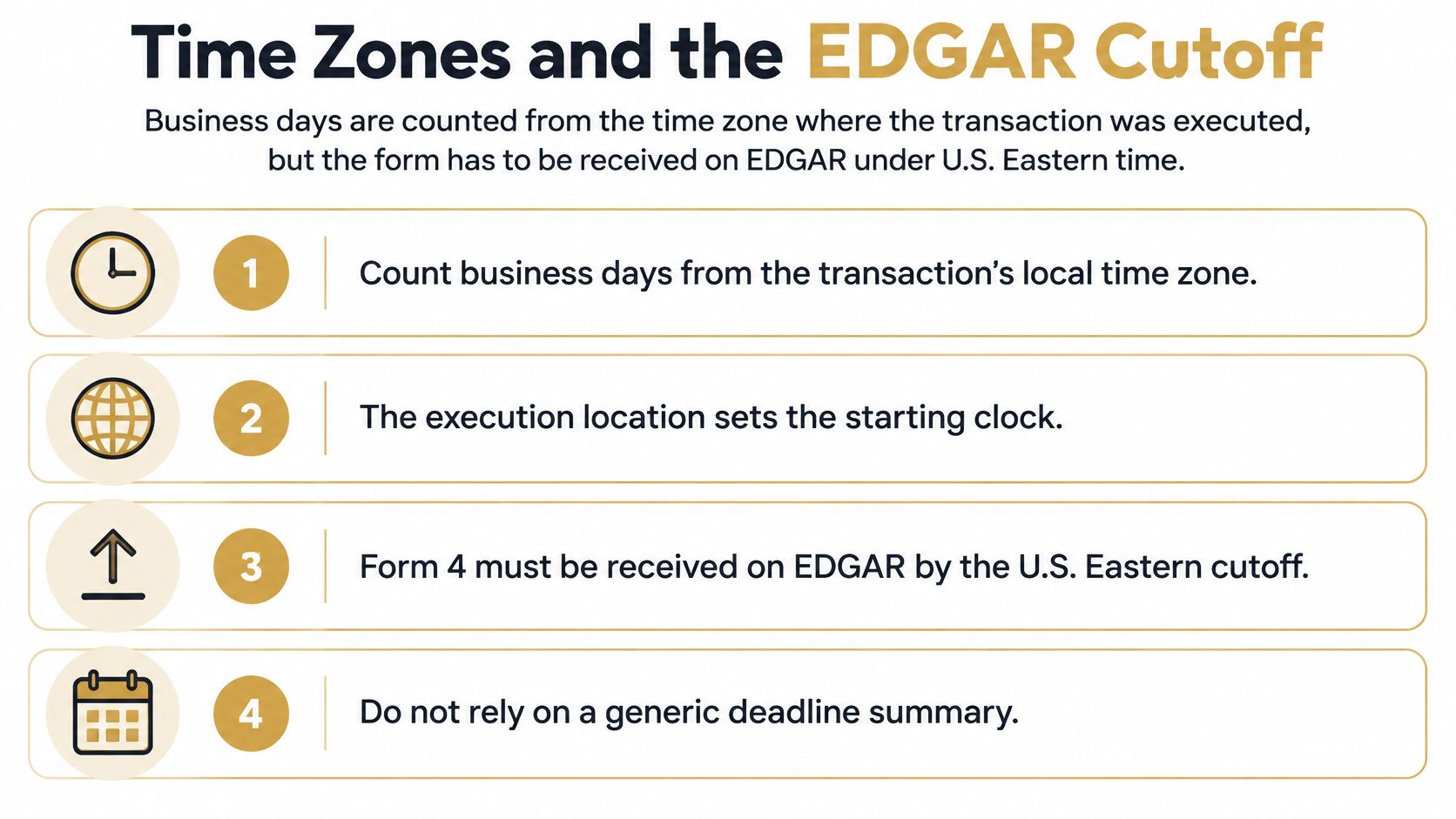
Most deadline summaries stop at counting days. That leaves out the mismatch that breaks the whole calculation for cross border trades. Business days are counted from the time zone where the transaction was executed, but the form has to be received on EDGAR under a U.S. Eastern clock. The SEC's Form 4 data guidance clarifies that the deadline is calculated from the time zone where the transaction was executed, but the filing must meet the applicable EDGAR cutoff in U.S. Eastern Time.
Those are two different clocks doing two different jobs. The execution location sets your starting date. Eastern Time decides whether your filing landed on the due date or rolled into the next business day.
One London Friday Shows the Problem
Say an executive sells shares while in London on a Friday afternoon local time. If it's still Friday in London, Friday is the execution date, even though New York is earlier in its day. You count the second business day forward from that Friday execution. So far, simple.
Now the filing gets transmitted near the deadline. For electronic EDGAR submissions, a filing received by 10:00 p.m. Eastern Time is deemed filed that business day. One pushed at 10:05 p.m. Eastern is treated as received on the next business day. Five minutes moves the legal receipt date, and that next day receipt can make the form late even if someone abroad believed they sent it on the local due date.
Reverse the mistake and you get the other error. A filing can look late to a reader converting dates casually, while the execution time zone and business day count make it timely. Your local calendar display isn't the rule. Receipt is.
A filing is made when the SEC receives it, not when an assistant finishes the draft.
Holidays add one more wrinkle. A foreign market holiday doesn't extend the U.S. deadline. And a U.S. federal holiday doesn't become a business day just because another market somewhere was open. You count U.S. business days forward from the execution date set by the local time zone, then you hold the filing to the Eastern receipt cutoff.
The Four Part Check Before You Say Late
Don't label a form late from the transaction date and filing date alone. I would run this check first.
- Execution location: Where the transaction was executed, since that time zone sets the starting date.
- Execution timestamp: The exact local date of execution, not authorization, settlement, or confirmation.
- Business day due date: The second qualifying day after execution, skipping weekends and U.S. federal holidays.
- Eastern Time receipt: Whether EDGAR received the form by the cutoff on that due date.
Skip any one of those and you're guessing. The whole edge in reading these filings is knowing whether you're looking at a genuine delay, a cutoff miss, or a trade that was never due as early as you assumed.
Who Must File and Which Trades Count
A reporting person under Section 16, the part of the securities law covering corporate insiders, is simpler than the legal phrase sounds. It's a director of the company, an executive officer who helps set policy, or a person or group that beneficially owns more than 10% of a registered class of the company's equity securities. If someone doesn't fall into one of those groups, don't expect a Form 4 just because they work at the company or own some shares.
The fast Form 4 window covers non-exempt purchases and sales, specified transactions that are exempt from short-swing profit recovery but still reportable, bona fide gifts, and exercises or conversions of derivative securities. That's a wide net by design. The point is a public record of ownership changes, not just the most dramatic trades.
Read the Code Before You Read Into It
The transaction code is one letter with a specific meaning, and the footnotes carry the context. Treating every form as a conviction buy or sell is the fastest way to misread the data.
- Code P: Often an open market purchase, meaning the insider bought shares in the market.
- Code S: Often an open market sale.
- Code F: Often shares withheld or disposed of to cover taxes when equity vests.
- Code M: Often an option exercise, turning a derivative into underlying shares.
Those are different facts, not different shades of the same signal. A tax withholding disposition can happen automatically at vesting. An option exercise can reflect an award granted long ago. Even a sale footnote matters. If a footnote mentions a Rule 10b5-1 plan, the trade was scheduled under a preset plan. It wasn't necessarily a reaction to this week's headline.
Don't rank any code as a buy or sell recommendation. The code tells you the mechanics. You still need the size, the price, the remaining holdings, and the footnote before the filing means much at all.
Form 4 Is Not the Only Insider Form
Readers blend three forms together, and only one runs on the two day clock. Form 3 is the starting statement, generally due within 10 days of becoming a reporting person. Form 5 is the annual cleanup form, generally due within 45 days after the issuer's fiscal year end for certain small or deferred items and some missed earlier reports.
The reason Form 4 moves faster goes back to a legal change. The SEC's final rule release on ownership reporting records that the two business day requirement became effective August 29, 2002, after Sarbanes-Oxley Section 403 replaced the old system. Before that reform, insiders generally reported within 10 days after the end of the month in which the transaction occurred. The reform compressed a reporting lag that could run for weeks into roughly two business days, which is why modern Form 4 data is useful close to the trade date at all.
What a Late Form 4 Actually Costs
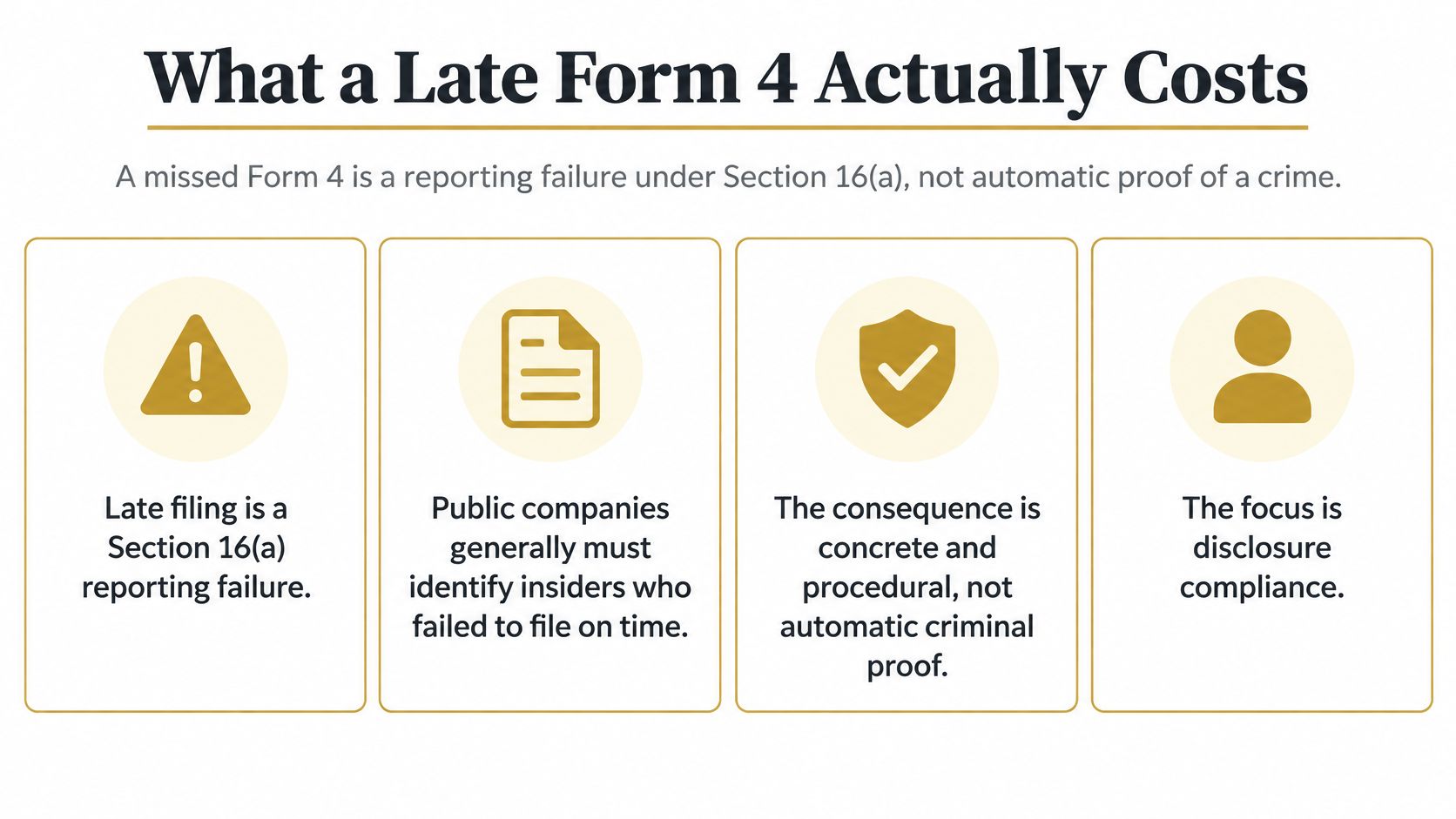
A late Form 4 is a compliance failure. It isn't automatic proof of a crime, and treating it that way will wreck your judgment.
Three ideas get blended together constantly. Filing late means the form missed its receipt deadline under Section 16(a), the reporting provision. Trading on material nonpublic information, meaning trading on important secret information, is a separate legal problem, and a date stamp alone doesn't establish it. Section 16(b) short-swing recovery is something else again. It can force an insider to give back profits on matching purchases and sales inside six months even when no secret information was used, because that rule targets the round trip itself.
The Concrete Consequence Is Disclosure
Public companies generally must identify insiders who failed to file on time in the annual proxy statement under Item 405 of Regulation S-K, the SEC rule covering that disclosure. The proxy is the document companies send shareholders before annual meetings. So a late filing can become a named, lasting entry in a governance document that institutional investors, boards, and lawyers read.
That's a real reputation cost and a diligence flag. A pattern looks worse than a one off, because repeated misses suggest weak internal controls around trade notification and filing preparation.
The SEC can investigate reporting failures and seek penalties. But there isn't a public menu of automatic fines that lets you say one late form costs a specific dollar amount, so don't trust anyone who quotes one. What you can verify is the late receipt, the proxy disclosure obligation, and whether the pattern repeats across insiders at the same issuer.
Plain truth: A late form proves the report was late. It doesn't prove why the trade happened.
For your research, a late form carries a simpler cost. It's stale before you can act on it even as information. The form still describes an old transaction. It doesn't mean the insider still holds the shares today, it doesn't mean the original reasoning still holds, and it definitely doesn't mean the price will move when the form appears on EDGAR.
Sort by transaction date first and filing date second. Then ask whether you're looking at news or a delayed record. Most of the time, a very late print is a record. Price and volume since the execution date will usually tell you the market has already had its say.
Form 4 Versus Congress and 13F Lags
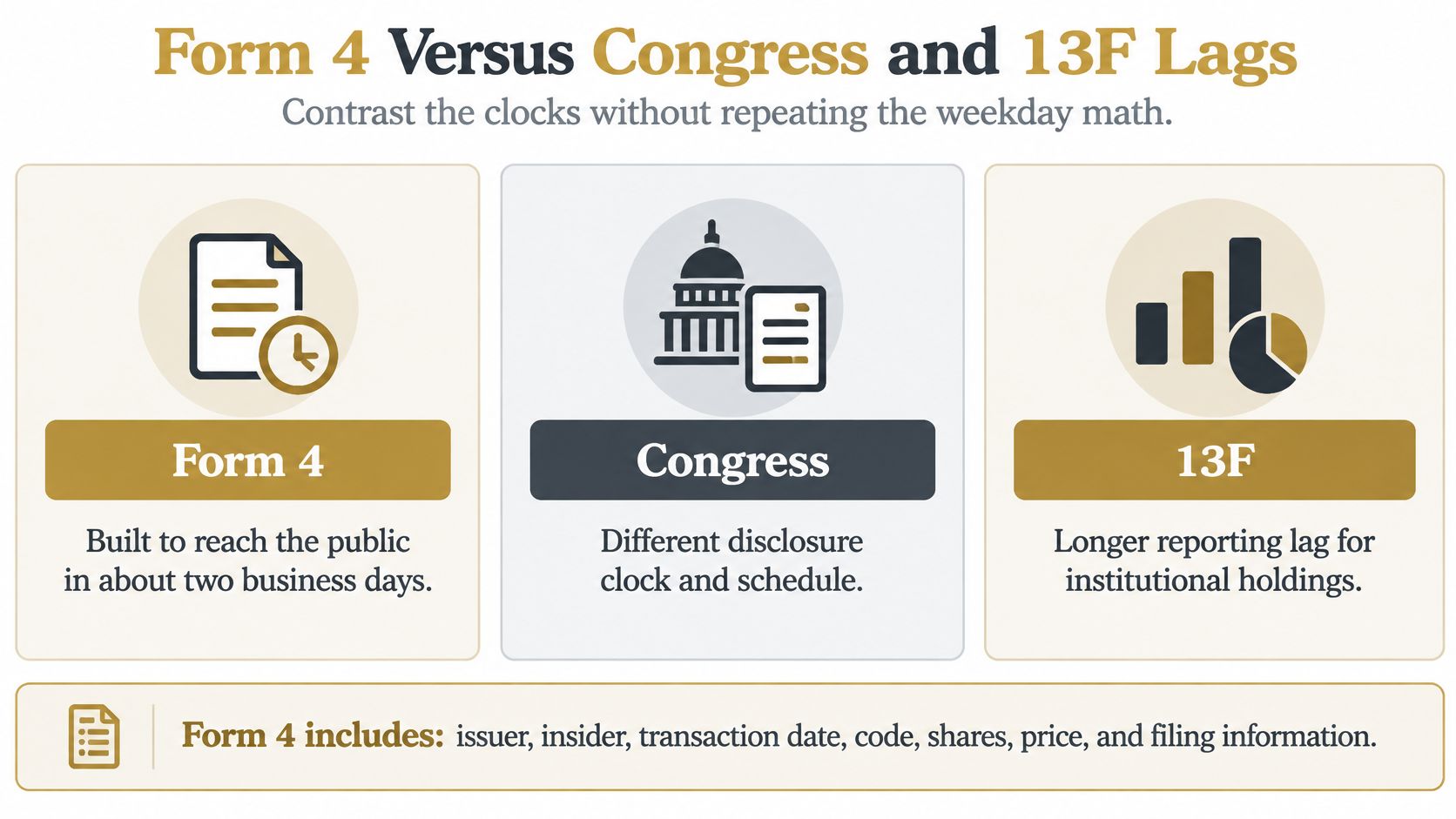
Put the three disclosures side by side and the SEC Form 4 filing deadline looks almost fast. The other records retail traders watch run on clocks measured in weeks or months.
A congressional filing under the STOCK Act, the law covering lawmaker trade disclosures, is called a Periodic Transaction Report, or PTR. The Senate Ethics Committee financial disclosure guidance applies the framework where a PTR for a covered transaction of more than $1,000 is due by the earlier of 30 days after the filer receives written notice or 45 days after the transaction date, and House filings use the same basic timing. Amounts are reported in ranges, not exact figures. By the time you read one, the trade can be several weeks old and the position can already be closed.
How long common ownership signals take to go public
| Signal | Typical public lag | What it establishes |
|---|---|---|
| SEC Form 4 | About two business days after execution | One insider transaction, with code, size, price, and post-trade holdings |
| STOCK Act periodic transaction report | Earlier of 30 days after written notice or 45 days after the trade | A covered congressional transaction over $1,000, with amounts in ranges |
| SEC Form 13F | Within 45 days after quarter-end | Quarterly institutional holdings, not each buy or sell |
A Form 13F is different in kind, not just slower. Large institutional managers, the whales, report holdings as of quarter end. The filing shows what they held on one snapshot date. It doesn't show when during the quarter they bought, what they sold and rebought, or whether they exited the day after the quarter closed. It's a footprint, not a tape of trades.
Form 4, by contrast, names the issuer, the insider, the transaction date, the code, the shares, the price, and holdings after the trade. That's ticket level detail on a two business day clock, which is exactly why traders watch it more closely.
Still, keep the hierarchy straight. The public trades on news, while an insider report describes one transaction, not future performance. A fast record is still a record of the past.
We surface congressional and insider disclosures together precisely because the clocks differ, and those disclosures on TradeLikeInsiders are delayed and are not real-time trades. Label each one timely, delayed, or late from its execution date and receipt date. Mixing a two day insider print with a 45 day congressional report as if they're equally fresh is a research error, whatever platform you use.
Check the Dates Before You React
Before you spend an hour on a Form 4, spend two minutes on its dates. Confirm the execution date, work out the due date under the second business day rule with weekends and federal holidays removed, then check the EDGAR receipt date.
The EDGAR filing index for each Form 4 shows the filing date and acceptance time. That's your receipt timestamp. If receipt landed after the due date, mark it late and treat the surprise as already stale. The market's had days to trade since execution.
If It Is on Time Then Read It Properly
If receipt sits inside the window, the filing earns a closer read. I would check the transaction code first, then the footnotes, then the share count against holdings after the trade. A small purchase by someone holding a huge position reads differently from a purchase that materially changes what they own. Neither one is a promise of returns.
Then decide whether a congressional report or a 13F belongs in the same story at all. Their clocks run to 30 days, 45 days, or quarter end plus 45 days. A whale snapshot and a lawmaker report can support the same theme, but they can't confirm a two day old insider trade was copied or coordinated.
Don't buy or sell a security because a form appeared. Use the four part time zone check when anything looks off, keep execution and receipt dates in your own notes, and let the timestamps discipline your reaction time.
TradeLikeInsiders surfaces STOCK Act congressional disclosures, SEC Form 4 insider filings and on-chain whale flow in one place with source timestamps. Those records stay delayed disclosures, which is exactly why the date check matters before any interpretation.
This content is for informational purposes only and is not financial advice. Do your own research.
If you track insider, congressional, and whale activity together, HeliosNet LLC through TradeLikeInsiders brings delayed STOCK Act disclosures, SEC Form 4 filings with their execution and receipt timestamps, whale moves, and policy signals into one research view so you can apply the date checks covered here without hopping across filing systems. Visit TradeLikeInsiders to sort those signals by when they happened, not just when they hit your feed.