
“Just follow insider buying” is popular advice, but it skips the hardest part: figuring out whether an insider chose to buy. A share award, an option exercise, and a cash purchase can all increase reported holdings without expressing the same conviction.
The useful edge in reading SEC Form 4 instructions isn't spotting a green buy label. It's separating the transaction from the compensation mechanics, checking when the information became public, and deciding whether a correction changes the story. A filing tells you what someone reported, not what will happen to the stock.
Table of Contents
- Form 4 Transaction Codes at a Glance
- How to Pull a Form 4 from SEC EDGAR
- How to Read Every Field on the Form
- Dates, Deadlines and Late Filings
- Amendments and Footnotes That Change the Signal
- Congressional Filings Run on a Slower Clock
- Turn Each Filing Into a Checklist Before You Act
Form 4 Transaction Codes at a Glance
A Form 4 is the report corporate insiders file with the Securities and Exchange Commission, or SEC, after reportable changes in ownership, including buying, selling, or receiving shares. Each transaction gets its own line.
Start with the transaction code and whether securities were acquired or disposed of. The code describes the transaction's legal category. The acquisition or disposition marker tells you which direction the securities moved.
Form 4 transaction codes you will see most often
| Code | Meaning | What It Usually Signals |
|---|---|---|
| P | Open-market or private purchase | Insider paying cash for shares |
| S | Open-market or private sale | Insider selling shares they hold |
| A | Grant or award | Compensation, usually not a market decision |
| M | Exercise or conversion of a derivative | Option or RSU converted into shares |
| F | Shares withheld to pay exercise price or taxes | Payment mechanics, not an open-market sale |
| G | Bona fide gift | Transfer with no payment |
| D | Disposition to the issuer | Shares returned to the company |
| J | Other transaction, explained in footnote | Read the footnote before classifying |
| K | Equity swap or similar instrument | Always paired with a primary code such as S/K or P/K |
A derivative is a security whose value or delivery depends on another security, such as an option to acquire company stock. An RSU, or restricted stock unit, is an award that can settle into shares subject to its terms.
Separate decisions from mechanics
P and S are the transactions people usually mean by insider buying and selling. Codes A, M, and F commonly describe compensation-related activity, so treating every acquisition as bullish or every disposition as bearish produces misleading conclusions.
An equity swap transfers economic exposure through a contract. Preserve the combined code instead of treating the swap modifier as an unrelated transaction.
Practical rule: Classify by code first, then read the footnote before drawing a conclusion.
Even a cash purchase doesn't disclose the buyer's entire financial situation. Use it as a reason to investigate, not a substitute for valuing the business.
How to Pull a Form 4 from SEC EDGAR
EDGAR is the SEC's public filing system. Start with the issuer, meaning the company whose securities are being reported, rather than an alert headline or an insider's name.
Use this search sequence to reach the underlying filing.
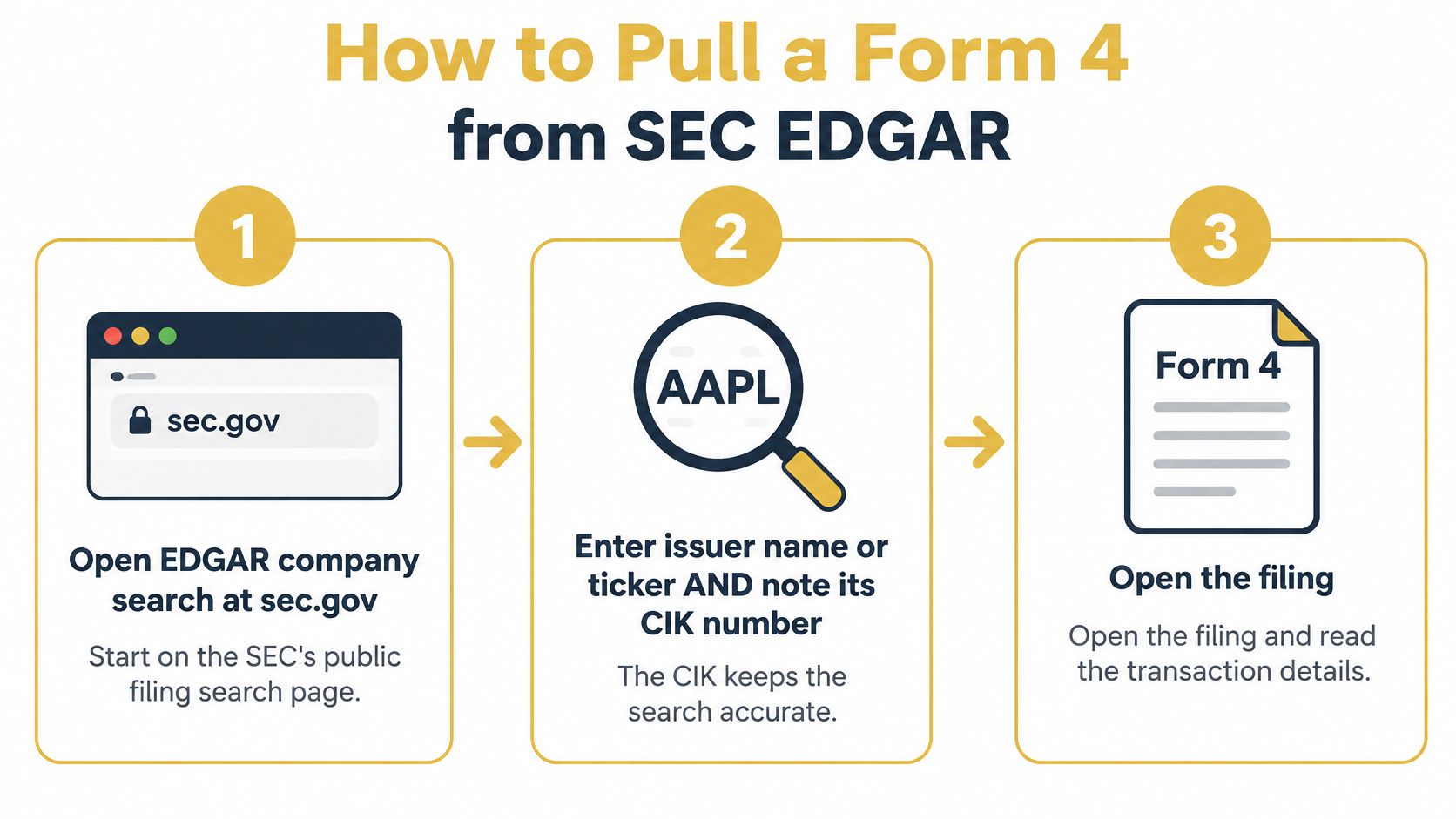
- Open the SEC website and choose its EDGAR company search.
- Enter the issuer's name or ticker. Record its CIK, or Central Index Key, the identifier that keeps your search consistent when company names change.
- Open the company's filing list and filter for Form 4. Include amended filings when reviewing the history.
- Open the filing's readable document view. The HTML rendering of the ownership XML displays the transaction tables.
- Confirm the issuer, reporting person, and relationship boxes. Check whether the person is a director, officer, or qualifying large owner.
- Record each transaction's date, code, quantity, and price. Keep separate rows separate.
- Save the accession number, the filing's unique identifier, so you can retrieve the document and connect later corrections.
Searching by insider name alone can mix activity across companies. Co-ownership and joint reporting can also create overlapping disclosures, so check the reporting persons and ownership explanation before counting apparent trades.
Verify against the official instructions
Keep the SEC's official Form 4 instructions open while reviewing unfamiliar codes. They explain transaction-level reporting, ownership disclosures, and special execution-date treatment, which is more reliable than guessing from a dashboard label.
A complete read captures role, code, shares, price, and holdings afterward. Save the original document alongside your notes, because a summary that drops the ownership vehicle or footnote can change the interpretation.
For a video walkthrough, use the embedded player alongside your own EDGAR search.
How to Read Every Field on the Form
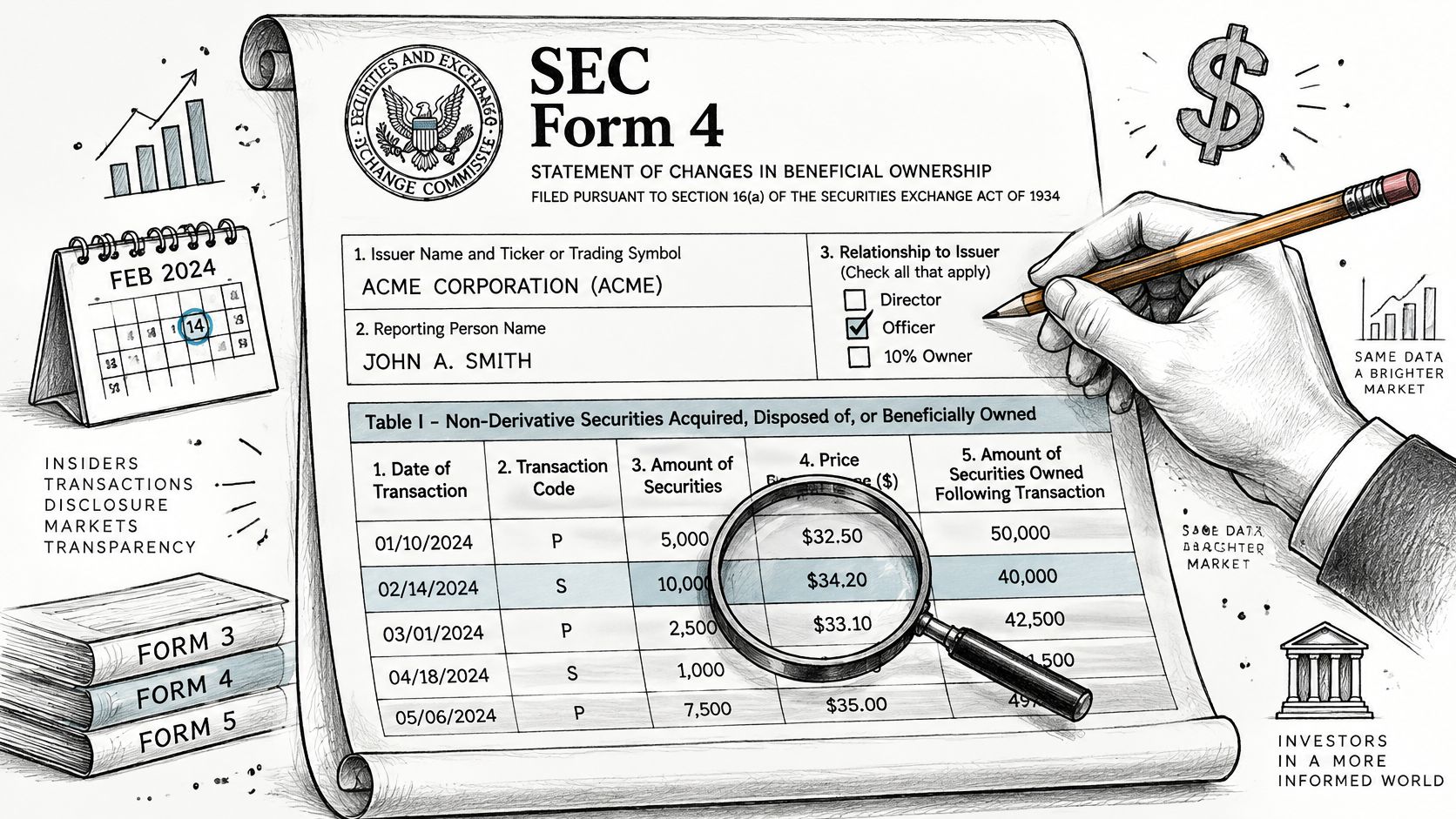
Read the header before the trade rows. Confirm the issuer, the reporting person's identity, and the relationship box, rather than assuming the person named in an alert is an executive.
Table I covers non-derivative securities, such as common stock. Table II covers derivatives, such as options and certain restricted stock units, and includes details about the underlying securities.
The SEC's Form 4 data instructions require each transaction on a separate line, use standardized transaction codes, and specify that equity swaps receive K alongside the applicable primary code. That structure lets you compare like transactions across companies without relying on headline wording.
Form 4 fields and what each tells you
| Field | What It Tells You |
|---|---|
| Reporting person and relationship | Who traded: director, officer or more-than-10% owner |
| Transaction date | When the trade was executed, not when it was filed |
| Transaction code | The transaction category, not necessarily the person's motive |
| Amount with A or D | Shares acquired or disposed of |
| Price per share | Trade price; often zero for grants and gifts |
| Shares owned after | Holdings after the trade, to check against the amount |
| Ownership D or I | Direct holding, or indirect via a trust or spouse named in a footnote |
| Footnote | Context such as a pre-arranged trading plan or an indirect vehicle |
The location of a letter matters. D beside an amount means disposed of, while D in the ownership column means direct ownership. Indirect ownership needs an explanation identifying the vehicle or relationship, such as a trust or spouse's account.
Use the document's field labels rather than reading a row as a sentence.
Reconcile the balance before interpreting the stake
Hypothetical: A director acquires 5,000 shares at a stated price and reports 42,000 shares afterward. Check that the acquisition fits the prior balance for that security and ownership category before describing the increase in stake.
Don't combine a personal account with a trust merely because the same person reports both. A mismatch is a reason to inspect the other rows and footnotes, not immediately assume an error.
Avoid these common misreads:
- Wrong clock: Treating the filing date as the trade date.
- Collapsed rows: Combining separate transactions and losing their individual codes or prices.
- Missing balance: Skipping post-transaction holdings and overstating the change in exposure.
The final test is simple: Can you say who traded, how many shares, at what price, and what they hold now? If not, the headline isn't enough.
Dates, Deadlines and Late Filings
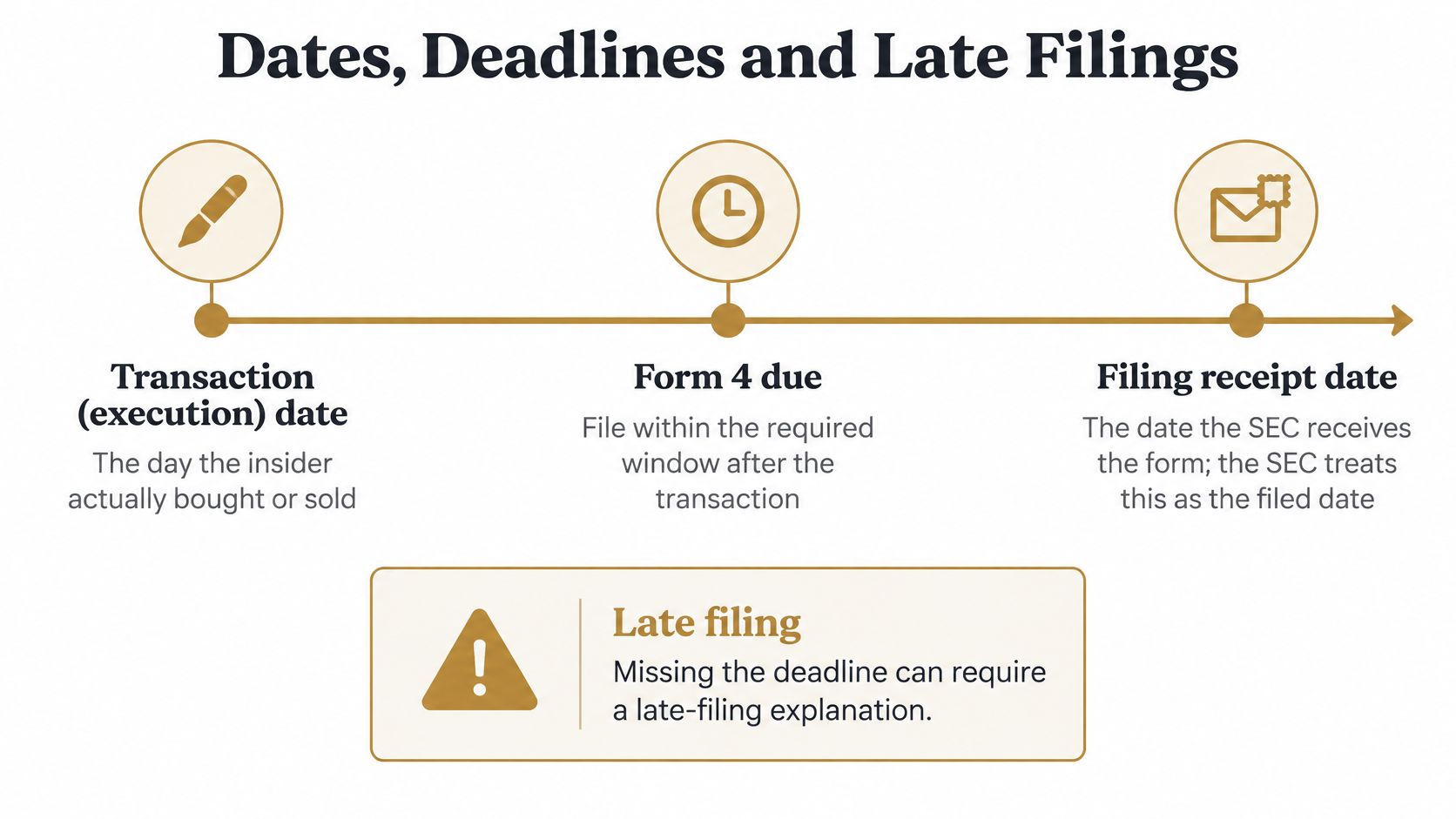
The execution date records when the transaction occurred. The filing receipt date records when the regulator received the disclosure, not when the insider made the decision.
Under Rule 16a-3, Form 4 generally must be filed before the end of the second business day after execution, and receipt determines the filed date. Weekends and applicable holidays therefore affect the window.
Work the calendar, not an elapsed-hours timer
Consider a hypothetical Thursday transaction with no intervening holiday. Friday is the next business day and Monday is the following one, making Monday the deadline; if Monday is an applicable holiday, the deadline moves to Tuesday.
For each event, establish the applicable execution date, calculate the deadline, and compare it with receipt. Record whether you're reviewing the original submission or a later amendment, rather than judging the original's timeliness from a correction's timestamp.
The timeline separates the trading event from the reporting event.
Treat lateness as a research flag
Wharton researchers identified more than 100,000 late-disclosed transactions involving over $122 billion, finding an association with significant abnormal returns and more opportunistic trading than timely disclosures, as summarized on Wharton researcher Benjamin Lynch's profile. Abnormal returns means returns measured against a benchmark, not a promise of profits available after an alert.
A late disclosure deserves closer inspection, not an automatic accusation.
Record lateness alongside transaction type, issuer status, and amendment history. That produces a useful filing-quality assessment without pretending you know why someone missed a deadline.
Check foreign-issuer coverage carefully. Foreign private issuers historically benefited from an exemption, but don't treat that historical boundary as a permanent rule or infer no trading from missing filings; verify the issuer's applicable reporting status.
Amendments and Footnotes That Change the Signal
Counting every Form 4/A, an amended Form 4, as a fresh trade can manufacture a burst of activity that never occurred. An amendment is a new document, not necessarily a new economic event.
The Wheels Up amended-filing example illustrates why explanatory footnotes and corrections require comparison with the earlier filing. The useful question isn't whether an amendment exists, but which reported facts changed.
Amendment types and whether they create a new trade
| Amendment Type | Typical Example | Log as New Trade? |
|---|---|---|
| Administrative | Fixing a typo or formatting | No, same event |
| Explanatory | Adding or moving a footnote | No, same event with added context |
| Ownership balance | Correcting shares owned after the trade | No, update holdings on the original event |
| Transaction-changing | Correcting shares, price or date of the trade | No, replace the original event |
| Mistaken form type | Filed as 4/A but should be an original Form 4 | Treat as the original filing of that event |
Preserve the event's history
- Retrieve the earlier accession and compare the documents line by line.
- Identify the changed field: quantity, price, transaction date, holdings, or footnote.
- Read the added explanation. A Rule 10b5-1 plan is a trading arrangement established in advance, which can help explain execution context without revealing every motive.
- Decide whether the correction replaces a reported fact or merely adds context.
- Link the amendment to the original event in your log instead of creating another trade.
A footnote-only addition doesn't change quantity or price when those fields remain untouched. A correction to shares owned can materially change your view of the remaining stake even when the transaction itself is unchanged.
An amendment also doesn't make an old execution newly timely. Keep the original event date and the correction history visible.
Use distinct confidence labels: reported fact, explained by footnote, and inferred intent. “The insider disposed of shares” may be reported fact; “the insider expects bad earnings” is an inference the filing may not support.
Congressional Filings Run on a Slower Clock
Form 4 versus congressional Periodic Transaction Reports
| Feature | SEC Form 4 | Congressional PTR |
|---|---|---|
| Who files | Section 16 insiders: directors, officers, more-than-10% owners | Covered House members, officers and certain employees |
| Filing deadline | End of the second business day after execution | Earlier of 30 days after notice or 45 days after the trade |
| Reporting threshold | Reportable transactions under Section 16 rules | Transactions above $1,000 |
| Amount detail | Reported share quantities and transaction prices | Amounts in ranges |
| Funds and ETFs | Not the focus of the form | Generally excluded |
| Where it appears | SEC EDGAR | Public House financial disclosure database |
The congressional thresholds and deadline in this comparison come from the House Committee on Ethics financial-disclosure guidance: covered transactions exceeding $1,000 require a Periodic Transaction Report, or PTR, by the earlier of 30 days after notice or 45 days after the trade. The STOCK Act framework makes these disclosures public, but it doesn't turn them into live execution feeds.
Spouse, dependent-child, or institution-managed activity may reach the filer through notice rather than personal execution. Amounts appear in ranges, so an exact position size can't be recovered from the transaction bracket alone.
Watch the deadline and duplication traps
The House PTR instructions specify no general extension when the deadline falls on a weekend or federal holiday. They also explain that activity reportable periodically can appear again in an annual financial disclosure.
Match the owner, asset, transaction date, and reported range before counting those appearances as separate trades. Mutual funds and ETFs are generally excluded from PTR reporting, and a missing PTR isn't a complete portfolio statement.
A congressional disclosure is delayed, range-based context, not an exact entry signal.
Members of both parties trade. Apply the same standards regardless of party, and distinguish a policy connection worth investigating from proof that legislation motivated a transaction.
Turn Each Filing Into a Checklist Before You Act
A useful filing review ends with a documented conclusion, not a bullish or bearish emoji. Run the same checks whether the alert concerns an executive, a lawmaker, or a large investor.
- Confirm identity and role. Match the issuer, reporting person, and ownership category.
- Read the transaction code and every attached footnote before assigning a direction.
- Check freshness. Compare execution with the applicable deadline and public receipt.
- Determine whether an amendment updates an existing event or represents a mistakenly labeled original.
- Identify the source. Keep congressional PTRs, corporate ownership reports, institutional Form 13F holdings disclosures, and on-chain wallet transfers in separate categories.
- Remove duplicate appearances across amendments, joint reports, and annual disclosures.
- Add market context. Check company announcements, earnings timing, and relevant legislation or agency action. Separate a proposed policy from an enacted or implemented change.
- Write down what remains unknown, including motive, hedges, and whether the position still exists.
Keep a usable research log
- Save identifiers: Keep accession numbers and document copies with your notes.
- Compare behavior: Review the same insider's history instead of treating an isolated transaction as decisive.
- Investigate clusters: Related filings warrant a closer look, not an automatic conclusion.
A whale is a large market participant. Institutional holdings and wallet movements don't establish the same facts as a corporate insider transaction, so don't flatten them into interchangeable buy signals.
TradeLikeInsiders surfaces STOCK Act congressional disclosures, SEC Form 4 insider filings, and on-chain whale flow, with policy signals available alongside them. Use aggregation to reduce manual searching while keeping the underlying disclosures central to your review.
For a consolidated starting point, visit TradeLikeInsiders to explore TradeLikeInsiders' congressional disclosures, insider filings, whale activity, and policy context, then verify an alert against its underlying document. This content is for informational purposes only and is not financial advice. Do your own research.