“Follow insider buying” sounds like a shortcut. It isn't, unless you know what the filing records. An ownership increase can come from compensation rather than a fresh investment decision, and a newly published disclosure can describe activity that happened earlier.
SEC insider trading filings are evidence to investigate, not trades to copy. The useful skill is separating an intentional change in investment exposure from an administrative ownership event, then checking whether the information is still relevant.
Table of Contents
- What Most Readers Get Wrong About SEC Insider Trading Filings
- Forms 3, 4, and 5 and the Section 16 Reporting Regime
- Anatomy of a Form 4 Filing
- Transaction Codes Explained in Plain English
- Filing Deadlines, Amendments, and Data-Quality Caveats
- Form 4 Versus STOCK Act PTRs Versus Form 13F
- Parsing a Real Form 4 Step by Step
- Why More Filings Do Not Always Mean Better Signals
- Turning Filing Mechanics Into a Practical Workflow
- Quick Reference Card for SEC Insider Trading Filings
- Frequently Asked Questions About SEC Insider Trading Filings
What Most Readers Get Wrong About SEC Insider Trading Filings
The popular mistake is treating an insider alert like a live trading tape. A headline says an executive acquired shares, and readers assume the executive bought stock with personal cash because they expect the price to rise.
But Form 4 records changes in beneficial ownership, not just discretionary purchases. Awards, exercises, tax withholding, gifts, and derivative transactions can appear alongside ordinary buying and selling. The SEC's explanation of insider ownership reports supports that distinction: an acquisition isn't automatically an investment decision.
Beneficial ownership means the ownership interest being reported, which may involve securities held directly or through another arrangement. Discretionary means the insider chose the investment action, rather than merely receiving compensation or completing a mechanical transaction.
The filter before the headline
Start with these questions:
- Who filed? Identify the reporting person and their relationship to the company.
- What happened? Read the transaction code before interpreting the share count or reported value.
- Was it discretionary? Check compensation context, plan status, related rows, and explanatory footnotes.
Consider two hypothetical filings. In one, a director purchases common shares; in another, an officer receives an equity award. Both can increase reported holdings, but only the first resembles the investment decision most readers mean by insider buying.
Even then, a purchase doesn't establish motive or predict the next price move. The filing tells you what was reported, not everything the insider believes.
Practical rule: Read an insider headline as an invitation to inspect the filing, not as the filing's conclusion.
The sharper question isn't "Did an insider acquire shares?" It's "What changed, why did it change, and what does the document support?"
Forms 3, 4, and 5 and the Section 16 Reporting Regime
SEC insider filings are a delayed, partly structured signal stream, not a live feed of trades. Section 16 of the Securities Exchange Act of 1934 sets the reporting framework for directors, officers, and shareholders who beneficially own more than 10% of a registered equity class, as described in the SEC's historical account of insider reporting. Covered insiders report through Forms 3, 4, and 5, which are publicly available in SEC EDGAR, the agency's filing database.
Forms 3, 4, and 5 at a Glance
| Form | Who files | When due | What it covers |
|---|---|---|---|
| Form 3 | A person entering the applicable insider reporting regime | Initial reporting requirement; check the applicable form instructions | Initial beneficial holdings |
| Form 4 | Covered insiders reporting most ownership changes | Generally before the end of the second business day following execution | Purchases, sales, and other reportable changes |
| Form 5 | Covered insiders with transactions requiring annual reporting | Annual reporting requirement; check the applicable form instructions | Certain transactions not previously reported |
Form 3 records the person's initial reportable holdings. Form 4 is the main report for changes in ownership, while Form 5 covers certain transactions that can be reported annually. These forms classify reporting events; they do not, by themselves, establish that a person made a discretionary investment decision.
Why modern disclosures are more useful
The Sarbanes-Oxley Act of 2002 sped up disclosure. Effective August 29, 2002, the reporting deadline shifted from the former monthly framework to the second-business-day deadline. Implementing rules took effect June 30, 2003, according to the SEC's historical account linked above.
Electronic filing and website availability changed how investors could examine reports, replacing a search through delayed paper records with accessible electronic documents. The filings are easier to retrieve, but their timing still matters: a reported transaction is not necessarily a real-time signal.
Later rule changes added context to some reports. Rules adopted December 14, 2022, took effect February 27, 2023. Amended Forms 4 and 5 apply to reports filed on or after April 1, 2023, as set out in the SEC's Form 4 instructions.
The revisions require identification of Rule 10b5-1 plan transactions and the plan's adoption date. They also moved bona fide gifts from Form 5 to Form 4. A Rule 10b5-1 plan is a prearranged trading plan. That detail helps distinguish activity scheduled under an existing plan from an open-market trade that may reflect a fresh choice, though neither the code nor the plan status alone reveals an insider's full motive.
Anatomy of a Form 4 Filing
Read a Form 4 from identity to transaction to explanation. Jumping straight to the largest share count is how readers confuse compensation, derivatives, and market activity.
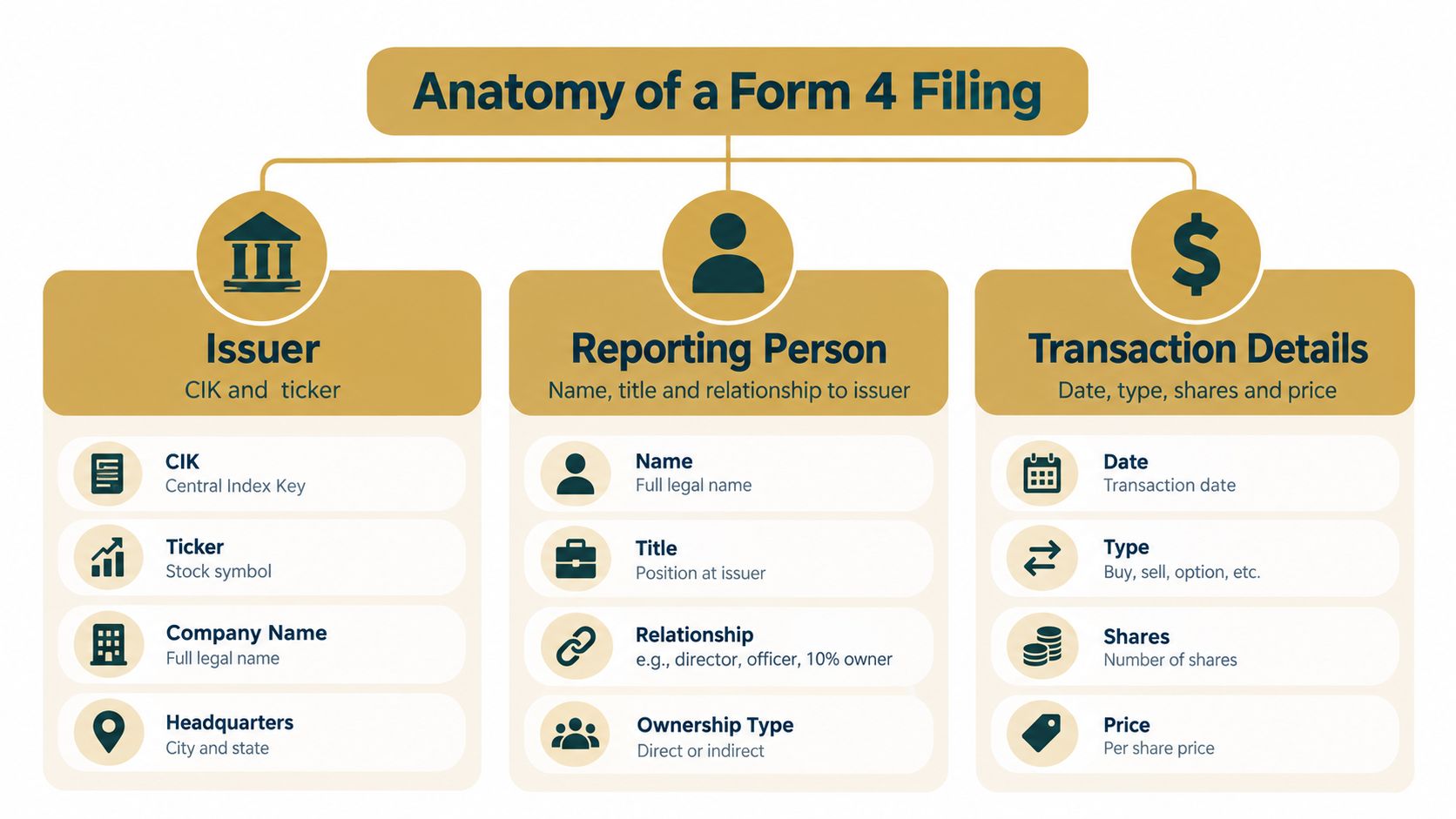
The filing's main components are easier to follow when separated visually.
Establish whose ownership changed
The issuer is the company whose securities appear in the report. Its CIK, or Central Index Key, is its SEC identifier; use it alongside the company name and ticker to avoid matching a filing to the wrong business.
The reporting person is the insider whose ownership is being disclosed. Relationship flags identify whether that person is a director, officer, or another covered owner.
Keep the transaction date separate from the filing's acceptance timestamp. One describes execution; the other tells you when the SEC accepted the disclosure.
The SEC's ownership-data technical specification maps structured fields to the displayed filing, including issuer information, reporting-person details, security titles, transaction data, and footnotes.
Read the correct table
- Table I contains non-derivative securities, such as common shares.
- Table II contains derivative securities, including options, warrants, and convertible instruments.
- Transaction fields describe the code, amount, price, acquisition or disposition, and resulting holdings.
- Ownership context distinguishes direct holdings from indirect arrangements and points toward explanatory footnotes.
A derivative is an instrument whose value or rights relate to another security. An option position therefore isn't interchangeable with common shares already owned.
Read Table II's exercise or conversion terms before comparing its rows with Table I. A derivative event and a common-share event may be connected, not independent expressions of conviction.
Finally, inspect the footnotes. They can explain trusts, family entities, indirect ownership, plan-based transactions, or how several rows relate.
Don't fill gaps with assumptions. If a price or ownership arrangement is unclear, label the interpretation uncertain until the filing resolves it.
Transaction Codes Explained in Plain English
The transaction code is the fastest defense against a misleading alert. It describes the transaction's character, which is more useful than an isolated acquisition or disposition label.
The SEC's investor guide to Forms 3, 4, and 5 explains the standardized codes and the ownership information reported. The examples below are illustrative, not attributed trades.
Common Form 4 Transaction Codes
| Code | Plain meaning | Discretionary? | Reader takeaway |
|---|---|---|---|
| P | Open-market or private purchase | Potentially | Investigate purchase terms, ownership, and plan context |
| S | Sale | Potentially | Don't infer motive from the sale alone |
| A | Grant or award | Usually compensation-related | Receiving shares isn't the same as buying them |
| M | Exercise or conversion | Context-dependent | Trace the associated derivative and share rows |
| F | Securities used or withheld for exercise cost or taxes | Usually mechanical | Don't automatically label it bearish selling |
| G | Gift | Not a market purchase or sale | Examine the recipient and ownership explanation |
| J | Another transaction requiring explanation | Unknown without context | Read the explanatory footnote |
Translate the event, not just the letter
A hypothetical P row could describe a director purchasing common shares. It deserves closer investigation, but P includes private purchases too, so calling every P event an open-market trade would overstate the evidence.
An S row describes a sale, not the seller's complete reasoning. A plan marker or footnote may change how you interpret the timing.
An officer exercising options could generate M activity. If securities are also withheld to meet an exercise cost or tax obligation, an F row may appear nearby; interpreting the rows separately could produce contradictory alerts.
An A award can increase holdings without the insider committing new cash. A G gift changes ownership without an ordinary market sale.
A transaction code classifies the event. It doesn't grade the investment opportunity.
Treat J as a stop sign for automated interpretation. The explanation is part of the transaction, not optional reading.
Filing Deadlines, Amendments, and Data-Quality Caveats
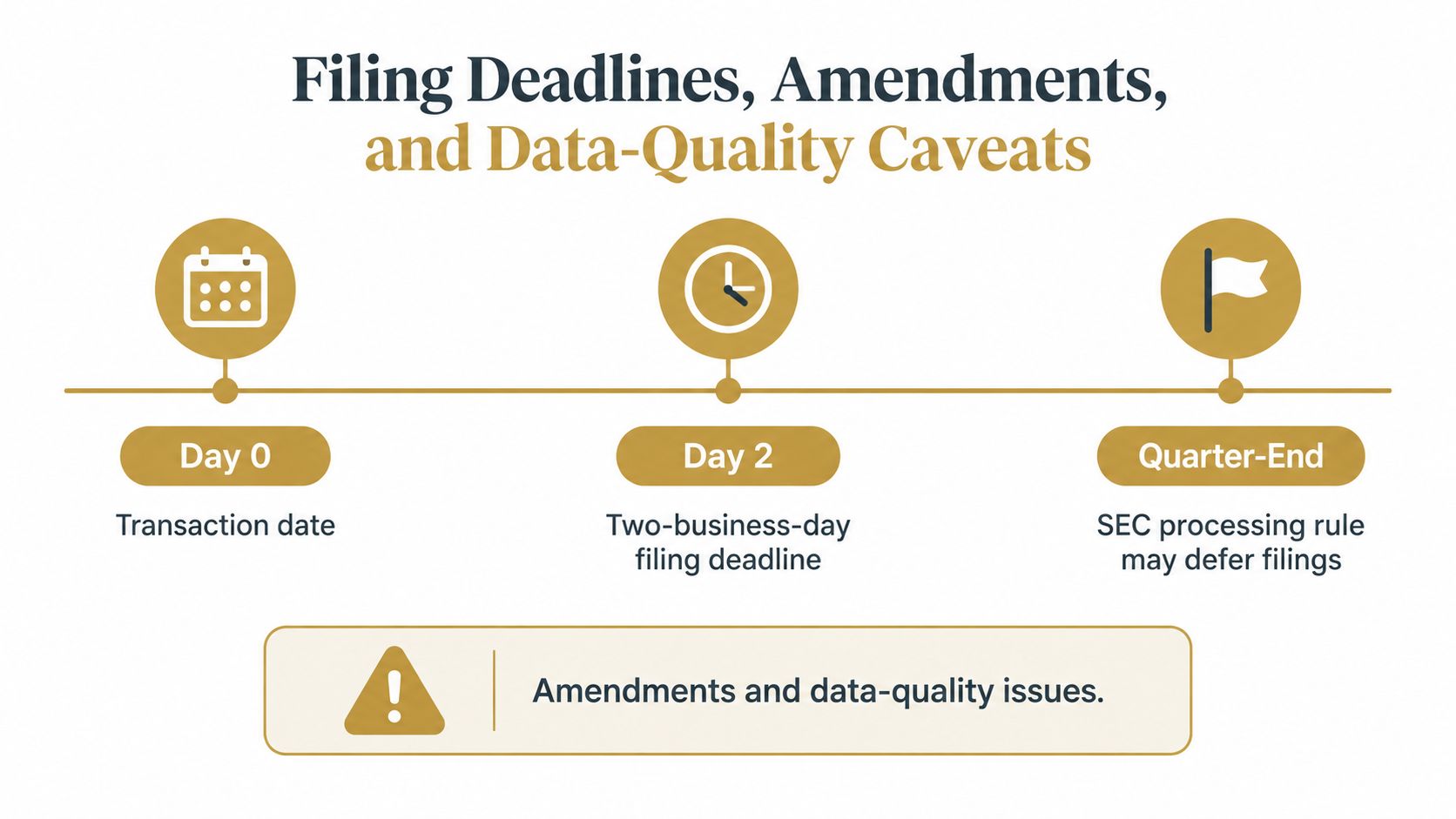
A disclosure system has several clocks. Execution, SEC acceptance, dataset publication, and your alert's arrival are different events.
For Form 4, the general deadline is the end of the second business day following execution. Under the previously linked SEC instructions, a Monday transaction would ordinarily be reportable by Wednesday, subject to applicable filing rules, holidays, and the relevant transaction time zone.
Legal timeliness isn't delivery speed
Quarterly datasets add another caveat. Documents filed after 5:30 p.m. Eastern on the last business day of a quarter may appear in the following quarterly posting, as discussed in the EDGAR-hosted insider-data analysis.
That's a dataset-processing issue, not a reason to assume every direct EDGAR filing remains unavailable until the next quarter.
The same analysis assembled more than 7.4 million transaction records across 2,515 Russell 3000 companies and reported 99.88% temporal data quality, while still identifying residual errors in prices, quantities, titles, and dates. Those findings distinguish accurate timing from accurate transaction content.
Preserve the audit trail
- Execution date establishes when the reported activity occurred.
- Acceptance timestamp records when the SEC received the filing.
- Ingestion timestamp records when your system obtained it.
- Amendment status identifies a correction that needs reconciliation.
- Raw filing and footnotes preserve the evidence behind a normalized alert.
An amendment shouldn't become another trade merely because it arrived later. Link it to the original, inspect what changed, and revise the affected record.
For a spreadsheet or ingestion pipeline, retain the accession number, issuer identifier, reporting person, table, and transaction-row identity. Use separate confidence labels for timing and interpretation instead of one unexplained bullish or bearish badge.
Form 4 Versus STOCK Act PTRs Versus Form 13F
A Form 4, a congressional PTR, and a Form 13F are different kinds of signals. None is a live feed of every trade. Each arrives on its own schedule and reports a different slice of ownership, so the first step is to match the filing to the question you want to answer.
A Periodic Transaction Report, or PTR, covers qualifying congressional transactions. Under the STOCK Act, covered purchases, sales, or exchanges exceeding $1,000 must be reported within 30 days after notice, and no later than 45 days after the transaction, under the Congressional Research Service's STOCK Act explanation. The notice-based clock matters: a posted report may describe a transaction that is already weeks old.
PTR amounts appear in ranges, not as exact execution values. That makes them less precise than a reported share count and price. They can still help track disclosed congressional positioning, but they do not show a real-time portfolio.
Comparing the Three Major Disclosure Regimes
| Regime | Who reports | Deadline | Best use |
|---|---|---|---|
| Form 4 | Covered corporate insiders | Second-business-day framework discussed earlier | Company-specific ownership research |
| STOCK Act PTR | Covered congressional officials and employees | Notice-based deadline, with the outer limit described above | Delayed political-positioning research |
| Form 13F | Qualifying institutional investment managers | Quarterly reporting schedule | Historical institutional holdings comparison |
Form 13F applies to institutional managers with investment discretion over at least $100 million in Section 13(f) securities. Reports are generally due within 45 days after calendar quarter-end, according to the Congressional Research Service's institutional disclosure overview.
A 13F is a holdings snapshot, not a transaction ledger. It does not provide a complete picture of cash, short positions, many derivatives, or global assets. A change in reported value alone therefore cannot establish that a manager bought more shares.
Choose the question before the filing
Use House and Senate financial disclosures to research reported congressional positions, including whether the owner was an official, spouse, or dependent child. PTRs are separate from annual disclosures. Repeated annual reporting should not automatically be counted as new trading activity.
Use SEC EDGAR Form 4 to examine reported changes in insider ownership. The official instructions reproduced through CRS describe reporting tied to changes in beneficial ownership. To assess whether a Form 4 suggests discretionary conviction, distinguish open-market transactions from mechanical compensation events, then check transaction codes, plan status, and ownership context. The filing reports an event; it does not predict what the insider expects.
Use SEC Form 13F to compare managers' reported holdings over time. Compare share counts separately from reported values, and treat each filing as a delayed snapshot rather than evidence of a specific trade date.
Parsing a Real Form 4 Step by Step
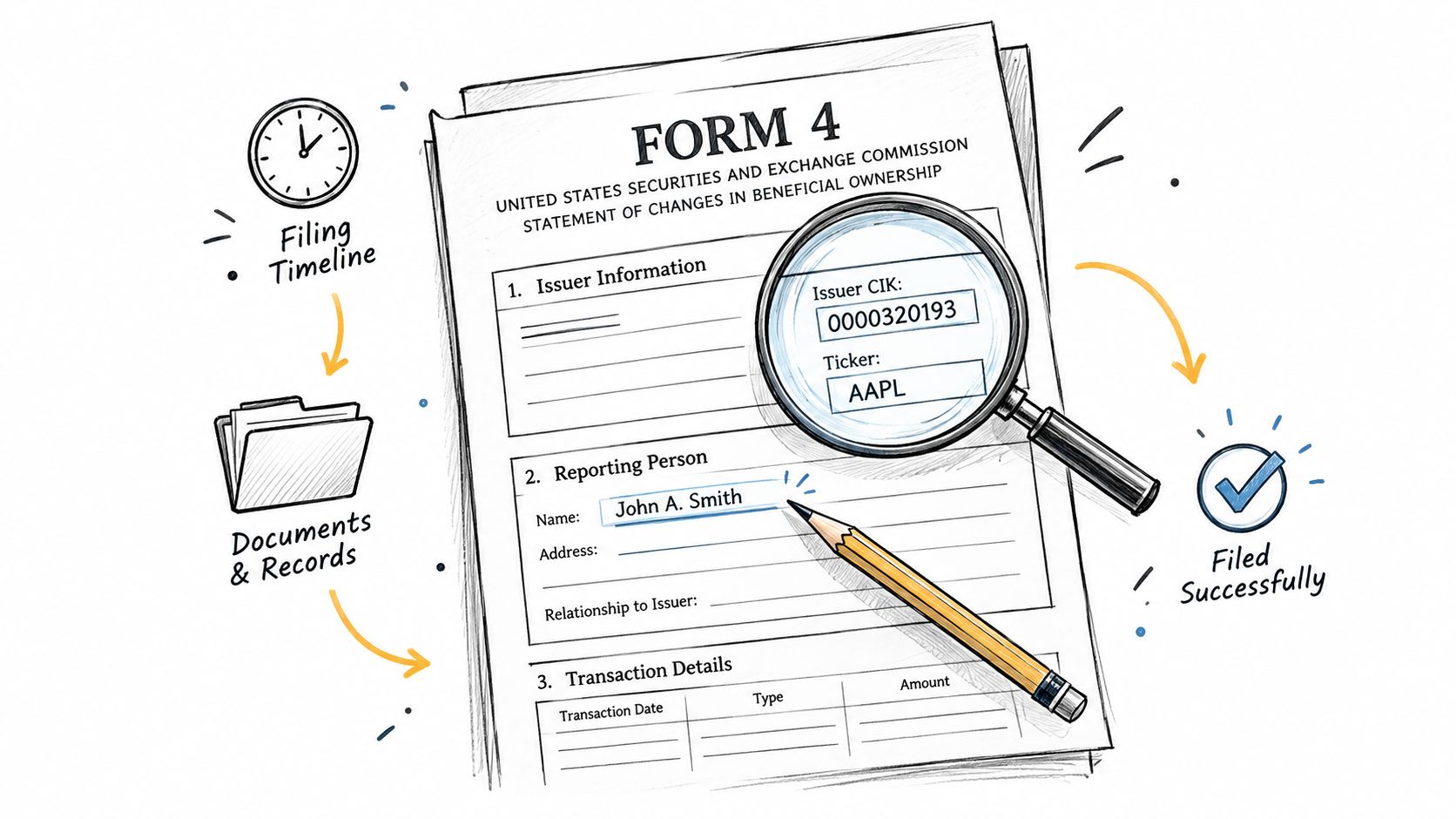
Open an actual Form 4 in SEC EDGAR and work from the document, not an alert's summary. Without a specific filing to inspect, assigning a company, insider, or trade would invent evidence; this checklist works on the filing you choose.
Start with identity and chronology
- Match the issuer. Record the company name, CIK, and security title. Don't assume every security issued by the company is common stock.
- Identify the reporting person. Capture the name, relationship flags, and officer title where shown.
- Separate the dates. Record execution and acceptance independently. Don't replace the transaction date with the date your alert arrived.
Then read each Table I row as a complete statement: the security, transaction code, acquisition or disposition, quantity, price, and resulting holdings.
A hypothetical P row for common shares supports the statement “the insider reported a purchase.” It doesn't, by itself, support “the insider expects an imminent announcement.”
Connect rows before interpreting them
Inspect Table II even when the alert mentions only common shares. An exercise can connect a derivative disposition with a common-share acquisition.
Follow every relevant footnote marker. If the filing describes a trust or family entity, preserve that ownership context rather than converting it into a direct personal holding.
Check plan information and amendment status before writing your summary. Then calculate ingestion delay from acceptance to retrieval, keeping the earlier execution-to-disclosure interval separate.
Your final research note should contain three distinct parts:
- Reported event stating what the document says.
- Interpretation explaining whether it resembles discretionary exposure.
- Unresolved questions identifying missing or ambiguous context.
That separation prevents an analytical guess from becoming a supposed filing fact. Keep the original document alongside your note so you can audit the interpretation later.
Why More Filings Do Not Always Mean Better Signals
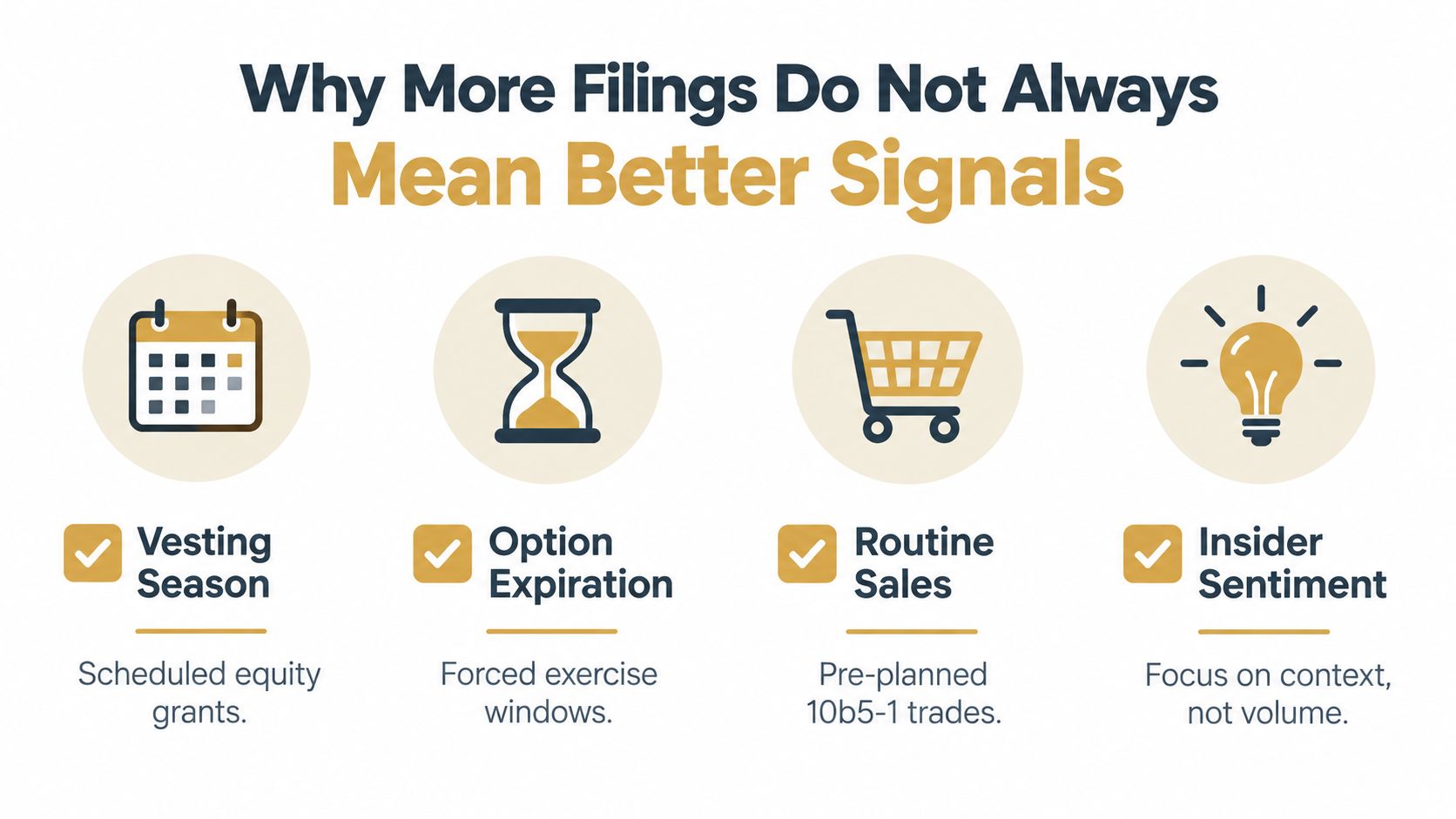
A crowded alert feed can make routine activity look like a major development. Counting filings without classifying transactions rewards activity, not understanding.
Compensation-related events can generate several connected rows. A prearranged sale can look urgent when published, even though its execution followed an earlier plan.
Grade the evidence separately
A useful research framework asks:
- Freshness How much time passed between execution, disclosure, and your review?
- Completeness Have you examined connected rows, derivatives, ownership arrangements, and footnotes?
- Decision timing Does a plan explain execution, or does the transaction appear discretionary?
- Net exposure Did the insider's overall economic interest change, rather than merely move between instruments?
- Interpretive confidence Which conclusions are explicit, and which remain assumptions?
Net exposure means the overall economic interest being increased or reduced. Common shares acquired through an exercise don't tell the whole story if a related option position disappears.
A filing can be easy to parse but weak evidence of fresh conviction. Conversely, a purchase may deserve attention while still leaving substantial uncertainty about motive and relevance.
Research discipline: Raise confidence because the evidence is clearer, not because the reported value is larger.
Timing matters beyond the filing system. If public news appeared between execution and disclosure, compare that chronology before treating the filing as new information.
The objective isn't to reject every signal. It's to explain each one well enough that a reader can distinguish a reported transaction from an investment thesis.
Turning Filing Mechanics Into a Practical Workflow
Build a watchlist around research questions, not famous names. “Did this officer make a discretionary purchase?” is more testable than “What are insiders doing?”
For congressional activity, apply the same standard across parties. Ownership disclosures don't establish privileged knowledge, misconduct, or the reason someone traded.
Keep policy and trading evidence separate
Policy research needs its own chain of reasoning. A proposed measure, an enacted law, and an agency implementation decision aren't interchangeable.
For a hypothetical sector analysis, ask whether the policy could change demand, costs, funding, or permitted business activity. Then examine which companies have relevant exposure, rather than assuming every company in the sector benefits equally.
- Identify the regime before choosing the timing and interpretation rules.
- Classify the transaction before reacting to its size.
- Preserve source dates so publication doesn't masquerade as execution.
- Read the ownership explanation before assigning the action to an individual.
- Write the policy mechanism separately from any observed trade.
- Journal the uncertainty instead of turning it into a confident forecast.
You can do this with SEC EDGAR, House and Senate financial disclosures, and a spreadsheet. TradeLikeInsiders is another option: it consolidates congressional disclosures, insider activity, whale moves, and policy signals, with AI summaries and an educational paper-trading environment.
A summary is a starting point, not a substitute for the filing. A simulation is a way to practice evaluating a thesis, not evidence that the thesis will work with live funds.
Keep factual observations, analytical judgments, and hypothetical decisions in separate journal fields. Nothing in that workflow requires copying a disclosed trade or treating it as personalized advice.
Quick Reference Card for SEC Insider Trading Filings
Use this card to sort filing mechanics from possible trading signals. A filing is a delayed, partly structured record, not a live feed; deadlines and thresholds describe reporting rules, not the importance of a trade.
Deadlines and coverage
- Form 4 is generally due by the second business day for covered insiders, including beneficial owners of more than 10% of a registered class, under the ownership-reporting framework discussed earlier.
- Congressional PTRs report qualifying transactions exceeding $1,000. They have a 45-day outer deadline and a notice-based rule, as described in the disclosure-regime comparison above.
- Form 13F applies to qualifying managers at the $100 million threshold and is generally due 45 days after quarter-end. The comparison above explains this institutional reporting regime.
- Amended reporting forms apply to filings on or after April 1, 2023. They add plan identification and adoption dates, and bona fide gifts are reported on Form 4, as noted earlier.
Interpretation checks
P means purchase; S, sale; A, award; M, exercise or conversion; F, exercise-cost or tax withholding; G, gift; and J, another explained transaction. A discretionary open-market purchase can signal a choice to invest. An award or withholding often reflects compensation mechanics instead, so check the code, plan status, and ownership context before drawing conclusions.
Keep execution, acceptance, and data ingestion distinct. Review amendments before counting events, retain footnotes, and remember that congressional ranges and institutional snapshots do not show exact live positions.
Frequently Asked Questions About SEC Insider Trading Filings
Are Form 4 filings financial advice?
No. They disclose reported ownership activity; they don't recommend a security or evaluate whether it suits your finances. Even a clearly discretionary purchase can be irrelevant to your time horizon or risk tolerance.
Why are congressional amounts reported in ranges?
The disclosure records an amount band rather than an exact execution value. Preserve the reported range instead of substituting a midpoint and presenting it as the actual trade size.
That limitation also means you shouldn't claim an exact return from the disclosure alone. The public record doesn't supply a complete trading account.
How should I handle amended filings?
Link the amendment to the original and inspect the corrected information. Revise the affected transaction record instead of automatically counting another purchase or sale.
Keep both documents for auditability. Your research note should explain which information changed.
What if an apparently bullish row has a trading-plan marker?
Separate the reported event from the decision's timing. The ownership change may be clear while the claim of fresh conviction is unsupported.
Read the plan information and connected footnotes. Don't treat a plan marker as either proof of wrongdoing or a guarantee of predictive value.
Can I copy a politician or institutional manager?
A disclosure doesn't reveal every position, constraint, or motive. Research the security independently, check the disclosure's age, and treat the reported activity as context rather than an instruction.
HeliosNet LLC offers consolidated research on delayed congressional disclosures, SEC insider filings, whale activity, and policy updates, alongside AI summaries and educational paper trading. Visit TradeLikeInsiders to inspect a signal's source and timestamps, then practice documenting your interpretation before treating it as actionable. This content is for informational purposes only and is not financial advice. Do your own research.