
Paper trading is often sold as a harmless sandbox where you can click buy and sell until your confidence improves. That advice misses the harder test. If you're following congressional disclosures, corporate insiders, or institutional positioning, a simulated trading platform should challenge your thesis, not flatter it with instant fills and ideal prices.
The public trades on news. Insiders and policymakers trade on information, incentives, obligations, and timing. By the time a disclosure becomes visible, the market may already have repriced the underlying security. Your job isn't to copy a filing blindly. It's to test whether the signal still works after publication delays, spreads, slippage, liquidity limits, and your own tendency to chase.
Table of Contents
- Why Paper Trading Is Your Ultimate Reality Check
- Decoding the Signals You Are Trying to Trade
- Core Features of a Serious Simulated Trading Platform
- Building a Trade Plan Around Policy and Insider Data
- Accounting for Market Friction and Execution Costs
- Tracking Behavior to Prevent Overtrading and Tilt
- Graduating from Simulation to Live Capital
Why Paper Trading Is Your Ultimate Reality Check
A simulator that reports lower returns after realistic costs can teach you more than one that produces flawless results. That sounds counterintuitive, but an event-driven strategy lives or dies at the point of execution. If a congressional filing becomes public after a substantial delay, or an insider transaction appears while the stock is already moving, the theoretical entry price may have little connection to the price you would receive.
A basic paper account lets you ask, “Would this trade have made money?” A serious simulated trading platform asks better questions:
- When was the signal public? Use the publication timestamp, not the official's or insider's original execution time.
- What price was executable? A quoted midpoint isn't the same as available liquidity.
- What did the trade cost? Include spread, modeled slippage, commissions, and other applicable charges.
- Would the position still work after delay? Test the signal after the information reached a retail trader, not before.
That distinction changes the purpose of paper trading. You aren't rehearsing button presses. You're testing whether your information process can survive contact with the market.
Practical rule: Never let a simulator give you credit for knowing something before the market could have known it.
The long history of simulated markets reinforces this point. Bulls & Bears appeared in 1883, later reached PLATO educational terminals in 1974 and 1982, and the 1975 Simulated Stock Exchange, commonly described as Simsex, used real exchange values and real companies. That system included long positions, short sales, margin trades, stock splits, dividends, and savings-account investments, as described in this history of simulated trading platforms. Simulation wasn't originally just a game. It was a way to represent the consequences of market decisions and portfolio mechanics.
For a modern trader, the standard is higher than “the chart went up after the filing.” A useful practice environment should preserve the signal record, the available quote, the order decision, and the resulting fill. It should also make losing assumptions visible. Start with the educational material and market research available through TradeLikeInsiders' research blog, then test the actual rules in a controlled account.
If your strategy only works with an immediate mid-price fill, perfect liquidity, and advance knowledge of a disclosure, the simulator hasn't validated it. It has exposed a backtest fantasy.
Decoding the Signals You Are Trying to Trade
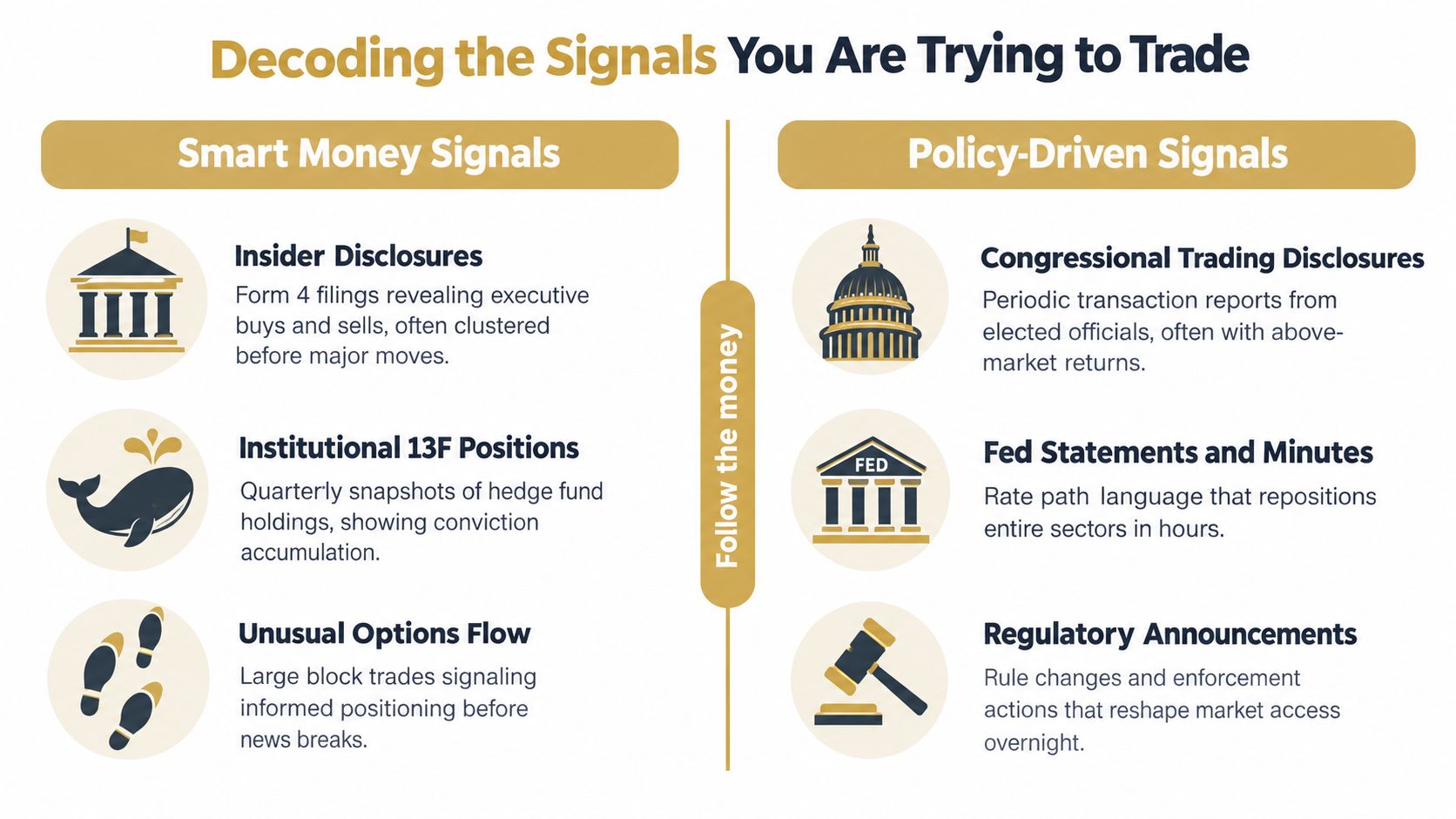
Before placing a simulated order, identify exactly what the filing represents. Congressional trades, corporate insider transactions, and institutional holdings don't carry the same timing, context, or information value. Treating them as one category called “smart money” is an efficient way to misread the market.
Congressional disclosures show exposure, not live intent
The STOCK Act disclosure process uses a Periodic Transaction Report, or PTR, for covered securities transactions that exceed $1,000. The filing deadline is the earlier of 30 days after the filer becomes aware of the transaction or 45 days after the transaction itself, according to House ethics guidance on financial disclosures. The rule can also cover securities owned by an official's spouse or dependent child.
The amounts are reported in ranges, and the filing date isn't the execution date. A retail trader therefore shouldn't treat a congressional PTR as a real-time alert. It can identify exposure to a company, industry, or policy-sensitive theme, but the lag makes short-term copying hazardous. A simulator should timestamp your hypothetical entry when the filing became available, then record the market price and liquidity at that point.
Form 4 is faster, but interpretation still matters
Corporate directors, officers, and other people subject to Section 16 generally report transactions that change beneficial ownership through SEC Form 4 within two business days of execution, subject to limited exceptions. The SEC's Form 4 enforcement material explains the electronic EDGAR process and the information available to the public, including transaction date, filing date, insider identity, security, transaction code, share count, and price or value information.
A purchase can represent personal capital at risk, but it doesn't guarantee a future gain. A sale may reflect taxes, diversification, compensation, or an expiring option rather than a negative view of the company. Read the transaction code, the insider's role, the size relative to their overall exposure, and whether multiple insiders are acting in a similar direction.
13F reports reveal institutional positioning with delay
Institutional investors disclose holdings through 13F filings, which provide a periodic snapshot rather than a live portfolio feed. The filing can help you study accumulation, concentration, and changes in reported exposure, but it won't show every current position or every trading decision. A fund may have changed its exposure substantially by the time the filing is public.
Policy signals need the same discipline. Legislation, committee activity, agency rules, central-bank language, and enforcement actions can move sectors, but the market often reacts before an individual retail trader can form a view. Use the disclosure as a starting point for a hypothesis. Then test whether the hypothesis survives the publication timestamp, the price response, and realistic implementation costs. A useful reference for this workflow is research on interpreting insider and policy signals, provided you verify the underlying filing before acting.
Core Features of a Serious Simulated Trading Platform
A basic simulator looks up a price and fills your order. That may be enough to learn where the order ticket sits, but it isn't enough to evaluate an event-driven strategy. The difference between a credible terminal and a decorative paper account is whether the platform models the path from signal to execution.
Compare the execution model before comparing the interface
| Feature | Basic Simulator | Advanced Terminal |
|---|---|---|
| Signal timing | Uses the event or chart without strict publication controls | Records signal, quote, and order-submission timestamps |
| Fill price | Often fills at the displayed or midpoint price | Models bid-ask spread and available liquidity |
| Limit orders | May fill immediately when price touches the level | Accounts for queue position, partial fills, and non-execution |
| Market orders | Treats the quoted price as executable | Applies assumed latency and modeled slippage |
| Order records | Stores entry and exit | Stores quantity, fill, cancellation, rejection, and rationale |
| Performance | Shows a single return figure | Separates gross results, spread cost, slippage, and delay |
| Testing controls | May allow convenient historical replay | Supports chronological walk-forward and out-of-sample evaluation |
A real order book has competing buyers and sellers. A limit order can remain behind displayed or hidden liquidity, while a market order can move through several price levels before it completes. A platform that fills every order instantly teaches the wrong lesson, especially for volatile crypto markets, thinly traded securities, and news-driven setups.
The journal is part of the execution engine
For each simulated trade, record the signal timestamp, quote timestamp, order-submission timestamp, assumed latency, bid and ask at submission, fill price, fill quantity, and cancellation or rejection reason. These fields let you distinguish a bad signal from a bad implementation.
A performance page should also show average time to fill, fill rate, gross return, and friction-adjusted return. Configurable slippage matters because the right assumption depends on the instrument, order size, market conditions, and strategy horizon. Research on crypto-market execution links latency-induced slippage to volatility, latency, and limit-order-book liquidity, so ignoring those variables can distort short-horizon results. The market execution research provides useful context for why a price lookup isn't an execution model.
Use a platform that lets you change the assumptions instead of hiding them. You should be able to test a conservative fill, a partial fill, a delayed order, and a rejected order. If the result changes dramatically when you stop receiving imaginary liquidity, the strategy needs more work.
For a practical example of a paper-trading environment that combines simulated positions with order journaling and performance history, review what TradeLikeInsiders offers. The important question isn't whether a tool looks polished. It's whether its records let you audit every assumption behind the result.
Building a Trade Plan Around Policy and Insider Data
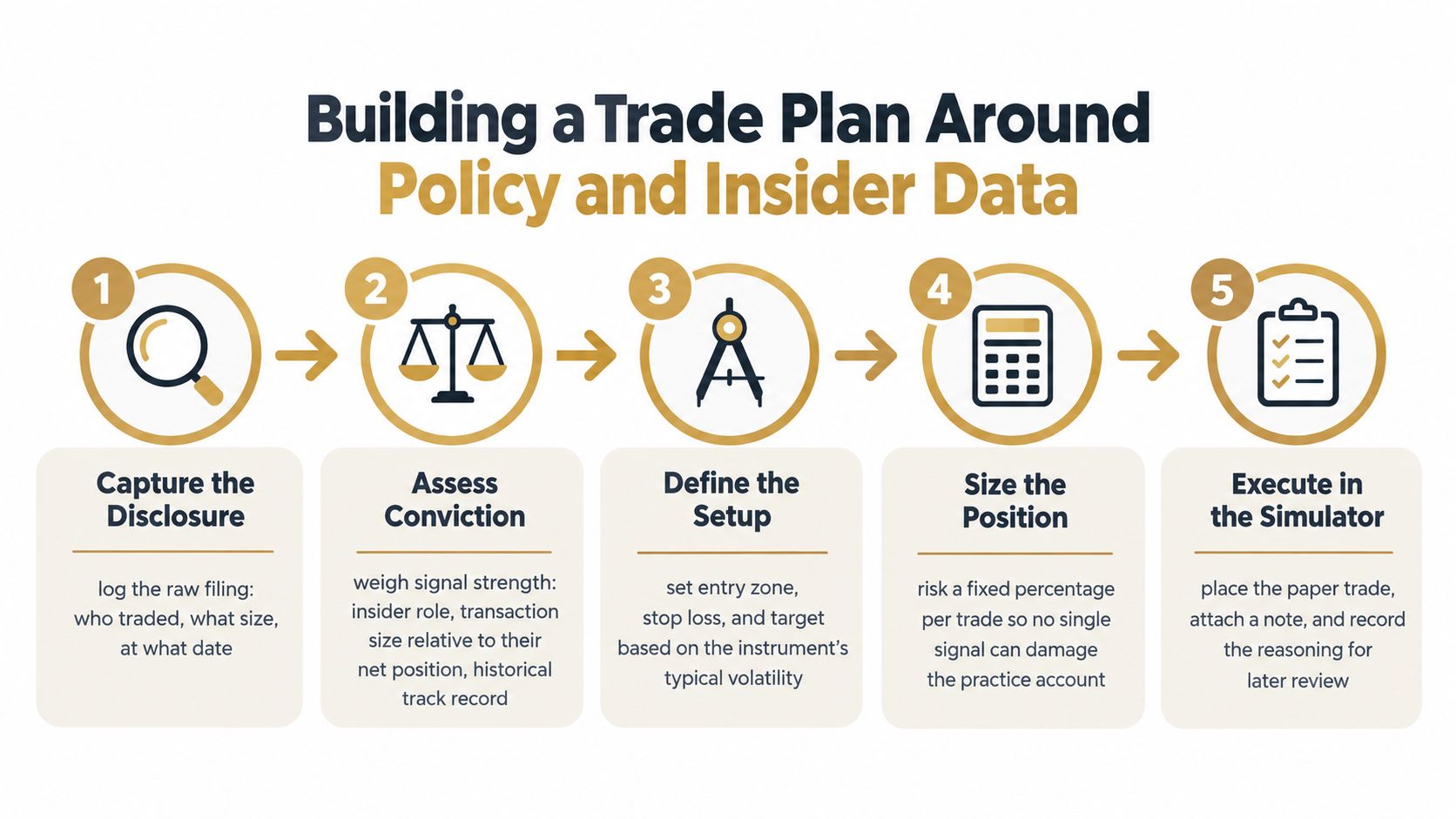
A filing should become a structured hypothesis before it becomes a simulated position. Start with the raw document, not a headline or social-media summary. Record who filed, what security was involved, whether the transaction was a purchase or sale, the transaction date, the filing date, the relevant code, and the reported amount or range.
Follow a timestamp-first process
- Capture the disclosure. Save the original filing and the time it became available. Don't backdate your simulated entry to the insider's execution date.
- Assess the signal. Consider the insider's role, transaction type, reported range, and relationship to the company or policy. A committee member's exposure may be relevant, but relevance isn't proof of foresight.
- Define the setup. Write the entry zone, invalidation level, and target before placing the trade. Base them on the instrument's behavior and the catalyst, not on a desired outcome.
- Size the position. Use a fixed risk rule in the simulator so an exciting filing can't dominate the account. Keep the exercise focused on process rather than headline profit.
- Execute and annotate. Use the order type you could realistically use live. Attach a note explaining why you entered, what would disprove the thesis, and what information would make you exit.
Suppose a committee member reports exposure to a defense contractor after a policy development. The responsible simulation doesn't assume the disclosure caused the move or that the official had actionable information. It logs the public filing, checks the stock and sector response after publication, and tests a limit order near the planned entry zone. If the market moves away before the order fills, the simulator should record a missed opportunity or partial execution, not award a perfect fill by default.
A stop-loss isn't a promise that a position will exit at the chosen price. In a fast market, the actual exit can be worse. A take-profit level isn't a forecast either. It's a rule that prevents the trader from changing the plan because the position is profitable.
Execution rule: A signal earns your attention first. It earns a position only after the timing, invalidation, and fill assumptions are written down.
The same framework works for Form 4 purchases, institutional changes in 13F holdings, and policy announcements. What changes is the quality and delay of the source. Keep the filing, the timestamp, and your interpretation together so a later review can separate evidence from hindsight.
Accounting for Market Friction and Execution Costs
The gap between a decision price and an actual execution price is implementation shortfall. A paper portfolio can look strong because it ignores the costs that live traders face. Spread is the first layer. Slippage from transmission delay, market movement, and limited liquidity comes next. Fees, borrowing costs on short positions, funding costs, and taxes can add further drag depending on the market and instrument.
For an insider-tracking strategy, the cost problem begins before the order ticket. A filing may be delayed, the market may react when it becomes public, and the available liquidity may be thinner than the displayed quote suggests. A congressional PTR can be especially difficult to use for short-term timing because the transaction may already be weeks old when the public sees it. The sensible simulation starts at public availability, not at the official execution.
Build tests that resist optimistic bias
Use chronological walk-forward testing. That means training or defining the rules with information available at the time, then evaluating later events without peeking forward. Out-of-sample testing matters because a strategy can appear convincing when its rules are shaped around information that wasn't available during the supposed decision.
Apply realistic commissions and fees. Use spread-aware fills. Allow partial execution and non-execution. Label stale or publisher-timestamped data. For every trade, show gross performance beside the result after modeled friction.
Research on trade execution describes a conflict among order completion, market impact, and opportunity cost. Aggressive orders may complete more reliably but pay more impact, while passive orders may receive a better price but fail to fill. The MIT trade-execution research also supports evaluating execution quality as a process rather than reducing it to a single return number.
Stress the strategy instead of protecting it
Run sensitivity cases with more adverse slippage and longer latency. Reduce assumed fill quantity when liquidity is limited. Compare a limit-order version with a market-order version, and keep the unfilled orders in the record. A strategy that survives conservative assumptions is more useful than one that depends on immediate mid-price fills.
The uncomfortable result is often the valuable one: lower simulated returns can indicate a more honest model.
Don't ask whether the paper account is profitable in ideal conditions. Ask whether the signal remains decision-useful after the market charges you for access.
Tracking Behavior to Prevent Overtrading and Tilt
A simulator tests the trader as much as it tests the signal. Without a journal, you may mistake activity for discipline. A rising position can make a weak thesis feel intelligent, while a losing position can trigger extra trades that were never part of the plan.
Academic evidence makes the behavioral issue concrete. A 2014 study found that overtrading was statistically significant in rising markets but not in falling markets, showing that market direction can change trading frequency and risk-taking even when participants use fictitious money. The finding appears in the PLOS ONE simulated-trading study.
Record decisions, not just outcomes
A useful journal captures the reasoning before and after the trade. Include:
- Signal source: Identify the PTR, Form 4, 13F, policy release, or other document.
- Public timing: Record when you could reasonably have seen the information.
- Expected catalyst: State what you believed could move the security or sector.
- Invalidation rule: Write what would make the thesis wrong.
- Execution quality: Note spread, delay, fill quantity, and any order rejection.
- Behavioral state: Mark whether you entered calmly, chased, revenge-traded, or changed the plan.
Track trading frequency, average holding time, drawdown severity, win and loss distribution, and the proportion of trades that followed the written rules. These measures reveal problems that a profit-and-loss line can hide. A profitable month built on impulsive entries is not the same as a repeatable process.
Separate signal failure from trader failure
Suppose a Form 4 purchase is followed by a decline. That doesn't automatically disprove the signal. The entry may have been late, the position may have been too large, or the broader sector may have moved against the trade. Conversely, a profitable trade can still be poorly executed if it ignored the plan and happened to benefit from a favorable move.
Review trades in groups. Compare filings acted on immediately with filings that waited for confirmation. Compare limit orders with market orders. Review whether policy-sensitive positions produced different behavior from ordinary setups. The journal should help you retire rules that encourage chasing and retain rules that create repeatable decisions.
A simulated account removes the financial pain of loss, so it can't reproduce every emotional response of live trading. It can still expose the habits that lead to poor decisions. If you overtrade when prices rise in a virtual account, real capital won't make that tendency safer.
Graduating from Simulation to Live Capital
Going live shouldn't happen because the account balance looks attractive. It should happen only when the process is documented, the execution assumptions are credible, and you understand how real money changes your behavior. Simulated performance doesn't guarantee live performance, especially when the simulation doesn't reproduce liquidity, delay, or emotional pressure.
Use a practical readiness checklist:
- Review the record: Confirm that every trade has a source, timestamp, rationale, entry rule, exit rule, and execution record.
- Challenge the assumptions: Recalculate results after realistic spread, slippage, fees, partial fills, and delayed entries.
- Check discipline: Look for skipped stops, oversized positions, revenge trades, and entries made after the signal had already moved.
- Define the live version: Write down the instruments, order types, maximum exposure, and conditions that permit a trade.
- Ramp gradually: Start with an amount that makes the process emotionally real without making one error financially destructive. Increase exposure only when live behavior matches the documented plan.
The supplied checklist visual uses a staged approach, from a sustained simulated record and positive risk-adjusted results to consistent risk discipline, a written playbook, and a gradual capital ramp. Treat those as conditions, not promises. You don't need to turn every public filing into a position, and you don't need to connect a brokerage account just because a signal looks compelling.
Keep the journal after the transition. Continue recording the publication timestamp, the available quote, the order decision, and the actual fill. Compare live execution with the assumptions from your simulated account, then adjust the model when reality differs. That feedback loop is more valuable than a single favorable result.
TradeLikeInsiders combines delayed congressional disclosures, SEC insider filings, whale activity, selected policy updates, AI-generated summaries, and an educational paper-trading environment for users who want to test these signals before risking live funds. Use it as a research and practice layer, not as a substitute for verifying primary filings and making your own decisions.
HeliosNet LLC brings congressional disclosures, SEC insider activity, whale moves, policy signals, and a simulated trading environment into one research workflow. Visit TradeLikeInsiders to review delayed event-driven signals, practice timestamped trade plans, and study execution results before connecting a brokerage account. This content is for informational purposes only and is not financial advice. Do your own research.