
The most popular advice about stock insider trading is also the easiest to get wrong: spot a politician or executive buying, then follow the trade. A filing isn't a live tip. It's a delayed public record, often with limited context, and by the time it appears, the stock may have already moved.
The useful question isn't “Who bought?” It's “What kind of transaction was it, how old is the information, and what does the filing establish?” That approach helps separate a potentially informative pattern from a headline that's politically interesting but financially weak.
Table of Contents
- The Insider Trading Myth Most Retail Investors Believe
- Legal Insider Trading vs Illegal Insider Trading
- How Corporate Insiders Report on Form 4
- How Congressional Trades Surface Under the STOCK Act
- Form 4 vs STOCK Act vs 13F Filings
- Reading Insider Activity as a Signal
- What the Research Says About Insider Trade Performance
- Building Your Own Insider Tracking Workflow
The Insider Trading Myth Most Retail Investors Believe
Social media often turns insider filings into movie scenes: a senator sells before a hearing, a chief executive buys before great results, a fund loads up before a merger. The filings are less dramatic. They usually show a transaction after it happened, alongside details that can be easy to misread or incomplete without context.
Corporate insiders generally report most covered transactions on Form 4 within two business days. Congressional disclosures can arrive much later, and a congressional trade's reported value is a range, not necessarily an exact amount. Those records help you establish that activity was disclosed. They don't show that you could have made the same trade at the same price, or that the filer acted on material information unavailable to the public. The SEC's overview of Forms 3, 4, and 5 explains the corporate reporting framework and the information Form 4 provides.
A filing is evidence, not a tip
That distinction changes how you read a headline. “An insider bought” doesn't tell you whether the purchase was made on the open market, whether it increased the insider's ownership, or whether others at the company made similar purchases. “An official traded” doesn't establish who made the investment decision, whether the position remains open, or whether the disclosure arrived before the market incorporated relevant news.
The more useful skill is interpreting the noise. A routine sale may have little to do with a view on the company. A cluster of discretionary purchases can deserve closer attention, but it still isn't a complete investment case.
Practical rule: Treat each filing as a prompt to investigate, not a reason to copy a trade.
The contrarian value of these records is often what they rule out. A sale under a planned program, a household transaction disclosed weeks later, or a filing that reports a broad value range may not provide the clean signal a viral post implies. In stock insider trading, good analysis starts with the limits of the data.
Legal Insider Trading vs Illegal Insider Trading
Legality is the wrong first question when you read a filing. The phrase "insider trading" covers two different things, and conflating them turns routine disclosures into scandals. Legal insider trading is a trade by a corporate insider or public official that follows the applicable rules and gets reported as required. Illegal insider trading involves buying or selling on material nonpublic information, or tipping someone else to trade on it, in breach of a legal duty.
A director who buys shares on the open market and reports the purchase has done exactly what the reporting system asks for. A consultant who learns about an unannounced merger and texts a friend who trades before the news breaks has crossed a different line entirely. Regulators focus on what the person knew, how they obtained or shared it, and whether the conduct breached a duty. An inside connection on its own establishes none of that.
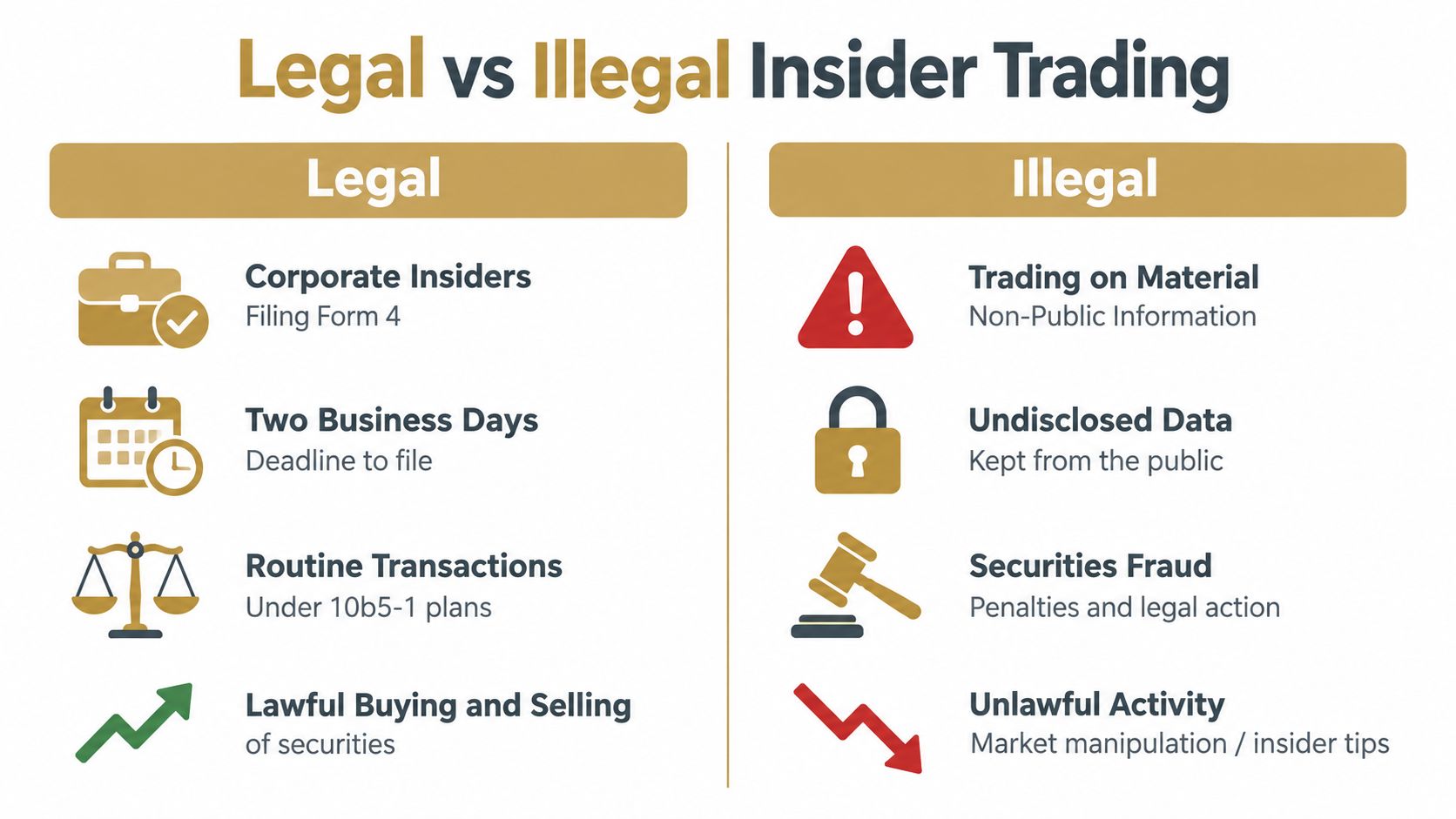
The headline isn't the legal test
The SEC and the Department of Justice enforce securities laws through different civil and criminal processes, and the SEC's insider trading enforcement actions show what triggers a case: confidential deal information, tipped relatives, trades timed around earnings nobody else had seen. A disclosure document sitting in a public database implies none of those facts. An allegation in a press release is an allegation until it's proven.
Here's the part that matters for your workflow. A filing being legal tells you almost nothing about whether it's informative. Legality clears a minimum bar. It says nothing about motive. An executive can sell shares to cover tuition, taxes, or a divorce and report it flawlessly. Another can buy with genuine conviction. Both filings are equally lawful, and only one of them deserves your attention.
Separating the two requires context, which is where latency enters. By the time a disclosure reaches you, the trade is already days old, so anyone reacting to the headline alone is trading on stale news. The readers who extract value score each filing instead: how old it is, whether it breaks from the insider's usual pattern, whether other insiders at the same company moved in the same direction. "Was this trade legal?" is a compliance question. "Is this trade unusual for this filer, disclosed late, and echoed by colleagues?" is an analytical one. The second is what separates a signal worth tracking from a viral post with a regulator's name attached.
How Corporate Insiders Report on Form 4
For corporate filings, start with the form, not the social post summarizing it. Form 4 is the document directors, officers, and other reporting insiders file when their beneficial ownership changes. The SEC generally requires it by the end of the second business day after a transaction, subject to limited exceptions, and the SEC Form 4 instructions spell out exactly what gets reported.
Two business days sounds fast. In practice it means a trade executed Monday morning might not surface until Wednesday evening, and by then the price has already moved, the headline has already circulated, and anyone reacting to the disclosure is late to information that was never going to arrive in real time anyway.
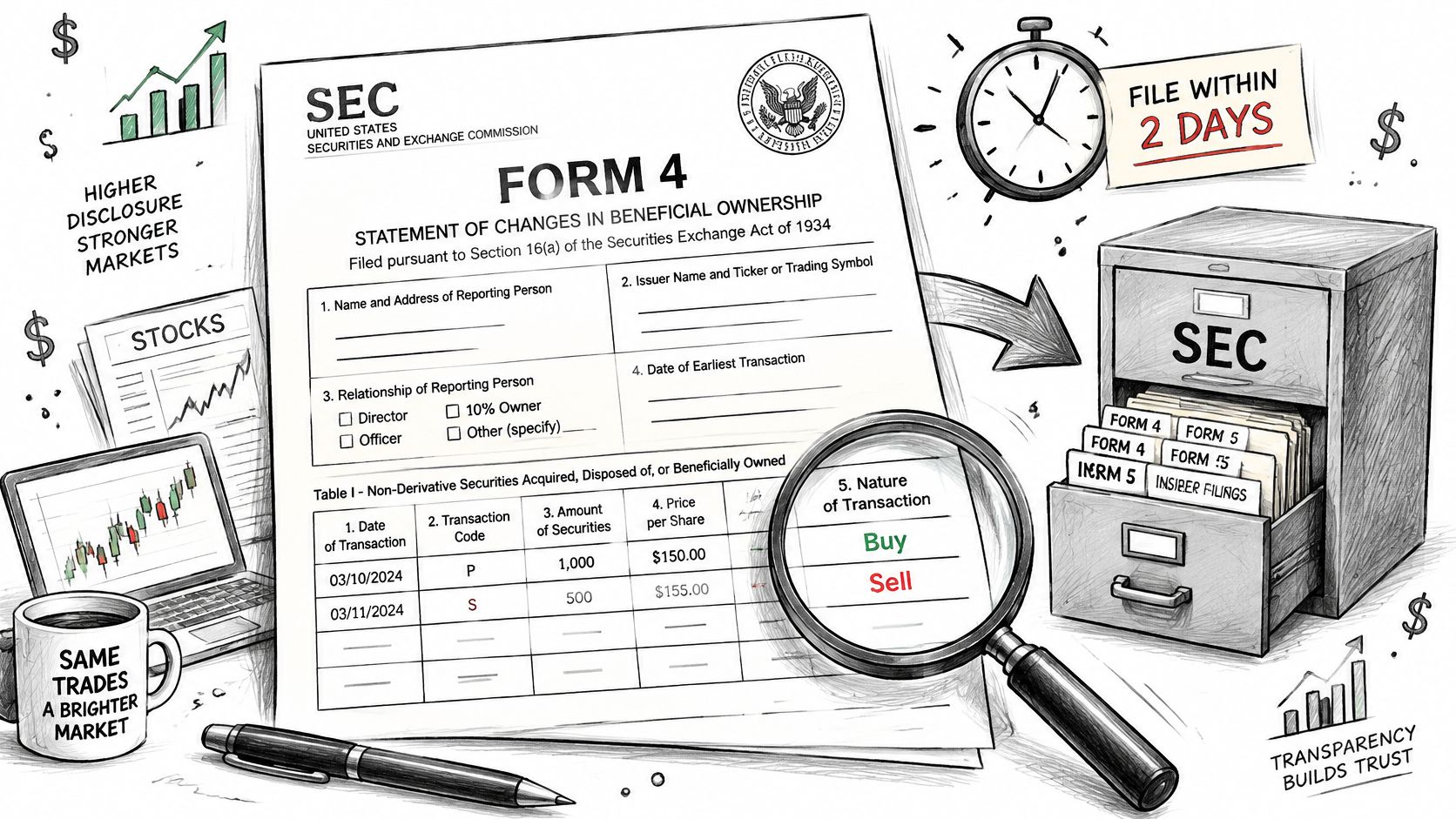
Read the transaction before judging its direction
Each Form 4 lists the transaction date, the amount and price, and the insider's ownership after the transaction. The transaction code is where the reading starts. A market purchase and an option exercise sit in the same database, but they carry very different information. Gifts, tax-related dispositions, and plan sales each get their own code, and a sale driven by compensation mechanics tells you far less about conviction than the headline suggests.
Check two things together: whether the insider increased or reduced beneficial ownership, and whether the filing describes an open-market trade or another transaction type. An executive buying shares in the market with personal funds is putting real money behind a view. Shares received through compensation are just payroll arriving in stock form. No single code settles the question, which is why scoring a filing means weighing the code against the insider's history, the filing's age, and whether colleagues moved the same direction.
The reporting population also includes beneficial owners holding more than 10% of a registered class of equity securities, under the SEC's Section 16 reporting rules. That pulls a large holder's transactions into the same stream as director and officer activity, so treat big filers as a distinct category when you score.
One more layer of delay sits on top. The SEC publishes machine-readable insider-transaction data in quarterly releases, and filings received after 5:30 p.m. Eastern Time on the last business day of a quarter roll into the next release. If you work from the bulk dataset rather than individual filings, that publication lag stacks onto the filing lag.
Here's a short walkthrough of the filing format and the kind of details to inspect:
How Congressional Trades Surface Under the STOCK Act
Congressional stock disclosures are public records, not real-time trading alerts. Under the STOCK Act, a covered transaction exceeding $1,000 must be reported in a Periodic Transaction Report, or PTR. A member must file within 30 days after receiving written notice and no later than 45 days after the transaction, according to the Senate Ethics Committee's financial disclosure guidance.
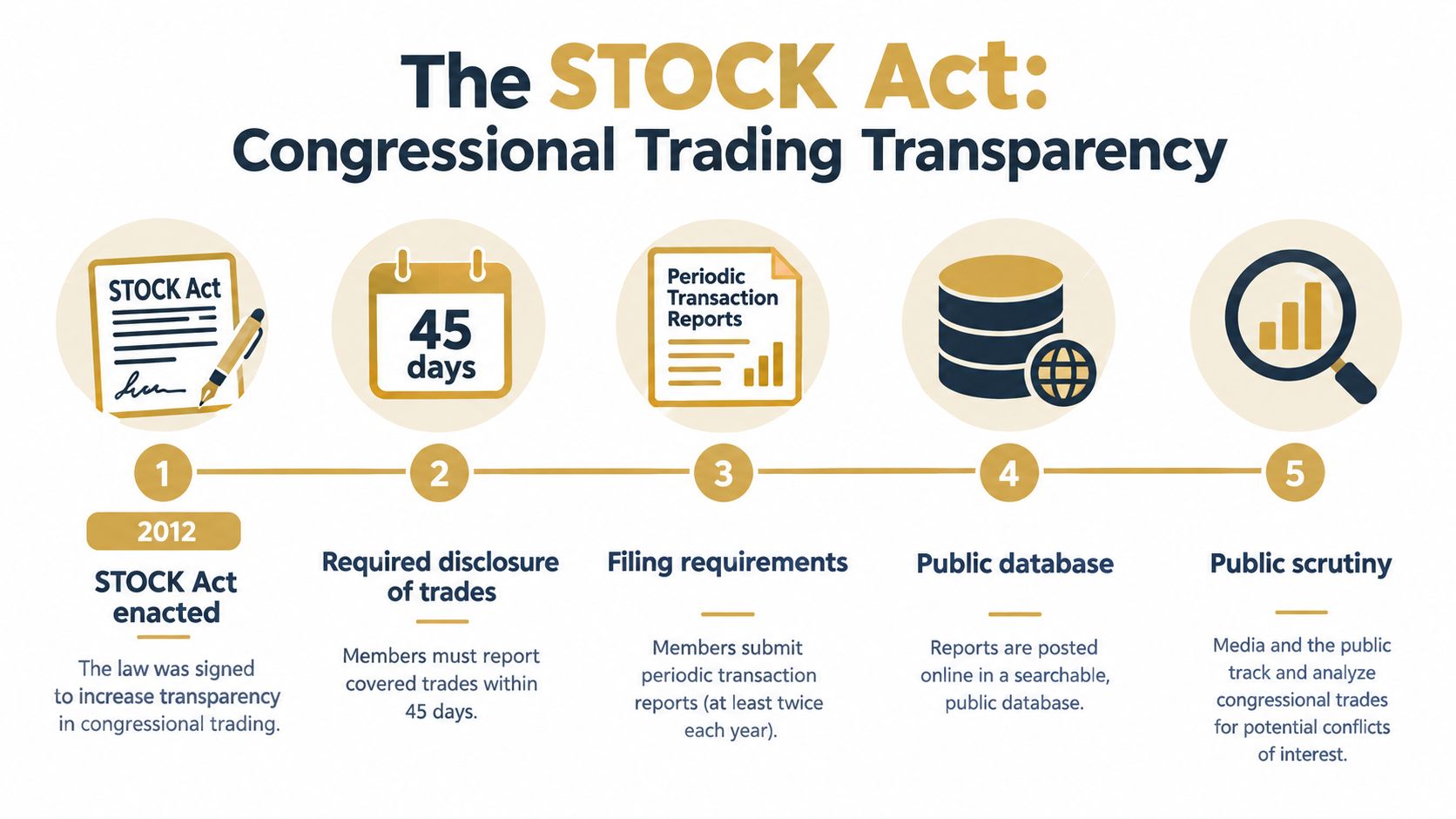
That lag matters. By the time a PTR is visible, the reported trade may be weeks old, and the filing doesn't guarantee that the position is still held. A disclosed transaction can also involve a member's spouse or dependent child. The report may capture household activity or account-management mechanics, not a direct investment decision personally made by the member.
Put the filer and the context ahead of the ticker
A ticker alone says little about why a congressional transaction matters. Ask who the filer is, whether the trade was made by the member or a family member, and whether the person's committee responsibilities relate to the company or industry. Committee relevance can give a disclosure political context, but it doesn't prove the person used confidential information or that the stock will move.
PTRs report transaction values in ranges, so don't treat a range as a precise investment amount. Nor should a disclosed purchase automatically become a bullish signal. The filing doesn't tell you whether the trade remains open, whether a diversified fund is involved, or whether the market has already priced in a policy change.
A useful way to think about a congressional filing is to score its context and latency: how old the trade is, who made it, how specific the reported asset is, and whether a relevant policy event affects the issuer or sector. A disclosure may warrant scrutiny as a potential conflict-of-interest concern while offering little evidence of a repeatable market edge. That distinction keeps political interest separate from trading conviction.
Form 4 vs STOCK Act vs 13F Filings
These records don't describe the same kind of market participant or answer the same question. Form 4 tracks covered corporate insiders, congressional PTRs document certain transactions by elected officials and their households, and 13F filings disclose specified institutional investment holdings. Treating all three as one stream of “insider trades” hides important differences in timing and coverage.
| Regime | Who files | Reporting window | What it reveals | Major blind spot |
|---|---|---|---|---|
| Form 4 | Covered corporate insiders and qualifying beneficial owners | Generally within two business days, subject to exceptions | Reported transactions and resulting ownership information | Transaction type and personal context still require interpretation |
| Congressional PTR | Covered members of Congress, with household transactions included where applicable | Within 30 days of written notice and no later than 45 days after the trade | Reported transactions with value ranges | It may be delayed, household-made, or no longer representative of a current position |
| 13F | Institutional investment managers required to file | After the reporting period ends | A snapshot of reportable institutional holdings | It isn't a live view of a manager's current portfolio or a complete record of every position |
The speed-versus-coverage trade-off
Form 4 usually arrives faster than a congressional disclosure, but it covers a narrower group of people and still requires you to interpret the transaction. Congressional PTRs can reveal political exposure, yet the delay and value ranges limit how precisely you can assess the trade. A 13F provides a view of an institution's reportable holdings at a point in time, not a live feed of what its managers are doing now.
13F filings also have boundaries. They don't give you a complete, continuously updated picture of an institution's portfolio, and a reported holding is not necessarily a fresh investment decision. A manager could have changed positions after the snapshot date. So “a large fund owns this stock” is not the same claim as “the fund is buying it today.”
Use each filing for what it can establish: Form 4 for disclosed corporate-insider transactions, PTRs for reported congressional and household activity, and 13F for a dated institutional holdings snapshot. The broadest view tends to come with a staler picture. Match the data source to the question, and don't turn a disclosure into a real-time alert it was never designed to be.
Reading Insider Activity as a Signal
The difference between a noteworthy filing and a noisy one often comes down to pattern and context. One executive sale, on its own, can have many explanations. Several insiders making discretionary open-market purchases around the same time may be worth investigating, especially if those purchases increase their ownership.
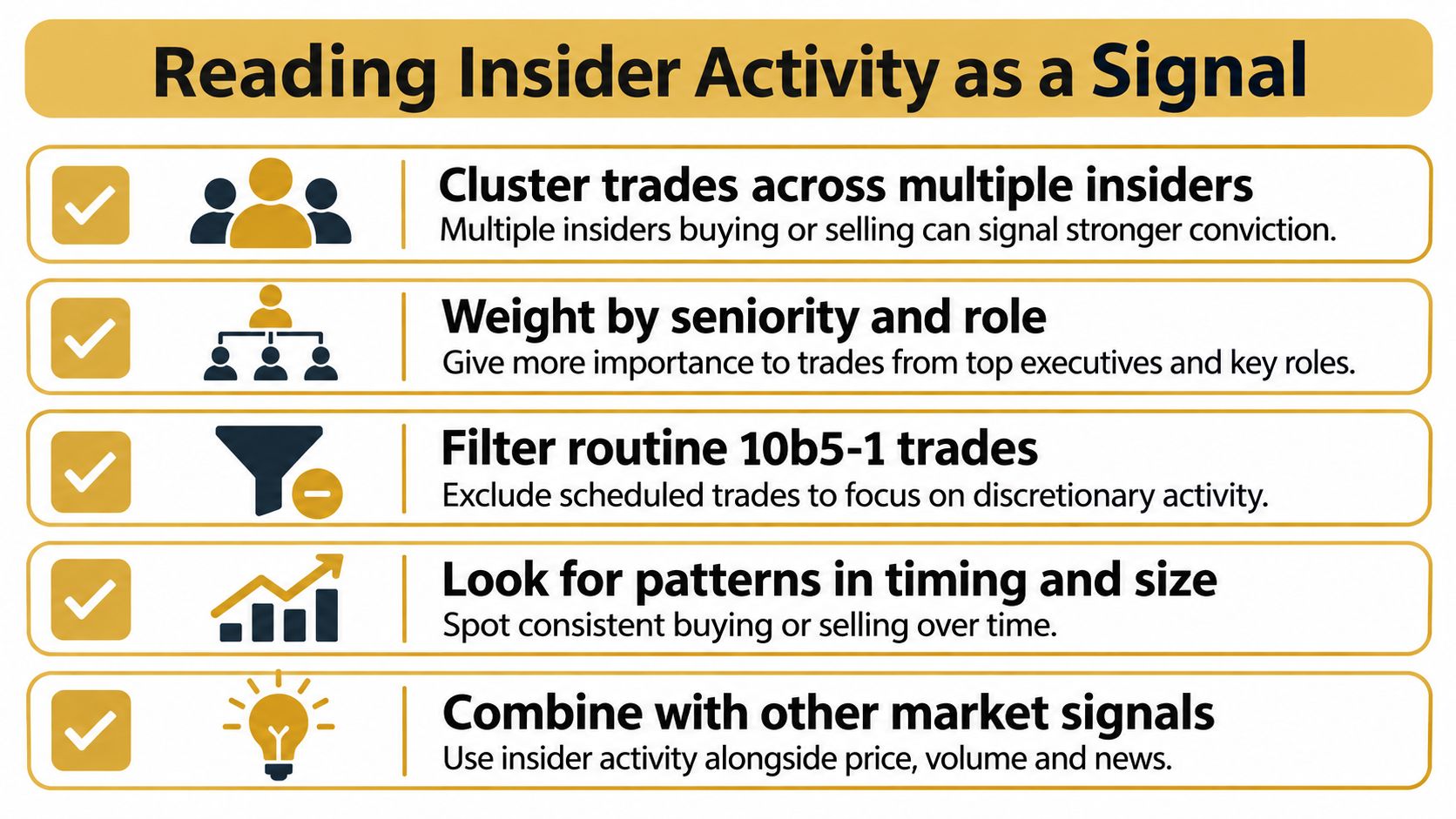
Use a fast filter before chasing the story
Work through the filing in a consistent order:
- Identify the transaction type: Separate open-market purchases from option exercises, gifts, compensation-related activity, and tax-related dispositions.
- Check the ownership change: See whether the insider's reported beneficial ownership rose or fell after the transaction.
- Look for a cluster: Compare activity across multiple insiders rather than letting one high-profile filer dominate your read.
- Consider the person's role: A senior executive or director may have a different relationship to the business than another filer. Role is context, not proof of superior information.
- Assess the stock's situation: Ask whether the trade sits within a wider company or sector story, and whether relevant news may already have moved the price.
Routine transactions deserve special care. A sale arranged through a Rule 10b5-1 plan can follow a preset process. It shouldn't automatically be read as a fresh negative view. A tax-related sale likewise doesn't carry the same meaning as a discretionary sale made in the open market.
Two-question check: What exactly happened, and how much of the apparent signal is still timely?
That check catches two common mistakes: reacting to an old filing as though it just happened, and treating every sale as a bet against the company. A cluster of open-market purchases can be more informative than an isolated filing, but it still doesn't account for valuation, business risk, liquidity, or upcoming events. Use insider data to decide what deserves research. Don't use it to skip the research.
What the Research Says About Insider Trade Performance
Academic findings offer a more measured picture than the “follow every insider” pitch. One review reports five-day abnormal returns of 0.417% after net insider purchases and 0.225% after net insider sales. Those are estimates from event studies, not promised gains for someone trading after a filing appears. The academic review of insider-trading research also summarizes longer-horizon findings in which insider purchases earned abnormal returns exceeding 6% annually in earlier periods, while sales did not show the same consistent pattern.
The historical setting matters. Research cited in that review found that profitability largely diminished after 2002, with returns of roughly 0.25% over six months. A statistically detectable pattern doesn't automatically translate into a dependable strategy. Public disclosure creates a delay, and transaction costs, risk, sample selection, and price adjustment can shrink a theoretical signal further.
Results depend on the market and the method
The UK evidence makes the trade-off especially clear. A study using FTSE-350 data reported approximately −0.752% market-model-adjusted returns after insider sales, while purchases didn't produce consistently positive abnormal returns across tests. It also reported average round-trip trading costs of about 2.9%, enough to erase modest gross signals in that setting. The study of insider transactions and trading costs shows why a signal can look interesting before costs and disappointing after them.
That doesn't mean insider disclosures are useless. It means results depend on the market, transaction direction, portfolio rules, and the time between a trade and a follower's execution. The same research describes stronger outcomes in narrower settings, which reinforces the point that an average result isn't universal. Don't transfer a result from one sample or period into a different strategy without testing it.
Before treating a filing pattern as useful, ask whether your analysis:
- Separates discretionary purchases from routine or compensation-related transactions.
- Measures performance against an appropriate benchmark.
- Accounts for disclosure delay and realistic execution costs.
- Tests the approach outside the data used to develop it.
A filing can point to a question worth asking. It can't answer whether a strategy remains profitable after costs, risk, and real-world timing.
Building Your Own Insider Tracking Workflow
A workable tracking routine doesn't need to start with a complicated model. It needs to preserve the context that headlines strip away. Begin with the transaction type, then the filer's role, ownership change, cluster pattern, and age of the disclosure. Keep corporate filings, congressional reports, and institutional holdings separate so you don't compare fresh transactions with stale snapshots as if they were equivalent.
A repeatable review habit
For each filing you choose to follow, record:
- What happened: Purchase, sale, option exercise, gift, or another reported transaction.
- Who was involved: Corporate insider, elected official, household member, or institutional manager.
- How fresh the information is: Compare the reported trade date with the filing or publication date.
- What context matters: Ownership change, clustered activity, committee relevance, and related company or policy developments.
- What you'll test: Define the signal and the conditions that would make it less persuasive before looking at the outcome.
The last step matters. If you decide a filing was bullish only after the stock rises, you've built a story, not a testable process. Paper trading and a written journal can help you examine how a rule behaves without risking live funds. Track what you would have done when the disclosure appeared, not at the original trade date shown in a later filing.
For a consolidated view, TradeLikeInsiders tracks congressional disclosures, SEC insider filings, large-whale activity, and selected policy signals, with summaries and a paper-trading environment for practicing a process. It's one option for organizing fragmented information, alongside primary records such as House and Senate financial disclosures, SEC EDGAR, and 13F filings. Whatever tools you use, open the underlying filing when a signal matters. A dashboard can organize evidence, but it can't make delayed data current or replace judgment.
This content is for informational purposes only and is not financial advice. Do your own research.
HeliosNet LLC offers TradeLikeInsiders, a research and alerting platform that brings congressional disclosures, corporate insider filings, whale activity, and policy updates into one place. Explore TradeLikeInsiders to review these signals and practice evaluating them with its paper-trading tools.