A Form 4 is the SEC's public Statement of Changes in Beneficial Ownership for covered corporate insiders, and most reportable transactions must generally be filed within two business days after execution. But the popular advice to follow insider buying skips the harder question: did the insider buy shares, or did something else change their reported ownership?
A filing can be accurate while the headline built around it is misleading. Read it as evidence of an ownership event, not an instruction to copy someone's trade.
Table of Contents
- Why Form 4 Headlines Can Mislead Traders
- What Is a Form 4 Filing
- Who Must File a Form 4
- When Form 4 Must Be Filed
- How to Read Every Form 4
- Decode Common Form 4 Transaction Codes
- Compare Form 4 With Other Filing Signals
- Use Form 4 Signals Responsibly
Why Form 4 Headlines Can Mislead Traders
A trader sees an alert saying an executive increased their stake. The immediate interpretation is bullish: someone close to the business wants more exposure. Then the trader opens the filing and discovers a compensation award rather than a purchase.
Reverse the scenario. An alert says an executive disposed of shares, but the filing describes securities withheld to cover a tax obligation. The ownership decrease happened. The supposed bearish investment decision may not have.
These are hypothetical examples, not reported trades. They illustrate why the headline quantity isn't enough to interpret insider activity. The SEC's investor bulletin on insider ownership reports explains the transaction categories that distinguish purchases and sales from awards, exercises, withholding, and gifts.
Separate the event from the interpretation
A useful reading separates what the document establishes from what a trader wants it to mean.
- The event: Securities were acquired, disposed of, exercised, or otherwise affected.
- The context: The transaction involved a particular security, ownership arrangement, and reporting category.
- The interpretation: The insider may have changed their economic exposure, but their motivation still needs investigation.
A reported sale can reflect taxes, diversification, an option exercise, or a scheduled trading plan rather than a fresh judgment about the company's prospects. The SEC discusses the reporting framework and its significance in its insider-reporting enforcement order.
A disclosure tells you what someone reported. It doesn't automatically tell you what they believe.
Your job isn't to decide whether every filing is bullish or bearish. It's to establish what happened, when it happened, and what remains unknown before assigning any investment significance.
What Is a Form 4 Filing
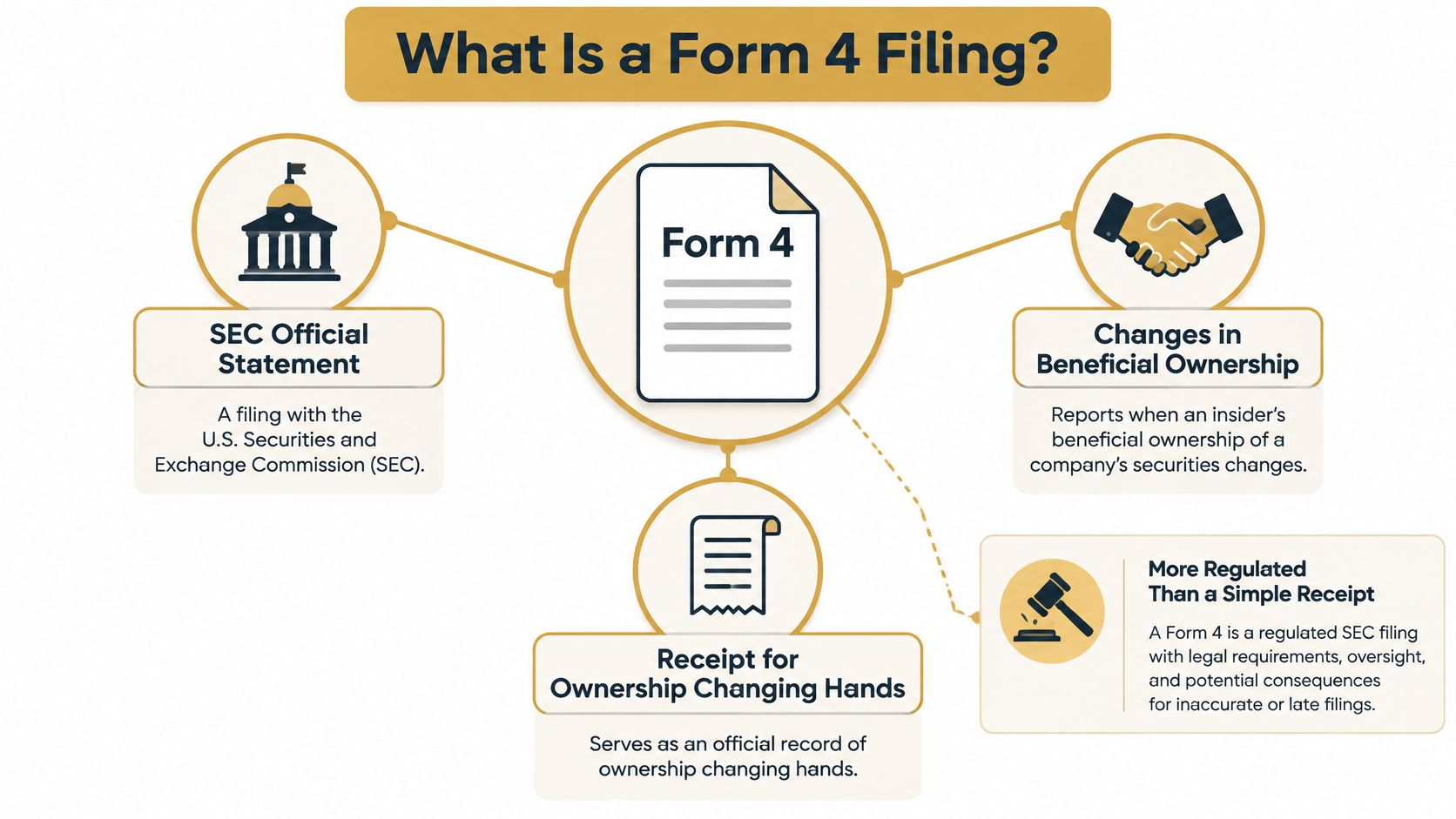
Think of Form 4 as a regulated receipt for a change in an insider's ownership. Unlike an ordinary brokerage confirmation, it creates a public record that other investors can inspect.
Its official name is Statement of Changes in Beneficial Ownership. The SEC's official Form 4 identifies the reporting person, company, security, transaction details, ownership form, and holdings after the reported event.
The ownership relationship is the central idea in this visual.
What beneficial ownership means for a reader
Beneficial ownership isn't necessarily the same as having shares registered in your own name. A filing can describe direct ownership or an indirect interest through an arrangement such as a trust, family entity, or controlled account.
That distinction matters because the person named on the form may not personally hold the securities in a brokerage account. Read the ownership description before treating the entire reported balance as their personally held stock.
The filing connects several pieces of information:
- Reporting person and issuer: Who reported the event and which company's securities were involved.
- Transaction details: The date, security, code, quantity, and applicable price.
- Resulting ownership: What remained after the transaction and how it was held.
The video below provides another introduction to the document.
The receipt analogy has a limit: not every ownership change is a purchase. Someone can receive securities through compensation or exchange a derivative for shares without making a new open-market investment.
So, what is a Form 4 filing useful for? Establishing a documented ownership change. Whether that change supports an investment thesis is a separate research question.
Who Must File a Form 4
Start with the reporting person's relationship to the company, not their fame, job title in a headline, or apparent wealth. Under the Section 16 framework, the principal covered groups are directors, executive officers, and holders of more than 10% of a company's registered equity securities, as identified in the SEC's Form 4 reporting instructions.
The reporting categories provide the starting point.
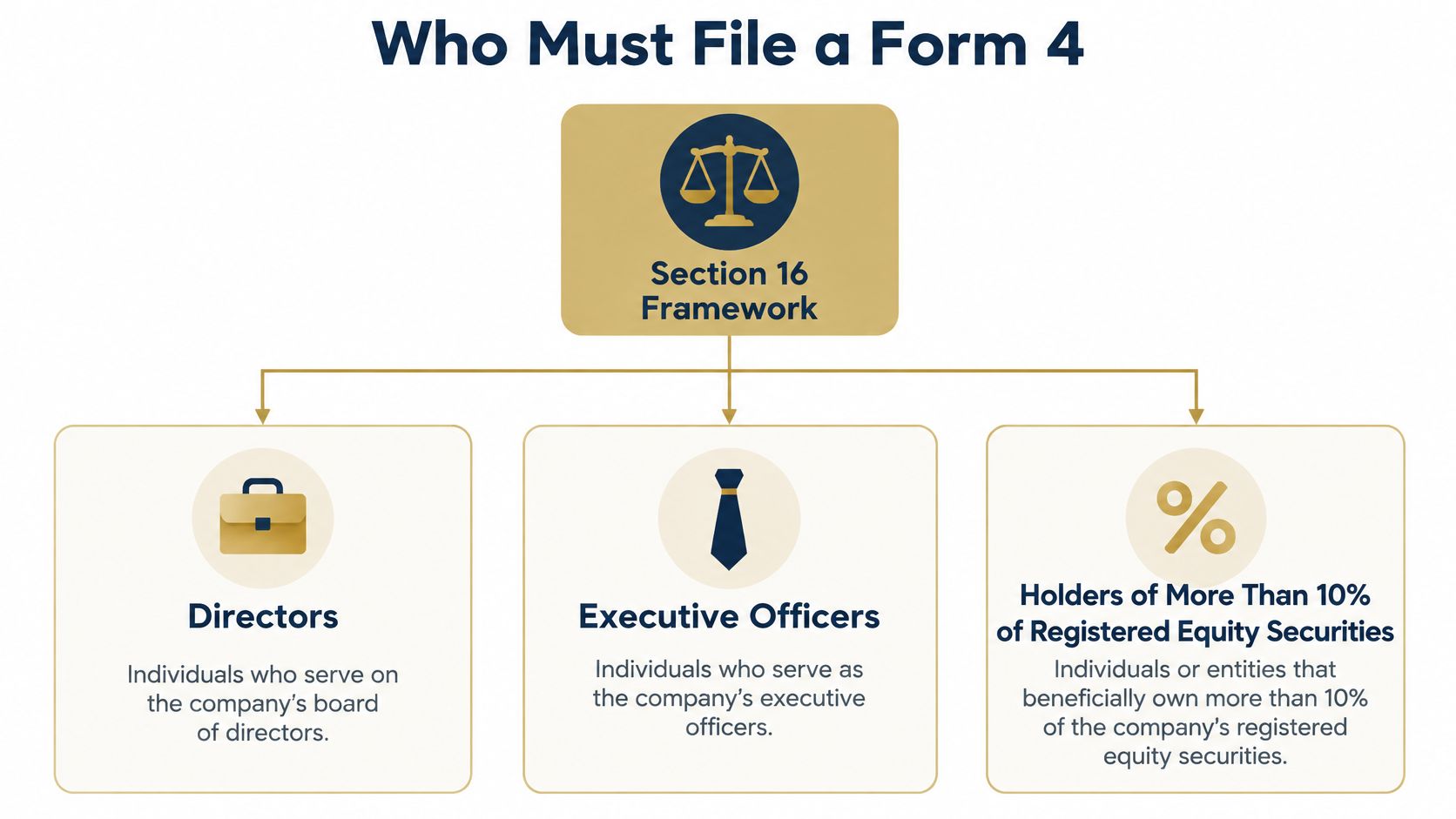
Identify the relationship before evaluating the signal
Use the filing's relationship information to classify the reporting person.
- Director: A board member, not necessarily someone managing the company's daily operations.
- Executive officer: A covered officer whose relationship places the filing within the insider-reporting framework.
- Large beneficial owner: A holder subject to the ownership-based reporting category, rather than necessarily a company employee.
Don't assume that everyone working at a public company files Form 4. Owning employer stock doesn't, by itself, establish that an employee belongs to a covered reporting category.
Likewise, a well-known outside investor doesn't automatically belong in the corporate-insider bucket. Check the actual relationship disclosed on the form instead of classifying the person from a social-media description.
Read the issuer and ownership vehicle together
The issuer is the company whose securities the filing concerns. Keep that company separate from any trust, investment entity, or account appearing in the ownership explanation.
For example, a hypothetical director's filing might report securities held through a family entity. The issuer is still the company whose stock changed hands; the family entity explains how the interest is held.
This isn't a complete test of every reporting exception or unusual situation. It's a practical screening habit: establish who reported, why they're covered, and whose securities are involved before treating the document as evidence about corporate-insider activity.
When Form 4 Must Be Filed
The deadline runs from execution, not settlement. Under the official form's general rule, submission is required before the end of the second business day after the transaction is executed, with limited categories eligible for deferred reporting.
That deadline is a reporting window, not a promise that public investors learn about the event immediately. A newly received alert can describe an ownership change that already happened.
The timeline below illustrates the general sequence.
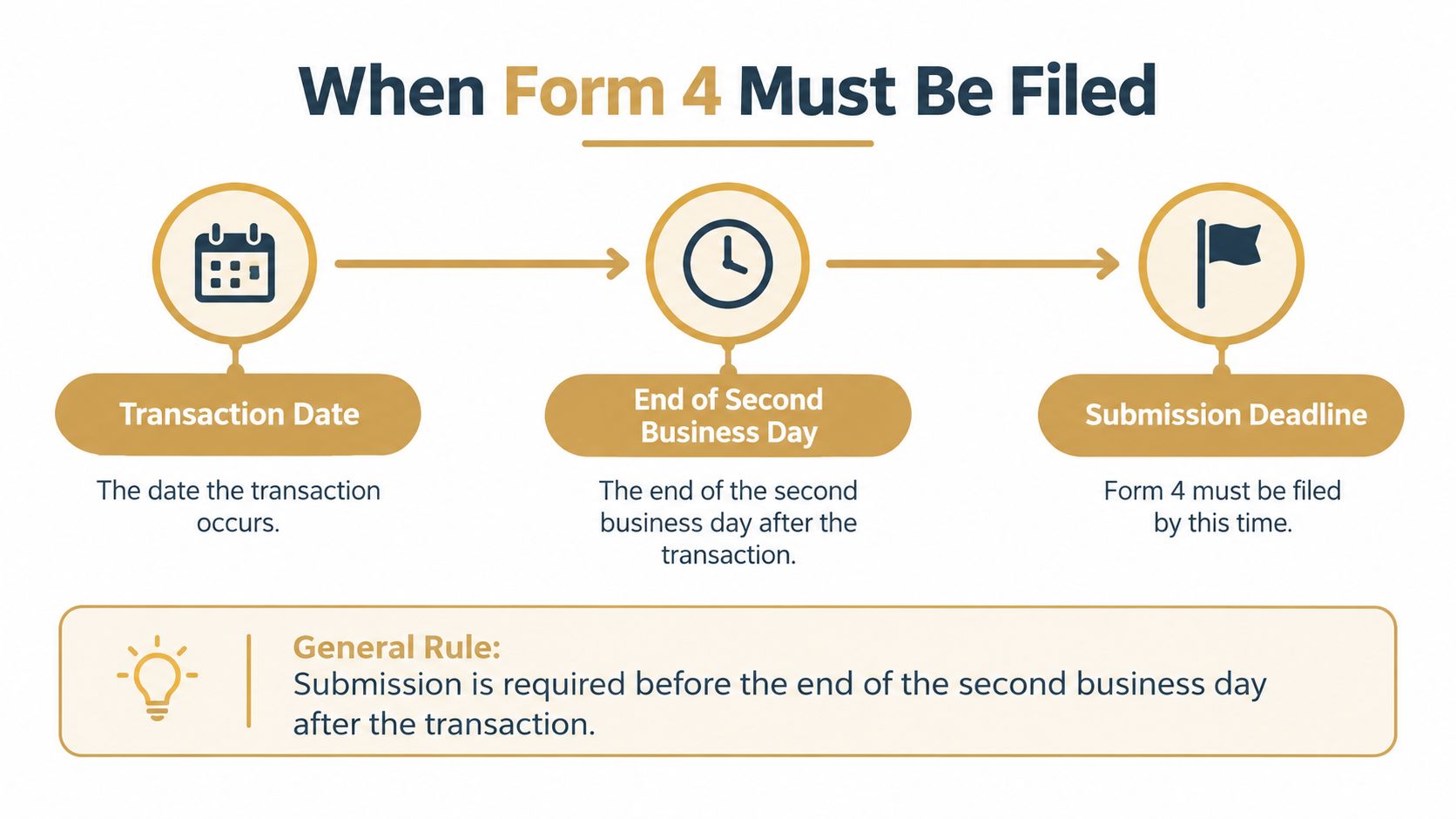
Keep the timestamps separate
The SEC's Form 4 instructions and timing requirements make execution timing central to the filing obligation. For research purposes, maintain separate fields for:
- Execution date: When the underlying transaction happened.
- Filing date: When the reporting document was submitted.
- Publication or alert timestamp: When your research platform displayed or notified you about it.
An alert timestamp answers when you learned about the filing. It doesn't replace the transaction date, and it shouldn't be used as though the insider traded at that moment.
Weekends and market holidays can affect the filing calendar. Special circumstances can also change the reporting treatment, so avoid declaring a filing late from a casual count of calendar days.
Fast disclosure still isn't live trading data
The practical mistake is treating a fresh notification as fresh execution. Those are different events, even when a platform delivers the notification promptly.
Practical rule: Check the transaction date before checking the chart.
Keep the same distinction when reviewing historical signals. If you evaluate a strategy using the execution date rather than the time the disclosure became available, you're giving yourself information you might not have had.
A disciplined research log should preserve the original transaction timing and the time of public availability. Otherwise, an apparently convincing insider-following idea may depend on hindsight rather than an observable disclosure.
How to Read Every Form 4
Read the document in a consistent order. Start with identity and timing, then determine the security and transaction mechanism, and finish with ownership and the remaining balance.
The form separates ordinary securities from derivative securities, such as options or convertible instruments. Derivative details can include an exercise or conversion price and expiration information, so don't combine every reported unit into a single share-purchase total.
Form 4 fields and what they answer
| Field | What it tells you | Question to ask |
|---|---|---|
| Reporting owner | Who disclosed the event | What is their relationship to the issuer? |
| Issuer | Which company's securities are involved | Am I researching the correct company? |
| Transaction date | When the event occurred | How old is the underlying activity? |
| Security title | What instrument changed | Is this stock or a derivative? |
| Transaction code | The reported transaction category | Was it a purchase, award, exercise, or something else? |
| Quantity and acquisition or disposition | What increased or decreased | Which direction did this particular entry move? |
| Price | Applicable transaction pricing | What does the price represent for this event? |
| Derivative terms | Exercise, conversion, and expiration details | How does this instrument relate to the underlying shares? |
| Ownership form | Direct or indirect holding | Who or what holds the reported interest? |
| Post-transaction balance | Holdings after the event | What exposure remained in this reported position? |
| Footnotes | Explanations attached to entries | Does an explanation change my initial reading? |
Follow a hypothetical filing through the sequence
Suppose an executive's filing shows an option exercise followed by shares used to satisfy a tax obligation. Reading only the acquisition entry could produce an insider-buying headline; reading only the reduction could produce an insider-selling headline.
Read together, the entries describe a different economic sequence. The executive exercised an existing instrument, received stock, and used some securities for an obligation. That's not equivalent to buying shares with fresh cash.
Use the post-transaction balance to check your interpretation. It describes the reported position after the event, not just the amount involved in the headline.
- Reconcile related entries: Look for a connected exercise, acquisition, or withholding sequence.
- Preserve ownership categories: Don't merge direct and indirect positions without understanding the relationship.
- Retain timing fields: Keep execution, filing, and alert timestamps distinct in your notes.
A useful summary should explain the event in plain English. If your summary is only “holdings increased,” you haven't finished reading.
Decode Common Form 4 Transaction Codes
The transaction code is the quickest way to challenge a misleading headline. It identifies the reported category, but you still need the price, ownership details, related entries, and footnotes to interpret the event.
The SEC's transaction-code guidance for ownership reports distinguishes purchases and sales from grants, exercises, tax-related transactions, gifts, transfers back to the company, and hedging arrangements.
Use the visual as an orientation aid, then rely on the more precise descriptions in the table.
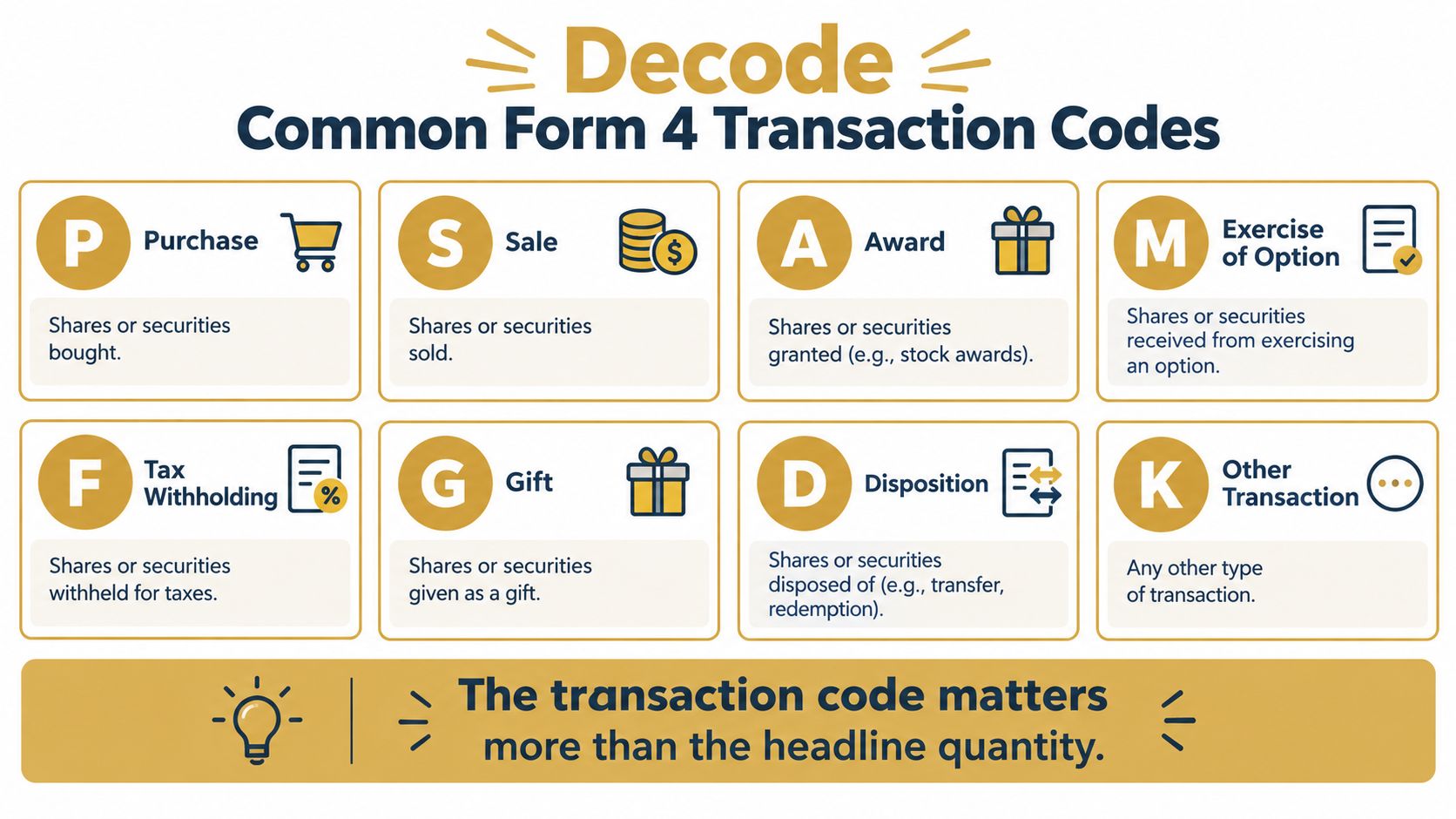
Common Form 4 transaction codes
| Code | General meaning | Why the distinction matters |
|---|---|---|
| P | Open-market or private purchase | Indicates a purchase, but doesn't by itself distinguish an exchange trade from a private transaction |
| S | Sale | Establishes a sale, not the seller's motivation |
| A | Grant or other acquisition from the company | Can increase holdings without a cash investment |
| M | Exercise or conversion of a derivative security | Can turn an existing instrument into shares rather than represent a new market purchase |
| F | Securities used to satisfy an exercise price or tax obligation | A reduction can reflect withholding rather than discretionary selling |
| G | Gift | Shouldn't be classified as an ordinary purchase or sale |
| D | Transfer back to the company | Isn't interchangeable with a market sale |
| K | Equity swap or similar hedging transaction | Requires attention to the arrangement's economic effect |
Similar quantities can describe different decisions
Compare hypothetical acquisitions coded P, A, and M. All may show an increase in common-stock ownership, but the mechanisms differ: a purchase, a company award, or the exercise or conversion of an existing derivative.
A purchase is more directly relevant to a cash-investment thesis than a compensation grant. Even then, you still need to examine whether the transaction was private, how ownership was reported, and what position remained.
Now compare reductions coded S, F, and G. They can all reduce reported holdings, but a sale, tax-related withholding, and a gift aren't interchangeable evidence of negative sentiment.
Avoid the shortcut: Acquired doesn't always mean bought, and disposed of doesn't always mean sold.
The same caution applies to derivatives. An M entry can increase common shares while changing the form of an existing exposure. Counting it as a new bullish purchase can exaggerate what the insider decided.
For screening, group acquisitions and dispositions by code, not just by direction. Keep compensation and tax events separately labeled, and investigate gifts, company transfers, and hedging rather than forcing them into a buy-or-sell sentiment score.
Compare Form 4 With Other Filing Signals
A corporate insider, a member of Congress, and an institutional manager can all appear in the same trade-tracking dashboard. Three names, three transactions, one scrolling feed. Treating them as the same kind of signal is where the analysis goes wrong.
Each disclosure answers a different question. Form 4 reports a specific ownership event by a covered insider, filed quickly after it happens. Congressional reports describe transactions with a delay and in ranges. Institutional filings capture a portfolio on a fixed schedule. Compare the source documents before you compare the apparent signals.
Congressional disclosures describe delayed transactions
Under the STOCK Act, covered congressional officials report qualifying securities purchases and sales exceeding $1,000 through Periodic Transaction Reports, per the Congressional Research Service's STOCK Act analysis. The same analysis describes the timing: generally within 30 days of receiving notice, subject to an outer limit of 45 days after the transaction, with values reported in broad dollar ranges.
Use House and Senate financial disclosures as the underlying records when researching congressional activity. A reported range isn't an exact position size, and the disclosure alone can't tell you whether the official still holds the security.
Keep policy research separate from accusation. Asking whether a legislative or regulatory proposal could affect a company's business is reasonable. Claiming a disclosed trade proves privileged knowledge is a conclusion the filing can't support.
Institutional filings describe holdings snapshots
A manager generally faces Form 13F reporting when it exercises investment discretion over at least $100 million in Section 13(f) securities, according to the SEC's Form 13F instructions. Reports are quarterly and generally due within 45 days after the relevant period.
A 13F doesn't show the manager's complete portfolio, and it reports no short positions. Changes between periods reflect what the filing captured at quarter end. Treat them as holdings research, not a live record of whale executions.
| Disclosure | Best research question |
|---|---|
| Form 4 | What ownership event did this covered insider report? |
| Congressional PTR | What transaction was disclosed, within what value range? |
| Form 13F | How did reported institutional holdings change between periods? |
The screening error that does the most damage is copying an apparent direction across filing types without matching scope, timing, and meaning. A delayed range, a quarterly snapshot, and a rapid event report measure different things. A dashboard that flattens all three into "insider bought" invites you to trade on a comparison the source documents never made.
Use Form 4 Signals Responsibly
A useful insider-research process ends with a defensible description, not an automatic trade. Your notes should explain the mechanism, ownership context, and uncertainty well enough that another reader could check them against the original filing.
Start with the source document in SEC EDGAR, where Form 4 filings are publicly available. A dashboard summary is a navigation aid; the filing is the primary disclosure record.
Build an evidence-based research note
Use a compact checklist that forces you beyond the headline:
- Classify the event: Assign the transaction category before attaching a bullish or bearish label.
- Reconcile the economics: Connect pricing, derivative terms, and related entries to determine whether the event involved a new cash investment or a different mechanism.
- Trace ownership: Keep the reported account, trust, or entity attached to the position.
- Compare the remaining position: Review the post-transaction balance alongside earlier filings rather than evaluating the disclosed quantity alone.
- Look across reporting people: Investigate whether several insiders reported comparable purchases, without assuming every cluster has the same explanation.
- Record uncertainty: Write down what the filing doesn't establish.
That last step matters. A filing doesn't establish the person's complete portfolio, future intentions, or current position after subsequent activity. It also doesn't guarantee any particular market outcome.
Keep policy hypotheses separate from evidence
For investors following government activity, separate the legislative question from the trading question. Ask what a proposal would change for a business, whether it has advanced, and what uncertainty remains before connecting it to a disclosed transaction.
Apply the same standard regardless of political party. Neither political affiliation nor a corporate title replaces evidence about the transaction itself.
TradeLikeInsiders brings congressional trades, insider activity, whale moves, and policy signals into one research platform. That can help organize related records, but an aggregated alert still needs the same source and timing checks as any other research input.
The strongest practical habit is to write a short explanation before drawing a conclusion: what changed, through which mechanism, and what you still don't know. If you can't explain the event without calling it bullish or bearish, revisit the filing.
Use that explanation as a research filter. Some disclosures will deserve closer investigation; others will turn out to be routine compensation or administrative activity. Rejecting a weak signal is a useful result, not a missed opportunity.
For an alternative to checking separate disclosure feeds manually, TradeLikeInsiders offers TradeLikeInsiders, which aggregates congressional disclosures, SEC insider filings, whale activity, and selected policy updates. Visit the platform to organize your Form 4 research, then verify relevant entries against the original filings before drawing conclusions. This content is for informational purposes only and is not financial advice. Do your own research.