
SEC Form 4 is the filing insiders must submit to the SEC, generally by the end of the second business day, after a change in their holdings of their company's stock.
The popular advice is to follow insider buying and avoid insider selling. That's too crude. An executive receiving compensation, exercising options, or moving shares into a trust can generate a filing without making a fresh prediction about the business.
A Form 4 records a legal event, not necessarily a bet. Before reacting to a headline, identify the transaction code and check what the insider still owns.
Table of Contents
- What SEC Form 4 Is in Plain English
- Who Must File and How Fast Filings Appear
- Reading Each Field on a Form 4
- Transaction Codes That Tell a Buy From a Routine Move
- Walking Through One Real Filing
- Routine Filings That Look Like Bets
- Form 4, Congress and 13F
- Turning Form 4 Signals Into a Research Routine
What SEC Form 4 Is in Plain English
SEC Form 4 is a public record of a change in an insider's ownership of company securities. Beneficial ownership means an ownership interest that can include securities held indirectly, not just shares sitting in a personal brokerage account.
The SEC's official Form 4 instructions call it a “Statement of Changes in Beneficial Ownership,” filed under Section 16(a) of the Securities Exchange Act of 1934, generally covering directors, executive officers, and holders of more than 10% of a registered class of equity securities.
That official name matters. It says changes, not investment recommendations.
Think of a ledger, not an opinion poll
A bank ledger records deposits and withdrawals. It doesn't tell you whether the account holder feels optimistic about the economy. Form 4 works similarly: it records changes that can have very different explanations.
Say an executive receives company shares as compensation. Their ownership rises, but they haven't necessarily opened a brokerage app and decided the stock is cheap. The distinction between receiving shares and choosing to purchase shares is the starting point for useful analysis.
The filing captures:
- Reporting person: The insider whose ownership changed.
- Issuer: The company that issued the securities.
- Transaction details: The date, security type, quantity acquired or disposed of, and price.
- Resulting ownership: What the insider holds after the reported event.
The form separates non-derivative securities, such as common stock, from derivative securities, such as options and warrants. A derivative is a security whose value or rights relate to another security.
The paperwork supports public transparency, but it doesn't supply a ready-made trading thesis.

What is SEC Form 4 useful for? Establishing what changed, who reported it, and how the event was classified. The transaction code and post-transaction holding help you decide what kind of change you're looking at.
Who Must File and How Fast Filings Appear
A transaction on Monday would generally produce a Wednesday filing deadline, assuming ordinary business days without a holiday. That's a useful hypothetical timeline, but don't confuse the deadline with the moment the insider traded.
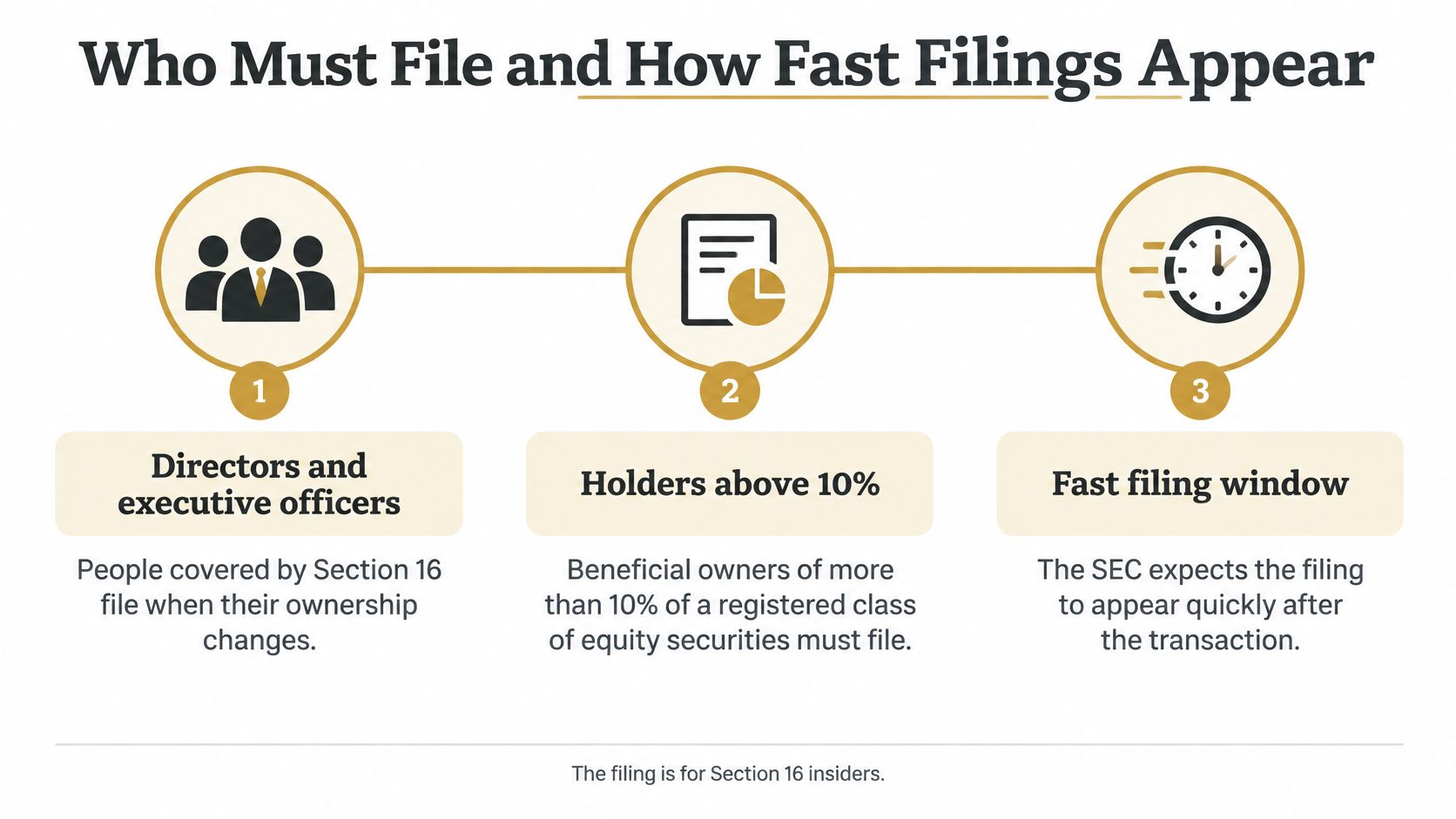
The SEC Form 4 filing requirements generally require submission by the end of the second business day after the transaction by covered directors, officers, and other Section 16 insiders. These are corporate ownership disclosures, not a public feed of orders executing at a broker.
The distinction between the people covered and the filing window is summarized below.
Keep the execution clock separate from the disclosure clock
EDGAR is the SEC's public filing system. A trader might encounter a record there, through an alert service, or in a news story after submission and acceptance.
Those discovery times aren't interchangeable. The transaction date tells you when ownership changed; the SEC filing timestamp tells you when the disclosure entered the public filing record. A news headline adds another timestamp that may be later still.
Each transaction appears on a separate line. A filing can therefore contain different types of ownership changes rather than a single uniform purchase or sale. The form also distinguishes the transaction date from a deemed execution date, a separate reporting date used where applicable.
Practical rule: Build the timeline from the transaction date and filing timestamp, not the time somebody posted a screenshot.
What a useful alert pipeline preserves
For an alerting system, the workflow should be explicit:
- Retrieve the filing from EDGAR when it's accepted.
- Parse each transaction line into the reporting person, issuer, date, code, quantity, price, and resulting ownership.
- Store both clocks: The actual transaction date and SEC filing timestamp belong in separate fields.
- Translate the codes into plain-English labels without changing their meaning.
- Connect amendments to the original filing so corrected records don't become duplicate trades.
- Display the disclosure delay alongside the alert.
This is also how to evaluate a service before trusting its notifications. A fast alert about a delayed disclosure is still a delayed disclosure.
Our congressional and insider disclosures on TradeLikeInsiders are delayed and aren't real-time trades. Getting the notification quickly doesn't rewind the market to the insider's execution price.
For a video companion to the filing process, use the embedded player below.
Reading Each Field on a Form 4
Start at the top, not at the biggest number. Identify the reporting person, their relationship to the company, and the issuer before interpreting any transaction.
Then identify the security. Table I covers non-derivative securities, including common stock; Table II covers derivatives, including options and warrants. Buying common shares and exercising an option aren't interchangeable events.
Key Form 4 fields and what each tells you
| Field | What It Tells You | Where to Find It |
|---|---|---|
| Reporting person | Who the insider is and their relationship to the issuer | Reporting owner section |
| Issuer | The company whose stock changed hands | Issuer section |
| Transaction date | The day the change actually happened | Table I, each line |
| Security title | Common stock or a derivative such as an option or warrant | Table I or Table II |
| Transaction code | Why the change occurred, such as P for a purchase | Transaction code column |
| Amount and A/D flag | Shares acquired (A) or disposed of (D) | Amount column |
| Price | Per-share price; often blank or zero for grants and gifts | Price column |
| Shares owned after | Holdings after the trade, the best gauge of remaining exposure | Post-transaction amount column |
| Direct or indirect (D/I) | Whether shares are held personally or through a trust or entity | Ownership form column |
The A/D flag describes direction, not motivation. An acquisition increases the reported holding, but that alone doesn't establish that the insider spent personal cash buying stock.
Price needs the same care. A blank or zero-price field on a grant or gift isn't a market quote. Read the transaction type and explanatory footnotes before treating the price field as evidence of what someone paid.
Read a line as a sentence
A Form 4 published by the SEC in 2025 reported the acquisition of 3,000 common shares at $12.17 per share. That gives you the security, quantity, acquisition direction, and reported price.
It doesn't, by itself, answer every investment question. You still need the reporting person, transaction classification, ownership form, and holding after the event.
Read each line in this order: the insider acquired or disposed of the stated security, through the stated transaction type, at the reported price, leaving the stated ownership balance. This turns scattered columns into an understandable record.
Check the transaction code, post-transaction holding, and transaction date first. Then use the remaining fields and footnotes to test your initial reading rather than hunting for confirmation.
Transaction Codes That Tell a Buy From a Routine Move
The code, not the headline, explains the transaction category. A screen that labels every increase as buying and every decrease as selling mixes investment decisions with compensation, taxes, and transfers.
The acquisition/disposition flag and transaction code are separate fields. In particular, an A flag doesn't automatically mean an A transaction code, and a D flag doesn't automatically mean a D transaction code.
Common Form 4 transaction codes
| Code | Meaning | How to Read It |
|---|---|---|
| P | Open-market or private purchase | Purchase activity, the code most often watched for a discretionary buy |
| S | Open-market or private sale | Sale activity; check for scheduled execution, taxes, or diversification context |
| A | Grant, award or other acquisition from the company | Usually compensation, not a market view |
| M | Exercise or conversion of a derivative security | Often an option exercise; check related lines for a sale |
| F | Shares withheld or delivered to pay exercise cost or tax liability | Mechanical withholding or payment, not an open-market sale |
| G | Bona fide gift | No purchase consideration changes hands |
| D | Disposition back to the issuer | Often administrative or a settlement |
P and S identify purchase and sale activity, including private transactions. They don't, on their own, prove that the insider made a spontaneous decision based on today's valuation.
A purchase is worth investigating because the insider acquired securities through a purchase transaction rather than receiving an award. A sale needs context because selling can serve purposes besides expressing a negative outlook.
Follow the sequence, not just the largest line
Say a filing contains an M acquisition of common shares and an S disposition. An option exercise followed by a sale is a different sequence from selling shares that the insider had held independently.
An option exercise means using the contractual right to acquire the underlying shares at the option's exercise price. The resulting common shares can then be retained, sold, or used in related transactions.
A code classifies an event. It doesn't disclose everything the person believed when it happened.
Likewise, F shouldn't be described as an insider dumping stock into the market. Withholding shares for an exercise cost or tax obligation is mechanically different from placing a sell order.
Read every line and its footnotes before adding quantities together. A filing can combine awards, exercises, withholding, and sales, and a single sensational label can erase those distinctions.
The useful mental shortcut is modest: investigate P, contextualize S, and decode the other letters before forming a view. None of those codes is a standalone recommendation.
Walking Through One Real Filing
A Form 4 published by the SEC in 2024 reported 50,000 common shares acquired at $4.21 per share and 50,000 shares sold at $45.9551 per share, a calculated per-share price gap of about $41.75.
That record is a useful test of headline skepticism. Calling the acquisition an ordinary stock purchase without checking its code could lead to a very different interpretation from the underlying filing.
Read the record in filing order
Begin with the reporting owner and issuer sections. Establish whose ownership is being reported, their corporate relationship, and which company's securities appear in the tables.
Next, inspect the transaction dates. Don't assume that entries appearing in the same document occurred simultaneously or formed a single economic decision.
Use this reading sequence:
- Acquisition line: Confirm the common-stock title, acquisition flag, reported quantity, price, transaction code, and resulting holding.
- Disposition line: Read the sale independently, including its date, disposition flag, price, and ownership balance afterward.
- Derivative table: Check whether related options or other derivative securities explain how the common shares were acquired.
- Footnotes: Look for explanations of transaction mechanics, ownership arrangements, or pricing.
The important move is to pair the quantity and price with the code. An acquisition paired with a sale may reflect an option exercise followed by a sale, but the code printed on the filing must establish that classification. Don't infer it merely because the acquisition price looks low.
What the price difference does and doesn't tell you
The arithmetic is straightforward: subtract the acquisition price from the sale price and round the result. The interpretation is not.
That gap isn't automatically the insider's complete economic profit. A full accounting could require information about derivative terms, taxes, transaction costs, and related events that a quick subtraction doesn't capture.
Nor does the price difference prove that the insider predicted a near-term decline or had a particular plan for the proceeds. Reported prices are facts; motives require evidence. Even a well-documented exercise-and-sale sequence shouldn't be rewritten as a personal explanation the filing doesn't provide.
Before summarizing any paired transactions, ask:
- Same day or not? Compare the actual transaction dates.
- Same securities or not? Match the class and quantity rather than assuming they offset.
- What remains afterward? Read the ownership balances and the nature of that ownership.
Those checks produce a more useful description than either insider bought or insider sold.
Routine Filings That Look Like Bets
A Form 4 published by the SEC in 2024 disclosed 6,000,000 Class B shares contributed to a grantor retained annuity trust. That's a substantial ownership event, but a contribution to a trust isn't an open-market sale.
A grantor retained annuity trust, often shortened to GRAT, is an estate-planning arrangement in which the person establishing the trust retains annuity payments under its terms. Moving shares into that structure changes the ownership arrangement; it doesn't establish a bearish market forecast.
This distinction is exactly why a transfer deserves its own label.

Administrative changes can look dramatic
Many ordinary corporate ownership events can produce eye-catching quantities:
- Compensation grants: The company awards equity under a compensation arrangement.
- Automatic exercises: Contractual or administrative mechanics trigger an exercise.
- Tax withholding: Shares cover an obligation associated with compensation or an exercise.
- Gifts and transfers: Securities move without an ordinary market purchase or sale.
These events still matter for ownership, governance, and future exposure. Calling them routine doesn't mean ignoring them. It means refusing to assign a market opinion that the record doesn't support.
Avoid the indirect-ownership trap
A trust, partnership, or family entity can appear as an indirect holding. If an aggregation system treats every ownership line as an unrelated personal position, it can misdescribe the insider's exposure.
Match the ownership form and footnotes before combining balances. A change from personal ownership to an indirectly held arrangement requires a different explanation from a sale to an outside buyer.
The same caution applies to substantial beneficial owners who file because of their ownership status. Their reported activity may reflect entity management or ownership restructuring rather than an operating executive's assessment of the business.
Research habit: Describe the mechanism first. Consider sentiment only after the mechanism is clear.
A single line rarely proves much about conviction. Patterns across filings, the filer's role, and the transaction categories are better grounds for further investigation, though they still don't establish a forecast.
Form 4, Congress and 13F
| Disclosure feed | What it describes | Where to verify it | Main interpretation risk |
|---|---|---|---|
| SEC Form 4 | Changes in a covered corporate insider's beneficial ownership | SEC EDGAR | Treating compensation or transfers as investment decisions |
| Congressional Periodic Transaction Report | Covered reportable transactions involving a filer or applicable family holdings | House and Senate financial disclosure systems | Treating delayed amount ranges as precise, current positions |
| Form 13F | Reportable institutional holdings at quarter end | SEC EDGAR | Treating a holdings snapshot as a transaction-by-transaction feed |
These records answer different questions. Form 4 describes an ownership change; a congressional report describes a covered transaction; Form 13F describes reportable holdings.
A Periodic Transaction Report, or PTR, is the congressional transaction disclosure associated with the STOCK Act. According to the Senate Ethics Committee's financial disclosure guidance, covered purchases, sales, or exchanges exceeding $1,000 must be reported within 30 days of written notification, but never later than 45 days after the transaction.
Compare the dates before comparing the actors
Congressional amounts are reported in ranges, not necessarily exact dollar values. A broker confirmation or account statement can supply the written notification, so an investor may encounter the disclosure well after execution.
Applicable reporting can include a spouse or dependent child. Don't automatically attribute every reported family transaction to the official personally directing a trade.
Form 13F has another limitation: it's a quarterly report of institutional managers' reportable holdings, not a list of their individual executions. It generally becomes due after quarter end, so a newly published position shouldn't be treated as something a fund just bought.
Policy context isn't proof of causation
Government decisions can affect sectors through spending, regulation, approvals, and restrictions. To evaluate that connection, identify the actual agency action or legislative text, distinguish a proposal from an enacted measure, and examine how the business earns revenue.
Committee exposure can supply context for congressional disclosures. It doesn't prove that an official used nonpublic information, and the same evidentiary standard should apply regardless of party.
Likewise, an institutional “whale,” meaning a large investor, doesn't become correct merely because its position is large. Compare each record's measurement date, publication date, and scope before combining it with another signal.
Turning Form 4 Signals Into a Research Routine
A useful research routine should slow down your interpretation without burying you in paperwork. The decision you control is whether to investigate a disclosure carefully or react to its headline.
Make every signal pass these checks
- Classify the event. Match the transaction code with the A/D flag. Resolve any conflict between the headline and the filing.
- Rebuild the timeline. Compare the transaction date with the filing timestamp, then examine what happened to the company in between.
- Establish context. Compare the insider's earlier filings, corporate role, ownership form, and remaining exposure. Read amendments before treating a pattern as confirmed.
- Test independent evidence. Examine institutional holdings, congressional disclosures, and relevant policy documents without assuming they describe the same period or support the same conclusion.
Keep a research journal that separates documented facts, your interpretation, and unanswered questions. If you can't explain why an event matters without relying on a dramatic headline, leave the conclusion open.
None of this is a recommendation to buy or sell a specific security. The purpose is to turn public records into better questions, not automatic orders.
We at HeliosNet LLC offer TradeLikeInsiders, which brings congressional trades, SEC insider activity, whale moves including on-chain flow, and policy signals into one research platform, with delayed disclosures identified as such. Visit TradeLikeInsiders to investigate a filing alongside its timing and related signals rather than trading on a headline. This content is for informational purposes only and is not financial advice. Do your own research.