
“Follow the smart money” is popular advice, but it skips the hardest question: what did you learn, and when could you have learned it? A politician's disclosed purchase, an executive's sale, or a large fund's holding can be useful evidence. None tells you, by itself, whether today's price offers an opportunity.
Why do market research? To test the story before you risk money on it, including the uncomfortable possibility that the story is already priced in.
Table of Contents
- The Three Reasons Market Research Exists
- Managing Risk Before You Commit Money
- Generating Ideas and Spotting Policy Shifts Early
- Reading Disclosure Sources and Their Time Lags
- How Retail, Quant and Institutional Traders Use Research
- Common Mistakes That Create False Confidence
- Build Your Signal Ledger Before You Act
The Three Reasons Market Research Exists
Market research is the habit of gathering evidence, testing it, and checking it against what happened before you commit money, time, or a product. For traders, that means investigating both the underlying business and the information surrounding a potential trade.
The public trades on news while informed participants trade on information. That's a useful distinction, not a claim that every insider knows the future or that public information is worthless. A headline attracts attention; research asks whether the facts change expected earnings, financing costs, demand, or ownership.
The three reasons at a glance
| Reason | Question It Answers | Mistake It Prevents |
|---|---|---|
| Risk management | Does the evidence support committing capital? | Acting on hype or a single anecdote |
| Idea generation | Where is demand, a catalyst, or a sector shift forming? | Missing changes until the price has already moved |
| Policy and regulatory impact | Which sectors and companies does this rule or bill touch? | Being surprised by rules that reprice whole industries |
These reasons overlap. A proposed regulation might generate an idea, reveal a risk in an existing position, and change which companies deserve further investigation.
The difference is the decision you're trying to make. Finding an interesting company isn't the same as establishing a sensible entry, and identifying a policy beneficiary isn't the same as proving that investors have underestimated its prospects.
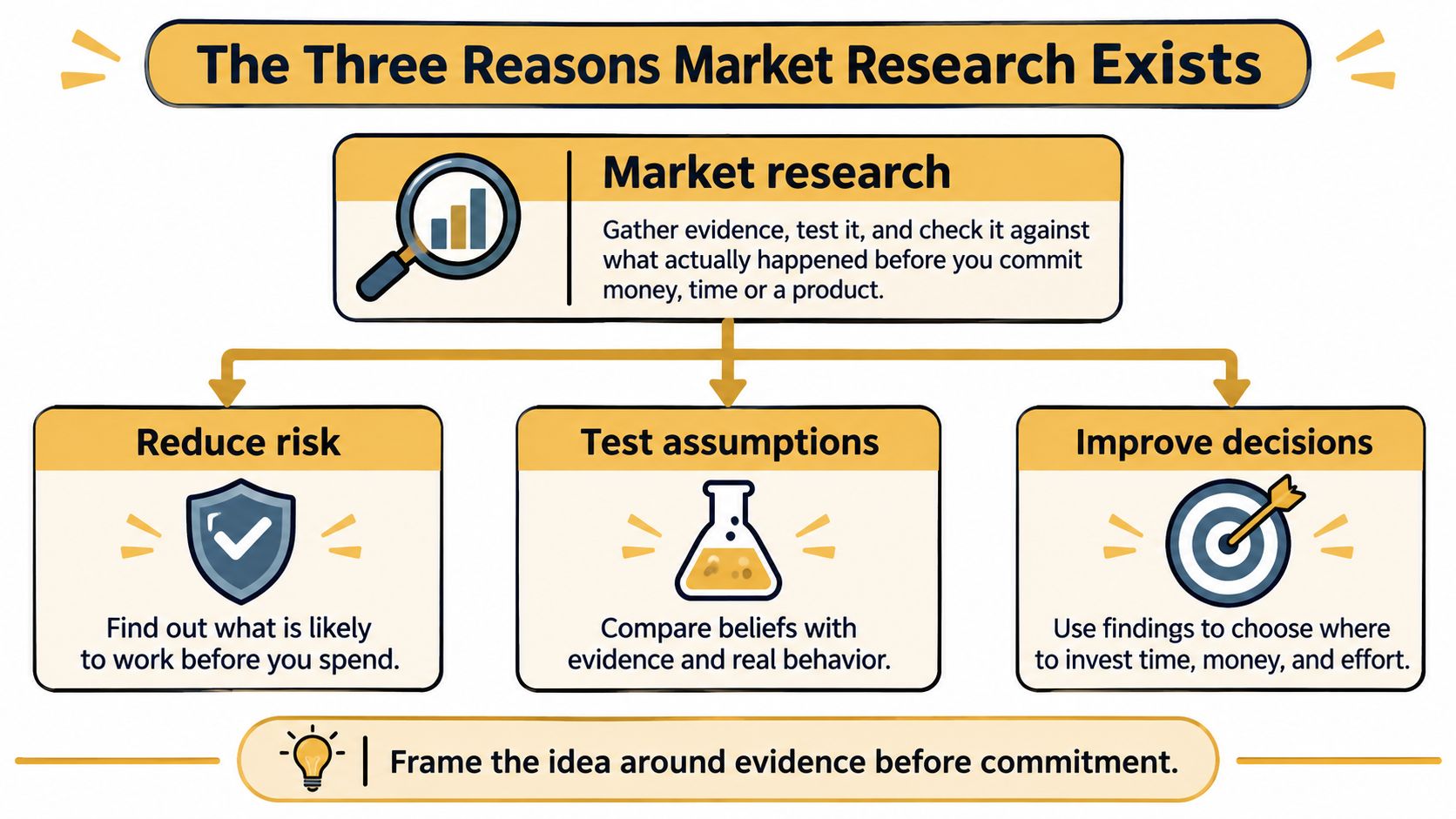
Evidence before commitment
Retail investors, quantitative traders, and institutional teams all use research. Their tools and constraints differ, but none can replace a clearly stated question with a pile of alerts.
Apply this test before treating an observation as actionable:
- Support: What evidence supports the idea beyond someone else's involvement?
- Disproof: What outcome would show that the explanation is wrong?
- Availability: When was the supporting information available to the public?
The last question matters more than a convincing chart. A strategy that looks brilliant only when you use information published after the supposed entry isn't a strategy you could have followed.
Managing Risk Before You Commit Money
Skipping research means committing capital before you understand the conditions that could defeat your idea. The consequences are visible well beyond trading: the Bureau of Labor Statistics business-survival analysis found that 34.7% of establishments born in March 2013 were still operating in March 2023, roughly two-thirds had exited, and the sharpest decline came in the first year, when survival fell by 20.4 percentage points.
The same BLS analysis puts ten-year survival at 50.5% in agriculture, forestry, fishing, and hunting; 43.6% in manufacturing; 32.1% in wholesale trade; and 24.5% in mining, quarrying, and oil and gas extraction.
Those are establishment-survival figures, not stock-return probabilities. They don't prove that research caused survival, either. They illustrate why treating different industries as interchangeable is a poor starting point.
Research the business behind the signal
A risk-focused pass checks industry structure, customer demand, competitive intensity, regulation, costs, and timing. An insider purchase doesn't answer those questions for you.
Say an executive buys shares in a manufacturer facing rising input costs. The purchase deserves attention, but you still need to investigate whether the company can raise prices, whether customers are delaying orders, and whether competitors have spare capacity.
Similarly, an institutional holding in a regulated sector doesn't establish that an approaching rule is favorable. The manager could have a different time horizon, offsetting positions, or a thesis unrelated to the policy you're watching.
Practical rule: Research should identify how you could be wrong before it helps you explain why you might be right.
Write the risk case before the trade case
Use a pre-trade checklist that forces a decision rather than another round of browsing:
- Required conditions: State what must happen for the thesis to work, such as improved margins or a rule taking effect.
- Invalidation: Name the evidence that would contradict it. Avoid vague escape clauses that let every outcome fit.
- Capital exposure: Compare the possible loss with your financial capacity and other correlated positions.
- Review point: Decide when you'll reassess, including what you'll do if nothing develops.
Research cannot guarantee an outcome. Its practical value is reducing the chance that you mistake an appealing story for an adequately tested decision.
Generating Ideas and Spotting Policy Shifts Early
A policy headline is not a trading signal. The useful question is whether a change reaches a company's costs, demand, or permitted activity, and when investors might price in that effect. A sound business thesis can still arrive too late, or take years to reach earnings.
Trace the chain: a bill, rule, or agency decision changes business conditions; those conditions affect companies; investors reassess exposed securities. Test each link. A proposal may not become law, and an enacted measure may have exceptions, delayed implementation, or little effect on a company's results.
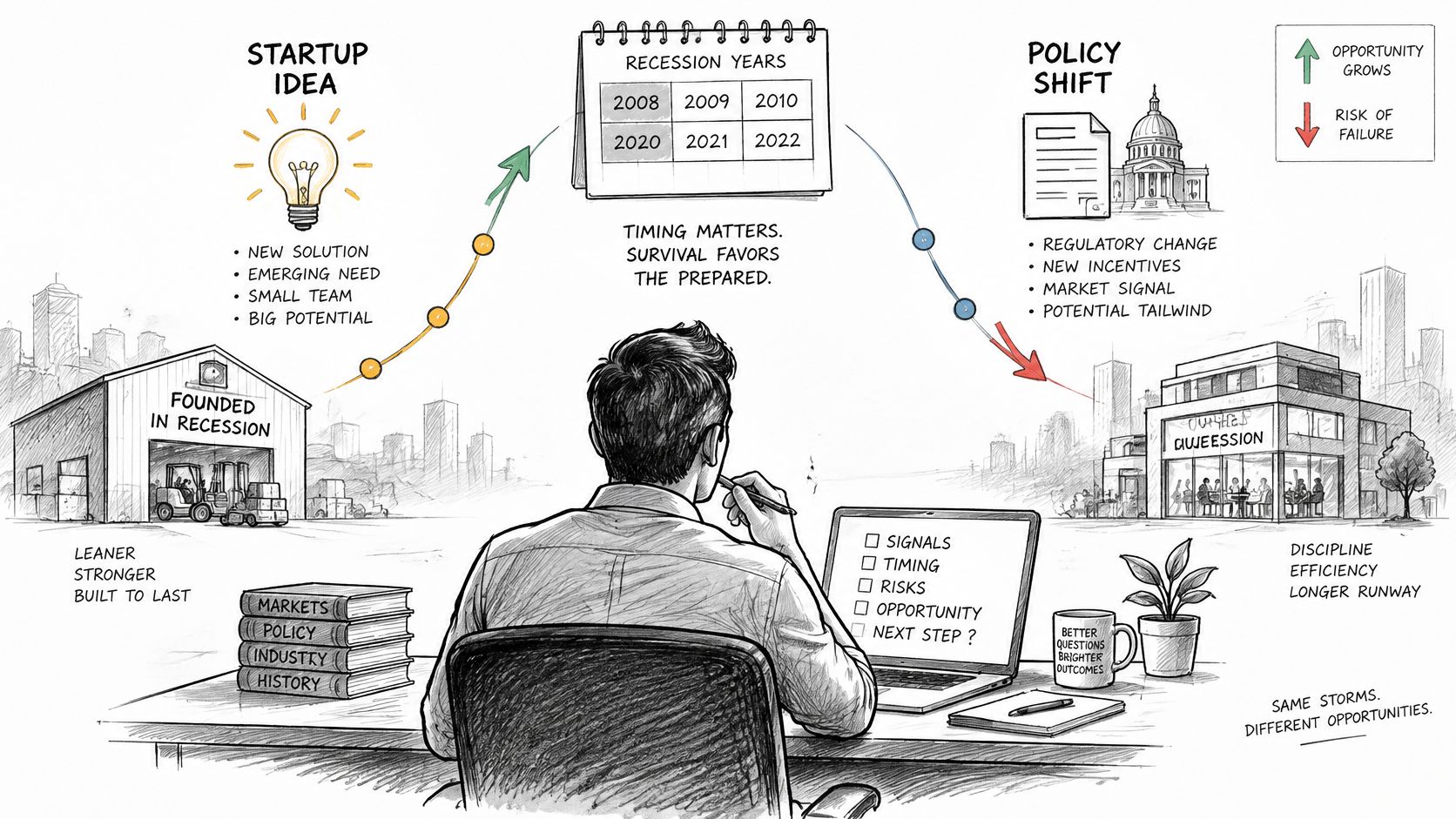
Trace the policy to the income statement
- Read the underlying text. Distinguish a proposal from an enacted law, final rule, or agency guidance. Check who is covered, what exceptions apply, and when implementation begins.
- Identify who pays and who benefits. A subsidy may help a recipient but affect its suppliers differently. Compliance costs might pressure smaller competitors while established operators absorb them more easily.
- Check the price reaction and timing. Compare trading around the announcement with the price action beforehand. The market may have anticipated the change before it appeared in your feed.
- Rank direct exposure. Focus on companies whose revenue, costs, or financing could change. A shared sector label alone is weak evidence.
- Set confirmation and rejection conditions. Look for contract awards, updated company guidance, changed customer orders, or signs that implementation has stalled. Treat each as a lead to test, not a reason to act automatically.
Interest-rate decisions can affect banks through funding costs and lending margins, utilities through financing needs, and real estate through borrowing costs and property demand. The effects can differ across businesses, so the policy direction alone does not settle the thesis.
Tariffs may raise costs for importers and companies with overseas supply chains. Pricing power and alternative sourcing can change the impact. Defense-spending headlines may point to contractors, but an authorization does not show which company will win orders or whether those orders will be profitable.
Use AI to widen the search, not certify it
AI can summarize lengthy policy documents and suggest industries to investigate. It can also make an incomplete reading sound conclusive. The Greenbook discussion of market research's AI shift reports that 67% of market-research suppliers embedded generative AI in client deliverables in 2025, while 40% of researchers identified data quality as their top barrier. These findings describe research work, not trading-model accuracy.
Use generated analysis to locate the source documents. Check for omitted exemptions, confusion between a proposal and an effective rule, or repeated articles that all rely on the same announcement. AI can widen the search; it cannot remove uncertainty about interpretation, implementation, or timing.
Congressional trading can suggest where attention is concentrated, but it does not establish that legislation will pass or that a transaction reflects a particular policy view. Disclosures may also arrive after the trade, and reported amounts can be range-coded, limiting what the record shows about size and timing. Apply the same evidentiary standard to members of both parties.
Reading Disclosure Sources and Their Time Lags
Disclosure sources, deadlines and lags
| Source | Who Files It | Filing Deadline | What the Lag Means |
|---|---|---|---|
| STOCK Act Periodic Transaction Report | Members of Congress and covered officials | Earlier of 30 days after notice or 45 days after the trade | The public may learn of a trade up to 45 days after it happened |
| SEC Form 4 | Corporate officers, directors, and large shareholders subject to reporting | Before the end of the second business day after the change | About two business days from transaction to public filing |
| SEC Form 13F | Institutional managers above the reporting threshold | Within 45 days after each calendar quarter end | Holdings are a snapshot from quarter end and may be weeks or months old |
The congressional deadline comes from the STOCK Act reporting statute, which requires qualifying transactions exceeding $1,000 to be reported by the earlier of 30 days after notice or 45 days after the transaction. The SEC's Form 4 instructions require filing before the end of the second business day after a qualifying change in beneficial ownership.
The Form 13F row describes the SEC Form 13F reporting schedule. Treat these institutional filings as historical portfolio snapshots, not a live feed of whale purchases.
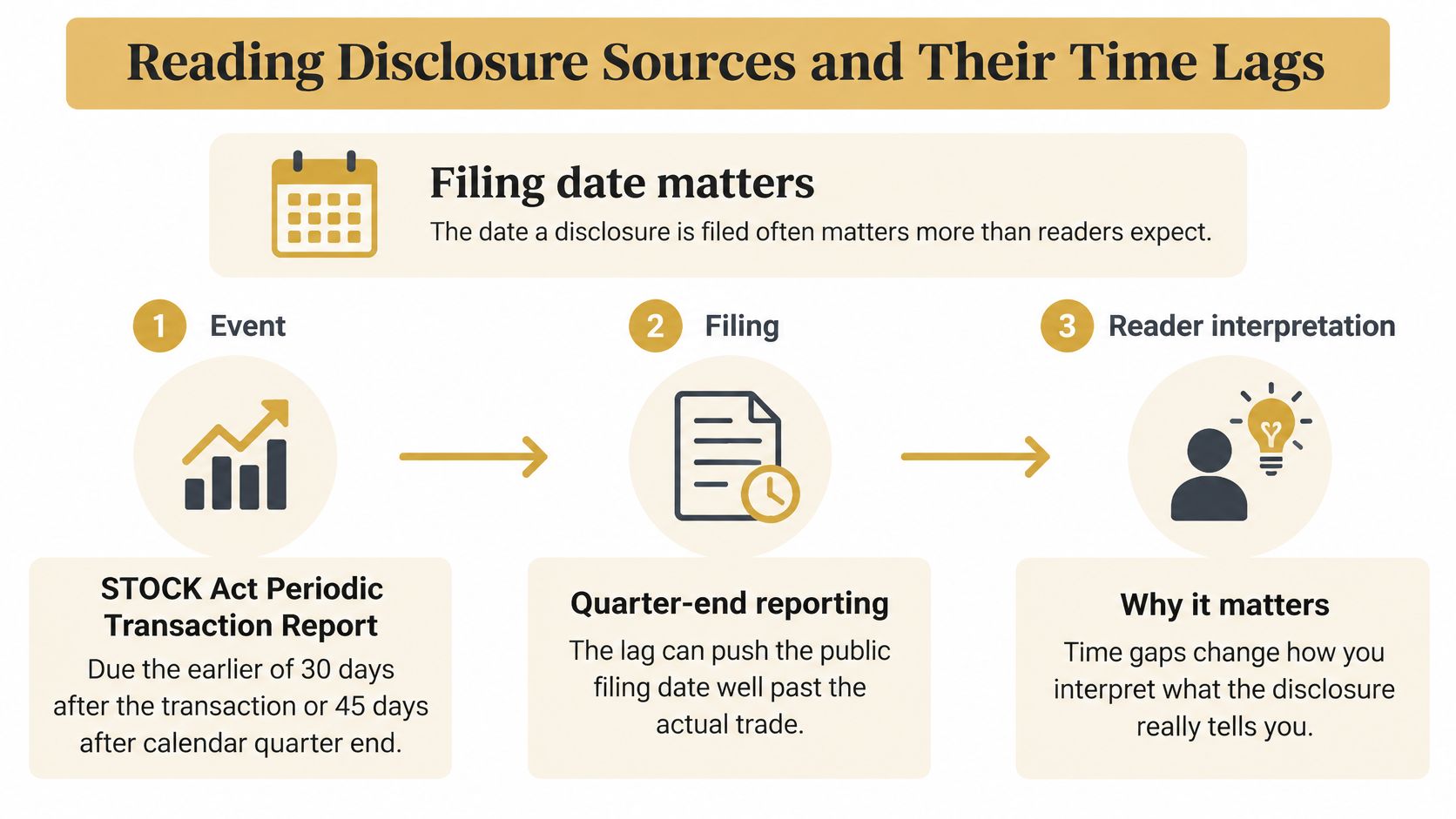
Use the statutory congressional deadline stated above, not a calendar-quarter deadline. Congressional PTR timing and institutional quarter-end reporting are different systems.
Read what the filing actually establishes
The House financial-disclosure framework reports congressional transaction amounts in broad ranges, not exact invested amounts. A purchase establishes direction and an approximate size band; it doesn't give you an exact entry price, share count, or percentage of the filer's portfolio.
Form 4 provides more transaction detail, but interpretation still matters. Beneficial ownership includes securities someone owns directly or can control or benefit from indirectly. Check transaction codes, footnotes, and resulting holdings to distinguish discretionary open-market activity from awards, option exercises, or tax withholding.
A Form 13F holding also needs context. Compare successive filings, but don't equate a changed holding with a manager's complete strategy or current conviction. On-chain whale flow is a different kind of evidence again: a wallet transfer establishes movement, not necessarily a purchase, sale, or known owner's intent.
A filing is evidence of a reported event, not permission to fill in everything it leaves unknown.
Keep the dates separate
Log the transaction or holdings date, public filing time, and price-observation time. For a quarter-end snapshot, use its reporting-period date rather than inventing a trade date.
Verify congressional records through the House and Senate financial-disclosure pages. For corporate and institutional reports, check SEC EDGAR and the filing itself. An aggregator helps you find the document; the document determines what you can responsibly conclude.
How Retail, Quant and Institutional Traders Use Research
A corporate insider purchase reported on Form 4 gives different researchers different jobs. A retail investor may ask whether the company deserves a closer look. An active trader may care primarily about the reaction after publication, while a quantitative researcher asks whether comparable events have produced repeatable results.
The institutional question is broader: does this observation change the investment case enough to justify altering an existing portfolio? The same filing can matter without producing the same decision.
Research needs by trader type
| Trader Type | Core Question | Main Data Used | Biggest Constraint |
|---|---|---|---|
| Retail investors | Which news, filings, or public-official activity deserves a closer look? | Public filings, news coverage, earnings releases | Limited time and delayed disclosures |
| Active traders | Is there a short-term catalyst, and how fast is it priced in? | Price and volume data, event calendars, filing alerts | Speed of reaction and transaction costs |
| Quantitative traders | Does a signal repeat across many events with a measurable edge? | Large historical datasets and backtests | Overfitting and data quality |
| Institutional investors | How does a policy change shift sector exposure in the portfolio? | Company filings, policy documents, portfolio exposures, and liquidity data | Position size, liquidity, and slower decision cycles |
Match the work to the decision
For a retail investor, the useful next step might be reading the latest earnings release and checking the buyer's role. The executive's business responsibilities may help frame questions, but the purchase doesn't establish the answers.
An active trader studies price and volume around publication. A persuasive business thesis may have little relevance to a short holding period if there's no identifiable near-term catalyst. Spreads, slippage, and transaction costs also belong in the assessment, not in a footnote after the result.
A quantitative trader records the purchase as a feature, meaning an input to a model. The researcher tests comparable events, accounts for other announcements, and checks whether the apparent relationship survives on observations not used to develop the strategy. Overfitting happens when a model captures quirks in its historical sample rather than a relationship likely to persist.
An institutional team cross-checks the signal against fundamentals, sector exposure, and position limits. Even an attractive thesis may be impractical if the team can't establish or exit a position without substantially affecting the price.
Borrow the discipline, not the infrastructure
You don't need an institutional research budget to adopt useful habits:
- Document the question: Decide whether you're evaluating a business, an event reaction, or a repeatable pattern.
- Preserve the timestamp: Keep the information set that existed when the decision was possible.
- Measure the result: Choose an outcome consistent with the original question.
For retail participants, a major constraint is relying on public information that may arrive after the underlying activity. Treat the observation as a lead for investigation, not a trigger that obliges you to trade.
Common Mistakes That Create False Confidence
The most tempting mistake is treating a polished explanation as stronger evidence. More information can make research worse when summaries hide uncertainty, apparent precision exceeds the source, or repeated coverage makes a lone observation look widely confirmed.
Keep observed facts, modeled inferences, and speculation in separate columns. “A filing reports an acquisition” belongs in the first; “the buyer expects improving demand” belongs in the second unless supporting evidence establishes it. “An announcement is imminent” may be speculation.
Replace shortcuts with checks
- Confusing publication with execution: Use your date fields to establish which event your chart measures. Never assess an alert using a price available only before publication.
- Turning a reporting band into an exact position: Preserve the disclosed range. Don't calculate precise conviction from an unknown portfolio denominator.
- Treating every insider acquisition alike: Inspect the transaction code and footnotes before categorizing it as a discretionary purchase.
- Assigning a price move to a convenient headline: Check publication timing and competing explanations, including earnings news and broad sector moves.
- Calling a small cluster a reliable pattern: Define the full eligible sample, include failures, and compare results with an appropriate benchmark.
These fixes aren't about making your notes longer. They stop you from answering a different, easier question than the one your decision requires.
Measure uncertainty rather than hide it
The Federal Reserve Bank of Atlanta's surveys distinguish business expectations from uncertainty: its Survey of Business Uncertainty examines expectations and uncertainty around employment and sales, while Business Inflation Expectations examines inflation views relevant to pricing decisions. That distinction is useful for traders too. A directional forecast and confidence in that forecast are separate judgments.
Calibration matters: If you repeatedly label weak evidence high confidence, a profitable outcome doesn't repair the research process.
Choose a benchmark that fits the thesis. A stock rising with its entire sector doesn't, by itself, establish that your filing signal added value. Count false positives as well as successful calls, and include realistic execution assumptions when evaluating a strategy.
Before acting, ask how much evidence is enough, what finding would change your mind, and how confidence should fall when sources are delayed, incomplete, or dependent on the same underlying report. Certainty isn't the target. Honest measurement is.
Build Your Signal Ledger Before You Act
Keep a written signal ledger before acting on an alert, idea, or headline. A spreadsheet is enough if it preserves the original source and prevents you from rewriting the thesis after the result.
Context deserves its own space. The Bureau of Labor Statistics analysis of survival by year and location identifies establishments born in 2001 and 2008 as having the lowest one-year survival rates in its published series, while survival for 2021 births ranged from 75.7% in West North Central to 84.6% in the Pacific division. Those establishment outcomes aren't trading forecasts; they demonstrate why timing and location shouldn't disappear inside an average.
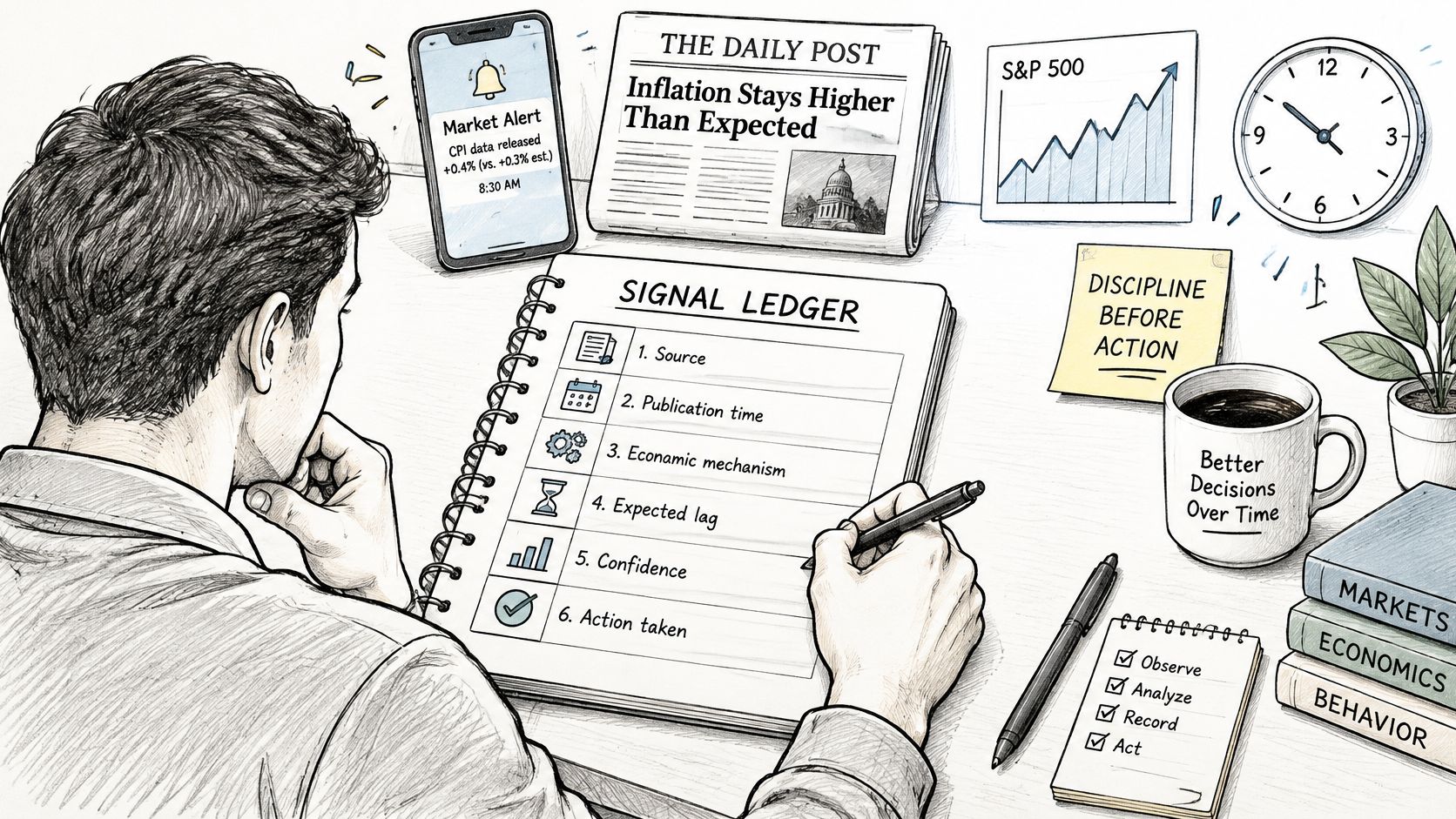
Make each entry reviewable
- Save the source and timing. Record the event date, public availability, and price observation.
- Name the mechanism. Explain how the event could change revenue, costs, financing, or demand.
- List exposed assets or sectors. Separate direct exposure from a loose thematic association.
- State direction and confidence. Include why uncertainty remains.
- Write the falsifying outcome. Specify what would undermine the thesis.
- Record the reaction and review date. Revisit after a period chosen before you know the result.
The review is what turns a notebook into a research process. Keep rejected ideas and uneventful outcomes too, otherwise you're building a scrapbook of memorable winners.
Keep the evidence beside the interpretation
Our TradeLikeInsiders platform brings congressional trades, insider activity, whale moves, and policy signals together with timestamped source context. We surface STOCK Act congressional disclosures, SEC Form 4 insider filings, and on-chain whale flow, with educational AI analysis to help frame follow-up questions.
Start with the next alert you would normally react to. Write the mechanism, disproof condition, and review date before deciding whether it deserves capital.
HeliosNet LLC offers TradeLikeInsiders' consolidated market signals, educational AI analysis, and paper-trading tools; visit TradeLikeInsiders to investigate a signal and practice documenting its outcome before risking money. This content is for informational purposes only and is not financial advice. Do your own research.