Most retail investors learn insider tracking backward. A financial alert flashes a headline about a CEO selling a huge block of shares, social feeds treat it like a fire alarm, and traders scramble to react without ever checking the single letter that explains what happened.
The public trades on news while insiders trade on information, yet most insider filings aren't directional trades at all. Every time a company grants restricted stock, withholds shares to pay an executive's tax bill, or converts an expiring option, the filing lands in the exact same SEC database as a voluntary cash purchase. Treating every reported share change as a bullish or bearish bet is the fastest way to misread corporate behavior.
Understanding SEC Form 4 codes fixes that problem. Those single-letter designations separate out-of-pocket conviction from routine payroll mechanics, tax settlement, gifts, and automated selling plans. Once you learn which letters reflect an actual investment choice and which ones just document corporate housekeeping, the noise disappears and the few signals worth studying stand out clearly.
Table of Contents
- Form 4 Transaction Codes at a Glance
- The Two Letters on Every Form 4 Row
- P and S Codes as the Open-Market Signal
- How Common Each Code Is in Real Filings
- Compensation and Tax Codes That Look Like Trades
- Filing Deadlines, Timestamps and Amendments
- What Form 4 Codes Cannot Tell You About Stock Prices
- How to Read a Form 4 and Decide What It Signals
Form 4 Transaction Codes at a Glance
A Form 4 transaction code identifies the legal and economic mechanism behind a change in beneficial ownership, not the insider's opinion of the stock. Under the SEC Form 4 instructions, filers must select from a controlled vocabulary of approved letters in the XML transactionCode field (TransCodeList), using J as the mandatory fallback when no listed category fits and attaching a written explanation of the event.
Because regulators need to track every way an officer, director, or 10% shareholder gains or loses equity, the official code list covers far more than open-market buying and selling. Only P and S represent straightforward purchases and sales. The other eight letters readers meet most often describe awards, option mechanics, tax settlements, gifts, or corporate actions.
| Code | What the SEC defines | What it usually reflects | Check alongside it |
|---|---|---|---|
| P | Open-market or private purchase | Insider buying with the insider's own money | Price, footnotes and same-day offsetting rows |
| S | Open-market or private sale | Taxes, diversification or planned sales | 10b5-1 plan flag, footnotes and related M rows |
| A | Grant or award | Compensation, not a market purchase | Vesting footnote and plan description |
| M | Exercise or conversion of a derivative | Option mechanics, often followed by a sale | Paired S row on the same day |
| F | Shares withheld to pay exercise price or tax | Tax settlement at vesting or exercise | Whether it sits alongside an M exercise |
| G | Bona fide gift of securities | Transfer with no market price | Recipient and footnote explanation |
| X | Exercise of in-the-money or at-the-money derivative | Compensation mechanics | Table II context and related M row |
| D | Disposition back to the issuer | Issuer-side transaction | Footnote naming the counterparty |
| U | Disposition in a tender offer or merger | Corporate event | Deal terms in the footnote |
| J | Other acquisition or disposition | Anything not covered by a listed code | Required explanation; flag for manual review |
How to Scan the Four Columns
Reading the table from left to right mirrors how experienced analysts screen a filing in seconds. Start with the SEC definition so you know the exact legal box the filer checked, since corporate counsel picks the letter based on Section 16 rules rather than market optics.
Next, weigh what the letter usually reflects in day-to-day filings. A massive share increase under code A or a steep share drop under code F happens on autopilot when equity packages grant or vest. Those rows rarely tell you anything about where the insider thinks the share price is headed.
Finally, run the companion check in the right-hand column before drawing any conclusion. Even a voluntary purchase or sale can look completely different once you read the transaction price, check for a Rule 10b5-1 trading plan marker, or spot a paired derivative exercise sitting on the same date.
Analyst filter: Treat the transaction code as a triage tag, not a verdict. Eight of the ten letters you'll see most often are administrative by design, and the remaining two still require context from the rest of the filing.
The letter alone never tells the complete story because Form 4 splits transaction type and share direction into two separate columns. Reading a filing accurately starts with keeping those two fields apart on every single row.
The Two Letters on Every Form 4 Row
Open an actual filing on SEC EDGAR and you'll notice two single-letter fields sitting near each other on every row of Table I (common stock and other non-derivative securities) and Table II (options, warrants, and other derivatives). Beginners routinely blur them together, which creates immediate confusion when a letter like A or D shows up twice in different places.
As the SEC Investor Alert on Forms 3, 4, and 5 makes clear, the XML filing schema separates the transaction code from the direction indicator (transactionAcquiredDisposedCode). One field tells you how the event happened; the other tells you only whether the insider's share count went up (A for acquired) or down (D for disposed). Collapsing both columns into a generic "buy" or "sell" label strips away the exact detail you need when reading SEC insider trading filings.
Look at how four common pairings read when you keep the columns separate:
- Flag A with Code A: The insider acquired shares through a company grant or equity award, meaning total holdings rose without a dime of personal cash changing hands.
- Flag A with Code P: The insider acquired shares through an open-market or private purchase, putting personal capital at risk.
- Flag D with Code D: The insider disposed of shares back to the issuing company, typically through a forfeiture or issuer-level plan settlement rather than an open-market sale.
- Flag D with Code F: The insider's share count dropped because the company withheld shares to settle an option exercise price or tax liability at vesting.
Notice why direction by itself misleads people. Flag A appears on both a free stock grant and a high-conviction cash purchase, while Flag D appears on both a tax withholding and an open-market liquidation.
Codes Outside the Ten-Letter Table
The SEC's complete instruction sheet includes additional letters that appear less frequently but still pop up on active watchlists. You'll occasionally see C for the conversion of a derivative security, E for the expiration of a short derivative position, V for a transaction voluntarily reported ahead of its normal deadline, and Z for a deposit into or withdrawal from a voting trust.
Use one simple handling rule whenever you encounter a letter outside the main ten, or whenever you see J on a row. Read the linked footnote first and classify the transaction as ambiguous until the filing's own written description proves what occurred. If a filer logs code J without attaching a clear explanation in the footnotes, flag it as a reporting error rather than a trading clue.
P and S Codes as the Open-Market Signal
Picture a company director who steps into the market on a Tuesday morning and buys a meaningful block of common stock at a stated market price, with no option exercise, no grant, and no offsetting disposition anywhere else on the filing. Compare that with a chief operating officer who sells a similar block of shares under a pre-scheduled trading plan adopted months earlier. Both filings live in the exact same open-market category, yet they carry completely different informational weight.

According to the official SEC Form 4 document, P designates an open-market or private purchase of a non-derivative or derivative security, S designates an open-market or private sale, and M designates the exercise or conversion of a derivative security under Rule 16b-3. Pay close attention to the words "or private" inside both definitions. Because the code covers private transactions alongside exchange trades, the letter alone doesn't tell you the execution venue or confirm that the trade cleared through normal public price discovery.
That phrasing is why you always verify the reported price and footnotes before acting on a P or S row. A private block transfer between affiliated entities or a negotiated off-exchange deal can carry the same letter as a live brokerage order, even though the underlying economics aren't identical.
Among all SEC Form 4 codes, P usually offers the cleanest signal for traders tracking insider buying in stocks. Nobody forces an executive or board member to wire personal cash into a brokerage account to buy company shares. When a P transaction involves a meaningful dollar commitment and stands alone without a compensating award or derivative offset beside it, it directly links the insider's own wallet to the stock's future.
Why Code S Needs More Context Than Code P
Selling works differently. Insiders hold concentrated wealth in a single employer's equity, so they sell shares regularly for mundane personal reasons that have nothing to do with an upcoming earnings miss.
- Scheduled liquidity: Many executives run Rule 10b5-1 trading plans set up months in advance to sell fixed blocks on preset dates or price triggers, removing day-to-day discretion from the trade.
- Taxes and diversification: Paying quarterly tax bills, funding a home purchase, covering college tuition, or rebalancing a lopsided net worth all trigger routine S filings.
- Paired option exercises: A large S row often represents the second half of an option exercise, where the holder converts vested options into cash before expiration.
Insiders buy shares for one primary reason, but they sell shares for a dozen personal and administrative reasons that have zero bearing on the business.
Keep a grounded rule of thumb in mind whenever you review open-market codes. Treat a clean, unhedged P purchase as a far stronger research lead than a standalone S sale, and never treat either letter as an automatic buy or sell instruction.
How Common Each Code Is in Real Filings
Scroll through a raw daily feed of Form 4 disclosures and one pattern jumps off the page: reported sales bury reported purchases, and non-market codes account for the large majority of total rows. Two published tallies built on different counting methods show how lopsided real-world filing activity is.
| Source | Period covered | Code P (purchases) | Code S (sales) |
|---|---|---|---|
| Signal8 2024 insider-trading statistics | Calendar year 2024 | 7,012 transactions | 24,439 transactions |
| Form4API code study | Multi-year sample beginning January 2023 | 6.1% of 1,350,114 rows | 22.2% of rows |
Both datasets point the same direction despite different windows and different counting units. In Signal8's calendar 2024 tally, S sales outnumbered P purchases by more than three to one. Across Form4API's sample of more than 1.35 million rows, S accounted for 22.2% of all rows while P represented just 6.1%.
The more interesting detail sits inside the ratios themselves. Divide Signal8's raw counts and Form4API's percentage shares and sales run ahead of purchases by roughly three and a half to one in both datasets. That kind of agreement across independent counting methods suggests the gap is a structural feature of executive pay, not a wave of bearish judgment calls.
Why Published Code Counts Never Match Exactly
Comparing raw totals across analytics sites without checking methodology will trip you up fast. Signal8 counted transactions within a single calendar year, while Form4API measured individual table rows across a multi-year sample. Those units are not interchangeable.
A single Form 4 can contain a dozen separate lines when an executive sells across multiple price fills or exercises several option tranches in one afternoon. A platform that aggregates fills by trade and a platform that counts every XML row will produce very different totals from identical filings. Percentages inside one dataset carry more meaning than raw counts placed side by side.
Add the P and S shares together inside the Form4API breakdown, and the remainder tells the story. Roughly seven out of every ten rows never touch the open market at all: grants, tax withholdings, derivative conversions, gifts, and dispositions back to the issuer, the machinery of modern equity compensation churning through the feed whether or not any insider made a market-timing call.
That imbalance changes how an alert should be weighted. Heavy S volume mostly reflects how public companies pay executives in stock rather than cash, so a high tally of sale codes says little about market direction. Scarcity cuts the other way. With P at barely six percent of rows, each discretionary open-market buy stands out precisely because the feed contains so few of them.
Compensation and Tax Codes That Look Like Trades
Nothing misleads retail traders faster than a headline claiming an executive "dumped" millions of dollars in stock when the underlying Form 4 shows a routine payroll event. Many beginner screeners lump every share-count increase into "insider buying" and every share-count reduction into "insider selling," blurring voluntary trades with automatic plan administration.
As the SEC Investor Bulletin on insider transactions explains, distinguishing economic trading decisions from administrative or compensation events is where most casual analysis breaks down. Code A marks a grant or award delivered by the compensation committee, code F marks shares delivered or withheld to satisfy an exercise price or tax liability, code M marks an option exercise or derivative conversion, and code D marks a disposition back to the issuer.
Two other non-discretionary codes regularly inflate reported volume as well. Code X records the exercise of an in-the-money or at-the-money derivative security outside Rule 16b-3, while code G records a bona fide gift transferred with no market price paid. Every one of those letters can move tens or hundreds of thousands of shares across an insider's balance sheet without the insider making a market-timing call.
The Same-Day Exercise, Withholding and Sale Chain
Consider a typical scenario that plays out thousands of times a year when employee stock options approach expiration or restricted stock units vest:
- An officer exercises vested options under code M, converting derivative rights from Table II into common shares in Table I at a preset strike price.
- The company automatically retains a slice of those shares under code F to cover the exercise cost and mandatory income-tax withholding, reducing the share count with no open-market broker order ever placed.
- On the exact same day, the officer sells the remaining net shares under code S to lock in the compensation payout.
A superficial tracker flashes a massive share reduction and cries panic. In reality, the officer didn't wake up bearish on the company's quarter; they completed a standard compensation settlement that left their baseline stock ownership unchanged.
Three Quick Checks Before Calling a Filing a Trade
Before reacting to any large share change, verify three fields that expose mechanical activity immediately:
- Read the footnotes first: Filers spell out vesting schedules, tax-withholding formulas, and option grant dates directly in the numbered notes at the bottom of the form.
- Scan for same-day offsetting rows: Check whether an S sale sits right next to an M exercise of the same share quantity, or whether an F disposition accompanies a vesting event.
- Cross-check Table II derivatives: If common shares increased in Table I while derivative contracts dropped by an identical amount in Table II, you're looking at a conversion rather than fresh capital entering the stock.
Reality check: The loudest, largest insider transactions in financial headlines are frequently the least informative once you match the letter code against the footnotes and ownership tables.
Filing Deadlines, Timestamps and Amendments
Even when a filing contains a genuine, high-conviction code P purchase, you're never looking at a live brokerage tape. Form 4 is a prompt regulatory disclosure built around a statutory clock, which creates a built-in delay between the moment an order fills and the moment the public can read it.
Under SEC Section 16 staff guidance, directors, officers, and beneficial owners of more than 10% of a registered class of equity securities generally must file a Form 4 by the end of the second business day after the transaction date. Congress tightened reporting to that two-business-day standard under the Sarbanes-Oxley Act of 2002, replacing a much slower legacy disclosure regime.
The clock starts in the time zone where the transaction executed, so execution location, weekends, and U.S. market holidays all shift the exact calendar deadline. A trade executed on a Thursday afternoon ahead of a three-day holiday weekend might not appear on EDGAR until Tuesday evening, well after the stock has already reacted to broader market news.
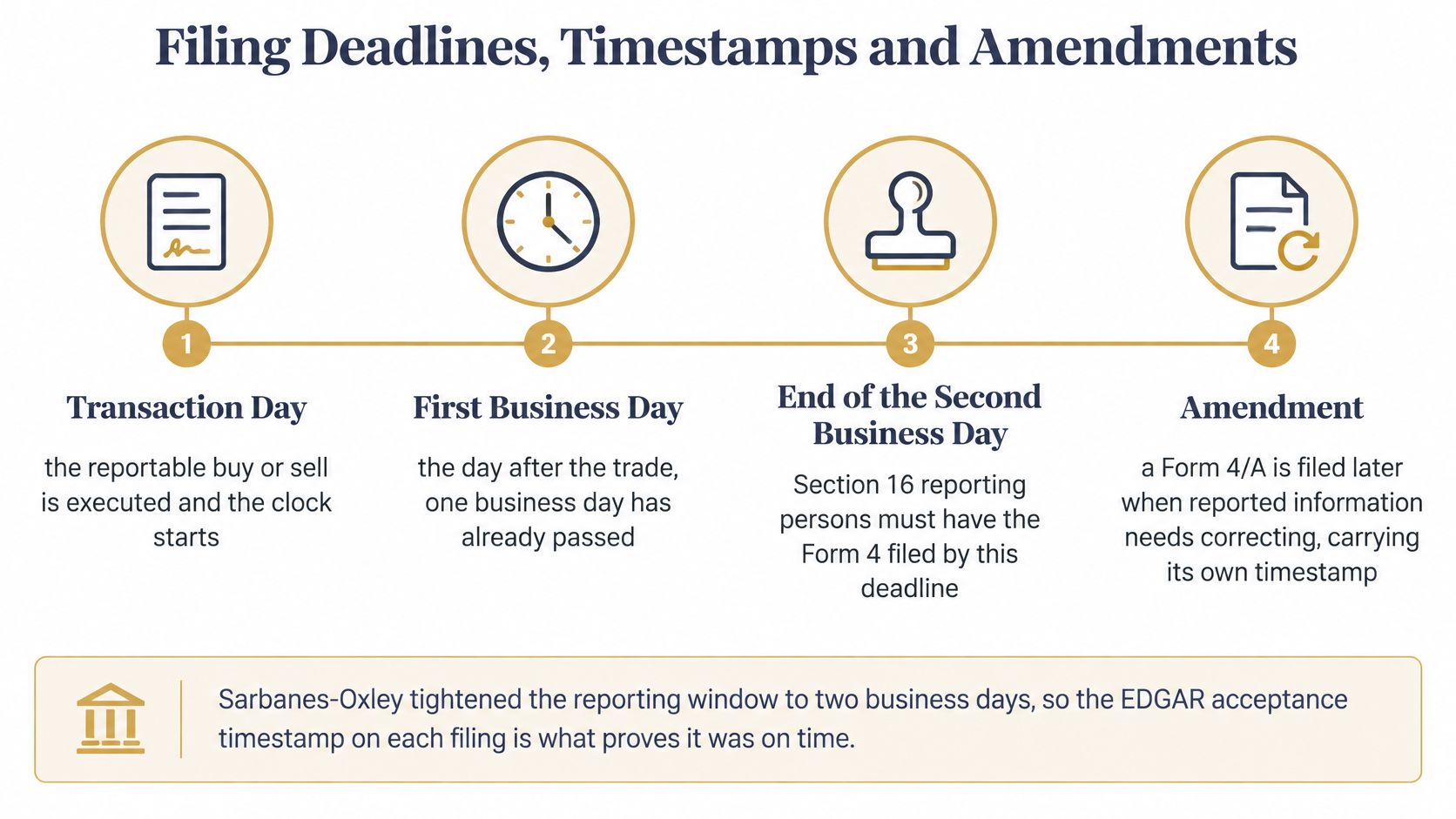
Rulemaking that took effect on February 27, 2023 closed two major blind spots in that timeline. Filers must now explicitly flag transactions executed under a Rule 10b5-1 trading plan, and bona fide gifts of securities made by insiders moved from annual Form 5 reporting onto Form 4 under the exact same end-of-the-second-business-day clock. Knowing every nuance of the SEC Form 4 filing deadline keeps you from mistaking a late-week filing burst for breaking news.
Three Timestamps and Accession Tracking
Whenever you log insider filings in a spreadsheet, journal, or quantitative backtest, never collapse timing into a single date column. Treating the filing date as the execution date warps event studies and exaggerates how early you could have reacted. Preserve three separate timestamps for every row:
- Transaction date: The calendar day the broker filled the order or the equity event took effect.
- EDGAR filing timestamp: The exact date and time the SEC accepted the submission, which marks the first moment the public could legally see the disclosure.
- Ingestion or review timestamp: The moment your alerting tool or personal watchlist picked up the filing, showing any downstream lag.
Watch out for Form 4/A amendments as well. When a filer corrects a misstated share count, price, or code days later, the SEC assigns a brand-new accession number rather than overwriting the original submission. Track filings by their unique accession identifier instead of deduplicating solely by insider name, company, and trade date, otherwise you risk either double-counting a trade or missing a critical correction.
What Form 4 Codes Cannot Tell You About Stock Prices
A Form 4 records how one person's financial incentives shifted inside one company. The form itself captures the issuer's ticker, the insider's identity and role, the transaction date, a transaction code, share count, execution price, and resulting holdings. That is evidence of an individual's incentives. It is not a forecast of where the stock trades next month.
Even the cleanest open-market row leaves large blanks. A code cannot tell you whether the executive holds offsetting hedges in sector funds, what share of their personal net worth the trade represents, or whether a macroeconomic shock will override company fundamentals a week later. A modest code P buy from a director with deep holdings signals something different from a career-defining purchase by a newly appointed CFO, and the letter on the row treats them identically.
Three Popular Assumptions That Produce False Signals
Code guides get dangerous when they treat every letter as a trading decision. Strip away these three common shortcuts before acting on any filing:
- "Insider selling means the stock will fall": A sale frequently reflects taxes, diversification, estate planning, or a pre-set 10b5-1 schedule rather than a negative view of upcoming earnings. The S code labels the mechanics of a disposal, never the motive behind it.
- "A code P purchase guarantees a rally": Corporate executives misjudge valuation and macro cycles too, so a single open-market buy is one piece of evidence rather than a promise of gains.
- "One insider buying equals management consensus": Roles, compensation structures, and personal cash reserves vary dramatically across a boardroom, so one director buying shares rarely reflects what the entire leadership team thinks ahead of major market catalyst events.
How Form 4 Differs From Congressional PTRs and 13F Filings
Investors who follow smart money often pair corporate insider filings with political disclosures and institutional portfolios. Each source runs on completely different rules, delays, and precision levels, so blending them without adjusting for scope creates messy conclusions.
Under the Ethics in Government Act as amended by the STOCK Act, Members of Congress, officers, and covered employees file a Periodic Transaction Report (PTR) whenever a covered securities transaction exceeds $1,000, due by the earlier of 30 days after receiving notice of the trade or 45 days after the transaction itself. PTRs disclose trade sizes in wide dollar brackets, ranging from $1,001 to $15,000 at the low end up to over $50,000,000, and can cover trades placed in a spouse's or jointly owned account. A congressional disclosure can confirm a member bought a given stock while hiding both the exact size and the precise fill day, two fields Form 4 always shows.
Institutional whale tracking carries its own lag. Institutional investment managers exercising discretion over at least $100 million in specified Section 13(f) securities report holdings quarterly on Form 13F, with filings due up to 45 days after calendar quarter-end. Because 13F tables show long positions at a single snapshot date without capturing short positions in the same way, a newly disclosed stake may already be trimmed by the time the report goes public.
Form 4 gives you sharper pricing and faster turnaround than either a congressional PTR or a quarterly 13F, yet all three remain delayed snapshots. The code on a row tells you which bucket a transaction falls into, discretionary or mechanical. It never tells you whether the insider was right. Treat every code you read as an opening research question that triggers deeper fundamental work, never as a shortcut around it.
How to Read a Form 4 and Decide What It Signals
A Form 4 is most useful when you treat each row as a question, not a verdict. The letters tell you what kind of transaction happened, while the price, share count, holdings change, footnotes, and timing tell you whether the row carries real analytical weight. That distinction matters because the code guide most traders use turns every letter into a trade. A careful read separates discretionary buying and selling from compensation, tax withholding, plan mechanics, and administrative transfers.
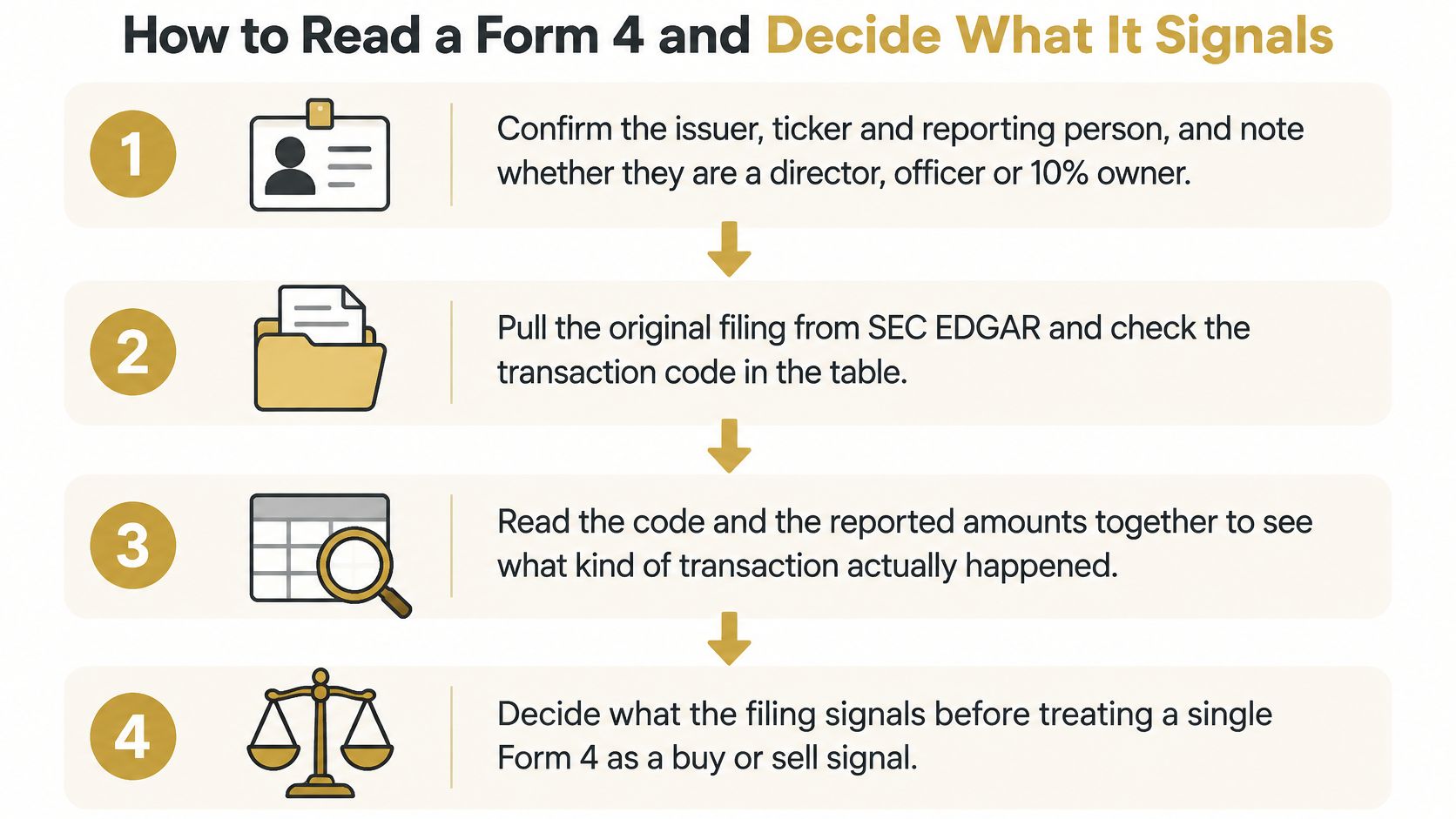
Use the same review path every time, especially as filing volume expands. The SEC's downloadable insider transactions datasets extract structured XML from Forms 3, 4, and 5, which makes large-scale screening possible. More disclosures widen coverage across issuers, but they also raise the cost of sloppy reading. A headline share count can look aggressive until you find an F withholding, an M exercise, or a footnote showing that the insider did not buy or sell shares in the open market.
The Nine-Step Form 4 Review Checklist
Run every intriguing filing through these nine steps in order:
- Confirm who filed and what role they hold. Check the issuer name, ticker symbol, and reporting person box to see whether the filer is a CEO, CFO, independent director, or 10% beneficial owner. An operational executive who sees daily sales pipelines carries different context than an outside fund crossing a 10% threshold.
- Pull the original submission from SEC EDGAR and log the accession number. Recording the unique accession ID ensures any later Form 4/A amendment registers as a distinct update rather than duplicating the first row.
- Separate Table I from Table II. Review common stock and non-derivative holdings in Table I first, then drop down to Table II to see whether options, warrants, or convertible notes moved on the same date.
- Record the transaction code and the acquired-or-disposed flag separately. Write down both letters side by side so you never confuse an A grant with a P purchase or an F tax withholding with an S sale.
- Log share quantity, price, post-transaction holdings, and filing lag. Calculate the total dollar value, compare the trade size to the insider's remaining stake, and note the gap between the execution date and the EDGAR submission timestamp.
- Inspect the Rule 10b5-1 checkbox and read every footnote. Look at whether the trade occurred under a pre-scheduled trading plan, and read the footnotes to catch private transfers, trust distributions, or weighted-average price ranges.
- Scan for same-day offsetting rows. Pair any M or X exercise with a matching S sale or F tax withholding on the same date so you isolate net economic exposure instead of gross share volume.
- Label the row and compare it against history. Tag the filing as discretionary, mechanical, or ambiguous, then pull the insider's prior 12 to 24 months of Form 4s to see whether the move breaks a routine pattern or matches past behavior.
- Write down what would disprove your view. Before letting a filing shape your watchlist, specify the concrete earnings metric, balance-sheet risk, or follow-up disclosure that would invalidate the thesis.
A clean signal usually becomes clearer after those checks. A P row executed at a clear market price matters more when it produces a meaningful increase in the insider's total holdings and sits without an offsetting M exercise, A grant, or private-transfer footnote beside it. A S row deserves the same scrutiny, but the conclusion can change if the sale merely covers taxes from vesting or follows a scheduled plan.
If you prefer seeing how these form fields line up on an actual filing screen, this quick walkthrough breaks down the key columns and footnotes visually.
Putting Delayed Disclosures in One Workflow
The workflow becomes practical when you group filings by what they can show. Open-market purchases and sales form one bucket. Grants, exercises, withholdings, and transfers form another. Ambiguous rows belong in a third bucket until the footnotes, amendment history, or prior filings clarify them. This keeps the unique angle intact: the letters describe transaction mechanics first and investor intent second.
Tracking those setups across EDGAR, House disclosure portals, and quarterly institutional filings takes hours every week, which is why many traders rely on structured insider trading alerts to filter out mechanical codes before they open a chart. TradeLikeInsiders surfaces STOCK Act congressional disclosures, SEC Form 4 insider filings, and on-chain whale flow in one place with clear timestamps, so delayed regulatory records stay separate from live market noise.
Never chase a headline share count before checking the transaction code, the 10b5-1 box, and the footnotes at the bottom of the page.
The best use of SEC Form 4 codes is disciplined elimination. Remove rows that only reflect compensation, tax, or plan activity. Keep rows that show a clear change in economic exposure, then test them against the insider's history and the company's fundamentals. Form 4 codes give you a sharp lens into how corporate insiders handle their own equity, provided you respect what each letter measures and ignore the administrative noise around it. This content is for informational purposes only and is not financial advice. Do your own research.
Want to stop sorting mechanical tax withholdings from genuine open-market buys by hand? Our platform brings SEC Form 4 insider filings, delayed congressional STOCK Act disclosures, whale moves, and policy signals together with clear timestamps and plain-English context. Explore the live signal engine and built-in paper trading tools at TradeLikeInsiders.