
Insider buying is a legal, publicly disclosed purchase of a company's own shares by an officer, director or large shareholder, reported on SEC Form 4 generally within two business days of the trade. The version of that signal worth acting on is a code P open-market purchase, where someone inside the business spends their own cash at the market price.
The advice you hear everywhere is to follow the insiders. Stated that way, it's wrong. Most of what lands in a Form 4 feed isn't buying at all. It's a grant vesting, an option converting into shares, or shares withheld to cover tax, and none of those involve a single dollar of the insider's own money.
What separates a conviction purchase from payroll mechanics is one letter in a box on the form, plus three questions: who bought, with what money, and alongside whom. Answer those and insider filings become one of the few public records where the people closest to a business put their own capital behind a view.
Table of Contents
- What Insider Buying Means in Plain English
- Who Counts as an Insider and What They Report
- Form 4 Codes That Separate Real Buys From Paperwork
- Read a Form 4 Filing Step by Step and Weigh the Signal
- What the Research Says About Insider Buying
- Insider, Congressional and Whale Filings Compared
- Where to Track Insider Buying Disclosures
What Insider Buying Means in Plain English
The line between a legal trade and a prosecutable one runs through information, not through the act of buying. The SEC investor bulletin on insider transactions and Forms 3, 4 and 5 draws it cleanly: lawful insider trading follows company policy and securities rules, while illegal insider trading rests on confidential, material information used in breach of a duty of trust. Owning shares in your employer is legal. Buying them the week before an earnings shock you already know is coming is not.
Section 16 is the statute that puts names on paper. It generally covers company officers, directors, and beneficial owners of more than 10% of a registered class of equity securities. That's why a chief executive's personal purchase becomes a public document within days while a neighbor's brokerage order stays private.

An owner buying more of their own restaurant tells you where their money sits. It doesn't hand you tomorrow's menu. That framing keeps you honest when you're working out what is insider buying in practice, because a filing records an event, not a thesis.
Form 4 identifies the issuer, the insider, the transaction date, the number of securities, the price, the ownership after the transaction, and a transaction code. Code P means an open-market purchase. Codes such as A, M, F and G cover awards, option exercises, tax-related share withholding and gifts, so a larger reported share count is not automatically a buy.
The deadline is generally two business days after the transaction. That makes the disclosure public and verifiable, but not real time. The signal is strongest when you can point to an open-market purchase funded by the insider's own money, which is the distinction at the heart of legal insider trading versus the illegal kind.
Who Counts as an Insider and What They Report
Sort the filers before you read a single trade, because the role printed on the form changes how much weight the purchase deserves.
| Insider type | Files Form 4? | Typical reported purchase | How much weight the buy carries |
|---|---|---|---|
| Officers (CEO, CFO and other executives) | Yes, generally within two business days | Buying shares with personal cash during an open trading window | Highest: closest to day-to-day operations and internal forecasts |
| Directors (board members) | Yes, generally within two business days | Open-market purchase in a permitted trading window | High: sees strategy and capital plans, not daily operations |
| Beneficial owners above 10% | Yes, generally within two business days | A large investor adding to a stake that now exceeds 10% | Mixed: an activist adding is intentional, a routine fund rebalance is not |
| Ordinary employees who are not officers | Generally no Section 16 filing | Company policy may still restrict their trades | Not visible in Form 4 data |
The 10% line creates insiders out of outsiders. A fund can push a stake past that threshold during a buying campaign and start filing Form 4s without anyone on the board handing it a desk, so the relationship box says "10% owner" rather than "director." That purchase might be activism, it might be an index rebalance, and the two look identical on the face of the form until you read the fund's filings.
Read the title field every time. An officer's cash buy carries operational insight, a director's carries strategic insight, and a large holder's carries whatever the holder's mandate implies.
The check most readers skip: the ownership percentage after the transaction, not just the dollar amount. A director who lifts a stake by a quarter is telling you something different from one topping up a rounding error.
Cross-check the trade date against the two-business-day filing deadline so you know exactly how much of a head start you're missing.
Form 4 Codes That Separate Real Buys From Paperwork
Most explainers fall apart here. The SEC's Form 4 form and instructions exist to report a change in beneficial ownership, not to grade what that change means, so the classification work falls to you.
| Code | Meaning | What it tells you |
|---|---|---|
| P | Open-market purchase | Cash paid at market price: the core buying signal |
| S | Open-market sale | Can reflect diversification, taxes or a pre-set trading plan |
| A | Grant or award | Compensation with little or no cash paid, not a bet on the stock |
| M | Option or derivative exercise | Options converted to shares, often followed by a sale |
| F | Tax withholding | Shares kept to cover tax, not discretionary buying |
| G | Gift | Ownership transferred with no market purchase |
A rising share count can rise for reasons that never touched the insider's wallet. Picture a director granted a block of restricted shares: the holdings line climbs, the transaction code reads A, and not one dollar changed hands. A headline built on that number says the director "increased their position," which is technically true and economically empty.
Watch for the M-then-S sequence on the same filing. An option exercise followed by an open-market sale usually means shares were converted and cashed out. That's a compensation decision, not a vote of confidence, and it reads bearish more often than bullish.
Common stock sits in Table I; derivative securities such as options sit in Table II. When someone tells you an insider "bought," check which table the line came from before you accept it.
The one test for a real buy: code P, a price per share, and cash that left the insider's own account. If any of the three is missing, you're reading compensation and calling it conviction.
Start every screen by filtering for P, then treat the other codes purely as context for who owns what. The SEC designed this system to report transactions, not to label their informational value, and that labeling is the job you're doing.
Read a Form 4 Filing Step by Step and Weigh the Signal
Reading a filing takes a couple of minutes once you know where to look. Take a fictional mid-cap manufacturer whose director reports an open-market purchase, and walk the document from top to bottom.
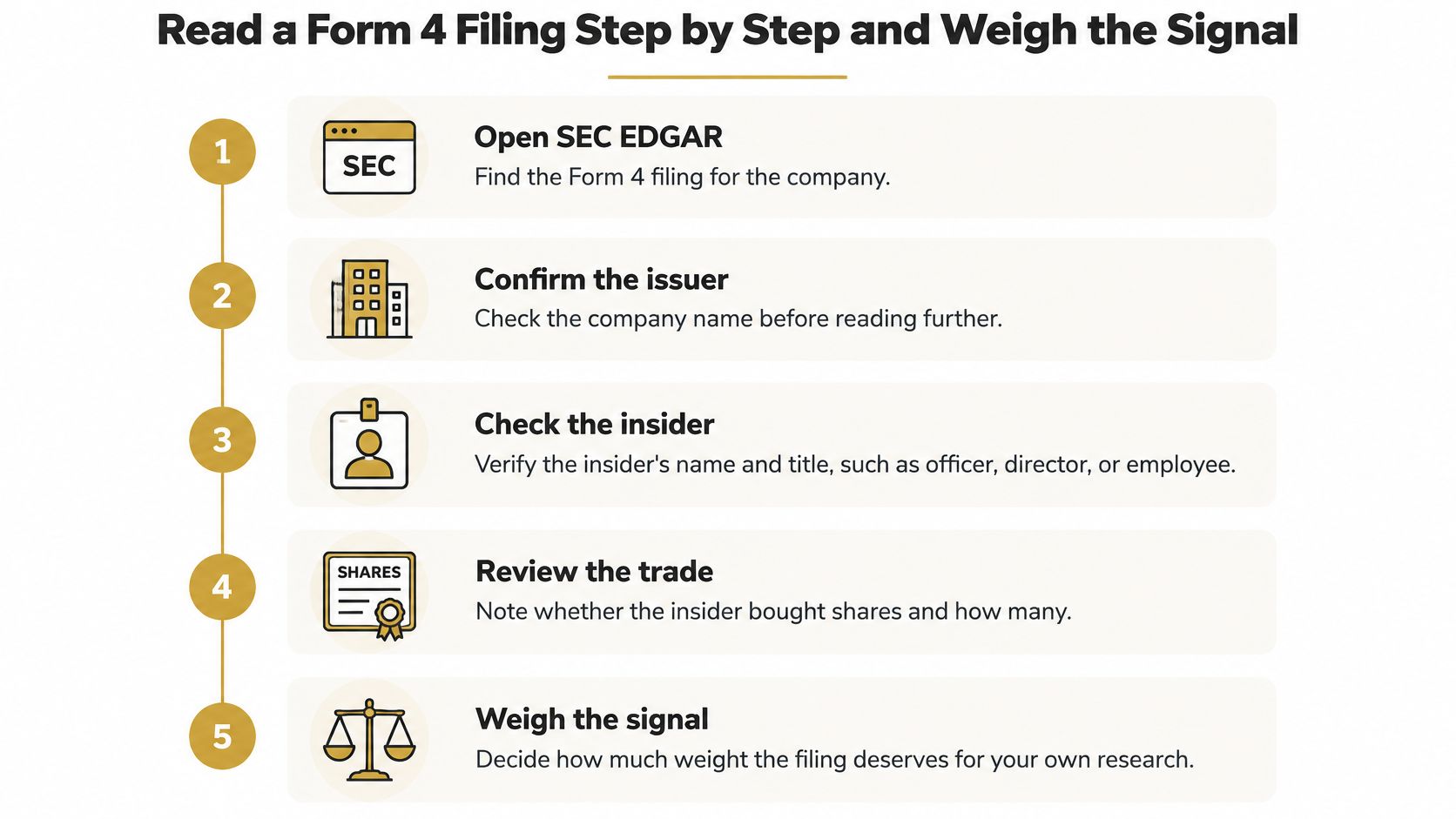
- Open the filing on SEC EDGAR. Confirm the issuer and the insider's name, then read the relationship box. Here it says director, which tells you the person sees board-level strategy rather than daily sales.
- Read Table I and find the transaction code. It says P, so this is an open-market purchase rather than a grant.
- Compare the transaction date with the filing date. The trade executed Monday and the form landed Wednesday, the two-business-day window in action.
- Read shares and price. 10,000 shares at $42.00 works out to $420,000 of the director's own money at a real market price.
- Read ownership after the transaction. Holdings went from 40,000 to 50,000 shares, a 25% increase in the stake. That's a commitment, not a trimming.
- Check for a cluster. Three independent directors buying inside two weeks outweighs a single purchase, and a mix of officers and directors outweighs three colleagues from the same team.
- Look at the price trend before the trade. A purchase made after a steep decline can be contrarian value buying rather than a peek at the next quarter. Research covered in a Harvard-hosted study of insider trading profits finds that profits from high-volume insider purchases are largely consistent with insiders holding superior information, while insiders also tend to buy after prices have declined. Both things can be true of the same filing.
- Confirm nothing else is inflating the count. No award, no option exercise, no withholding line. The increase came from the purchase alone.
The mechanics are one thing. What you do with them is another. If you'd rather watch the walkthrough than read it, the video below covers the same ground.
Where a single buy stops being a lead
One director, one purchase, no cluster, no obvious catalyst: that's a name to research, not a trade to place. The filing tells you someone with board visibility decided the price was attractive enough to risk $420,000. It doesn't tell you why, and it doesn't tell you what happens next quarter.
Measurement matters as much as interpretation. Returns should be read from both the trade date and the public filing date, because a strategy that only trades after disclosure captures less of whatever advantage existed, and benchmarks belong in the math so a rising market doesn't get mistaken for insider insight. Any backtest worth trusting carries transaction costs, liquidity constraints and a screen for automatic or non-discretionary lines.
A filing is a piece of evidence about how an informed person sized a bet. It is never an instruction.
What would raise the weight: a second insider buying, a larger purchase relative to the person's compensation, a purchase after a fall that the fundamentals don't justify, or a stake increase big enough to matter to the insider's net worth. What would lower it: a tiny purchase, an isolated trade months after the last one, or a company with a deteriorating balance sheet.
What the Research Says About Insider Buying
The statistical record on insider buying is real, and it's narrower than the pitch. Start with the landmark study. The 1992 Quarterly Journal of Economics paper by Nejat Seyhun, covering U.S. insider transactions from 1975 through 1989, found that the aggregate net number of open-market purchases minus sales predicted as much as 60% of the variation in one-year-ahead aggregate stock returns. That's a relationship between whole-market aggregates and future market returns, not a forecast for any single ticker.
| Study | Measure | Result | Caveat |
|---|---|---|---|
| Seyhun (1992), U.S. insiders 1975 to 1989 | Aggregate net open-market purchases minus sales | Predicted as much as 60% of one-year-ahead aggregate return variation | Aggregate measure, not a single-stock forecast |
| 39-country study | Country-level net insider purchases | 0.9% higher next-quarter return per one-standard-deviation increase | Averages after many controls, not guarantees |
| InsiderAction.io, purchases filed in 2024 | 12-month return after insider buys | 0.9% median vs -2.9% median benchmark; outperformed in 54.7% of cases | One provider's sample, so check the method |
| Older U.S. research | Price reaction once trades became public | Little immediate movement | The signal may build over longer horizons |
Three limits keep that table in perspective.
Averages aren't outcomes. A hit rate just above half is a thin edge spread across thousands of trades, and a median return that small is what a thin edge looks like once the winners and losers cancel out.
Insiders often buy after declines. A purchase can be a value call on a beaten-down stock rather than a preview of good news, which means the same filing supports two very different stories.
The payoff may take months. The NBER working paper on insider trading notes that older research found little immediate market movement when trades or filings became public, which points to a signal that builds over longer horizons or through stock selection rather than a pop on disclosure day.
Where a filing and a known event line up, the catalyst calendar becomes part of the read. Buying ahead of an earnings date or a regulatory decision is confidence with a deadline attached, and it deserves a harder look than a purchase in a quiet month.
What the numbers don't say: none of these results tell you what one filing means. They tell you that a crowd of filings has carried predictive content, which is a different claim entirely.
Treat insider buying as a probabilistic input, not a buy button.
Insider, Congressional and Whale Filings Compared
Three disclosure regimes get mixed together constantly, and they run on different clocks.
| Filing | Who files | Deadline | What it shows | Main limit |
|---|---|---|---|---|
| SEC Form 4 | Officers, directors, owners above 10% | Two business days after the trade | Exact shares, price, code and ownership after | Shows the event, not the reason |
| STOCK Act Periodic Transaction Report | Members of Congress and covered staff | Earlier of 30 days after learning of the trade or 45 days after it | Asset, transaction type and value range above $1,000 | Ranges, not exact amounts; can be weeks old |
| SEC Form 13F | Institutional managers meeting the reporting threshold | Within 45 days after quarter end | Quarter-end U.S. equity holdings and certain options | Snapshot only; trades inside the quarter stay hidden |
Congressional disclosures are not alerts. Under the STOCK Act, members, officers and certain employees report qualifying securities transactions exceeding $1,000 on a Periodic Transaction Report, due the earlier of 30 days after the filer learns of the transaction or 45 days after the transaction itself, as set out in the House Ethics STOCK Act guidance. A report can legitimately land six weeks after the trade, which makes the "politician just bought" headline a description of the past.
The same guidance makes a subtler point: the filing obligation doesn't depend on whether the official personally conducted or directed the trade. Awareness of a reportable transaction can be enough to trigger it, so a filing isn't proof of a deliberate bet by the person named.
Institutional positioning carries its own lag. Form 13F discloses specified U.S. equity holdings and certain options as they stood at quarter end, filed within 45 days after that quarter closes, so a manager can have exited the entire position before you read the report. A reported stake is a historical observation.
If the paperwork itself is the part you want to get right, the breakdown of congressional financial disclosure reports walks through the line items that matter on each form.
Rule of thumb: match the filing to your question. Ownership changes, ask Form 4. Policy exposure, ask the Periodic Transaction Report. Portfolio reconstruction, ask 13F.
Trackers that gather these delayed disclosures are useful for coverage, but the records are not live trades. Check the filing date on every alert before you treat it as new information.
Where to Track Insider Buying Disclosures
Go to the primary documents. Aggregators are convenient, but the filing itself carries the details you need.
- SEC EDGAR, company and filer search. Pull Form 4 filings by issuer or by insider name. Because filings land within two business days, a weekly check catches most of the activity on a watchlist.
- The House Clerk and Senate financial disclosure portals. Open the Periodic Transaction Report and read the transaction date, disclosure date, asset, transaction type and reported value range rather than the summary someone wrote about it.
- Form 13F on EDGAR. Treat it as a quarter-end photograph filed up to 45 days later, then compare it with what the manager has said and done since.
- Price history, side by side with the filing. A buy after a steep drawdown raises the value question; a buy near a high raises the information question.
- A written checklist you apply every time. Code, cash, role, stake change, cluster, trend. Same order, every filing.
Once you're checking several names a week, an insider trading tracker saves you from rebuilding the same filing history by hand.
TradeLikeInsiders surfaces STOCK Act congressional disclosures, SEC Form 4 insider filings and on-chain whale flow in one dashboard, and its paper-trading simulator runs on simulated money, so you can run the checklist above before any real capital is at risk. Speed matters less than sequence: the filings are delayed, the interpretation isn't.
This content is for informational purposes only and is not financial advice. Do your own research.
TradeLikeInsiders pulls the delayed congressional disclosures, SEC Form 4 insider filings and whale flow into a single view, so you can read a filing next to the policy context that surrounds it instead of chasing three separate portals. Educational AI summaries sit alongside a paper-trading simulator, which means you can test how you'd weigh a cluster of code P purchases using simulated money before committing any of your own. Start at TradeLikeInsiders and read the filings yourself.